Showing posts with label Hong Kong Philharmonic Orchestra. Show all posts

Review - Mahler Symphony Nos. 2 & 9, Bruckner 7, Hong Kong Philharmonic Orchestra

Hong Kong Cultural Centre Concert Hall, 27 April 2019
Symphony no. 9 (Mahler)

Hong Kong Cultural Centre Concert Hall, 4 May 2019
Piano Concerto no. 20 (Mozart)
Symphony no. 7 (Bruckner)

Khatia Buniatishvili (piano)

Hong Kong Cultural Centre Concert Hall, 18 May 2019
Christus factus est (Bruckner)
Ave Maria (Bruckner)
Symphony no. 2 (Mahler)

Ying Fang (soprano)
Karen Cargill (mezzo-soprano)
Netherlands Radio Choir
Hong Kong Philharmonic Chorus

Hong Kong Philharmonic Orchestra
Jaap van Zweden (conductor)


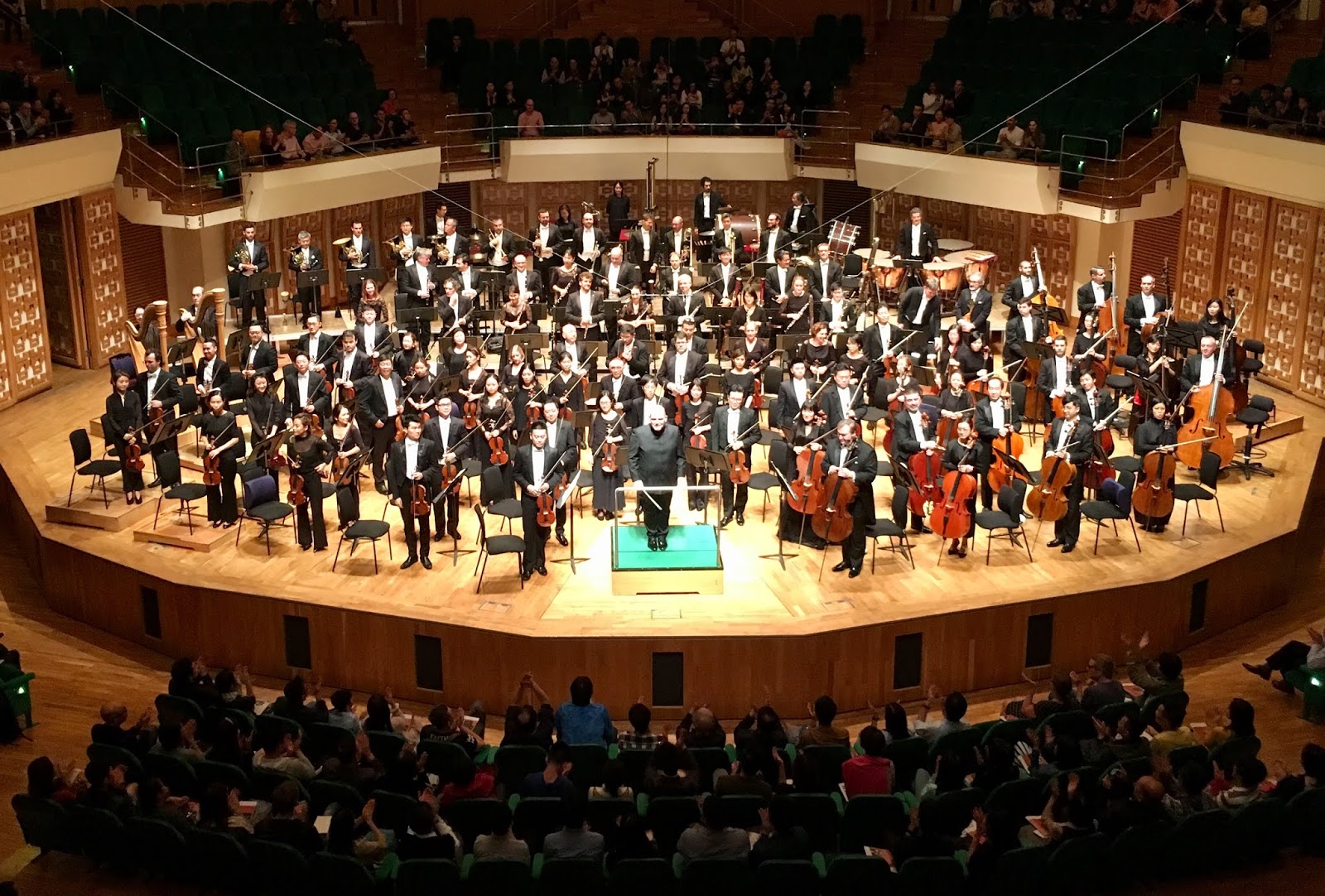
These three performances made an ambitious showcase of the late romantic symphonies during Jaap's spring residence with the philharmonic. The augmented orchestra with extras in brass, wind and percussion reminded us the large orchestration deployed in the Wagner ring project before. It was a demonstration how the orchestra has progressed technically and musically under the baton of Jaap. The produced tone was often meaty and confident. Though sometimes it has its temperament of inconsistency at the recent indifferent rendition of Nutcracker for the Hamburg Ballet. When it is on top form and knowing the direction, it was left to a matter of interpretation and execution.

Among the three symphonies, Mahler's ninth symphony was the most progressive and sophisticated of all. The composer probably found the ultimate resolution to his long obsession of repeated emotional struggle between love and traumatic abyss since symphonies at the Wunderhorn period. Bernstein suggested the last movement a gesture of farewell to the world, yet I thought it was Mahler finally parting away from the emotional negotiations he had been seeking so long.

Jaap emphasised the emotional contrast by adding a sheer sense of dramatic intensity, but sometimes overdoing it that felt too deliberate for a theatrical drama. A sticky start to the moody opening of first movement that led to the rocking lyric theme being playing passionately. The first climax was a crushing devastation, and the following ebb and flow remained vigorously expressive. Effective dynamic and emotional contrast that differentiated the mysterious tiptoed like transition passage and the third reappearance of the rocking theme.

The next climatic point was explosive with a rich and bold sound body, which was different from the mysterious bare sound landscape that followed. It felt more wholeheartedly triumphant as the orchestra developed another exuberant climax, but quickly vanished by a crushing blow from the brass that hinting a sense of last judgement. The main theme turned melancholy and became a march. A rhythmically tricky duet for the horn and flute and concluded with a flute solo that depicted darkness loomed in the atmosphere.

The second movement switched the emotional focus to the bold and coarse Landler dance. Jaap's interpretation was bombastic, hurried and flamboyant. It felt sticky at first and gradually gained more momentum. The gallop carried the sheer energy and swinging wildly. An audible slip from the clarinets though. The wildness grew to fullness in the grotesque third movement. The wind playing gave a mad impression of chaos throughout the complex fugal passage. The tender entry of the solo trumpet changed the atmosphere to another bold and exciting climax midway before the final recapitulation of madness.

The tutti strings began the last movement with an outpour of emotions. The warm tone made a rather positive impression before reaching the reflective mid section. The texture became leaner that carried a sorrow sense, and further reinforced by the horns on sustaining the emotional ebb and flow. A calm transition was played by the wind quartet before pushing towards a climatic point. The brass fanfare reinforced the strings to announce the radiance of love without any further reservation of irony. Jaap seems interpreted with more hope than bleakness. Towards the spellbinding end, it was felt alike the composer had found a resolve to his long search of question between hope, love, loss and death.

Despite the tender touch Khatia demonstrated in Mozart's twentieth piano concerto was elegant and seamless, her adopted tempo felt too slow at times. The orchestra and Jaap instead wanted to get it going than indulging too much. Khatia's playing carried a dense tragic colour in the first movement. Her weight on the keyboard not aggressive and carried the weight of colours. The cadenza was dramatic in contrast from the subtle impression before.

She redeployed the soft touch in the tender introduction of second movement. Though the same dynamic for the tempestuous mid section undermined the growing sentiments. The recapitulation even felt like a lullaby. It was increasingly frustrating to hear her holding the excitement further for a mysterious impression in the last movement. The cadenza filled with sentiments that felt odd to rush the coda at break neck tempo.

Compare to previous two encounters of Jaap conducting Bruckner's 4th and 8th symphony, the 7th emphasised on blazing sound but not so much a musical narration. The strings made a majestic introduction yet the upper strings were not quite together with the winds. Beautiful flute playing in the wind trio followed by a tragic passage in the lower strings. A complex sentimental negotiation of a vast sound world between heaven and earth went on. The brass ended it on a confident fanfare to create a long chord of a full blown pipe organ.

A huge sound of the majestic theme began the second movement emotionally forward. A lyrical part for the strings to play in unison with richness. The crescendo led to a climatic peak accompanied by another glorious brass fanfare before resetting to a bare landscape. It ended on a solemn announcement by the horns with a flute solo leading to a delicate pause.

A wild but bold gallop started the third movement which culminated the intensity for an explosive climax. The ebb and flow of emotion was followed by a pastoral mid section which the main theme was more romantic driven. The recapitulation was unhurried and grand. The introduction of the last movement became more witty and optimistic at first. The brass fanfare put the melancholy dialogue between the woodwind and strings aside. There was even a hint of recalling Wagner's music painting of the Rhine river yet the under grow development felt random. In contrast, the thundering brass theme added more confidence and certainty to the triumphant conclusion.

In the next programme, two familiar motets by Bruckner were sung by the Netherlands Radio Choir prior to Mahler's 'Resurrection' Symphony. Though I was puzzled why the Philharmonic Chorus was not performing the motets together with the Dutch choir. Klaas Stok, the choirmaster of the Radio Choir, took a rather vertical approach to 'christus factus est' with a dragging tempo. The dynamic contrast was effective from the choir yet not a dramatic execution of the music. Klaas's conducting also did not help to get the parts together and there were some untidy corners. 'Sancta Maria' was emphasised particularly through the diction in the 'Ave Maria'.

The orchestra felt far more confident in the second symphony than the ninth symphony before. The lower strings began the first movement in rage. It made a contrasting picture of hell and heaven when the upper strings played the heavenward theme with warmth. The wild tutti gallop which followed shattered the sweet pastoral picture before. Gradually it developed to a triumphant climax until the violent passage returned once again in sheer intensity. The brass played the theme bold and full in contrast to the calm and tender closing.

The dance in second movement was gentle and gracefully played in a warm tone. Jaap took the tempo on the fast side to keep the waltz elaborate and optimistic. Nervousness returned in the third movement and, despite carrying the forwardness in momentum, the upper strings were not tidy in the note heavy passage. The melancholy gallop culminated to a wild and explosive climax, which the percussions effectively built up the theatrical intensity. Karen Cargill phrased the fourth movement poetically yet the orchestra was not that responsive to her deployed rubato. Her diction was sometimes cloudy and a rather bright timbre for the part.

The musical narration of last judgement to resurrection was vividly portrayed in the final movement. After a brief recapitulation of the opening of the first movement, the brass announced the judgement theme steadily. The majestic impression left no room for cliche and a heavenward glimpse was gloriously rendered. In contrast, the tutti devastation that followed was crushingly loud and wild. The brass reinforced the climax continuously with explosive intensity until the chorus hushed entry. The combined choirs were uncertain at first with Zweden's conducting but grew more confident when the orchestra joined. Ying Fang sang with a clarion clear timbre and complimented Karen very well in their duet. The excitement was hold back until the final exultation, which was gloriously rendered for the ultimate salvation. 


Review - Madame White Snake (Long), 2019 Hong Kong Arts Festival

Madame White Snake - Susannah Biller
Xiao Qing - Michael Maniaci
Xu Xian - Peter Tantsits
Abbot - Gong Dongjian

The Hong Kong Arts Festival Chorus
Hong Kong Children's Choir
Hong Kong Philharmonic Orchestra
Lan Shui (conductor)
Michael Counts (director)


For the second year, the arts festival continued the western opera adaptation of a well know Chinese Opera libretto. In terms of staging and technological employment, this production of Madame White Snake was more sophisticated than last year grandiose attempt of The Dream of the Red chamber.

The highlights include a projected white snake lurking on an umbrella opened by Madame White Snake after meeting up her lover Xu Xian for the first time. Her transformation between between human and snake prior to Xu Xian confrontation with drugs was also beautifully portrayed. The projection of a mountain scene with falling snow was vividly displayed. The epilogue would have been a success in conjuring a stormy scene, but the choreography failed to demonstrate the intense battle between the abbot and Madame White Snake. There was also an awkward moment when Madame White Snake struggled to wear her wedding dress on stage and left me bewildered what was going on.

Musically it was a mixed affair which the first half showed much composition interest. Despite an exciting parts for the orchestra, I thought the vocal effect during the first quarrel between the abbot and Madame White Snake was rather silly. The Puccini like music passage in the fourth act felt less attractive probably due to the lack of dynamic contrast. Even so, the tender lyric coda made a moving end to an intense evening.

Biller took some time to warm up her voice as the her timbre felt rather coarse at first. Though as her vocal body became fuller and more legato, the singing excelled as the evening went. Maniaci carried a good vocal projection as countertenor but I found his diction style rather cloudy, especially not very clear with the articulation in consonants. Perhaps due to the theatre dry acoustic and positioning in the pit, the diction of festival chorus was not clear too and also sometimes underweight while singing against the orchestra. The choir also had a difficult job to read the music in mostly very dim environment. The positioning of the children's choir before the pit was therefore more ideal with the benefit of more refreshing parts to sing. Members of the philharmonic orchestra under the direction of Lan Shui did an excellent job to keep the music momentum and energy going.


Review - Symphony No. 7 (Mahler), Hong Kong Philharmonic Orchestra, 17 November 2018

Symphony No. 7 (Mahler)

Hong Kong Philharmonic Orchestra
Jaap van Zweden (conductor)


Among all the symphonies by Mahler, I felt the seventh musically most complex and experimental. This performance by HKPO was the second time I heard the symphony in live and like any revisit one was still awe by each new discovery. Jaap took a rather slow and steady tempo for the introduction of the first movement. It felt rather heavy and lacked forwardness. Though I was impressed by the bright and bodied from the brass and caught up more momentum as the orchestra galloped more. The thematic development was almost abstract to an extent and nothing fixed. It became a thick and raging gallop as the music piling up texturally.

In contrast, the picturesque image of lake and natural landscape were more apparent in the quiet passage. It was also more romantic and sentimental than before. Though the focus turned away to a sombre funeral march played by the lower strings and brass. It then grew into a flamboyant explosion of thematic repetitions, which the orchestra gave a weighty and dramatic built up. The climaxes were emotionally driven and wild howls thundering along to shake the world in sheer intensity.

The second movement instead turned to melancholy and recalling the wunderhorn symphonies. Texturally lighter with some hints of humour but sarcastic the same time. It felt alike a spirited ride in the countryside while waltzing along. The depiction of an unsettling night with cow bells and melancholy dance felt rather enigmatic.

There was more urgency and abstraction to the scherzo of the third movement. The dance patterns grew more grotesque and energetically motivated. Jaap let the music to lead the shape as the orchestra sailed the continuous change of musical shapes. It did not lose the energy and sustained the rhythmic activeness throughout. Though the thinking seems lacked some depth despite being musically driven.

Finally the strings and winds could play with more warmth in the scenic fourth movement. A gentle serenade to an extent but underneath increasingly nervous and unsettling. The ebbs and flows of emotion swelled, which the lyrical dance theme negotiates with sentiments. It was not a wholehearted happiness but a sudden surge of inner excitement.

The beginning of the fifth movement marked by the triumphant and majestic gallop that gloriously rendered. Jaap took a rather swift tempo to allow the orchestral excitement exploded in fullness. Structurally the last movement was more classically orientated and square in phrasing. The brass fanfare was decorated by elaborate winds' descant. It was another explosion of thematic and rhythmic experimentation, which culminated to madness with different parts clashing into a chaos. Yet it was Mahler in exuberant mode at the recapitulation of the opening triumphant theme by stamping hard and wildly driven. A virtuosic part for the timpanist with the orchestra built towards an explosive and  intense conclusion. Most impressive performance as a whole and still amaze me that HKPO is continuing to perfect their playing.

Review - Turandot (Puccini), Opera Hong Kong, 12 October 2018

Oksana Dyka (Turandot)
Alfred Kim (Calaf)
Valeria Sepe (Liu)
George Andguladze (Timur)
Sammy Chien (Ping)
Chen Chen (Pang)
Chen Yong (Pong)
Apollo Wong (Mandarin)
Alexander Chen (Emperor)

Edge 'n Pointe Dance Centre
Opera Hong Kong Chorus and Children Chorus
Hong Kong Philharmonic Orchestra
Paolo Olmi (conductor)
Michael Capasso (director)

For its 15th anniversary celebration, Opera Hong Kong puts out a lavish production of Turandot that heavily decorates with gold and red, auspicious colours for prosperity and happiness in Chinese culture. John Farrell's stage set looks grand and would have satisfied those after an elaborate visual spectacle. The opera topic also feeds those fascinate by imperial China from the past as drama topic with a touch of western opera.

Yet the narrative approach, for all things look bright and beautiful, is naive and uninspiring by dressing up with a comfort blanket than addressing some questionable aspects. Despite the director's claim of not creating a faithful historical realisation and some kind of European perspective, the purpose of costume style for the crowd and ministers resembling stock characters in Pantomime is unclear. With Venetian long nose mask, Panama hat and slim fit disco glitter shirt, Ping Pang Pong seems more at home if they are at a broadway show. Whereas the lead characters are in some sort of traditional Chinese costume mixing with middle Asia outlook that not really defining their roles among the crowd. These all feel like a random visual twist yet no insight reflects by the dramaturgy nor any directorial indication. Although adding dancers enhance the mobility of the choreography, the routine is mostly conventional with many 'park and sing' moments for the singers and the chorus.

Capasso is also more concerned about the scene locations than, more importantly, exploring Puccini's dilemma on Liu and Turandot. In this production, Liu's innocent sacrifice feels rather sudden since there are not many moments to support why she is so determined to keep the secret for Calaf. Whereas Calaf is no hero but a forceful predator to make Turandot succumbs to his knees for the love union that so bizarrely celebrates. While male dominance and power progression are presented, the women are left to be a subordinate body and obedient to the populist demands that bend them to their knees. The mise-en-scène lacks the level of insight and depth, neither entirely success in its visual spectacle portrayal as explains above.


Yet the most problematic part I found was the conductor Paolo Olmi, who did not really able to get the orchestra and singing on stage together until the third act. His window washing conducting style not able to give a clear indication to keep the everyone together but uncertainty instead. There were moments that he followed the orchestra rather leading them the way, which resulted in some dangerous corners for the singers as how to synchronise with the orchestral playing. The busy trio by Ping Pang Pong went ahead of the orchestra for several bars in act one. The oboe solo sounded always behind during Liu's tender solo 'signore, ascolta!'.

Turandot's riddles for Calaf were rather unnaturally sung and Oksana Dyka did not quite knowing how to finish a phrase while the orchestra dragged behind. She managed to secure the top notes with ease but her timbre sounded grainy and thin in body. Her portrayal of Turandot felt rather unimaginative than the icy tough impression I would have in mind. Alfred Kim possessed a more powerful voice with the energy to sustain his lines in full, which helped the orchestra to stay more together with he was singing. Though his lower range nearly disappeared like Valeria Sepe that resulted in some inaudible moments.

Sepe carried more warmth in her timbre and her less forceful singing style suited the tenderness in Liu's part very well. George Andguladze was rather muddy in his diction and not really connecting the vocal lines. The three local singers for Ping Pang Pong coordinated more successfully in act two than the confusion they had in the first act. The chorus might have a hard time with the director from some rumour I heard, yet one did not find they had a difficult choreography to master. Diction was marginally clear and the tenors sounded rather thin on the top. Perhaps due to tiredness the choral energy dwindled slightly after two evenings, the blending was good but dramatically underwhelming.


(Photo credit: Opera Hong Kong)

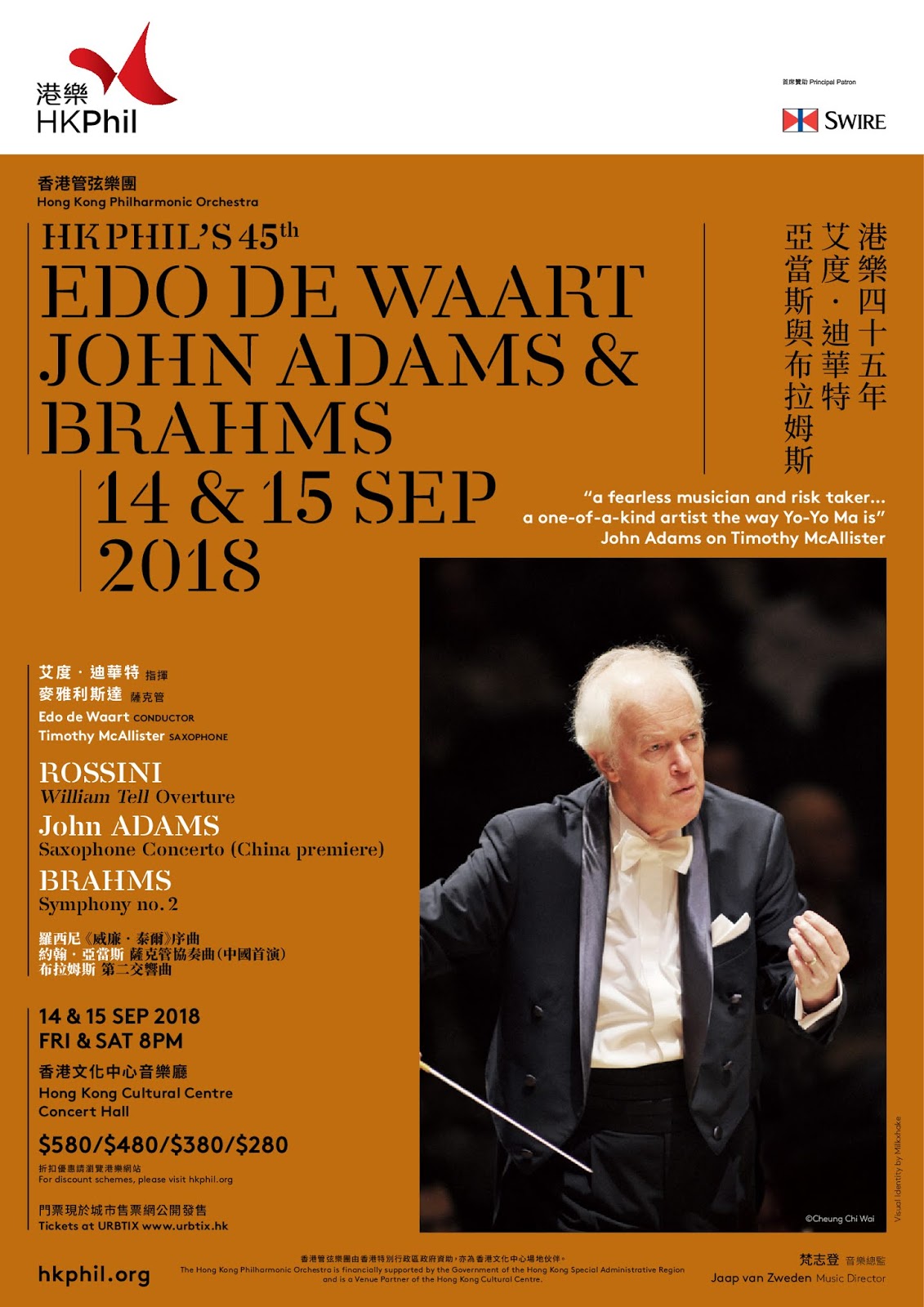
Review - Edo de Waart, Hong Kong Philharmonic Orchestra, 15 September 2018

Overture to William Tell (Rossini)
Saxophone Concerto (John Adams)
Symphony No. 2 (Brahms)

Hong Kong Philharmonic Orchestra
Timothy McAllister (saxophone)
Edo de Waart (conductor)

It was an interesting to hear how the orchestra responded to its former music director on the podium again. The cello solo employed a broad tempo to begin the overture with a lot of vibrato in rich tone. A quiet start to the storm section before exploding into a full thundering climax. Though under a steady tempo the impact was not as terrifying as expected. Beautiful duet between the cor anglais and flute during the pastoral scene. The closing gallop was tidy and majestic, also effective accelerando geared towards a triumphant close.

John Adams's saxophone concert felt alike a busy rhythmic exercise for the soloist. Fragmented patterns jointed jazz and blues together for a hurry and restless ride. The brass kept the momentum going but hard to tell where the music was sailing to. At reaching the middle of the first movement then the orchestra played without the soloist. The dreamy transition was enigmatic yet the saxophone solo had a more lyrical part than previously. The music landscape became flatter and calmer before returning to fierce gallop, and then retreated to a quiet end.

The second movement dominated by syncopated patterns and stayed vigorous on momentum. It was a tight dance in irregular phrases but also abstract as to where the music was heading to. Timothy McAllister sustained the energy throughout in his playing and kept the music flowing naturally. Though the dynamic and emotion contrast were more able to display in his encore.

The orchestra kept the dawn awakening like introduction to Brahms's second symphony flowed with a warm gentle tone and not too weighty in body. Neither aggressive at the climatic exuberance and stayed bright with a lot of legato to sustain the line. Though whether to do with de Waart's conducting style, the winds sometimes felt a fraction behind the strings. Tempo was rather laid back for a gentle and unhurried gallop at the end of the first movement.

The cellos began the noble theme of the second movement in a mellow warm tone that gave a tender and sunny impression. A misty respond from the winds against the emotional outpouring from the strings. Yet as in Brahms's style sentimental negotiation never reach a full answer but hold back by the recapitulation of the noble theme. The tragic sentiments gained more weight before resolving to a quiet end.

The winds began the pastoral scene of the third movement with a busy strings' part underlaid. Rhythmically it gained momentum yet carried more lyricism within.

An explosive start to the last movement in an energetic gallop. The transitions felt rather enigmatic though, which the lines would have been more effective if there was an aim than a mere shape. The majestic theme was passionately rendered in a warm tone. After a long negotiation the music finally located the end in certain with a glorious triumphant conclusion.


Review - Jaap and Joshua Bell, Hong Kong Philharmonic Orchestra, 8 September 2018

Academic Festival Overture (Brahms)
Violin Concerto (Sibelius)
Symphony No. 41 "Jupiter" (Mozart)

Hong Kong Philharmonic Orchestra
Joshua Bell (violin)
Jaap van Zweden (conductor)

Like the season opening performance before, a festive symphonic overture is programmed for an uplifting start. Though the orchestra was too energetic throughout Brahm's Academic Festival Overture, and as a whole it felt lacking character and essence. Jaap probably felt the swift tempo would keep the momentum going than dragging along. Yet already restless than being mysterious at the tip toe like beginning. By reaching the first triumphant climax then the orchestra was more stable and let the music sang. Despite displaying the tonal contrast, it galloped in hurry and occasionally lost in details.

The first violin began Sibelius's Violin Concerto with a spellbinding pianissimo and set the stage for the solo violin. Bell's playing produced a sweet rich tone with clarity, but his bowing did not always have the smoothness to sustain the long line and sometimes felt abrupt. He approached from a sentimental perspective by employing a lot of vibrato. His playing was passionate and expressive on the ebbs and flows of emotions, rather than holding back the sentiments in stillness. Despite a challenging part to play, tuning on the double stops were noticeably a hit and miss Whereas the orchestra strings seems holding back their response to avoid being overpowering. Interestingly, I thought there was a brief moment alike the motive of Siegfried's assassination from Wagner's Götterdämmerung towards the end of the first movement.

Bell began the second movement beautifully on the lush expressive violin part, yet the horns' accompaniment did not sound convincing. Occasionally I felt Bell put too much weight on the bow that it felt too rich and sticky than allowing his playing to flow more. The orchestra achieved more charity and locating its voice in the tragic response. Yet the syncopated section not really able to build up the climax despite effective dynamic contrast.

A busy start into the third movement for the solo violin part, but Bell was driving the tempo so much that his phrasing not quite grasping the shape of the polonaise dance. Tuning was very good with the harmonics and not so with the arpeggio climbs to the high positions. As a whole I felt mixed by Bell's playing, but after learning from friend's past experience, Bell could have been experimenting different approaches than giving a  straightforward interpretation.

I had not been impressed by Jaap's Mozart in the past but what he achieved from the orchestra on the "Jupiter" symphony changed my mind completely. Finally a more relaxing tempo was adopted for the first movement and the playing was very polished. Perhaps the violins could employ more accents in the down bow to give more rhythmic excitement than only sustaining the elegant impression. Contrast in tone colours at counterpoints was effective with beautiful tone at the majestic recapitulation. A flowing elegant impression was made at the beginning of the second movement. The sadness and solemnity at the tragic transition seems a reference to earlier piano concertos by Mozart. Later the landscape became smooth with a sweet and clean tone, while being sedate and slightly sentimental. The third movement became an elegant and majestic dance in thicker texture than the movement before. The orchestra was very responsive and immediate with the gallops in the last movement that kept the momentum forward. The brilliancy of Italian opera fanfare like section was effectively realised. The bright tone gave the dance like movement a flamboyant touch. The final gallop was energetic with the sheer rhythmic excitement that gave more audio satisfaction than the first half.

(Photo credit: Hong Kong Philharmonic Orchestra)

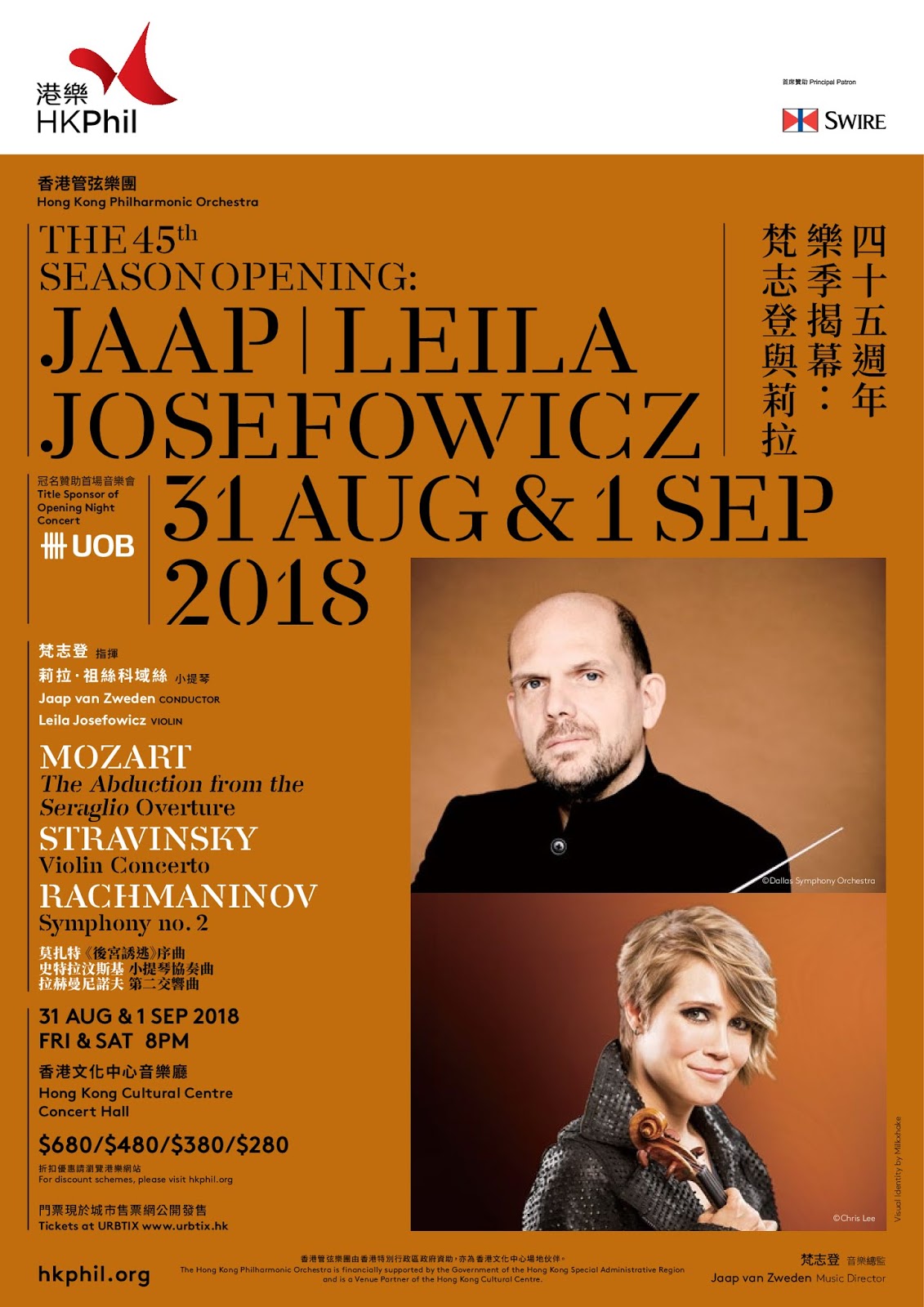
Review - The 45th season opening performance of Hong Kong Philharmonic Orchestra, 1 September 2018

Overture to the Abduction from the Seraglio (Mozart)
Violin Concerto (Stravinsky)
Symphony No. 2 (Rachmaninov)

Hong Kong Philharmonic Orchestra
Leila Josefowicz (violin)
Jaap van Zweden (conductor)

The overture to Mozart's exotic opera Die Entführung aus dem Serail is supposedly a lively curtain raiser by including a large battery of percussion with the strings and winds. Yet the philharmonic orchestra seems more indifferent to that idea and gave a lukewarm account in its rendition. Jaap took a steady tempo that aimed for refinement than after a dramatic interpretation. The strings particularly lacked dynamic contrast nor making the colour to enrich their playing. A friend thought perhaps to do with the orchestra being too big than the right formation, but I felt the heart and mind were not in place.

The orchestral playing was certainly more passionate in the Stravinsky and musically carried more contrast and interest. An energetic introduction was given between the winds and solo violin that felt alike a colourful country scene. Despite the two domains have different rhythmic patterns, Josefowicz executed the big jump on positions with ease and sustained a flowing impression in her playing. The music became more nervous and less optimistic in the second half of the first movement.

A melancholy or even bizarre start to the second movement by the solo violin. The music became rather abstract with the irregular music patterns and fragmented parts. Sentiments dominated the third movement and longer line in a phrase than previously. The main theme by a trumpet and two flutes made a tragic calling, but not knowing where the music was heading into than thematic repetition.

The last movement was more certain started with a syncopated gallop. A busy part for the solo violin while the bassoons provided the rhythmic backbone. Josefowicz sustained the energy in her playing with clarity, maintained the beauty in tone colour and allowed the music to breathe. The rhythmic patterns are ever changing and include some reference to Bach. Later even a reminder to the Rite of Spring as the music went tribal and exuberantly driven towards the end.

I was unsure at first whether this performance of Rachmaninov's second symphony would be as memorable as the one in the previous edition of Hong Kong Arts Festival by the Oslo Philharmonic. The climaxes is alike an endless musical orgasm from the start til the end. Though the beginning of the first movement is supposedly more gloomy and mysterious than the rest. Yet the philharmonic orchestra played with a warmer tone than the chilling landscape in mind. Romanticism already culminated in full swing even at the early climax. Lush strings' playing sustained the contrast in the ebbs and flows of emotions, but not as flowing as desired. The stormy transition also lacked the tension and bleakness. Only at reaching another big climax the sheer intensity gained weight. The return to the romantic theme was sweet and passionately driven, also more clarity among the strings. Interestingly the brass sounded rather like a military band at the closing of the movement.

Tempo for the descending start to the second movement was on the swift side and kept the momentum forward. Though more majestic and steady in its emotional response. The tempestuous gallop in turn was thundering throughout but not overtly wildly driven.

It took the orchestra some time to calm down than being restless in the sweet and tender opening of the third movement. Andrew Simon's clarinet solo was spellbinding and paced very well in the long line of phrase. The dialogue between oboes and cor anglais along rest of the orchestra carried a lot of energy in gearing towards another climatic peak. Calmness returned at the end yet the strings' playing not as silky and flowing as expected. Sentiments were felt again from the ebbs and flows of emotions.

An energetic start to the festive introduction of the last movement, but clarity and togetherness were not that effective among the strings. The outpour of romantic lushness was given in full and gloriously rendered. The transition from the nervous passage back to the brilliant opening theme was intense and filled with sheer excitement. The crescendo built into a majestic and triumphant lush conclusion. It certainly came close to the breathtaking impression I had previously.


Review - Celebrate Bernstein on Broadway, Hong Kong Philharmonic Orchestra, 7 July 2018

On the Town: New York New York; Lonely town; I can cook, top
Peter Pan: Dream with me
Wonderful Town: A little bit in love; One hundred easy ways to lose a man; Wrong note rag
On the waterfront Suite
Candide: Overture; I am easily assimilated; Nothing more than this; Glitter and be gay
1600 Pennsylvania Avenue: Take care of this house
West Side Story: Dance at the Gym; Maria; Tonight
Trouble in Tahiti: Island Magic

Hong Kong Philharmonic Orchestra
Lorina Gore
Louise Dearman
Nathaniel Hackmann
Nadim Naaman
John Wilson (conductor)

Since 2009, John Wilson and his orchestra are a regular feature at the annual BBC Proms that gives quality and memorable performances of film music and musicals. As an arranger and musicologist, Wilson always came up with a programme that in good musical sequence and mixture of styles. The same to be said of this concert featuring Bernstein's works for the broadway productions, which the first half was more serious than the entertaining second half.

The curtain rose with On the Town which gave a taster for what to come later: big band, jazz and lyric song. Yet due to the hall layout and acoustic, the balance between orchestra and vocalist not always ideal that the singing was often drowned out even miked up. Lorine Gore took a rather operatic approach in Dream with me from Peter Pan. Her tuning was not too good though and employed vibrato seems excessive for my taste. Louise Dearman brilliantly realised the humorous lyrics in One hundred easy ways to lose a man Wonderful Town.

The orchestral suite of On the waterfront showing Bernstein's more serious compositional style. After a gentle horn solo, it grows into a vigorous tribal dance with the large battery of percussions thundering along. A beautiful flute solo accompanied by harp and winds answer alike calm after storm. Then the sentiments built into a long climax but the thematic repetition was enigmatic. A slow march in pentatonic style creates further dreamy impression until the brass fanfare gives an explosive coda. Though I was not sure if Wilson enjoyed the work as his conducting not very clear sometimes in coordinating the parts. Rhythmic tricky sections were not very tidy and some slips were audibly noticed.

The overture to Candide was robust and bombastic but also has a majestic theme. 'I am easily assimilated' was seductive by impression, though more sentimental in 'Nothing more than this'. Hackmann's singing style felt alike from the back of throat that did not enhance his clarity of the text. 'Glitter and be gay' was melancholy at first then transformed into a operatic firework that brilliantly rendered by Lorina Gore in all exaggeration. 'Take care of this house' instead was more emotional and soft.

The Dance at the Gym from West Side Story demonstrated the colourful scoring and energetic momentum, which the percussions and brass went wild in sheer excitements. Hackmann was more successful in Maria especially in capturing the tenderness and beauty of his timbre. Island Magic from Trouble in Tahiti again calling a noisy diva role, which Gore sustained her unflagging vocal energy throughout. The lush music and swings in Wrong note rag reached a lively conclusion, and two more encores were given including Tonight from West Side Story. Wilson certainly looked more cheerful and satisfied than the first half.


Review - Shostakovich & Tchaikovsky, Hong Kong Philharmonic Orchestra, 16 June 2018

Variations on a Rococo Theme (Tchaikovsky)
Symphony No. 7 'Leningrad' (Shostakovich)
Encore: Overture to 'Die Fledermaus' (Johann Strauss II)

Hong Kong Philharmonic Orchestra
Wang Jian (cello)
Jaap van Zweden (conductor)

Pairing a light piece by Tchaikovsky as amuse-bouche with Shostakovich's Leningrad Symphony is lazy programming, neither does it makes much impression. The Fledermaus overture could have started the concert to form the tuneful progression, than serving as an anti climax after the symphony. Alike Tchaikovsky's ballet scores, sweet, tender and lyric are the features of the rococo variations. In the first part, extreme range on finger positions for the solo cello as it gets to the end of fingerboard with harmonics. Wang Jiang kept the music flowing and switched positions smoothly. Though sometimes too much vibrato on the long notes for my taste, and impatient with the tempo than sustaining the elegant impression. The repetition of the main theme was beautifully played by the flute solo, though composition style wise not dramatic at all. Melancholy made the sorrow response in the mid section before galloping at the coda, which rhythmically and audio more interesting than before.

Zweden's account of the Leningrad Symphony realised the graphical abstraction, yet a lot of warmth within that gave more hope than devastation. The majestic theme that began the first movement was muscular and sunny without any sign of doubt. Even in the following pastoral section, with flute solo playing folk tunes, felt rather sweet and sedate under the relaxing tempo. Then the march to battle reminded us the long crescendo of repetition from Ravel's Bolero. First pizzicato on tutti strings forms the rhythmic structure and harmonic foundation, duet between oboe and bassoon give the melodic tune, while the brass dramatise and thundering the tune in full force of power. The principal percussionist Aziz Luce kept the rhythmic momentum tight and consistent on the snare drum throughout, also effective progression from pianissimo up to the climatic violence then faded to a quiet end. Yet the second view of the landscape was colourless as the bassoon depicted, but the first violins were not that tidy in their lyrical response.

It also took few bars to agree on the tempo between the strings and oboe solo at the start of the second movement. The theme led by the clarinet was alike clock ticking, and became surreal with the energetic dance gave a grotesque outlook. One felt the recapitulation of the opening theme enigmatic that not sure where the music was trying to head to. Dialogue between bass clarinet, harp and flutes seems to lament the calmness and tranquility of normality prior the war. A spiritual start to the third movement with the winds playing a chorale theme, which the strings gave an emotional pouring response. Beautiful flute solo accompanied by pizzicato on the strings. Texturally it recalled the music landscape of Sibelius for the clearness and a heavenward glimpse.

Yet the elegant strings' passage before the last movement was calm before storm. The tense gallop and bombastic brass brought the violence of war back to the centre stage, which was muscular but flowing. Sorrow and hope negotiated, though more certain in direction that reassured by the majestic unison strings. The built up towards the thundering climax was less triumphant and naive compare to the one we heard in the first movement. It was turned into a wild dance with sheer dramatic intensity. The aftermath was bleak over the vast landscape, which was gloomy and mysterious that visually near disfigured. Instead horns' fanfares and strings culminated towards a blazing magnificent conclusion. Victory was unlikely the answer, but a conviction that manifestation of hope and glory would triumph over doubts. The long struggle certain put the Fledermaus into an odd extra as to whether we needed more to reassure ourselves, even though the philharmonic was certainly energetic enough to deliver a fiery rendition.


Review - Das Lied von der Erde, Symphony No. 4 & 5 (Mahler), Hong Kong Philharmonic Orchestra

27 May 2017, Hong Kong Cultural Centre Concert Hall:
Overture 'A Midsummer Night's Dream' (Mendelssohn)
Piano Concerto No. 1 (Mendelssohn)
Symphony No. 4 (Mahler)

Lan Rao (soprano)
Serena Wang (piano)
Long Yu (conductor)

The ongoing Mahler cycle by the philharmonic orchestra now spread across three seasons, but not knowing whether the eighth symphony being planned for future performance or not. Two of the concerts in this review are long overdue for review, yet recent performance of Das Lied von der Erde provides the excuse to recall what happened. The 2016/17 season focused mainly on symphonies of the wunderhorn phase with the fourth symphony marked the conclusion.

Mendelssohn filled the first half for a lighter start supposedly, but reading my notes it seems impatient and aggressive playing created most of the impression. The strings hurried along the overture that the gallop was energetic but rough. There was hardly any shape in phrasing but the simply hurrying through. Whether to do Yu Long's unclear conducting, who just beating out in two than showing any shape, or an individual in the orchestra played ahead, the end of one line was audibly messy and wrong. The orchestral's wildness continued into the first movement of the piano concerto which too much energy expressed by the playing. Lyrical moment was not elegantly rendered and the orchestra began to shape the music on auto mode by ignoring the conductor. Serena Wong's playing on the piano was smooth and beautifully executed, particularly the second movement, which she allowed the space for the music to breathe and recalled the much needed calmness. The orchestral entry to the third movement was more relaxing with a flowing progression yet swift in tempo. Technically Serena Wong was precise with a good touch that never being aggressive, yet it would take her few more years to sophisticate and mature her thinking on the work.


Though the orchestra was impatient again at the start of Mahler's fourth symphony. It did not feel like a delicate dance and the dynamic contrast felt rather extreme. A rather awkward structure continued with too much rubato employed in the lyrical section and lacked direction during the melancholy transition. The crushing climax fell short of the violent effect, yet the return to the more happy looking expressive moment stayed very loud and muscular. These all created a heavy footed impression by being sticky and lacked contrast in colours. Focus was lost by the broad and steady tempo adopted in the second movement. The orchestra dragged along and failed to realise the atmospheric change from the grotesque outlook to the sweet coda.

Strings managed though to play more tenderly in the third movement but still very vertical progressed, which lost some momentum and turned it into fragments than continuation. It was probably why the climaxes lacked the weight of impact and the pastoral excitements felt extreme than naturally developed. Neither was the connection between ebbs and flows of emotions effectively created, but merely making an explosive sound or accelerando. To further dampen the appreciation, Rao Lan's singing was often inaudible with poor diction in the fourth movement. Vocally she did not carry the support in reaching the high register and at times not even together with the orchestra. The orchestral playing instead became over dramatic with the woodwinds being wild. Messy coordination again when Yu Long also forgot to indicate the rubato. After Gergiev's chaotic performance with the World Orchestra For Peace some years ago at the BBC proms, this added to another disappointing live experience onto the list.


9 September 2017, Hong Kong Cultural Centre Concert Hall:

Piano Concerto No. 2 (Beethoven)
Symphony No. 5 (Mahler)

Yuja Wang (piano)
Jaap van Zweden (conductor)

The game switched three months later with Zweden in charge of the fifth symphony. The first half continued the week long feature of Yuja Wang with Beethoven's second piano concerto. Despite textually it still bears the Mozartian features, the orchestra gave a rather vertical reading of the introduction than sustaining a forward momentum. Wang played tenderly on the lyrical passage but also impatient with the tempo. Later she was more even rhythmically in the arpeggios, while the orchestra ably made appropriate dynamic contrast to accompany her in the background.

Yet there was the tendency to rush through and made a muscular tone, instead of the majestic and silky sound that had in mind. The cadenza seems could not make up its mind how to develop than a labouring of notes in thick texture, which felt rather odd with the composition style. Wang and the orchestra hurried through the first half of the second movement, which also felt too energetic and too bold than the sweet gradual progression. Yet right hand playing at the pianissimo passage made a spellbinding effective and the orchestra finally allowed the music to sing with the space. Wang and the orchestra felt more at home in the third movement with the lightness to keep the direction with dynamic contrast.

After the interval, an explosive start to the fifth symphony after a confident and accurate trumpet solo, which was most effective compare to past performance of the same work by HKPO in my memory. Strings did not linger on the expressive theme and blazing tone from the brass. A violent climax was reached with sheer devastating cries in contrast to the gentle march later, which was sweeter than melancholy. The contrast in the second crushing climax was effective followed by attaca into the second movement with masculine brass entry being very crisp in tone colour. The tone of lower strings was thicker and tidier than the upper strings. Ebbs and flows of sound waves culminated for sheer intensity. Sadness drove between the negotiation of hope and sorrow. Explosion passage created a hurricane impression with emotional sentiments. The raw tone on strings recalled the chilling wind alongside war like percussion. Triumphant fanfare from the brass accelerated the impact to fullness before dying down to a mysterious close.

An energetic start to the third movement that strings played the accent exaggeratedly for a muscular dance. Flowing wind passage compare to the strings' complex fugal dialogue. The horn solo sustained a bright tone and stayed swift in momentum. Soon a chamber like dialogue made a change from the loud and violent beginning. Each part seamlessly connected with the others, and the dance had more bite and energy this round to create an exuberant swing even at quick tempo. The horn solo took the risk for sheer excitement in the gallop and aimed for a resounding end.

Whereas the depth of emotions poured out in full at the fourth movement. Zweden even managed to keep the climax flowing like a song without word that was magical in many ways. Dynamic difference at the ebbs and flows was big in the leap, followed by a heartbreaking fade on the violins. A majestic entrance to the fifth movement from the horn and woodwind. The following fugue was energetically driven in full bodied tone, though at points it also felt rushing along. Though there was the intention to slow down in order to build up the climax for a resounding impact. The sound of wall, machine gun like, marked hope triumphantly over sorrow by the brass fanfare. A highly dramatic finale from the abyss of melancholy to the wholehearted celebration of positivism. It was surely the most dramatic account of the fifth symphony I experienced so far.


28 April 2018, Hong Kong Cultural Centre Concert Hall:
The Song of the Earth (Ye Xiaogang)
Das Lied von der Erde (Mahler)

Yu Guanqun (soprano)
Ildikó Komlósi (mezzo-soprano)
Klaus Florian Vogt (tenor)
Yuan Chenye (baritone)
Long Yu (conductor)

Instead of the usual programme formula with works from the classical period, the performance of Das Lied von der Erde was paired with Ye Xiaogang's composition that based on the original Chinese poems in the first half. A colourful introduction to the first movement with woodwind imitating tides and waves. Despite diction was not that clearly articulate at the first hearing of Yu Guanqun's singing, her intonation was secured and carried the projection. The reach to top notes was smooth and flexible in switching between registers. Vocal style recalled those in Elektra but harmonically simpler and less violent. It tried to be broad and majestic in style. The second movement was rhythmically more energetic especially among the percussion, but was not quite the shyness that depicted in the text. It was festive enough to visual a lively scene but the soprano vocal part was less sophisticated comparing to the first.

A broad sound world that captures the atmospheric beauty of night music in the third movement, with bells chiming in the background like clock ticking. The baritone finally appeared in the fourth movement for the violent and tense opening. The composition style was similar to a mixture of Peter Grimes and Turandot. Yuan Chenye sang dramatically throughout but lacked the vocal body. The drum rolls towards the end of the movement felt abrupt and should have been continued into the fifth movement. A return to the vast and deep sound world, but Yuan's line was not that smoothly executed. The brass fanfare gave a positive outlook to the exuberant fantasia, though lacked some sonic impact. Mysterious finale in the last movement while being tranquil. The heroic climax was ironic for the first time, yet the return to the calm and sedate atmosphere was awkwardly developed. It recalled the night music of Mahler's seventh symphony to some extend, but the coda with clashing gongs and bass drum fading away was completely opposite.

An exuberant start in swift tempo to Das Lied von der Erde, which the orchestral playing was so wild and aggressive that nearly drowned out the singing. Though Vogt's singing still managed to filled the hall and kept the tender impression. Yu Long seems lost control of the orchestra and the playing felt rather unsettling throughout the first movement. He was not able to get the depth out of the orchestral playing than an energetic chase. Same being felt in the next movement with the oboe led theme, which was rather out of shape and simply galloping along. Komlósi sounded uncertain how to fit her singing within the restless progression. Her diction was unclear too and employed heavy vibrato in the higher vocal range. Yu Long's conducting also looked all over the place that flicking the baton aimlessly.


While Vogt tried hard to stay soft in the third movement, Yu Long did not able to slow down the orchestra from hurrying the tempo of the festive March. It created further hurdle to Komlósi who struggled to fit the sung text while the tempo was pushed to extreme in the fourth movement. No musical shape at all but a mechanical galloping to jump leaps. The festive wildness went too far and created chaos, which the return to lyrical part was abruptl. The coordination throughout the fifth movement was better than before with the orchestra more responsive to Vogt's word painting. He continued to keep the vowels bright and kept the projection forward. It felt sweeter even in such excitement.

The white hot orchestral colour carried too much brightness for the mysterious opening of the last movement. Komlósi's phrasing was out of shape again and not able to sustain the long vocal line, also audibly employed too much vibrato. Flute solo was beautiful and enchanting at the tranquil transition into the calm and expressive moment. Yet the swift tempo followed was in great hurry and difficult to understand what she was singing. Only at the climax then Komlósi able to sing more than speaking the text early on, and conveyed the emotions, but her mid vocal range was insecured with poor tuning. The full sense of sorrow was finally realised in the moody and melancholy second half. Sadness was expressed in the funeral march but lacked some direction of a slow dance. Though again it needed to hold back the forwardness to allow more space and broad tempo for the dream like conclusion.

Review - Hosokawa, Falla, Mendelssohn, Debussy, Hong Kong Philharmonic Orchestra, 31 March 2018

Circulating Ocean (Hosokawa)
Nights in the Gardens of Spain (Falla)
The Hebrides (Mendelssohn)
La mer (Debussy)

Hong Kong Philharmonic Orchestra
Ingrid Fliter (piano)
Jun Märkl (conductor)

This mostly sea themed programme displayed vivid imagery of landscape and movements. A sequence from darkness to light was also carefully planned. Hosokawa's circulating ocean began the concert with its slow grow and weighty outlook. A vast space, probably describing a long shoreline, set the beginning with bells chiming in distance and long notes sustaining among strings. Further tension added to the mysterious impression with crushing bass drum alike roaring tides. The raging percussion effects created an eerie impression, while brass and winds made chilling cries of a tempest.

The bleak landscape marked a contrast from the warmth and rhythmic activeness later in Falla's musically painting of Spanish gardens. The first movement, which depicted the Generalife at the Alhambra in Granada, had the brightness in tone though the ebb and flow felt like waves. The orchestra made a blazing sound, while the solo piano seems accompanying with an improvisation part than carrying a leading theme. The orchestra galloped in the second movement rather than a vigorous dance with dynamics swelling throughout. The run speed up in the last movement with an explosive entry of horn fanfare. It was more symphonic with the thick texture but occasionally heavy footed that lost some of the dance quality. Towards the end it became more lyrical and emotionally expressive, which the majestic coda recalled the fantasia like second movement.

Märkl adopted a rather swift tempo in the Mendelssohn. The misty opening was clear up by the tempest with sheer intensity in the strings' tremolo. The orchestra responded well to the changing moods in tone colour and dynamics, which ably built the momentum forward.

Among all four works, Debussy's la mer was arguably most vivid in scenic depiction and musically sophisticated. Märkl continued the swift tempo in keeping the motion forward and urgency to float. The colour bloomed and rhythmically exciting as the sunrise scene was gloriously portrayed by the brass. It was alike an ecstasy in celebrating a blazing moment. Dialogues between parts were seamless in the second movement. Märkl was able to draw them to articulate their parts and employed rubato effectively. The contrast in dynamic and rhythmic changes again produced a colour image with excitement. Though the brass seems less focused and intense than the lower strings in the stormy scene of the third movement. The growing emotions nonetheless maintained the heroic and majestic impression, which was memorable as a whole. 

Review - Götterdämmerung (Wagner), Hong Kong Philharmonic Orchestra, 21 January 2018

Gun-Brit Barkmin (Brünnhilde)
Daniel Brenna (Siegfried)
Shenyang (Gunther)
Eric Halfvarson (Hagen)
Michelle DeYoung (Waltraute)
Amanda Majeski (Gutrune)
Peter Kálmán (Alberich)
Eri Nakamura, Aurhelia Varak, Hermine Haselböck (the Rhinemaidens)
Sarah Castle, Stephanie Houtzeel, Jenufa Gleich (the Norns)

Hong Kong Philharmonic Chorus
Bamberg Symphony Chorus
State Choir Latvija
Hong Kong Philharmonic Orchestra
Jaap van Zweden (conductor)

The philharmonic orchestra ring cycle project since 2015 finally reached its finale. In between I saw other ring cycles in Melbourne and Berlin, but theatrical experience was different from the setting as a concert presentation. Since there was no staging, the audio appreciation became the focus inevitably. Yet one could not ignore the ideology, philosophy and symbolism, and the contemporary relevancy. Like Rheingold, the theme of cunning plans, lies, greed and violence was revisited extensively in Götterdämmerung. Despite the solution to end all woes was already known at the beginning, which to give up the ring and return to the rhinemaidens. It was not until Brünnhilde made the unexpected move by sacrificing herself, which put an end to the old establishment.

To stay true and honest seems more difficult than exercising self interest, selfishness and manipulation. Such paradox still happens in our society, and never fail to amaze us of how much excuse one can deploy to legitimise mistakes. Though it is too simplistic to make Hagen solely as an example of evilness, who was also a by-product of Alberich and inherited that loveless power driven desire. Siegfried too failed to be a total hero as he did not realise the bigger picture, also stubborn enough not to give up the ring at the advice of rhinemaidens and warned him that death looming. Neither the ring nor the tarnheim brought the promised power and protection, instead those desired or possessed the two items brought themselves to destruction. Yet unorthodox partnerships and father-daughter reconciliation sometimes broke off the cruel world by celebrating the power of love and humanity, which gave us hopes that the world could change for a better future. The ring told a painful lesson, but only until Die Meistersinger and Parsifal that Wagner suggested for social transformation only through arts and ideological transformation would succeed.

Musically this performance of Götterdämmerung had successfully delivered the full package. Arguably the best display of the entire cycle and also most satisfying concert experience of the current season so far. The vocal line up were more pleasant for the ears than previous instalments, and technically outstanding that exceeded the expectation. Although the work was lengthy in duration, the orchestra never lose shape under the baton of Jaap van Zweden and every line being phrased meaningfully. It was also worth breaking the bank to augment the choir with reinforcements from abroad. Despite lacking a sonic depth and could have accented more on the chords, a polished and majestic orchestral entry was given at the prologue. Sarah Castle, the first Norn, sang poetically and injected much colour to her diction, yet the lower register seems slightly soft for the vast acoustic. Stephanie Houtzeel, in the role of second Norn, improved her diction and tuning as her voice warmed up. As she sang the passage that described Loge's involvement and fate, her singing tone was richer and gave a colourful painting of the text. The third Norn had the highest vocal range of the three and texturally more fluid. Though Jenufa Gleich would need to articulate consonants more to improve her diction and flexibility in switching registers.

The orchestra kept the momentum forward and responsive to the thematic transitions between the breaking of the thread and the sunrise scene. The devastation was felt with sheer intensity and urgency as the thread broke, followed by a still and mysterious passage on the cellos that depicted the break of dawn, and reached the climatic exultation of passionate love and sunrise brilliancy as the tutti excitement culminated in full. Gun-Brit Barkmin debut as Brünnhilde surprised me by her rich mezzo soprano timbre and still could reach the rather higher vocal range. She was steady with tempo at first and carefully phrased the lines. As she warmed up, her singing became more relaxed and opened up that enhanced the clarity in diction. Daniel Brenna, who already several stage experience as Siegfried, carried more space and warmth in tone, also acting out the role for interaction. His timbre made a pleasant impression of his line but vocal weight slightly light for the hall acoustic. He too was cautious with the words and the register changes. The pair maintained the passionate exuberance, and showed no sign of vocal strain to reach the climatic top notes. The thickened strings' layers during Siegfried's Rhine journey was rhythmically energetic and excited, but slips were audible from the horn solo. It all built into a majestic and polished tutti bold moment with dynamic contrast, but could swing more to lighten up the thick texture.

The orchestral introduction of Gibichung Hall was less eerie and dense than expected. Shenyang's Gunther felt very commanding than a puppet by his confident singing, whereas Eric Halfvarson's dense and rich bass tone recalled Fafner than the cunning Hagen. Both made the impression that they were in command of the situation even before Siegfried's arrival, which added the chilling weight as the assassination plot gradually unfolded. As Gutrune, Amanda Majeski had the right timbre for the role and stayed fluid in her singing despite tuning on high register not that secured. At Siegfried's entrance, the brass produced a crushing chord that seems marking the beginning of the end for the hero. Yet at the description of treasures that Siegfried had, Halfvarson lacked the urgency in portraying Hagen's underlying desire and some stage realisation would have given some visual context. The orchestra again responded vividly to the emotional changes as Siegfried took the potion that Gutrune had prepared. Brenna and Shenyang too delivered a dramatic interaction on the adventure to Brünnhilde's rock, and marked the swearing of brotherhood more daunting as what to follow. The brass ably produced the youthful excitement yet could have loosen up more to unleash the wildness. In contrast, the orchestral playing could be more chilling and bleak as Hagen narrated his cunning plan alone. Instead the lower brass created the atmospheric heaviness of curse by its tragic and gloomy tone colour.


The tender love theme in reintroducing Brünnhilde on the rock was short-lived, but horns were muddy at announcing the arrival of Waltraute. Barkmin interpreted the sisters' reunion as an emotional charge with a dramatic reception, while Zweden drove the orchestra to celebrate the joy of recalling the past. As always, Michelle DeYoung phrased the music poetically with very clear text and her voice filled the space effortlessly. Her narration of the fall of ash tree and Wotan's preparation for final destruction realised the varied emotions of horror and sadness. Here Barkmin carried more warmth in the her lower register and clear with her diction. She also effectively conveyed the ebbs and flows of emotional response with colourful contrast in the words. Upon Siegfried's return, the orchestral transition was warlike and tense in opposite to Brünnhilde in rapture. Though disguised Siegfried in tarnheim and confrontation between the pair would be more vivid with stage actions than solely relied on music narration. Instead the orchestra gave an eerie accompaniment as Brünnhilde was devastated by the betrayal and cried in horror.

Instead of an eerie dreamy impression, the orchestral introduction of act two carried more warmth than expected. Visually Peter Kálmán made a youthful Alberich compared to Halfvarson's Hagen, yet his baritone like timbre lacked the same resonance and richness. Though the portrayal was accurate as Alberich was eager on retrieving the ring, whereas Hagen stayed dreamy and uninterested to his father's urge. The bass clarinetist gave a subtle and smooth account of Hagen's awakening, but Siegfried's return seems slightly soft in presence on the orchestra part. Perhaps the intention was to leave room for the war like summon as Hagen sounded the alarm, in turn the combined male chorus thundered with a wall of sound. It gave the much desired dramatic intensity and the choral singing stayed bright and ringing. Gunther's announcement of the marriages was clear and definite, whereas Barkmin portrayed herself as an emotional Brünnhilde, who questioned the confused Siegfried and raged over the betrayal. Her vocal entries carried the urgency and furious impression, which was achieved by colourful word painting that conveyed the emotions. The orchestral underlay responded along by some raw playing on the strings, and increasingly violent as the misunderstanding and hostility deepened. The chorus also gave a bombastic questioning over the confusion and sounded very big in body. As the assassination plot was drawn up, the orchestra gave a devastating and dramatic finish.

The horns gave a blazing account of Siegfried's hunting calls that began the last act. Again the orchestra was able to intertwine between the witty playful part of the rhinemaidens and the chromatic recalling of curse and destruction. The three sopranos as rhinemaidens blended well together with a lot of active vocal energy on high tessitura passages. They drove the momentum forward with great intensity, which was in contrast to Brenna rather fluid and light timbre. It made a contrasting portrayal of the rhinemaidens being very noisy in their complains against Siegfried's disbelief of their warnings and his arrogance. Later when Siegfried recalled his past memory at Hagen's suggestion, Brenna gave a colourful account of his part. Yet he began to struggle in sustaining the legato at the thematic imitation of the woodbird, and swelled in order to reach the top notes. Even so, he managed to sustain the vocal energy and kept the tuning by giving his all. In turn, the orchestra made a crushing built up towards the assassination point, responded with a lush and sentimental transition to mark Siegfried's last declaration of his love to Brünnhilde.

For whatever reason, I was very moved for the first time by the funeral march, which was rendered majestically and bold. Perhaps the orchestra's tone colour carried more the tragic sentiments than solemnity, or truth was finally revealed after all the preceded lies and chaos, which allowed emotions to pour out in full. Hagen's terrifying announcement of Siegfried's death and the blaming game with Gunther and Gutrune were as expectingly tense, but only stage action could realise the visual bloodshed. Zweden adopted an unhurried tempo for the immolation scene that aimed for a monumental and emotional end. Although Barkmin's higher register lacked the warmth of her lower vocal range, she phrased the music poetically and stayed smooth in her vocal switch. One felt particularly poignant and emotional when Brünnhilde recounted the past wrongdoings and betrayal, yet the moment of destruction and cleansing had arrived finally to undo it all. Along with radiant brass playing, the long crescendo built into a highly moving conclusion of this landmark project. The philharmonic orchestra had demonstrated it had reached a new musical height, and delivered an exceptional memorable performance. 

Review - Charles Dutoit, Nikolai Lugansky & Hong Kong Philharmonic Orchestra, Hong Kong Cultural Centre, 18 November 2017

Roman Carnival Overture (Berlioz)
Piano Concerto no. 3 (Rachmaninov)
Encore: Prelude op. 23 no. 7 (Rachmaninov)
The Song of the Nightingale (Stravinsky)
Daphnis and Chloe Suite no. 2 (Ravel)

Nikolai Lugansky (piano)
Charles Dutoit (conductor)
Hong Kong Philharmonic Orchestra

Despite an attractive programme with a reputable conductor and pianist, the performance was far from a success and even some shockingly disastrous moments. Though the problem was not apparent at first in the festive and lively Roman Carnival overture, which Kwan Sheung-fung played the cor anglais solo beautifully after an electrifying introduction by the strings. Yet Dutoit's conducting was rather square and not indicating the line, and let the orchestra to phrase the line on its own. Soon the playing lost focus and rather vertically looking. The strings produced a warm tone and Italianate in style, but too polite overall than carrying the dramatic urgency in mind. They were also sluggish and lacked the bite on the attacks until the winds gave a crushing entry at the time change. The brass fanfare added the wildness and intensity to the tone colour, which lacked before at the presto ending by merely being full and broad.

Compare to other works on the programme, Rachmaninov's third piano concerto is more symphonic and arguably the more familiar to the audience. A flowing start but already signs of untidiness among the orchestral playing. Lugansky preferred a rather swift tempo in the tranquil theme but Dutoit's indication on the pulse was rather random with his right hand, which seems confused the orchestra. Despite the piano solo was majestic, the thick descending passage did not stay together with the winds. Lugansky also placed a lot of weight in his left hand playing and rather cloudy on the pedal that produced a dense tone. The phrasing felt rather out of shape at the rhythmic tricky part and also some wrong notes on the piano playing. Yet the duet between the flute and oboe were played beautifully with a bell like tone. The recapitulation was relaxing and played at a soft dynamic but odd when Dutoit suddenly speed up the tempo to reach the coda.

The orchestral playing of the second movement introduction was uncertain, which Dutoit was unclear in his conducting and even at times followed the players' tempo. Lugansky's left hand was heavy on the touch again and created a dense colour on the sentimental theme that lacked contrast. Then the pianist and orchestra were dangerously out of synchronisation for few bars when Dutoit seems at lost. Despite Lugansky tried to hide the disaster by being very expressive on his part and possibly improvised, the music was structurally out of shape and randomly developed. Although a virtuosic and muscular start to the third movement on the piano, the orchestra was still lost and confused by Dutoit's conducting. Strangely enough everything got back together in the dream like section, but the concentration and focus were lost already with the slow tempo. Heavy handed playing at the heroic and exuberant passage, but tempo suddenly gone slow by half, and it was a surprise that everything finished together in the end. One was also amazed by the rather enthusiastic reception to such chaotic performance.

Luckily everything was back on track in the second half that Dutoit's conducting seems more in place even the orchestra was leading the direction. Percussions and winds made an explosive entry to Stravinsky's rather colourful score of the song of the Nightingale. The harmonic language imitated festive Chinese instruments but fragmented. Megan Sterling's flute solo carried the rhythmic energy by being crisp in her playing, but the music became abstract and moody as the dialogues of night music dominated. It sprang back to the excitement half way onward with the winds' energetic playing and kept the rhythmic momentum forward. Emperor's nightmarish vision was realised by the sudden cry on the strings and shapeless dances on the woodwind part. At coda it became even more mysterious with a grotesque slow march on the strings, but jazzy blue solo on the trumpet that sounded certain among the cloudy music that being built upon.

The soft blurry impression continued into the dreamy opening of Ravel's second ballet suite of Daphnis and Chloe. The calm image of ocean with ripples was tenderly realised, and one felt the vastness of sound when the strings built up the sunrise climax. Megan Sterling again gave a confident lead between the lyric expressive part and the energetic rhythmic driven section. The impressionistic sound landscape was played in a broad sense as waves but cloudy. All was clear up when the winds played the gallop wildly and explosive during the exuberant dance section. The orchestra had more bites in its playing finally that added to the desired dramatic intensity and became an energetic beast. It seems the leaner orchestral parts had the upper hand this evening and sentiments failed to excel as in the Rachmaninov.


Review - Symphony No. 8 (Bruckner), Hong Kong Philharmonic Orchestra & Jaap van Zweden, 13 October 2017


Symphony No. 8 (Bruckner)

Hong Kong Philharmonic Orchestra
Jaap van Zweden (conductor)

Despite the one and half hour long performance was greeted by an enthusiastic reception, Zweden did not appear satisfy as some previous performances like the Mahler fifth. Prior to the orchestra's Beijing tour, this one off account of the composer's spiritual journey on death and transfiguration for the hometown audience felt like a work in progress than a full understanding. The blame was equally shared between the orchestra and also Zweden himself. They have to go back to the drawing board and adjust for a more all rounding results.

After being used to the rich and full bodied playing by the Lucerne Festival Orchestra in Tokyo, it took few minutes for my ears to adjust back to the orchestra's colour. Although upper strings played tidily in a beautiful tone, the sound body was slightly thin even for the soft beginning. Same happened to the horns too and sluggish woodwind playing without a clear direction. After the first round of ebb and flow of climatic moments, the violins were more able to shape the lyrical theme. It was confidently answered by a muscular brass fanfare upon another climax. Megan Sterling's flute solo responded beautifully and carried more direction than her colleagues. Further sentimental playing from the strings that gradually built up another crushing climatic point before the music faded away in its leanest sound body.

The strings knew the road map well enough in the Scherzo of the second movement, which had more urgency in its playing and galloped through with great energy. In contrast, the woodwind was not responsive and neither crisp. Brass was slightly polite at the triumphant gallop while upper strings made a raw sound to response emotionally. The horns' duet was supposedly a sublime and majesty passage, but it was the weakest moment of the evening and rough edged along with the harps and strings. The lyrical theme also lost focus and messy among the brass, which lacked smoothness while playing tenderly. Lower strings also needed to play the notes in fuller value to let the line sings more. Direction and confidence regained at recapitulation with the upper strings realised the accelerando with sheer intensity, though woodwind was rather impatient with the tempo.

Zweden seems preferred a rather swift tempo for the lengthy third movement but that sacrificed the space for the music to sing. The sentimental theme which began the movement was not devastating enough. Upper strings somehow lost its focus and gave a rather mechanical rendition than keeping the line flowing. Instead the lower strings was more able to create the colours through the ebb and flow of emotions. Later the woodwind sextet did not really click together as an ensemble and lacked the chemistry. The broad expressive theme then developed into a magnificent climax with sentiments, but the playing again felt vertically progressed and lost energy. A quick ascend to the next climax that felt in hurry than enjoying the big moment. Perhaps Zweden saw the focus was the inner emotions later expressed mysteriously than the triumphant peaks. The tender revolve seems too energetic and not idiomatic with the movement's broad impression. It needs to be more patient and phrased the line longer for a calm and relax closing.

Blazing brass fanfare made a wild and crushing entrance into the fourth movement, responded by an emotional expressive theme on the strings in rich tone. Whereas the strings increasingly employed more rawness in their playing, the woodwind answered subtly alike a walk in the woods. Then a bold chorale theme was majestically rendered responded by a sweet tune on the solo oboe. The muscular fanfare returned again at fortissimo and strings gave a warm and expressive response. Horns' solo line again not beautifully played neither majestic, though another devastating climax became the focus. It became a classic struggle between triumph and melancholy that searched endlessly for a resolve. Harmonically the recapitulation developed into a new sound world and became more confident to overcome the uncertainty. It developed a complex of emotions through brass bombardment against sentimental strings' motive. Sorrow seems prevailed but the finale finally reached a triumphant resolve against an epic struggle in grandeur. No wonder the audience could not hold back their appreciations even it was not a resounding success.