Showing posts with label Rachmaninov. Show all posts

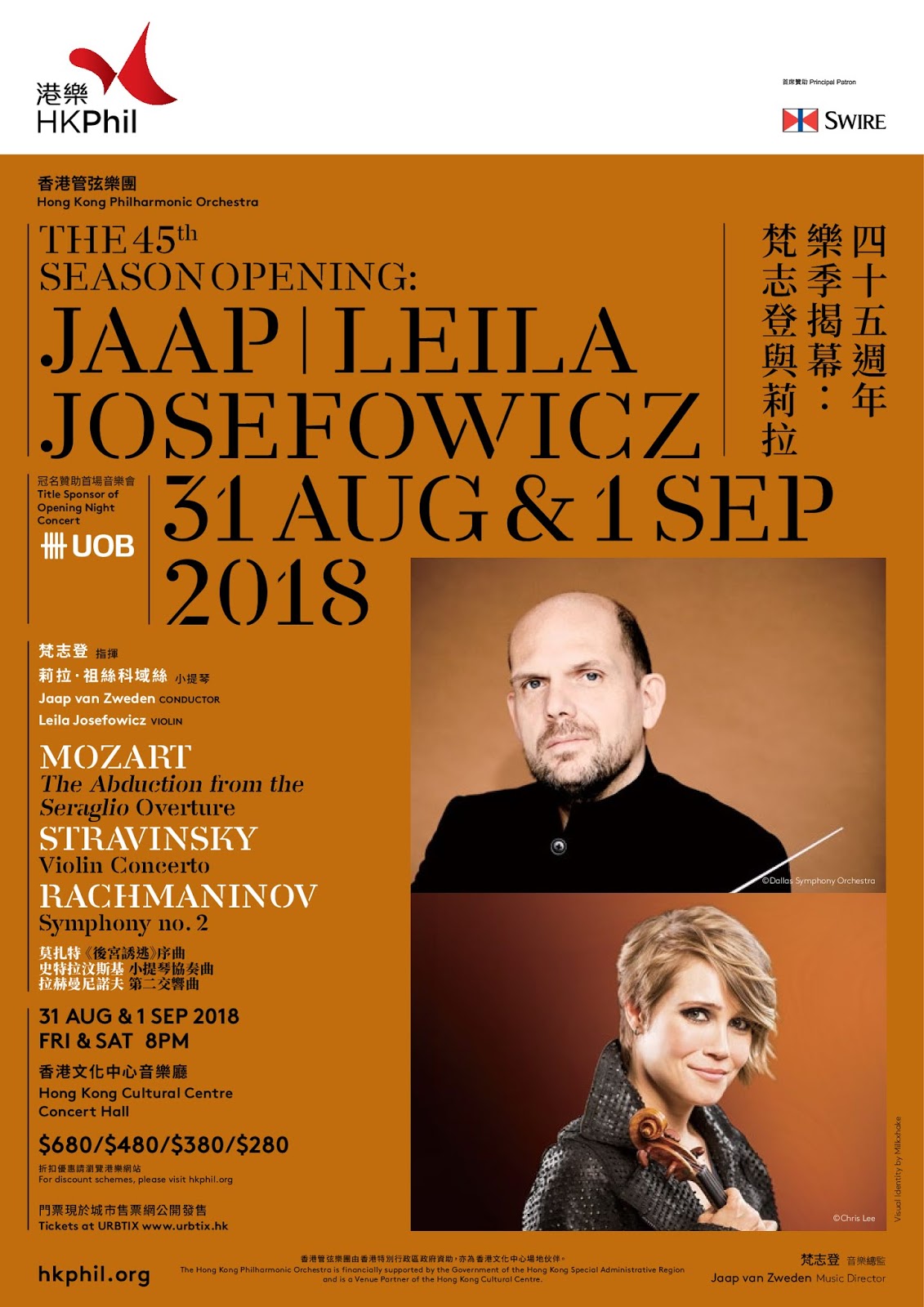
Review - The 45th season opening performance of Hong Kong Philharmonic Orchestra, 1 September 2018

Overture to the Abduction from the Seraglio (Mozart)
Violin Concerto (Stravinsky)
Symphony No. 2 (Rachmaninov)

Hong Kong Philharmonic Orchestra
Leila Josefowicz (violin)
Jaap van Zweden (conductor)

The overture to Mozart's exotic opera Die Entführung aus dem Serail is supposedly a lively curtain raiser by including a large battery of percussion with the strings and winds. Yet the philharmonic orchestra seems more indifferent to that idea and gave a lukewarm account in its rendition. Jaap took a steady tempo that aimed for refinement than after a dramatic interpretation. The strings particularly lacked dynamic contrast nor making the colour to enrich their playing. A friend thought perhaps to do with the orchestra being too big than the right formation, but I felt the heart and mind were not in place.

The orchestral playing was certainly more passionate in the Stravinsky and musically carried more contrast and interest. An energetic introduction was given between the winds and solo violin that felt alike a colourful country scene. Despite the two domains have different rhythmic patterns, Josefowicz executed the big jump on positions with ease and sustained a flowing impression in her playing. The music became more nervous and less optimistic in the second half of the first movement.

A melancholy or even bizarre start to the second movement by the solo violin. The music became rather abstract with the irregular music patterns and fragmented parts. Sentiments dominated the third movement and longer line in a phrase than previously. The main theme by a trumpet and two flutes made a tragic calling, but not knowing where the music was heading into than thematic repetition.

The last movement was more certain started with a syncopated gallop. A busy part for the solo violin while the bassoons provided the rhythmic backbone. Josefowicz sustained the energy in her playing with clarity, maintained the beauty in tone colour and allowed the music to breathe. The rhythmic patterns are ever changing and include some reference to Bach. Later even a reminder to the Rite of Spring as the music went tribal and exuberantly driven towards the end.

I was unsure at first whether this performance of Rachmaninov's second symphony would be as memorable as the one in the previous edition of Hong Kong Arts Festival by the Oslo Philharmonic. The climaxes is alike an endless musical orgasm from the start til the end. Though the beginning of the first movement is supposedly more gloomy and mysterious than the rest. Yet the philharmonic orchestra played with a warmer tone than the chilling landscape in mind. Romanticism already culminated in full swing even at the early climax. Lush strings' playing sustained the contrast in the ebbs and flows of emotions, but not as flowing as desired. The stormy transition also lacked the tension and bleakness. Only at reaching another big climax the sheer intensity gained weight. The return to the romantic theme was sweet and passionately driven, also more clarity among the strings. Interestingly the brass sounded rather like a military band at the closing of the movement.

Tempo for the descending start to the second movement was on the swift side and kept the momentum forward. Though more majestic and steady in its emotional response. The tempestuous gallop in turn was thundering throughout but not overtly wildly driven.

It took the orchestra some time to calm down than being restless in the sweet and tender opening of the third movement. Andrew Simon's clarinet solo was spellbinding and paced very well in the long line of phrase. The dialogue between oboes and cor anglais along rest of the orchestra carried a lot of energy in gearing towards another climatic peak. Calmness returned at the end yet the strings' playing not as silky and flowing as expected. Sentiments were felt again from the ebbs and flows of emotions.

An energetic start to the festive introduction of the last movement, but clarity and togetherness were not that effective among the strings. The outpour of romantic lushness was given in full and gloriously rendered. The transition from the nervous passage back to the brilliant opening theme was intense and filled with sheer excitement. The crescendo built into a majestic and triumphant lush conclusion. It certainly came close to the breathtaking impression I had previously.


Review - Charles Dutoit, Nikolai Lugansky & Hong Kong Philharmonic Orchestra, Hong Kong Cultural Centre, 18 November 2017

Roman Carnival Overture (Berlioz)
Piano Concerto no. 3 (Rachmaninov)
Encore: Prelude op. 23 no. 7 (Rachmaninov)
The Song of the Nightingale (Stravinsky)
Daphnis and Chloe Suite no. 2 (Ravel)

Nikolai Lugansky (piano)
Charles Dutoit (conductor)
Hong Kong Philharmonic Orchestra

Despite an attractive programme with a reputable conductor and pianist, the performance was far from a success and even some shockingly disastrous moments. Though the problem was not apparent at first in the festive and lively Roman Carnival overture, which Kwan Sheung-fung played the cor anglais solo beautifully after an electrifying introduction by the strings. Yet Dutoit's conducting was rather square and not indicating the line, and let the orchestra to phrase the line on its own. Soon the playing lost focus and rather vertically looking. The strings produced a warm tone and Italianate in style, but too polite overall than carrying the dramatic urgency in mind. They were also sluggish and lacked the bite on the attacks until the winds gave a crushing entry at the time change. The brass fanfare added the wildness and intensity to the tone colour, which lacked before at the presto ending by merely being full and broad.

Compare to other works on the programme, Rachmaninov's third piano concerto is more symphonic and arguably the more familiar to the audience. A flowing start but already signs of untidiness among the orchestral playing. Lugansky preferred a rather swift tempo in the tranquil theme but Dutoit's indication on the pulse was rather random with his right hand, which seems confused the orchestra. Despite the piano solo was majestic, the thick descending passage did not stay together with the winds. Lugansky also placed a lot of weight in his left hand playing and rather cloudy on the pedal that produced a dense tone. The phrasing felt rather out of shape at the rhythmic tricky part and also some wrong notes on the piano playing. Yet the duet between the flute and oboe were played beautifully with a bell like tone. The recapitulation was relaxing and played at a soft dynamic but odd when Dutoit suddenly speed up the tempo to reach the coda.

The orchestral playing of the second movement introduction was uncertain, which Dutoit was unclear in his conducting and even at times followed the players' tempo. Lugansky's left hand was heavy on the touch again and created a dense colour on the sentimental theme that lacked contrast. Then the pianist and orchestra were dangerously out of synchronisation for few bars when Dutoit seems at lost. Despite Lugansky tried to hide the disaster by being very expressive on his part and possibly improvised, the music was structurally out of shape and randomly developed. Although a virtuosic and muscular start to the third movement on the piano, the orchestra was still lost and confused by Dutoit's conducting. Strangely enough everything got back together in the dream like section, but the concentration and focus were lost already with the slow tempo. Heavy handed playing at the heroic and exuberant passage, but tempo suddenly gone slow by half, and it was a surprise that everything finished together in the end. One was also amazed by the rather enthusiastic reception to such chaotic performance.

Luckily everything was back on track in the second half that Dutoit's conducting seems more in place even the orchestra was leading the direction. Percussions and winds made an explosive entry to Stravinsky's rather colourful score of the song of the Nightingale. The harmonic language imitated festive Chinese instruments but fragmented. Megan Sterling's flute solo carried the rhythmic energy by being crisp in her playing, but the music became abstract and moody as the dialogues of night music dominated. It sprang back to the excitement half way onward with the winds' energetic playing and kept the rhythmic momentum forward. Emperor's nightmarish vision was realised by the sudden cry on the strings and shapeless dances on the woodwind part. At coda it became even more mysterious with a grotesque slow march on the strings, but jazzy blue solo on the trumpet that sounded certain among the cloudy music that being built upon.

The soft blurry impression continued into the dreamy opening of Ravel's second ballet suite of Daphnis and Chloe. The calm image of ocean with ripples was tenderly realised, and one felt the vastness of sound when the strings built up the sunrise climax. Megan Sterling again gave a confident lead between the lyric expressive part and the energetic rhythmic driven section. The impressionistic sound landscape was played in a broad sense as waves but cloudy. All was clear up when the winds played the gallop wildly and explosive during the exuberant dance section. The orchestra had more bites in its playing finally that added to the desired dramatic intensity and became an energetic beast. It seems the leaner orchestral parts had the upper hand this evening and sentiments failed to excel as in the Rachmaninov.


Review - Piano Recitals by Daniil Trifonov and Rafał Blechacz, 26 September 2017 & 12 October 2017

26 Septebmer 2017, Hong Kong Cultural Centre Concert Hall:
Variations on a Theme of Chopin (Mompou)
'Chopin' from Carnaval, Op. 9 (Schumann)
Studie 'Hommage à Chopin' from Stimmungen, Op. 73 (Grieg)
Nocturne, Op. 33 (Barber)
Un poco di Chopin from 18 Pieces, Op. 72 (Tchaikovsky)
Variations on a Theme of Chopin, Op. 22 (Rachmaninov)
Variations on theme from Mozart's Don Giovanni, Op. 2 (Chopin)
Sonata No. 2 in b-flat minor, Op. 35 (Chopin)
Encore: Fantasy-Impromptu in C-Sharp Minor, Op. 66 (Chopin)
Largo from Cello Sonata (Chopin, arr. Cortot)

Daniil Trifonov (piano)

12 October 2017, Hong Kong City Hall Concert Hall:
4 Duettos, BWV 802-805 (Bach)
Rondon in G, Op. 51, No. 2 (Beethoven)
Sonata No. 3 in C, Op. 2, No. 3 (Beethoven)
Fantaisie, Op. 49 (Chopin)
Nocturne in f-sharp minor, No. 48, No. 2 (Chopin)
Sonata No. 2 in b-flat minor, Op. 35 (Chopin)
Encore: Intermezzo in A, Op. 118, No. 2 (Brahms)

Rafał Blechacz (piano)

Less than a month after Daniil Trifonov's Chopin themed recital, Chopin's works again filled the second half of Rafał Blechacz's programme. Both had the second piano sonata as the concluding item, yet the two approached differently. One felt Trifonov was rather expressive and romantically driven, whereas intimacy and inner emotions marked in Blechacz's playing.

When Blechacz played the short prelude in A major as his final encore, it reminded us of Mompou's theme and variations that Trifonov began his recital. Despite the vast acoustic of cultural centre concert hall, one enjoyed the soft and sedate opening. It led to a lyrical passage marked by contrasting dynamics before resolving to the dreamy state again. The dotted passage felt pondering than carrying a direction though, and became rather cloudy in the tender and tuneful theme. At reaching the expressive and passionate climax, Rachmaninov seems more in mind by the harmonic colours and rhythmic patterns. Trifonov restrained from keyboard bombardment in the fantasia like gallop but instead gave a rather feminine touch to it. The four short pieces by Schumann, Grieg, Barber and Tchaikovsky as hommage to Chopin was an interesting selection. Grieg's approach reminded me of Rachmaninov than Chopin by the expressive arpeggios, whereas Barber harmonically was rather modern looking with the mysterious outlook that gone very distanced from Chopin. Tchaikovsky though lacked a definite outlook but only soft and tuneful.

Despite Rachmaninov referenced the funeral march from the third movement of Chopin's second sonata in his theme and variations, his idea went beyond the original with a rather symphonic sound world in mind. Trifonov kept the slow march flowing than indulging on the tragic sentiments. A mysterious and sorrow start to the fugue,which then developed into a lively and complex progression. Spread chords were expressively played and not aggressively hammer. A brief romantically driven passage followed by a crushing and wild gallop. Contrasting dynamics created immense emotional contrast and later it developed into another mysterious and unsettling transition. Then it galloped into a broad and muscular sound world with sheer intensity, in contrast to the fantasia like development that later lightened up by a lyrical theme. A triumphant and exuberant climax was given yet Trifonov rightly so to play the return of funeral march as devastating and bold than before.

The second half though lacked the brilliancy and lost focus. Variations on the theme from Mozart's Don Giovanni recalled those technical showcase piece by Liszt, but it did not feel right for Trifonov. His playing became untidy and phrasing seems random. Gallops were sometimes out of shape and sounded blurry by being sticky on the pedal. Later he was impatient in the first movement of the second sonata by hurrying through. It felt like a tense pressing after a lyrical resolve but never reach. Employing the same approach became dull for the ears and lacked contrast in colours. Questionable phrasing again in the second movement that did not carry the dance momentum but only as a rhythmic exercise. Nevertheless, he regained the calm and submissive touch in the tender interlude that at times was spellbinding and effective. Cloudy tone resurfaced at recapitulation even it was energetically driven. The funeral march of the third movement recalled the Russian context alike Rachmaninov early on. Trifonov seems more at home in building up the majestic crescendo in contrast to the still and lullaby like passage, which the softness magically stayed on the same level without losing the intention. As the funeral march returned, the emotions culminated again for the sheer devastation. Twice I listened to the short and chromatic styled fourth movement, one still could not understand by its purpose. Perhaps I was tired by then or Trifonov employed too much rubato without a clear intention, neither the Fantasy-Impromptu or arrangement of the cello sonata interested me anymore.

The acoustic of City hall concert hall is more ideal for solo instrumental recital with a warmer sound, and more in proportion by the smaller performing space than the cultural centre. It elevated Blechacz's smooth and delicate playing into a beautiful tone throughout. He began the Bach tidily and aimed for the counterpoint in the first movement. Each thematic entry at the fugue of second movement was introduced clearly and structurally transparent. The good work continued into the third movement and kept the momentum flowing. His ornamentation sank naturally into the tricky rhythmic patterns of the fourth movement with the dynamic differentiation that created a colourful sound world. However, I did not enjoy his interpretation of Beethoven's Rondo in G as much as the other works. It felt he was hurrying along and rather mechanical in approach, which pushed the tempo too quickly than letting the music to sing. The attacks were rather sudden and shapeless by his playing being impatient.

In turn, he had shown more thoughts and interest for Beethoven's third piano sonata. A muscular flourish opened the piece and the progression flowed tightly that had the intention to move forward. Though he could have been more relax in the soft passage by being more tender than tense It would have allowed more dynamic contrast from the dense and bold interlude followed. Composition wise it seems Beethoven wanted to experiment new harmonic language and those thoughts were given a quick glimpse. Blechacz maintained the smoothness and clarity as the music descended to the lowest range before repeating the opening theme. The second movement was romantically driven at first but at the end the classical style returned, which was more optimistic than the tragic sentiment in first place. Spellbinding tenderness during the quiet and soft passage that sustained the textual silkiness. Scherzo of the third movement was probably the most experimental of the whole work. Harmonically complex and structurally dense but leaving an open end without a clear resolve. Blechacz kept the rhythmic excitement by aiming at the spring board to the next phrase that began the fourth movement. The heavily scaled passage carried the sheer intensity with forward momentum and again Beethoven experimented ideas before a conventional closing.

Chopin's Fantaisie began rather mysteriously and moody. It was rather inward looking before a climatic built up from the soft and lyrical theme into a vigorous dance. Blechacz's left hand was sometimes heavier than the right but still able to maintain the clarity. He preferred a tidy and unhurried playing in the flourish than a technical run off with bold gesture. Nocturne in f sharp minor is a more typical Chopin piece with the subtlety and calmness more familiar with. Tenderness and the intimate sentiment were sustained throughout that a grand overview.

Compare to Trifonov's interpretation, Blechacz approached the first movement of the second piano sonata with a more sustained and legato playing. Even the expressive gallop stayed subtle which lightened the emotional flourish. Yet the progression stayed tightly and maintained the direction. Structural clarity was achieved even at romantically driven passage than over expressing. This time the second movement still had the virtuosic impression but managed to carry in a rich tone. It was gentler and more sedate through articulating the contrast between intimacy and rhythmic excitement. Funeral march of the third march was also given a lighter touch and flowed in boldness. Dynamic contrast was more faithfully observed to avoid being dense and over sentimental. The lyrical theme was highly moving by the sensitive touch with lightness, before the funeral march reappeared majestically. Intermezzo in A by Brahms put the smile back on the face and ended this performance on a satisfying high point. 
Review - Oslo Philharmonic and Vasily Petrenko, 2017 Hong Kong Arts Festival

14 March 2017:
Peer Gynt Suite No 1 (Grieg)
Cello Concerto No 1 (Shostakovich)
Symphony No 2 (Rachmaninov)

15 March 2017:
Excerpts from 100 Folk Tunes from Hardanger (Tveitt)
Cello Concerto (Elgar)
Symphony No 2 (Sibelius)

Oslo Philharmonic
Truls Mørk (Cello)
Vasily Petrenko (Conductor)


A fine selection of symphonic and concerto works from the late romantic period up to the post war period were given by the leading Norwegian orchestra. Though the weakest moment happened at the start in the iconic Peer Gynt Suite by Grieg. Whether due to Petrenko being impatient with the tempo or the orchestra was sight reading the score, woodwinds' dialogues depicting the scene of rising sun in the well known morning mood were messy at entries. Their playing lacked a flowing momentum with much hesitation and uncertainty in direction. Strings' sorrow theme on lamenting the death of Aase were more secured and flowing. It achieved a spellbinding pianissimo, but one could sense that Petrenko rather preferred to move things forward than indulging broadly. Strings were also able to produce the lightness and dynamic contrast in the tipsy dance like third movement. Though the wild gallop at the hall of the mountain king was somehow underwhelming that lacked the energy by its indifferent playing.

Shostakovich's first cello concerto in turn marked a contrast from the optimistic sunny outlook by an enigmatic impression. It began with the solo cello playing at the end of fingerboard, and felt like ironic and restless. Solo horn's entry though was late and not secure with tuning. Screaming winds and heavily scored solo cello part continued until it came to an abrupt end. A sorrow start to the second movement by the solo cello again and this time inward looking yet tragic. Violas and clarinet played a gloomy and lifeless Russian folk tune, later increasingly eerie and grotesque as the music became more dissonant from the celesta and strings. Emotional anguish was realised by the solo cello with double stopping in wide interval jumps and irregular rhythmic patterns. It made a dramatic contrast to the lament expressed at the meditative start of the third movement. The orchestral response was sarcastic but the tone quality of the horns did not match the rest. A stormy coda with wild cries and hurried gallops from the winds and strings. For encore, Truls Mørk played a movement from Bach's cello suite that carried a sense of solitude.

Emotional outpour and the unending search for positivism in Rachmaninov's second symphony finally gave assurance and hope, which departed from the sadness that dominated the first half. Despite a bleak and dark beginning, emotions gradually culminated and eventually some glimpse of positivism. Beautiful strings playing at the dance like section, subtle and seamless in the romantic driven dialogue between parts. Ebbs and flows of movement produced waves of emotional charge, though constantly negotiated between tragic and optimism. Brass made devastating cries that heightened the tension and conjured a rather tempestuous scene. In turn, strings responded with a sweet tune at the unison lyric passage before plunging back into the intense conflict. Momentum sustained as the playing descended into the lower range with an explosive ending to the first movement. Romantically rich tune began the second movement with a fiery gallop, which the strings' attacks were dramatic and swift. The heroic ride developed from a fast and passionate drive into a full scale of wildness. Horns' tone quality improved at forte with a sheer dramatic impression.

Calmness returned at the third movement with a sublime and tender clarinet solo. Strings responded to Petrenko's indications on dynamic difference, and again created waves of emotions to build climatic points one after another without any lingering. The dialogue between solo clarinet and violas had a wonderful sense in phrasing the lines. Ethereal sweetness rounded off the third movement in a sublime heavenward climax. Sheer brilliancy during the triumphant and carnival like start to the last movement, which the orchestral playing flowed with strong direction. It was answered by a sweet and expressive passage before a stormy transition returned. The contrast was marked by the dynamic change from the softest dynamic into another muscular climatic point. A resounding finale as the match towards the coda coupled with fanfare to give an ultra romantic send off. It was definitely a very memorable and brilliant deliverance from Petrenko and the Oslo Philharmonic.

In terms of produced tone quality and technical security, the second evening had the edge as the orchestra felt more at home with the hall acoustics. Tveitt's adaptations of folk tunes showed a variety of orchestral effects and moods even short in durations. The gallop built on a witty folk tune until it reached an explosive end in Friar-foter. A sorrow theme was played on the strings which began the next movement titled 'Du' with a haunting impression, but softened up by the winds playing a sweet tune. Percussive effects was focused in the following Langeleik tune with pizzicato and col legno on strings. Instead the brass played a deformed tune at a muscular tutti section near the end for a sarcastic portrayal of a drunken wedding party. The last movement, titled 'Hardanger ale', was majesty in style and had some influence of the blue music. A tipsy theme on the brass developed into a glorious fanfare, joined by the whole battery of percussions, for a colourful and festive finale.

For me, Elgar's cello concerto is a difficult piece to understand compare to his other works. Whether because it dwells on raw emotions in full tragical sense, or the absence of a noble and sentimental theme, one never know how to embrace the enigmatic outlook. Truls Mørk employed a lot of vibrato in his playing at the sorrow start, which accommodated by the lower strings and winds at a considering pianissimo. Though the climb to the end of fingerboard was not entirely smooth, Mørk probably preferred a more relaxing tempo whereas Petrenko tried to push the orchestra's playing forward. Interestingly tuning was not too good at first position even with a lesser reach for the fingers. Strings were more able to shape and dramatise the music from the moody part into a charging tremolo. A romantic and emotional start to the middle movement, which was tender and meditative throughout. Orchestra remained sensitive to dynamic balance and never overwhelm the soloist. The solo cello took the lead again in the third movement with an emotional outpour yet tragic by style. Notes heavy on the solo part compare to the flickering texture in the orchestral parts, which rhythmically more energetic in driving the momentum forward. Towards coda, it again went into a negotiation between mixed feelings with melancholy strings one hand and sorrowful solo cello the other. The unending gallop at soft dynamic rather bewildering by its infinite direction and left an open end impression where it was heading to.

The ice cold vast landscape in Sibelius's second symphony was the answer, but Petrenko also injected much thoughts and insight in his conducting to aim for a dramatic rendition with sonic impact. Strings and winds began the dance like opening in a rich bodied tone and passionate playing to draw out the emotions in full. Tempo was on the swift side made a strong sense of direction to sustain the energy and momentum. Blazing brass fanfares that muscular in sound with urgency to drive the music further forward. It made a fiery impression and injected more warmth to the tone colour. A moment of tranquillity returned at the beginning of the second movement when the bassoon played a noble folk tune with pizzicato on the lower strings. Though the peace was broken again by the explosive and emotional strings' parts against the devastating tragical calls from the winds. The image was increasingly bleak and violent til the end, while brass made a strong lead in the midst of the ebbs and flows of emotions. Despite the reappearance of the folk tune, it did not have the meditative stillness but tempestuous instead.

The storm continued into the third movement that reinforced dramatically by the brass again. There was a brief moment of lush sunny passage from the woodwinds but yet quickly restated by violence, which was rather sturm und drang by composition style. The last movement was sentimental and expressive as the strings built up a lush and majestic triumphant theme. It reached a solemn and heavenward climax but the negotiation did not stop. A variations on the theme followed until reaching an emotional outpour of an expressive theme. Lower strings in turn played a mournful chromatic march and developed into a thick textured furore. Even so, the coda was a victory over darkness after a long crescendo and blazing brass for a resounding finale. As a whole the performance managed to paint the picture vividly and one could felt the dramatic surroundings of nordic countryside.