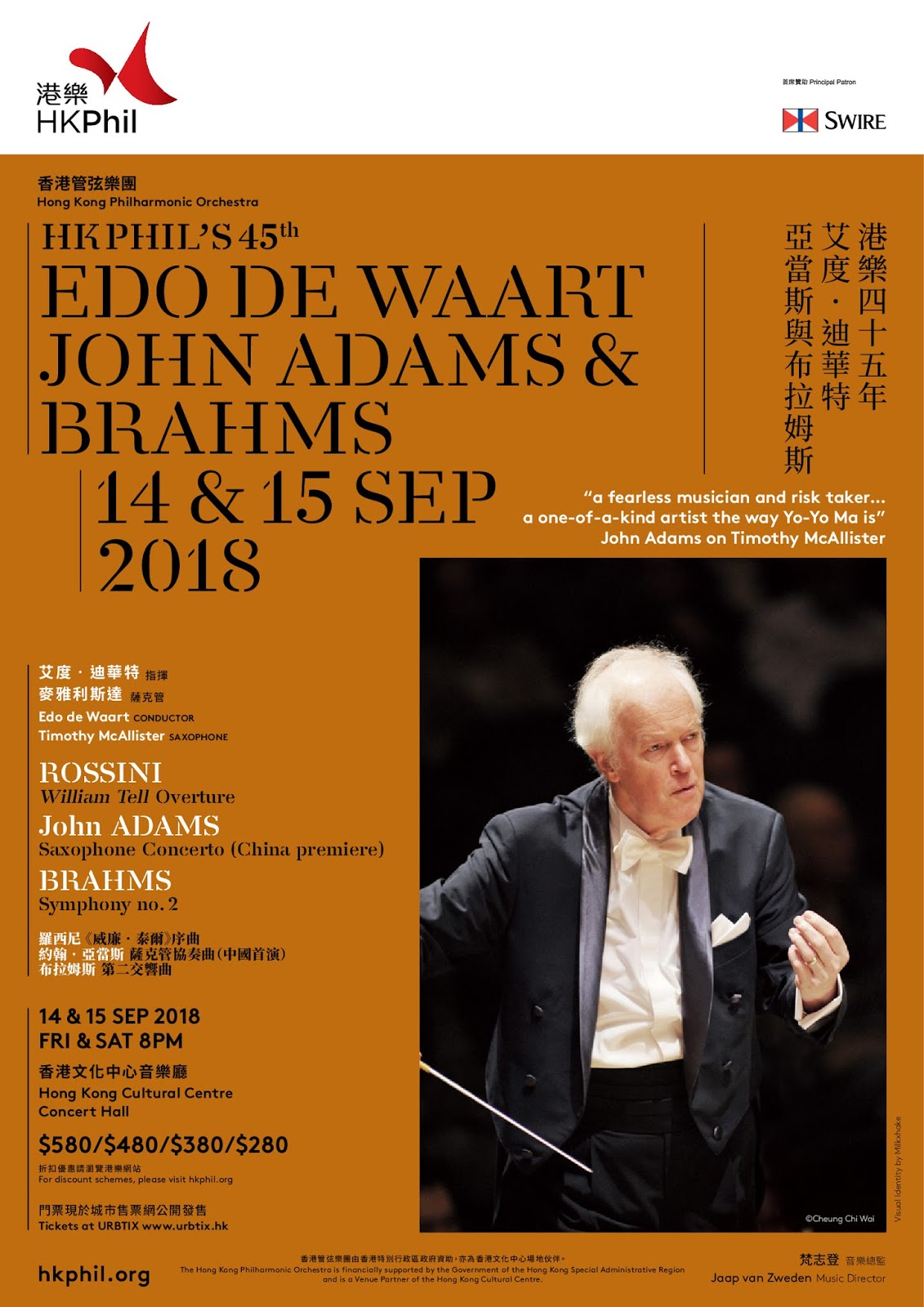
Overture to William Tell (Rossini)
Saxophone Concerto (John Adams)
Symphony No. 2 (Brahms)
Hong Kong Philharmonic Orchestra
Timothy McAllister (saxophone)
Edo de Waart (conductor)
It was an interesting to hear how the orchestra responded to its former music director on the podium again. The cello solo employed a broad tempo to begin the overture with a lot of vibrato in rich tone. A quiet start to the storm section before exploding into a full thundering climax. Though under a steady tempo the impact was not as terrifying as expected. Beautiful duet between the cor anglais and flute during the pastoral scene. The closing gallop was tidy and majestic, also effective accelerando geared towards a triumphant close.
John Adams's saxophone concert felt alike a busy rhythmic exercise for the soloist. Fragmented patterns jointed jazz and blues together for a hurry and restless ride. The brass kept the momentum going but hard to tell where the music was sailing to. At reaching the middle of the first movement then the orchestra played without the soloist. The dreamy transition was enigmatic yet the saxophone solo had a more lyrical part than previously. The music landscape became flatter and calmer before returning to fierce gallop, and then retreated to a quiet end.
The second movement dominated by syncopated patterns and stayed vigorous on momentum. It was a tight dance in irregular phrases but also abstract as to where the music was heading to. Timothy McAllister sustained the energy throughout in his playing and kept the music flowing naturally. Though the dynamic and emotion contrast were more able to display in his encore.
The orchestra kept the dawn awakening like introduction to Brahms's second symphony flowed with a warm gentle tone and not too weighty in body. Neither aggressive at the climatic exuberance and stayed bright with a lot of legato to sustain the line. Though whether to do with de Waart's conducting style, the winds sometimes felt a fraction behind the strings. Tempo was rather laid back for a gentle and unhurried gallop at the end of the first movement.
The cellos began the noble theme of the second movement in a mellow warm tone that gave a tender and sunny impression. A misty respond from the winds against the emotional outpouring from the strings. Yet as in Brahms's style sentimental negotiation never reach a full answer but hold back by the recapitulation of the noble theme. The tragic sentiments gained more weight before resolving to a quiet end.
The winds began the pastoral scene of the third movement with a busy strings' part underlaid. Rhythmically it gained momentum yet carried more lyricism within.
An explosive start to the last movement in an energetic gallop. The transitions felt rather enigmatic though, which the lines would have been more effective if there was an aim than a mere shape. The majestic theme was passionately rendered in a warm tone. After a long negotiation the music finally located the end in certain with a glorious triumphant conclusion.
Showing posts with label Rossini. Show all posts
Review - Il barbiere di Siviglia (Rossini), Opera Hong Kong, 6 May 2017
Rosina - Stephanie Lauricella
Il Conte D’Almaviva - Edoardo Milletti
Dr. Bartolo - Kevin Glavin
Don Basilio - Kevin Thompson
Bertha - Bobbie Zhang
Fiorello - Zhou Jian Kun
Ambrogio - Frankie Fung
Hong Kong Sinfonietta
Hong Kong Dance Company
Opera Hong Kong Chorus
Roberto Gianola (Conductor)
Lorenzo Mariani (Director)
Director Lorenzo Mariani’s light-hearted and action-packed reinterpretation of the much loved opera is doubtless a creative innovation. Drawing on the parallels between flamboyant Rossinian dramatics and the creative elegance of 1930s American musicals, Mariani set the opera against the glitzy background of Hollywood. The stage was filled with bright costumes and objects inspired by musicals and films of that time. Scenes and arias were also interwoven with ceaseless flows of action which served to enliven and emphasise the sung text - especially during Don Basilio’s ‘La Calunnia’, the ‘All'idea di quel metallo’ duet and the ‘Don Basilio – Cosa veggo’ quintet. A particularly memorable scene was towards the end of Act I where Mariani courageously broke the mould of traditional narratives of how Count Almaviva was released: instead of revealing to the officers his identity, Count Almaviva bribed them, and the officers began to distribute the cash amongst themselves surreptitiously.
That said, there were times when Mariani's explicit sense of humour fell flat and turned trite. For example, it was not entirely easy to make out why there were swimsuit figures on the top of a pool slide in Dr Bartolo’s mansion or why Figaro’s shop resembled a phallic structure with a large bulb on top. There were also other times, often after repetition of long sequences and excessive action, when less would actually have been more. Finally, although the production should not be analysed in terms of strict logic, Mariani’s rather abstract reconceptualisation had the tendency of compromising the very physical and chronological details which made the opera comical and exhilarating in the first place. For example, the disappearance of the massive cage in which Rosina was locked after the first scene created a bit of spatial confusion as to where Rosina actually was. Similarly, the highly abstract escape scene at the end of Act II failed to bring out clearly how the ladders were intended to be a means of escape or how they were ultimately removed to frustrate Figaro’s plan. At those places a more conventional and conscious treatment would have probably enhanced the drama and its hilarity. While the creative aspects of this production were generally admirable, they became counterproductive when overdone as the opera gradually devolved into hammy acting and choreographed singing.
Edoardo Milletti as Count Almaviva was underwhelming. Initially struggling with intonation in his first few solo arias, Milletti carried the legato lyrical lines disappointingly and often brought them to abrupt and unpleasant brakes – a persistent problem in ‘Ecco, ridente in cielo’. Phrasings reflected poor taste and his voice is insufficiently agile to traverse the florid passages with confidence. Constantly brandishing his baton, Kevin Thompson’s Don Basilio was perhaps the oddest of all characters whose repeated antics became more of an annoyance towards the end. Thompson has a massive and extremely resonant voice but unfortunately suffers from a rather bland tone. The orchestra was generally satisfactory but missed the opportunity to bring Rossini’s animated music to life, certainly coming off as lacklustre and vapid in the Overture, only to be marginally rescued by the choreography on stage. It was also very obviously out of sync with the entry of Fiorello in the first scene. Overall, while credit must be given to Mariani's visually exhilarating and dynamic production, the whole Hollywood concept ran the risk of turning the opera into a one-dimensional slapstick drama with over-the-top Americanised humour.
Photo credit: Opera Hong Kong Facebook Page
Review - Karen Gomyo, Jaap van Zweden, Hong Kong Philharmonic Orchestra, Hong Kong Cultural Centre Concert Hall, 17 June 2016
Overture from 'La Gazza Ladra' (Rossini)
Violin Concerto No. 1 (Bruch)
Solemn Night Music/ Feierliche Abendmusik (Borstlap)
Pines of Rome (Respighi)
Hong Kong Philharmonic Orchestra
Karen Gomyo (Violinist)
Jaap van Zweden (Conductor)
This concert started and ended with Italian festivity in fullness. The Bruch violin concerto made a sentimental contrast, but Borstlap's orchestral attempt in neoclassicism seems far from making a distinctive impression. The orchestra gave a full bodied opening in the thieving magpie overture. Symphonic in texture but not too muscular and the music still danced. The 'Rossini crescendo' were carefully paced and had many thrilling climatic moments.
Highlights of Karen Gomyo's violin playing were the exquisite tone, tenderness, elegance and smoothness in fingers position changing. Generally a steady tempo throughout which allowed double stopping to be precise and unhurried in arpeggio climbs. Though some bowing could be abrupt and not always sustaining the legato. The first and second movement fared better than the last when tiredness sank in. Tempo was then slightly sluggish but still maintained a good sense in phrasing. The lyrical passage was sweet in tone and elegantly played. Surprisingly intonation on the higher finger positions more accurate than the lower first position. The produced sound also rang more with brightness and colour differentiation. Same happened in the Bach's Chaconne during encore that being appropriate in performing style and phrasing, but not always accurate with tuning at lower positions. The orchestral accompaniment was smooth and in good coordination with the soloist. Warm and confident playing from the woodwind in the beginning of the first movement. Vibrato was not overdone on the tutti strings.
Second half of the concert musically and programme wise made an unfinished impression. John Borstlap's new work was alike deconstructing a late 19th century symphonic work without the theme or tune, except some occasional reference to themes from other composers like Elgar. Whether it was Jaap not able to draw the orchestra's attention locating the melodic line, or the piece intended to be a demonstration of inner part, I felt it was generally dull in texture and dramatically underwhelming. The conclusion sounded cheesy that in hurry to finish off with anything sweet.
Thus, the underwhelming experience prompted me to prefer the whole set of Respighi's 'Roman Triptych' being present than just Pines of Rome. It seems unnecessarily wasteful to augment the orchestra with a large brass section plus organ and piano for a mere twenty minutes rendition. Vibrant music colour and atmospheric contrast would be more interesting for the ears and music curiosity, as demonstrated by the festive and lively first movement in Pines of Rome. Orchestra winds' playing were glorious and highly spirited for an uplifting start. The mysterious and timeless atmosphere of catacomb were vividly captured by the lower strings at the beginning of second movement. One could see the flashback to a glorious past of an empire when later the trumpet gave an emotional solo passage, followed by the orchestra playing the 'roman' march with a patriotic flair before the music died away again. The colourful solo from the clarinet would be enchanting if the phrasing was more natural and smooth in the third movement. Beautiful playing from the strings at the lyrical passage, with harmonic reference to nostalgic blues but stayed romantic in melodies. The stillness in air of a clear evening was sensibly produced. The cor anglais solo could indulge more on rubato in the seductive introduction of last movement. The sheer impact of the glorious and triumphant conclusion would have been effective if Jaap took a bit more time in pacing the momentum, so to accumulate the energy and making the volume contrast towards the climatic peak. Otherwise, it was a thrilling end.
Review - 2016 Hong Kong Arts Festival - Shostakovich and Prokofiev, Teatro Regio di Torino, Hong Kong Cultural Centre Concert Hall, 4 March 2016
Symphony No 9 (Shostakovich)
Alexander Nevsky (Prokofiev)
Encores:
'Va. pensiero' from Nabucco (Verdi)
Overture from Guillaume Tell (Rossini)
Orchestra & Chorus of Teatro Regio Torino
Daniela Barcellona (Mezzosoprano solo)
Gianandrea Noseda (Conductor)
Pairing two Russian works from before and after the Second World War make an interesting contrast. Alexander Nevsky is a bold statement of patriotism and dense in texture, whereas Shostakovich's ninth symphony being enigmatic and nothing definite. These works neither reflect the trademarks of the composers' compositional styles. Prokofiev turns into formalist and writing masculine angular music based on religious chants, in contrast, Shostakovich bears all the late Prokofiev style for being sarcastic, violent and ironic. Both works also bear a sense of being impersonal and not to stir up the inner emotion too much, but an objective reflection of the time. It is logically then to round off the concert with the two well know Italian pieces pouring out the long awaited sentiment and brilliant triumphal end as encores.
On the podium, Noseda always wanted to push the momentum but his conducting not always accurate with indications. The first movement of the ninth symphony emphasised on robust rhythm bites but with the orchestra rushing through it, the playing lacked structure and some untidy corners among the strings as results. Woodwinds were better in terms of tone quality and responsiveness as a section. They hold everything together even when Noseda was late to indicate entries and more natural in music phrasing, especially for the climatic end of the brutal and dark third movement. A battery of percussion later joined the chorus for Alexander Nevsky. The choir was slightly imbalance with the male parts more able to project the sound of wall than the ladies. Intonation was fine but the diction did not convince me, which I heard the vowels more than identifying each word. Daniela Barcellona had the right timbre for the mournful aria describing the field of the dead, though from where I sat at one side of the orchestra, she was underwhelming in vocal volume and difficult to understand her diction. The Guillaume Tell overture would have been brilliant if the flautist had rehearsed the tricky solo part beforehand than a quick sight reading on site.
Subscribe to:
Posts (Atom)


