Showing posts with label Der Ring des Nibelungen. Show all posts

Review - Götterdämmerung (Wagner), Hong Kong Philharmonic Orchestra, 21 January 2018

Gun-Brit Barkmin (Brünnhilde)
Daniel Brenna (Siegfried)
Shenyang (Gunther)
Eric Halfvarson (Hagen)
Michelle DeYoung (Waltraute)
Amanda Majeski (Gutrune)
Peter Kálmán (Alberich)
Eri Nakamura, Aurhelia Varak, Hermine Haselböck (the Rhinemaidens)
Sarah Castle, Stephanie Houtzeel, Jenufa Gleich (the Norns)

Hong Kong Philharmonic Chorus
Bamberg Symphony Chorus
State Choir Latvija
Hong Kong Philharmonic Orchestra
Jaap van Zweden (conductor)

The philharmonic orchestra ring cycle project since 2015 finally reached its finale. In between I saw other ring cycles in Melbourne and Berlin, but theatrical experience was different from the setting as a concert presentation. Since there was no staging, the audio appreciation became the focus inevitably. Yet one could not ignore the ideology, philosophy and symbolism, and the contemporary relevancy. Like Rheingold, the theme of cunning plans, lies, greed and violence was revisited extensively in Götterdämmerung. Despite the solution to end all woes was already known at the beginning, which to give up the ring and return to the rhinemaidens. It was not until Brünnhilde made the unexpected move by sacrificing herself, which put an end to the old establishment.

To stay true and honest seems more difficult than exercising self interest, selfishness and manipulation. Such paradox still happens in our society, and never fail to amaze us of how much excuse one can deploy to legitimise mistakes. Though it is too simplistic to make Hagen solely as an example of evilness, who was also a by-product of Alberich and inherited that loveless power driven desire. Siegfried too failed to be a total hero as he did not realise the bigger picture, also stubborn enough not to give up the ring at the advice of rhinemaidens and warned him that death looming. Neither the ring nor the tarnheim brought the promised power and protection, instead those desired or possessed the two items brought themselves to destruction. Yet unorthodox partnerships and father-daughter reconciliation sometimes broke off the cruel world by celebrating the power of love and humanity, which gave us hopes that the world could change for a better future. The ring told a painful lesson, but only until Die Meistersinger and Parsifal that Wagner suggested for social transformation only through arts and ideological transformation would succeed.

Musically this performance of Götterdämmerung had successfully delivered the full package. Arguably the best display of the entire cycle and also most satisfying concert experience of the current season so far. The vocal line up were more pleasant for the ears than previous instalments, and technically outstanding that exceeded the expectation. Although the work was lengthy in duration, the orchestra never lose shape under the baton of Jaap van Zweden and every line being phrased meaningfully. It was also worth breaking the bank to augment the choir with reinforcements from abroad. Despite lacking a sonic depth and could have accented more on the chords, a polished and majestic orchestral entry was given at the prologue. Sarah Castle, the first Norn, sang poetically and injected much colour to her diction, yet the lower register seems slightly soft for the vast acoustic. Stephanie Houtzeel, in the role of second Norn, improved her diction and tuning as her voice warmed up. As she sang the passage that described Loge's involvement and fate, her singing tone was richer and gave a colourful painting of the text. The third Norn had the highest vocal range of the three and texturally more fluid. Though Jenufa Gleich would need to articulate consonants more to improve her diction and flexibility in switching registers.

The orchestra kept the momentum forward and responsive to the thematic transitions between the breaking of the thread and the sunrise scene. The devastation was felt with sheer intensity and urgency as the thread broke, followed by a still and mysterious passage on the cellos that depicted the break of dawn, and reached the climatic exultation of passionate love and sunrise brilliancy as the tutti excitement culminated in full. Gun-Brit Barkmin debut as Brünnhilde surprised me by her rich mezzo soprano timbre and still could reach the rather higher vocal range. She was steady with tempo at first and carefully phrased the lines. As she warmed up, her singing became more relaxed and opened up that enhanced the clarity in diction. Daniel Brenna, who already several stage experience as Siegfried, carried more space and warmth in tone, also acting out the role for interaction. His timbre made a pleasant impression of his line but vocal weight slightly light for the hall acoustic. He too was cautious with the words and the register changes. The pair maintained the passionate exuberance, and showed no sign of vocal strain to reach the climatic top notes. The thickened strings' layers during Siegfried's Rhine journey was rhythmically energetic and excited, but slips were audible from the horn solo. It all built into a majestic and polished tutti bold moment with dynamic contrast, but could swing more to lighten up the thick texture.

The orchestral introduction of Gibichung Hall was less eerie and dense than expected. Shenyang's Gunther felt very commanding than a puppet by his confident singing, whereas Eric Halfvarson's dense and rich bass tone recalled Fafner than the cunning Hagen. Both made the impression that they were in command of the situation even before Siegfried's arrival, which added the chilling weight as the assassination plot gradually unfolded. As Gutrune, Amanda Majeski had the right timbre for the role and stayed fluid in her singing despite tuning on high register not that secured. At Siegfried's entrance, the brass produced a crushing chord that seems marking the beginning of the end for the hero. Yet at the description of treasures that Siegfried had, Halfvarson lacked the urgency in portraying Hagen's underlying desire and some stage realisation would have given some visual context. The orchestra again responded vividly to the emotional changes as Siegfried took the potion that Gutrune had prepared. Brenna and Shenyang too delivered a dramatic interaction on the adventure to Brünnhilde's rock, and marked the swearing of brotherhood more daunting as what to follow. The brass ably produced the youthful excitement yet could have loosen up more to unleash the wildness. In contrast, the orchestral playing could be more chilling and bleak as Hagen narrated his cunning plan alone. Instead the lower brass created the atmospheric heaviness of curse by its tragic and gloomy tone colour.


The tender love theme in reintroducing Brünnhilde on the rock was short-lived, but horns were muddy at announcing the arrival of Waltraute. Barkmin interpreted the sisters' reunion as an emotional charge with a dramatic reception, while Zweden drove the orchestra to celebrate the joy of recalling the past. As always, Michelle DeYoung phrased the music poetically with very clear text and her voice filled the space effortlessly. Her narration of the fall of ash tree and Wotan's preparation for final destruction realised the varied emotions of horror and sadness. Here Barkmin carried more warmth in the her lower register and clear with her diction. She also effectively conveyed the ebbs and flows of emotional response with colourful contrast in the words. Upon Siegfried's return, the orchestral transition was warlike and tense in opposite to Brünnhilde in rapture. Though disguised Siegfried in tarnheim and confrontation between the pair would be more vivid with stage actions than solely relied on music narration. Instead the orchestra gave an eerie accompaniment as Brünnhilde was devastated by the betrayal and cried in horror.

Instead of an eerie dreamy impression, the orchestral introduction of act two carried more warmth than expected. Visually Peter Kálmán made a youthful Alberich compared to Halfvarson's Hagen, yet his baritone like timbre lacked the same resonance and richness. Though the portrayal was accurate as Alberich was eager on retrieving the ring, whereas Hagen stayed dreamy and uninterested to his father's urge. The bass clarinetist gave a subtle and smooth account of Hagen's awakening, but Siegfried's return seems slightly soft in presence on the orchestra part. Perhaps the intention was to leave room for the war like summon as Hagen sounded the alarm, in turn the combined male chorus thundered with a wall of sound. It gave the much desired dramatic intensity and the choral singing stayed bright and ringing. Gunther's announcement of the marriages was clear and definite, whereas Barkmin portrayed herself as an emotional Brünnhilde, who questioned the confused Siegfried and raged over the betrayal. Her vocal entries carried the urgency and furious impression, which was achieved by colourful word painting that conveyed the emotions. The orchestral underlay responded along by some raw playing on the strings, and increasingly violent as the misunderstanding and hostility deepened. The chorus also gave a bombastic questioning over the confusion and sounded very big in body. As the assassination plot was drawn up, the orchestra gave a devastating and dramatic finish.

The horns gave a blazing account of Siegfried's hunting calls that began the last act. Again the orchestra was able to intertwine between the witty playful part of the rhinemaidens and the chromatic recalling of curse and destruction. The three sopranos as rhinemaidens blended well together with a lot of active vocal energy on high tessitura passages. They drove the momentum forward with great intensity, which was in contrast to Brenna rather fluid and light timbre. It made a contrasting portrayal of the rhinemaidens being very noisy in their complains against Siegfried's disbelief of their warnings and his arrogance. Later when Siegfried recalled his past memory at Hagen's suggestion, Brenna gave a colourful account of his part. Yet he began to struggle in sustaining the legato at the thematic imitation of the woodbird, and swelled in order to reach the top notes. Even so, he managed to sustain the vocal energy and kept the tuning by giving his all. In turn, the orchestra made a crushing built up towards the assassination point, responded with a lush and sentimental transition to mark Siegfried's last declaration of his love to Brünnhilde.

For whatever reason, I was very moved for the first time by the funeral march, which was rendered majestically and bold. Perhaps the orchestra's tone colour carried more the tragic sentiments than solemnity, or truth was finally revealed after all the preceded lies and chaos, which allowed emotions to pour out in full. Hagen's terrifying announcement of Siegfried's death and the blaming game with Gunther and Gutrune were as expectingly tense, but only stage action could realise the visual bloodshed. Zweden adopted an unhurried tempo for the immolation scene that aimed for a monumental and emotional end. Although Barkmin's higher register lacked the warmth of her lower vocal range, she phrased the music poetically and stayed smooth in her vocal switch. One felt particularly poignant and emotional when Brünnhilde recounted the past wrongdoings and betrayal, yet the moment of destruction and cleansing had arrived finally to undo it all. Along with radiant brass playing, the long crescendo built into a highly moving conclusion of this landmark project. The philharmonic orchestra had demonstrated it had reached a new musical height, and delivered an exceptional memorable performance. 

Review - Der Ring des Nibelungen (Wagner), Deutsche Oper Berlin, 13, 14, 15 & 17 April 2017

Wotan - Derek Welton (Rheingold), Iain Paterson (Walküre), Samuel Youn (Siegfried)
Siegfried - Stefan Vinke
Siegmund - Stuart Skelton
Hunding - Tobias Kehrer
Sieglinde -Eva-Maria Westbroek
Brünnhilde - Evelyn Herlitzius (Walküre, Götterdämmerung), Ricarda Merbeth (Siegfried)
Loge - Burkhard Ulrich
Alberich - Werner Van Mechelen
Mime - Paul Kaufmann (Rheingold), Burkhard Ulrich (Siegfried)
Fasolt, Hagen - Albert Pesendorfer
Fafner - Andrew Harris
Fricka, Second Norn (sung), Waltraute (Götterdämmerung) - Daniela Sindram
Gunther - Seth Carico
Gutrune - Ricarda Merbeth
Freia - Martina Weischenbach
Erda, Grimgerde, First Norn - Ronnita Miller
Woglinde - Meechot Marrero (Rheingold), Martina Welschenbach (Götterdämmerung)
Wellgunde, Rossweiße - Christina Sidak
Floßhilde, Siegrune - Annika Schlicht
Helmwige - Martina Welschenbach
Gerhilde, Third Norn - Seyoung Park
Ortlinde - Sunyoung Seo
Waltraute (Walküre) - Michaela Selinger
Schwetleite - Rebecca Raffell
Woodbird - Elbenita Kajtazi
Donner - Noel Bouley
Froh - Attilio Glaser

Chorus of the Deutsche Oper Berlin
Orchestra of the Deutsche Oper Berlin
Donald Runnicles (conductor)
Götz Friedrich (director)
Peter Sykora (designs)
Jasmin Solfaghari (Rheingold, Siegfried), Gerlinde Pelkowski (Walküre and Götterdämmerung) (revival directors)


Götz Friedrich's second ring production had been a regular repertoire of Deutsche Oper Berlin since 1984, including two overseas tours to Japan and America. The set is specially marked by the tunnel view as fixture throughout the cycle. Finally this Easter the production received its farewell appearance over two cycles with a promising cast. I am grateful to my friend who kindly gave his tickets to me, so to enjoy this spectacle from a great viewing spot on the first balcony. As a whole there were many memorable moments especially the impressive stage set and forward looking dramaturgy that mostly stood the test of time. Though it had also shown its age and one could see the reasons why it would be replaced by a new production in 2020.

Friedrich focused on the visual conception that many dramatic points began by observing from afar, and characters grew in size as they emerged from the back. The stage floor gradually descended and became steep towards the front to give a magnifying impression inside the tunnel. The enclosed structure kept the focus within space, and I felt acoustically it helped to concentrate and project the singing forward. Stage smoke was also skillfully produced like an actual cloudscape in different forms and even the tempo of formation was controlled. One particular moment was the thunderclouds realised with special lightning effects when the raging Wotan stormed upon valkyries after Brünnhilde and Sieglinde. The effect was memorable and spectacular enough for an epic mythology. Another spectacle was the magic fire of Brünnhilde's rock with flames lit from nine big stage holes alike volcanic ones. Despite it recalled the technological limitation back then when the stagehand had to lit the fire by torch, visually it looked grand and effective. Fafner the dragon as a giant robot and Valhalla in the form of a walnut lectern with revolving top also made impressive sights. Though thirty years since the first viewing, both began to look dusty and rather symbolic than generating the theatrical excitement.

Yet importantly, the attraction of this production was that the contemporary relevance and convention approach reached a fine balance. It did not go too far from a direct narration but neither afraid from making directorial concepts, which gave more insight than just showing decorative backdrops. Both the beginning of Das Rheingold and end of Götterdämmerung saw white hooded figures around the stage in silent. Their inanimate presence recalled the role of silent actors as props in Greek tragedy, which the composer had in mind to conceive the ring as mythological play but also a modern myth. They were the eternal spirit that never vanish though neither play a moving role in the drama. Though importantly they reconnected where the same tale could restart again like the wheel of fate. From there they gave an indirect introduction of the rhinemaidens, and the guarded gold that later led to the curse that brought the gods to their destruction. Instead of a mine, Nibelheim rose from the ground and had a reception with Alberich as bouncer guarding the entrance, which the decorations suggested an underground disco club. Nibelungs, faces hidden, were the enslaved lot and fearful of Alberich's command. Displays of personal ego and their cunning deeds were emphasized in greater importance within the context. Loge was indifferent to Wotan's authority as first, until his involvement in capturing Alberich made him no different from the others being tied to the tangle webs. It made the paradox of building Valhalla at great costs more poignant as he helped to assemble the wealth before Fafner killed Fasolt over greed. Though rest of the dramaturgy in Rheingold were symbolically portrayed that I felt the revival directors could have directed better. Fricka was tame in making her demand which undermined the demonstration of tension between her and Wotan. Confrontation between gods and giants were clumsy and far from a gripping violent scene. God's slow dance to Valhalla was pretentious enough, but far from the ascend that the music had gloriously suggested. The dramatic lightning scene was also underwhelming when Donner hit his hammer to break the cloud.

The tunnel was absent for the first time in the first act of Die Walküre and a bunker formed Hunding's dwelling instead. The dim stage lighting created a gloomy atmosphere with a huge and grotesque structure as the tree which Siegmund later pulled out Notung. Hunding entered the room with his huntsmen, which gave a more logical development in hunting after Siegmund than on his own. A chilling and bleak impression was in contrast to later the passionate and fantasy like reunion of the Wälsung, which warm lights flooded the stage with a healthy tree in the foreground. The tunnel reappeared as the couple eloped, then saw a fallen giant (Fasolt?) and model of a ruined city sat on the slope. It was unclear whether the ruins symbolised where Valkyries retrieved the heroes to Valhalla, or Wotan's vision envisaged the doom of gods. Though likely served as a metaphorical object to Wotan's dilemma when the destruction was approaching. Fricka became an irritating moaner and Wotan lost his temper by her complaints, yet it reminded him that he had promised to uphold the moral codes. The tangled web turned Wotan from a cool and stern outlook, previously at Rheingold, into an angry and moody figure. The death of Siegmund did not move Wotan that much neither the hesitation to kill, which the Wälsung siblings were a tool in his grand plan than considered as his children. He was visibly more troubled by Brünnhilde not because of her disobedience, but rather her wisdom and council made him felt guilty. Out of all the characters, she was also the only one wearing a classic outfit in armour and a norse helmet with wings. Interestingly, rest of the valkyries wore leather attire alike rebellious punk teenagers. By act three, a large sculpture replaced the city ruins but nothing symbolic than as backdrop. There was not much scenic wise until the magic fire spectacle as mentioned early, followed a conventional exchange between Wotan and Brünnhilde.

Among the four instalments, the staging of Siegfried was the least directorial and closer to a direct narrative. Mime's hut and workshop were half underground, but the set was visibly had the dusting looking. Stage lights stayed same throughout even when Mime was terrified by Wotan's threats after the riddles, which was dramatically underwhelming. Only Siegfried's forging of Notung with effects on sound, lights and stage equipment regained some theatrically interest. While the hero forged the sword under spotlight, Mime prepared the poison on the side and plotted against him. When it came to the confrontation between Fafner and Siegfried, the disguised dragon became a robot for a stage machinery display. The fight though felt like a fantasy of toy battle that far from dramatic and rather still in action. After Mime was stabbed and he disappeared into the back, it left an empty stage that far from marking the chilling cost of Siegfried's revenge. Stage lights turned red when Wotan told Erda of his plan emotionally. The mother of earth lost her colourful outlook of an indigenous figure by then and fully in white instead. Although it was in Wotan's plan to have Siegfried breaking his spear, he stayed to watch the hero in reaching Brünnhilde's rock. Friedrich probably felt the point of Wotan's confidence in his plan being succeeded was also the mean to an end, which hesitation sunk in and the risk heightened as future no longer involved his interference.

The staging for Götterdämmerung was uneven though that theatrically first act was not always able to realise the symbolism visually. Only later in the final two acts saw more thoughts showing by the sequence of actions. While the Norns weaved a long thread, smoke effects at the back of the tunnel and changed from red to white as the doom of gods was told. It thickened as the thread broke and turned into a volcanic orange colour to set up for the sunrise scene. Instead of seeing the couple awakening from the bed, Brünnhilde sat next to the side while Siegfried ran up the stage and waving Notung. But from then the two did not show any affection and just stood in the same position. Light projection was used for the colourful effects of Siegfried's Rhine journey. The scene then changed into a steel surrounding alike a factory interior and Hagen was looking at Gunther and Gutrune. Magnifying panels stood around and it became a spying exercise. Later Hagen showed more interested in knowing about the ring than the brotherhood ceremony between Siegfried and Gunther. Though the dullness in dramaturgy continued with Hagen sat motionless than displaying the darkness of his cunning plan to retrieve the ring. Siegfried's deception to take the ring from Brünnhilde by force was symbolic than an actual fight. Only the light and sound effects as Waltraute rode to meet Brünnhilde, and the magic fire sensing the approach of Siegfried had the dramatic intention.

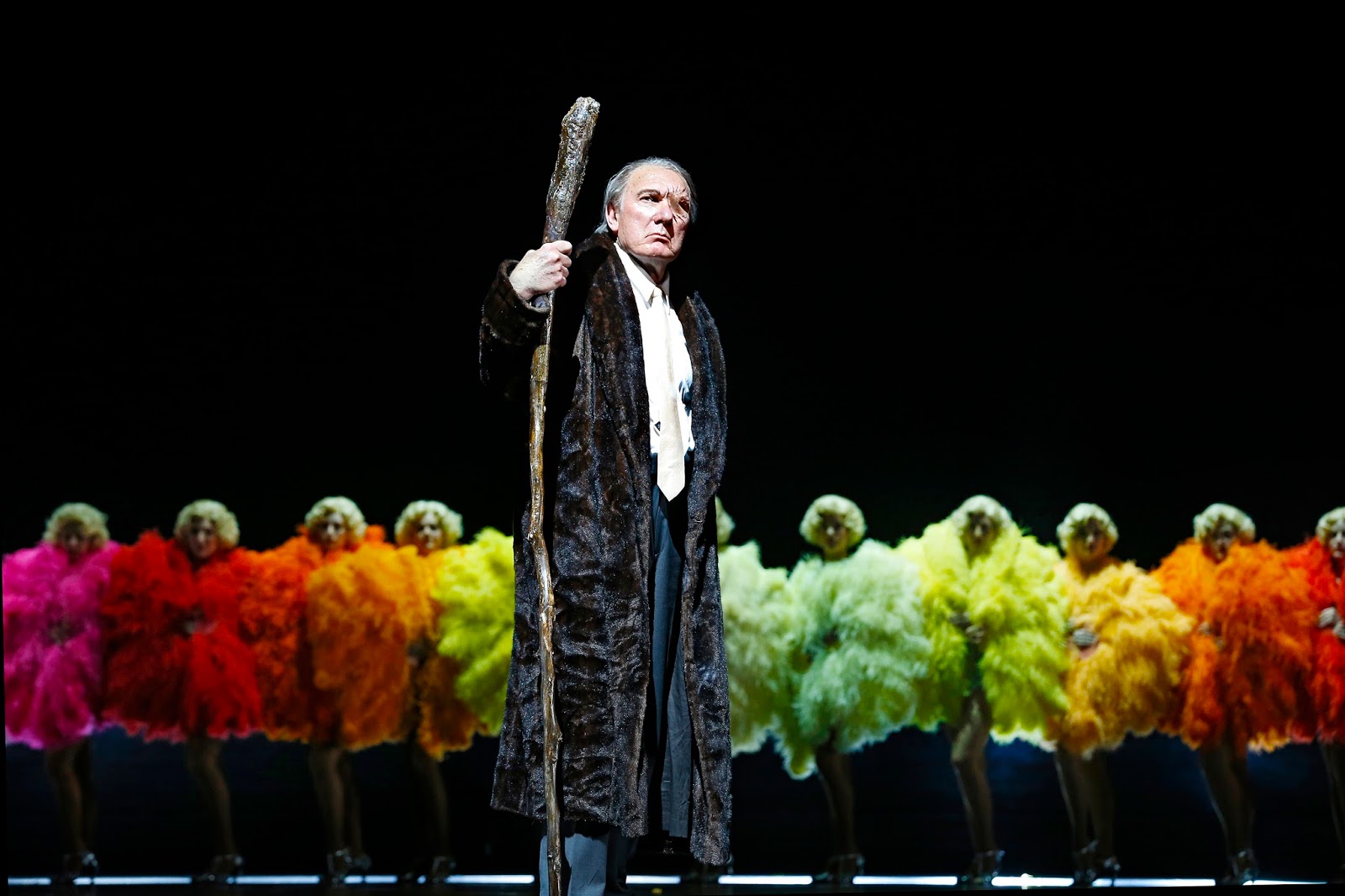
A solemn and chilling surrounding alike a war assembly decorated the wedding scene of act two. Gibichungs had their spears and torches in full viewing, and there was nothing joyous about and Siegfried was confused by Brünnhilde's accusation. The stage was also near in total darkness to suggest the killing scene of Siegfried was expected. By act three it further confirmed that the murder of Siegfried was planned ahead at the knowledge of the whole hunting party than a sole assassination by Hagen. Huntsmen were not surprised by the killing but instead of forming a funeral procession, they covered themselves in black gowns. They joined the crowd later to witness the transformation of immolation scene from darkness to light, but being a spectator of the epic saga than involving within. The rhinemaidens covered the stage with a large rainbow coloured sheet and Hagen disappeared along without drawing much attention. White hooded figures from the beginning of Rheingold reappeared and marked the return to the beginning.

Interestingly, singers in this cycle made the impression that Wotan was the prime focus. It was rightly so since the ring was substantially about his attempt to save his legacy by all means but eventually led to the ultimate destruction. The three singers ably showed how the complex character evolved over the three instalments. Derek Welton portrayed a rather stern looking and cool Wotan in Rheingold, who also avoided from getting his hands dirty and commanded Loge to set the trap on Alberich. The set back on giving up the ring after Erda's warning felt alike a daunting lost, which his plan after power and dominion did not work accordingly. One felt Wotan's pride and authority by his rich vocal projection and bodied timbre. His diction was clear and phrased the line for a dramatic rendition. In contrast, Iain Paterson approached the role more poetically and saw Wotan became an emotional and human figure in Walküre. Being cornered by Fricka to kill Siegmund and Sieglinde, he threw chairs around in frustration. Later Wotan's monologue in telling Brünnhilde of the tangled web he faced was increasingly dramatic. It became violent when Wotan commanded Brünnhilde to kill the Wälsung by threat, and later when she fled with Sieglinde at the death of Siegmund. All these culminated to a climatic moment when Wotan raged over the plead of valkyries not to punish Brünnhilde, which Paterson displayed an angry character in full. Later he was able to realise the bitterness when Wotan had to punish Brünnhilde and also the dilemma they both experienced. It left the room for Wotan's farewell to be emotionally moving, and sublime by the beautiful and tender singing. A heartbreaking moment when Wotan fell on his knees, shaking and trembling after putting Brünnhilde into sleep. In Siegfried, Samuel Youn portrayed Wotan as a fearless character that being more aggressive than before. His dark timbre with a ringing bass tone made a terrifying wanderer, who was overconfident by his plan to undo the rules that bound his power and moral responsibilities. There was not much sentiment being brought forward from Walküre, but the arrogance and pride aimed to intimidate the others like Mime. Though all these self confidence were ignored by Erda and Siegfried. When Wotan's spear was destroyed, it left a power vacuum as the lead player of this saga lost the control on the game. Compare to Welton and Paterson, Youn's phrasing did not consistently sustain the interest of the sung text and sometimes sounded bland.

With such strong characterisation and confident singing from all three singers in the role of Wotan, rest of the cast would have to match the game but mixed results instead. Stefan Vinke had more warmth in his singing when he carried the vocal energy at Siegfried's forging of Notung. He showed the flexibility in switch his vocal colours to realise the changing emotions. A powerful introduction marked Siegfried's first entrance on the roof of Mime, then being sentimental when Mime recalled the past of his birth and Sieglinde's fate, and later heroically announced his adventure into the forest. Vinke's phrasing flowed more naturally in the tender and lyrical passages of the second act. After killing Fafner and Mime, Vinke was able to capture the mixed emotions that Siegfried felt. It was followed by more legato singing in the fantasy like passage as the woodbird called him to reach Brünnhilde's rock. The awakening scene of Brünnhilde was probably the most beautiful I had experienced in live so far. Besides Vinke phrased his singing poetically, Ricarda Merbeth vocally flexible and smooth at the vocal climbs between wide intervals. Her tessitura sat very comfortably in the vocal range and sustained the tenderness with ease. The lyrical and highly romantic passages was very beautifully rendered by the enchanted and clean singing. Both also realised the emotion transition as Brünnhilde first shocked by the loss of her power, but eventually embraced Siegfried's affection over the ecstasy of love. Vinke was lesser impressive at the beginning of Götterdämmerung which his timbre lacked the warmth and projection. It was not until the third act when Siegfried teased by the rhinemaidens then Vinke regained more legato vocally. Siegfried's final recall of his affection for Brünnhilde also carried smoothness throughout the romantically expressive singing.

Evelyn Herlitzius, as Brünnhilde in Walküre and Götterdämmerung, vocally not consistent with mixed impression in her characterisation. Her Hojotoho lacked body in Walküre and vibrato heavy on higher vocal register. Her singing sounded rough in the lyrical expressive passage that recalled the vocal condition of an aged woman. Intonation during the duet at the sunrise scene of Götterdämmerung was flat and did not produce the excitement of rapturous joy. Her lower register in the immolation scene was often underweight and only the ascend in vocal range then her singing was more audible. Due to sickness, Stuart Skelton was not at his best vocal condition either in the first act of Walküre. His voice strained by reaching wintersturme despite a confident start with a rich projection. He redeemed himself in the second act by carrying the lyrical tenderness when Siegmund vowed to protect Sieglinde and refused Brünnhilde's advice. His counterpart, Eva-Maria Westbroek, in contrast made a magnificent Sieglinde with a rich mezzo timbre, powerful projection and phrased her singing beautifully. Her vocal highlight was in the second act by exhibiting the nightmare horror and nervous outburst of Sieglinde's meltdown in the forest. She made an emotional plead to the valkyries for protection with endless vocal energy, a contrast from Herlitzius's muddled singing.

Vocally singers in the roles of villain were more consistent but characterisation not always effective. Werner Van Mechelen saw Alberich more than a greedy torturer, but as a naive figure that easily tricked by the rhinemaidens and fooled himself by his arrogance. When Wotan took the treasures from Alberich by force, the cursing of the ring was emotionally expressed for a poignant reminder of the perils followed. He possessed a rich voice with the depth in colour and clear in his diction. Burkhard Ulrich had the nasal timbre in mind for the role of Mime. His word painting was poetically phrase and gained the interest to listen to compare with Samuel Youn's rather blurry diction. Early on when he sang as Loge, his projection on higher notes sometimes lacked the support and experienced coordination problems with the orchestra. Though again like Mime, he phrased the words in the right flow and approached the expressive parts lyrically.  In comparison, Albert Pesendorfer was too nice as Hagen that far from realising the cunning personality by his gentle and warm timbre. He seems to ponder around than an evil planner plotting against Siegfried and Gunther. Only as the music became more dramatic in act two and three, his singing was more able to convey the urgency, authority with vocal projection. He announced Siegfried's death devastatingly even he was the murderer. The quarrel with Gunther was tense and threatening even the immolation soon overshadowed his presence. Besides as Brünnhilde in Siegfried, Ricarda Merbeth also took on as Gutrune. She demonstrated her vocal flexibility by giving a fuller weight with the clarity in her singing. Even the role did not have much to sing, she made a memorable account of it by the sheer dramatic intensity and vocal excitement.

Among the minor roles, Daniela Sindram did not have a rich voice as Waltraute in Götterdämmerung. She sang her part beautifully and more heroic as reaching the immolation motive, but rather vertical looking than sustaining the forward momentum. Perhaps the characterisation or dramaturgy did not help to create the thinking when the sisters were more meditative on what would happen next. Tobias Kehrer's Hunding not only had the commanding outlook as a gang leader but also with a ringing bass tone. One could sense the heaviness in the air as Hunding sat across from Siegmund and forced him to reveal his identity. Ronnita Miller had a rich mezzo tone colour that suited the timbre of Erda very well. Her vowels were on the bright side for clarity in her diction and phrased the lines majestically. She successfully portrayed as mother of earth as a blind woman yet with wisdom in Rheingold, and later in dreamy state as she was indifferent to what Wotan bashing about his self confidence against fate. The Norns were more consistent in their singing than the trios for rhinemaidens, whose sang with more bell like tone colour at Götterdämmerung than the covered voices in Rheingold. Both singers for the giants had a good flow on articulating the sung text with a rich and again majesty singing.

Lastly, it was a marathon for the orchestra to sustain the stamina over four nights with only one day in between to rest. Though it did not begin confidently when the horns being uncertain with the tempo in the underwater motive. Later the brass played magnificently at the descend and ascend of Nibelheim by being bold and muscular. The full orchestra made a crushing sound when Alberich screamed at his slaves to bring the treasures to surface as ransom. The orchestral flourish was even more devastating after Alberich cursed the ring, yet the strings played beautifully at the transition when Freia was brought back by the giants. The orchestra hold back from not being too aggressive and crushing again when the giants had a tense exchange with Wotan on the ring. The brass was also realised the daunting sense effectively in its playing as Wotan hesitated on whether to give up the ring. They neither indulge too much in the tuneful motives and sustained the momentum forward in the triumphant march into Valhalla.

However, the orchestra had more problems in Walküre than other evenings. Dynamic contrast was observed attentively in the opening gallop but it felt like a restless beast. Solo cello played the sorrow theme beautifully with an emotional depth. Though the horns had trouble again in the syncopated rhythms and some slips occurred. Problems continued as the orchestra fell behind Stuart Skelton and the brass became very sluggish in their entries, even the music was gloriously blazing in colour. The orchestra managed to realise the violence and tense passages in act two when Wotan recalled the turbulent past emotionally. It also gave a majestic entrance upon Brünnhilde's entry in shimmering armours. However, there were coordination problems in being together with Evelyn Herlitzius and both seems unsure how to fit into each other by dragging the tempo along. Only at the tense and dramatic moments when Siegmund heroically declared his protection of Sieglinde then the orchestra found its way back with the brass playing wildly. The playing was more crisp and tidy during the ride of the Valkyries. It went bombastic and muscular as Valkyries pleaded to Wotan noisily. A highly moving coda when the magic fire motive was played and Wotan reconciled with Brünnhilde.

The orchestra flowed more fluidly in Siegfried with the urgency and direction to create the dramatic intensity of act one. It tried to stay away from portraying Mime's house overtly moody nor too violent as Siegfried entered excitingly with the bear. Brass again played boldly as Wotan told Mime about the giants and Nibelung in a daunting sense. A spirited orchestral transition was given when Wotan left Alberich after no success in awakening Fafner. The orchestra also played beautifully to produce the sweetness that Siegfried was enjoying as the woodbird told him about Brünnhilde's rock. Wotan's triumphant gallop at the beginning of act three was played brilliantly and gradually drove into another explosive climax. It sustained the excitement and momentum as Wotan was so eager to reveal his plan to Erda. The expressive love theme was gloriously played and later Siegfried's ascend to Brünnhilde's rock was so magnificently delivered. The sensual unison line was delicately rendered for a spellbinding effect by the tutti violins. Though sometimes the orchestra was slightly behind Stefan Vinke even woodwinds responded each other smoothly. The strings gave it all by being tense and expressive in the emotional outpours. It was increasingly romantic as the sensual feelings heightened and the brass played magnificently to capture the sense of wonderment when Brünnhilde saw Siegfried for the first time. Siegfried's idyll was tenderly played and the full orchestra made a glorious conclusion.

A rather swift opening to Götterdämmerung that kept the momentum flowing forward. It became increasingly unsettled as the Norns foretold the end they knew from the thread. Sunrise scene was gloriously played by the brass in a blazing tone colour and the orchestral playing drove more direction than the singing. The love theme was beautifully played before an exciting transition into Siegfried's journey to the Rhine. Again the orchestral playing had more urgency compared to the singers, but the horns slipped again. It played wildly when Siegfried and Gunther made the blood brotherhood, followed by an energetic gallop to drive the excitement forward. The daunting atmosphere and evil impression were too effectively produced. Both the chorus and orchestra delivered many walls of sound for the crushing dramatic effects of the second act. Horns were swift in tempo at the beginning of act three and made a devastating noise when Hagen killed Siegfried. Winds though were not tidy in their entries before the death march, and only then the brass played more brilliantly with the sheer impact by being muscular and heroic in sound. My seat was directly behind Donald Runnicles so could not tell if his conducting was the reason why the horns had troubles many times, though I suspected the players were not careful enough with their playing or due to tiredness. Now finally it is time to look forward to the new production by Stefan Herheim, and one expect he will have many interesting things to say.


(Photo credit: Deutsche Oper Berlin Facebook Page)

Review - Siegfried (Wagner), Hong Kong Philharmonic Orchestra, 19 Jan 2017 & 22 Jan 2017

Siegfried - Simon O'Neill
Wanderer - Matthias Goerne
Mime - David Cangelosi
Brünnhilde - Heidi Melton
Alberich - Werner van Mechelen
Erda - Deborah Humble
Woodbird - Valentina Farcas
Fafner - Falk Struckmann

Hong Kong Philharmonic Orchestra
Jaap van Zweden (Conductor)

Siegfried, the scherzo of the monumental ring cycle, is often overlooked by its fairy tale outlook. Wagner spent fifteen years to complete the work, and the plot is more complex, challenging and progressive than Rheingold and Walküre. On surface a hero appears for an adventure, learning fear after meeting his opposite sex for the first time and eventually falls in love with her. Though arguably it is about Wotan being the master planner, who nearly succeeds in saving his legacy by all means but ultimately the consequence turns against his will. Whether Siegfried is an unconscious slave of fulfilling Wotan's objectives or a child of nature forging his own path is debatable. He learnt from the forest and befriended with animals as an orphan, instead of Mime who took him in at Sieglinde's request before she died. But later Siegfried destroyed Wotan's staff in half with the sword Notung, which released Wotan from all bindings and promises after a careful engineered sequence of events. The unorthodox affection between Siegfried as nephew in love with his aunt Brünnhilde, promises to bring change and free will that conventional relationship cannot not in Wagner's ideology. However, Siegfried fearless self-confidence set himself to trap later in Götterdämmerung. The ring never return to Wotan as planned and Brünnhilde, who promised to guide Siegfried to the goal, allows the free hero to seek his adventure further into the Rhineland. The high risk strategy, which Wotan adopted to save himself, runs offtrack and Brünnhilde's revenge on Siegfried's betrayal leads to the final destruction. Vocally it is also a demanding role for the protagonist, who has to be capable both dramatic and lyrical singing, maintaining the stamina for four hours long and ideally possess a pleasant timbre for the ears.

Surprisingly, it was Cangelosi's Mime who nearly stole the show for being so brilliantly sung with vivid characterisation. He had the right timbre for the role, clear diction and effective phrasing of the music and the text. His bright tone and more projected voice gave more colours and dramatic contrast to the lengthy dialogues. A poignant impression when Mime recalled the past, accused Siegfried being ungrateful of his care and vowed for revenge. Mime was also felt to cunning, intelligent and more greedy than Alberich in these performances. Their fierce argument over the sharing of treasures was dramatically intense, but more successfully realised at the Thursday performance. Mime was no longer a minor role and held the fate of events that triggered the course of actions. The downfall of Mime was his arrogance and covetous of power, than because of Siegfried learnt the true intention after covering in dragon's blood. The only moment Cangelosi could not penetrate through the thick orchestral texture was the crushing crescendo, when Wotan left Mime in horror with flickering flames growing in his hut. He seems also developed a cold and sometimes lacked the vocal weight in the Sunday performance.

Simon O'Neill should be credited for his professionalism in covering Mime's part briefly on Thursday. Cangelosi was visibly struggled with coughs at the ironic moment when Mime attempted to poison Siegfried. O'Neill seems more appreciative of the orchestra and tried very hard to portray the role. Though his timbre and vocal weight were not ideal for the role of Siegfried but better as Mime. In both performances one felt underwhelmed by his voice in the exuberant and masculine passage of the first act. The nasal tone was not appealing for the ears and sounded thin in body. Diction was often muffled and difficult to understand. It did not have the youthful energetic tone colour but the impression of an elderly man instead. The interruption and humiliation of Siegfried at Mime was tame and ineffective. Orchestra had to hold back the volume during the forging scene of Notung to accommodate the balance, which reduced the sheer brilliancy and excitement of the music. Although later his was more audibly detected over the leaner orchestral accompaniment of act two and three, the tone colour was bland and lacked any emotional intention. Siegfried's challenge to Wotan also fell short from the hostile intensity. Later the discovery of Brünnhilde was more a dreamy awakening scene, than the life changing sensation when Siegfried finally learnt fear at last. Even so, the lyric moments were more suited to his rather legato singing style. Projection improved at the call of entering Brünnhilde's rock, timbre was more pleasant and refined during the exchange of affection. Though the outcome still made an impression of Siegfried as a supporting character than on equal partnership, which was supposedly in reverse.

Matthias Goerne improved vocally with better characterisation of Wanderer/Wotan compare to Rheingold and Walküre previously, but still work in progress. Despite a better sense of phrasing, projection and vocal presence, he had a coordination problem with the orchestra at the first attempt. During Wotan's test on Mime regarding giants and gods, Goerne sang dangerously ahead of the orchestra. The problem was rectified in the second attempt with a more fluid progression. Though his rather covered way of singing style produced a cloudy sound than a ringing tone. Diction was often unclear, lacked the vocal richness nor the authoritative impression of Wotan as the master planner. Interestingly, Wotan's summon of Erda was his best moment I reckon. Brightening the vowels and opened up his voice helped the projection and injected more emotion to the singing. It was more attractive to listen to and a sense that he was in command of the situation.

Although Brünnhilde only appears in the later part of act three, it demands the soprano to meet the wide vocal range with limited space of time to warm up the voice. The best part of Heidi Melton's timbre was her rich and creamy mid range with warmth. Her voice filled the hall nicely with a ringing tone, and captured Brünnhilde's negotiations between doubt, fear of change and her affection for Siegfried effectively. Though problematic as her tessitura reaching the higher register and the reach to top notes were not always accurate. The first performance was often a forceful cry that hit and miss with tuning. She was more steady with the tempo in the Sunday performance and more successful at the climbs. Though the switch between registers lacked the smoothness and sounded rough sometimes.

Lesser roles further confirmed that villains had the upper hand with their singing than the goodies in these performances. Pleasant and refined singing from Werner van Mechelen as Alberich. Diction was clear and words were appropriately stressed to flow naturally with the music. The confrontation between Alberich and Wagner before waking Fafner was dramatically delivered. But I am convinced that Mechelen's voice is more suited to Wotan than being a villain, which requires the roughness in timbre than a noble colour. Falk Struckmann, who had recorded Wotan before, carried the depth and vocal weight in his ringing bass tone. The battle between Fafner and Siegfried was dramatically realised when he inserted mockery laughters and painful cries. Mixed results with Valentina Farcas's Woodbird though that her singing lacked the flexibility and direction. Tuning was flat the first time but rectified in the second performance. Beautiful legato singing from Deborah Humble with a rich mellow alto voice. Erda's heated exchange with Wotan was fierce that she was indifferent to his claims nor desires. Though to capture the dreamy state of Erda, a cool tone would have been more effective than passionate.

Jaap van Zweden continued to draw magnificent playing from the Philharmonic Orchestra, and lifted the performance level to a high standard that more than an achievement. Probably due to the performing hours and energy levels, tempo was swift on Thursday compare to Sunday. The bassoon and tuba opening in both occasions though sounded moody and tired than creating a haunting forest scene. Lower strings' built up with tutti brass would need more bites for the violent effect. Tuning among the horns were much better and more confident on Sunday. Strings were particularly alert and responsive to the ebbs and flows of emotions in act one. It would have been dramatically exciting and energetic at the forging scene of Notung if the orchestra did not have to sacrifice for the balance. The spooky and chilling introduction of act two was also more successfully produced on Sunday, particularly the ring motive that made a crushing and devastating effect. Cor anglais's mimic of birdsong was slightly too refined than the out of tune intention in mind. French horn solo of Siegfried's call was accurately rendered but the finishing diminuendo seems exaggerated than a natural recline. Polished woodwinds' playing to evoke the sweet and beautiful forest scene, which Siegfried was excited by the woodbird foretelling the prospect of meeting Brünnhilde finally.

The majesty and masculine introduction of the third act was magnificent rendered on Thursday, which the brass playing was wild in its fullness sense. Though signs of tiredness began to surface on Sunday when the concentration began to lose and drag with the tempo. In both performances the orchestra still managed to elevate the hostile exchange between Wotan and Erda with dramatic playing above the ebbs and flows of emotions, despite the singing lacked dramatic intensity. Later the lush upper strings' playing produced a magical sensation and wonderment at Siegfried's discovery of Brünnhilde. The music spoke for its beauty and tenderness when the idyll theme was played. A magnificent conclusion as the orchestra sent out the ecstatic state of affection in full. The naive hope of love and joy put smile on our face and the sheer thrilling excitement, even after wrongdoings and evil plans are ongoing in this epic tale.

Review - Der Ring des Nibelungen (Wagner), Opera Australia at Arts Centre Melbourne, 21, 23, 25 & 28 November 2016

Wotan - James Johnson
Brünnhilde - Lise Lindstrom
Siegfried - Stefan Vinke
Siegmund - Bradley Daley
Sieglinde - Amber Wagner
Alberich - Warwick Fyfe
Hagen/Fasolt - Daniel Sumegi
Gunther - Luke Gabbedy
Fricka - Jacqueline Dark
Fafner/Hunding - Jud Arthur
Erda - Liane Keegan
Mime - Graeme Macfarlane
Waltraute - Sian Pendry
Gutrune - Taryn Fiebig
Loge - Andreas Conrad
Freia - Hyeseoung Kwon
Wood bird - Julie Lea Goodwin
Froh - James Egglestone
Donner - Michael Honeyman
Rhinemaidens - Lorina Gore, Jane Ede, Dominica Matthews
Norns - Tania Ferris, Jacqueline Dark, Anna-Louise Cole
Valkyries - Anna-Louise Cole, Dominica Matthews, Olivia Cranwell, Sian Pendry, Hyeseoung Kwon, Amanda Atlas, Nicole Youl, Roxane Hislop

Opera Australia Chorus
Melbourne Ring Orchestra
Pietari Inkinen (Conductor)
Neil Armfield (Stage Director)


To mount a ring cycle is a challenge both musically and staging wise. Besides assembling a competent troupe of musicians, the scale of the production also determines the underlying ideologies and styles. Neil Armfield's approach is not so much about extravagant display of stage machinery or colourful scenery nor making political statements, but as a stylish spectacle from a humanistic psychological perspective. The production sees genuine love and affection to rectify mistakes and overcome all perils. It is close to a plain narrative of the tale but still some twists in conceptual direction. The use of simple but effective theatrical elements also make a strong and precise impression of actions. A reminder that the ring is a piece of theatre on equal importance as the music. As a whole the staging style and concept is consistent, original and coherent. Musically the orchestral playing improved as the week went on and there were many magnificent moments. Overall the cast of singers possessed the right timbre, rose to the vocal challenge and some even exceeded the expectation.

Rheingold began with a crowd in circular shape moved slowly towards a direction on a revolving stage, and a large hanging mirror behind to reflect. It was as to create the river flow but also a reference to the ring turning alike the medieval concept of the wheel of fate. The circular movement reappeared many times again in various forms throughout rest of the cycle. The orchestra though would need more direction in its playing and the brass was particularly sluggish in tempo. The crowd stopped at the singing entry of the rhinemaidens, who wore an over the top stylish and feathered samba outfits. The trio's intonation was good but poor in diction that I hardly could distinguish the words, the tempo was also too broad for my preference. Warwick Fyfe's Alberich put the disappointment aside that he not only had an ideal vocal colour and the projection, but also being natural in phrasing the text and the music. He undressed and chased the rhinemaidens around but unsuccessfully. The crowd then brought out the gold coloured pom-poms, metaphorical representing the glittering gold of the Rhine, and spread across the stage. The revealing could have made more impact if a swifter tempo was used in the orchestral playing. Alberich's stealing of the gold saw him taking hostage of a young girl from the crowd and then darkness descended on the stage again. Though dramatically the idea seems tame to reflect the great loss instead of capturing the crowd with a big net or rope.


The scene of god's realm was weak in concept and would need a rethink for a more sophisticated presentation. The high point was Wotan's first appearance from the back door in a pitch black stage that gave an introduction in focus. However, he laid down on the floor and James Johnson made an elderly and soft outlook of the role. Although with the right timbre, his singing far from a ringing tone to fill the hall and diction was poor. He nearly missed an entry after Fricka warned of Freia to be taken hostage by the giants. It struck me odd that a Wotan did not have the physical nor the vocal authority. There were cases of stuffed animals in the backdrop but far from making the intended message. In turn, Jacqueline Dark's Fricka, in her gold dress outfit, was more comfortable with the vocal range and gave a fuller bodied tone. The orchestra again took a board tempo for the Valhalla theme that did not provide a direction where the music was sailing to.

Jud Arthur's timbre, as Fafner, had the richness and colour of a bass than Daniel Sumegi, as Fasolt, who was more baritone in his timbre. The giants were portrayed as a pair of mafia businessmen but not too rough in outfit. The stage choreography was rather static in a park and sing routine. Wotan stood motionless without any sign of decision to prevent the conflict. The rest only walked around and did not much, which was far from realising the tension and confrontation while bargaining with the giants. Andreas Conrad's Loge gave a promising start as a highly competent actor and well paced in his singing and the diction. Though he tried too hard to dramatise every phrase that resulted in missing entries later, also shaky tuning and even dangerously out of place with the orchestra. The coordination problem had caused the strings no intention in accenting the downbeats to maintain the rhythmic pulse. James Johnson only warmed up, when the gods stood under the spotlights at the front stage while Loge urged them to stay strong without the apples from Freia.


The orchestral playing and dramaturgy improved immensely since the descend to Nibelheim. The produced music danced and more energetically engaged. Alberich and Mime were very natural in their singing and clear with diction. The vocal projection were far better than Wotan in terms of body and volume. On the ground there were several stage doors and workers emerged from the holes but fearful of Alberich's power later in wild cries. The tricks of tarnhelm were cleverly demonstrated as a circus magic show with a feather girl holding the python on her neck. It was a more effective visual presentation than a video showing or mechanical replica of a snake. After Alberich being captured by tricking him into a frog, the three races, giants, gods and rhinemaidens, posed like sculptures on the turntable at the music ascend to god's realm. It was as if to remind us their inseparable connections with the ring and metaphorically resembled the wheel of fate again.

When workers brought gold blocks to stage for Alberich's ransom, Warwick Fyfe impressed very much again for his sheer vocal energy and momentum. In contrast, Wotan remained a vulnerable and incompetent figure than Alberich. The villain even dared to grab Wotan's staff and cursed the gods in return. There was also a strange moment at the return of Freia that she was with Froh than with the giants. Like Wotan's first appearance, Erda also entered from the small door in the rear.  Liane Keegan had the right colour and richness in her voice, but could not really project her voice into the hall. Sluggish tempo reoccurred when the giants appeared for ransom. Though I was impressed by the effort that the gold blocks being actually piled up to cover Freia. At the outset Fafner already decided to fight after the treasure than sharing. The killing of Fasolt was dramatically intense and the orchestra effectively reflected the brutality in their playing. Michael Honeyman's Donner did not have the rich and full voice for that dramatic calling of thunder. The brass playing could have given more in dynamics at the glorious conclusion. Otherwise, the troupe of feather girls, with rainbow pompom and glittering stage lights, made a highly effective and memorable scene of the god's entrance to Valhalla. The rhinemaidens and Loge were disappointed by Wotan's indifference while watching the ascend that inevitably brought the destruction later.


Hunding's hut alone on a revolving stage with snowing effect set the first scene of Die Walküre. The simple outlook made a pretty scene later as Siegmund and Sieglinde grown in love. The orchestral introduction would need to play more on the downbeat accents and the brass lacked direction in their playing. Horns were not confident at the forest hunting calls and shaky intonation as a result. The escalated tension between Siegmund and Hunding confrontation not really reflect by the indifferent instrumental playing. Bradley Daley, as Siegmund, sang with great passion but lacked the warmth. Higher vocal register was sometimes strained, notes were muddled up and being throaty. Even so, lower strings gave spellbinding playing when the Wälsungs met and fell in love at first sight. Good diction and secured intonation from Amber Wagner, who sang the role of Sieglinde. Jud Arthur continued to impress as Hunding this time with the richness in his timbre and a powerful voice to fill the hall. Though at the revealing of Notung and Siegmund's narration of the past, tempo remained relax and far from a passionate impression of the twins. Bradley Daley began to sound tired and not always able to sustain the vocal energy. The orchestra dragged the tempo even more at winterstürme and lost the focus in shape. Only Amber Wagner's beautiful singing redeemed from a disappointment by being tender and sweet in tone.

The second act was delayed by an hour due to a motor malfunction under the revolving stage. It was not a surprise though since the stage set was one of the most elaborate of the whole cycle. A multistorey circular runway dominated the stage with stuffed animals hanged within. Since there was only one way to descend or ascend, it reinforced the notion of a labyrinth that the gods were stuck without an alternative path. The animals probably represented deceased heroes being brought back to Valhalla but the visually not effective as backdrop only. The orchestra was far more dramatic than first act with a good momentum in directing the music forward. The Wälsungs first hurried down the runway followed by Wotan, but James Johnson's singing was still timid in terms of vocal volume. Lise Lindstrom, who made her debut as Brünnhilde in a full ring cycle, managed the athletic battle cry 'Hojotoho!' confidently but her voice needed some time to warm up. The timbre of Jacqueline Dark, as Fricka, had the colour of an aged woman but her vocal projection was less impressive than in Rheingold.


James Johnson projected more in the lower vocal register when Wotan narrated how he was trapped by promises while evils spread around freely. His image of frustration made a contrast to the cold and still impression in Rheingold. He flung his clothes off at the emotional foretelling of the god's doom and the Wälsungs, his children, to be killed. Exquisite woodwinds' playing during the scene change when the twins stopped for rest at their escape. Amber Wagner sang in a radiant tone at the highly dramatic nightmare passage but Bradley Daley far from matching her voice by lacking the desired warmth. The brass had more direction and energy in its playing but tuning was not always accurate. Lise Lindstrom's tessitura was comfortable in the higher vocal range during the dialogue with the orchestra winds, but James Johnson was again very thin in vocal body after Siegmund was killed.

The ride of the valkyries in act three was a military operation to retrieve the bodies of fallen warriors to Valhalla. However, the dramaturgy looked random that the crowd appeared rather lost on stage by walking around aimlessly. The impression did not match the sheer dramatic impact of the music. The voices of the eight valkyries complimented each other very well and delivered a powerful ensemble singing. James Johnson improved in vocal volume when Wotan arrived in rage of Brünnhilde defiance of his order, but diction remained muddy. The lower vocal register was problematic for Lise Lindstrom as her singing became rather grainy and not natural in phrasing. Towards the final scene of magic fire, the music was very moving with the tenderness and outpour of emotions as the father and daughter finally reconciled. A ring of fire in the middle of the dimmed bare stage was an effective and simple approach to realise Wotan's fatherly love to protect Brünnhilde.


My experience of Siegfried in live or on records so far were often with mixed results. The most challenging part I reckon was the final scene when the music style switched from a dramatic style to lyrical. Rarely singers could manage the changes evenly and also vocal stamina to last for four hours. In terms of staging, Armfield emphasized Siegfried as a play in the theatre. Mime's living room occupied the front stage with his workshop on the left and a bunk bed on the right. The tall white wall behind actually helped singers to project their voice with the hall acoustic. Previously in Rheingold and Walküre, the singing was often trapped within the stage. It was probably why the orchestra sometimes hesitated and sluggish as they struggled to hear the singers from the pit. This was no longer the case in Siegfried, which the orchestral playing had a much better sense in rhythmic flow and more energetic in momentum.

Stefan Vinke, as the protagonist, made a confident start vocally and being a native German speaker his diction was most naturally placed in the singing. Though Graeme Macfarlane's Mime did not match close that the phrasing were sometimes random and out of the place. Instead of an actual bear, Siegfried dressed up as one to scare Mime off and annoyed him after being accused of ungrateful to Mime's care since birth. Musically the heated exchange between the two was highly dramatic with the right ebbs and flows. The orchestra was very excited and confident in its playing that even ahead of the singers at various points. James Johnson's Wotan also projected better vocally with a fuller tone. Stage lights flickered as he quizzed Mime with riddles and threatened him with his staff to recognise his true identity. The orchestra made an impact in the crescendo until the stage flooded with lights and Mime trembled in fears. His introduction of fear later to Siegfried was intense vocally and the orchestra gave strong rhythmic pulse at the sword forging scene. Stefan Vinke had the vocal energy to sustain the heroic singing without any strain and most excited with the sheer impact. The highly dramatic orchestral playing put a brilliant end to act one and we saw Siegfried cut through the white wall to look for Fafner's cave. The audience went wild in reception.


An exaggerated facial expressions of a clown was projected on screen at the beginning of act two. The terrifying image of Fafner, as the music depicted, was wonderfully captured and realised. It was a brilliant touch than to recreate a dragon head, but a pity that one viewing only and later the rest happened behind the back of a theatre set in white. There were leaves scattered on the stage to evoke the forest floor, and tossed around by wind to imitate the dragon's breath. Though visually it looked underwhelming and not able to capture the sense of a haunted place. Warwick Fyfe's Alberich continued to impress with a ringing tone to fill the hall and very natural with the sung text. The amplification of Jud Arthur's rich and deep tone, as Fafner the dragon, achieved the right balance and effect in the auditorium.

However, Graeme Macfarlane dragged the tempo too much sometimes, and Stefan Vinke was not legato enough in the lyrical line of imitating the singing of wood bird on a picnic blanket. The scene of killing the dragon was not a spectacular fight, but a raw erotic impression when a naked and wounded Fafner in blood dragged out of the hole instead. The wood bird was in a plain dress only, which one questioned why not the Ziegfeld girl's outfit in Rheingold with elaborate feathers instead. Julie Lea Goodwin technically competent as a lyric coloratura soprano, but her tuning was insecure and dense in timbre than the preferred bell like quality. Towards the end, Siegfried positioned the bodies of Fafner and Mime next to the cave entrance probably as a show off. Stefan Vinke was more able to connect the long notes in the higher vocal register than the previous more athletic passage.


In act three, only the stage arch left with Wotan lying on the floor in the spotlight at first. Without the white wall to bounce the singing back like before, James Johnson's singing lost the projection again. The orchestra though continued to sound powerful in volume, especially the brass, and the computerised drum effect to imitate the sound of thunder made a dramatic sonic impression of what would follow. Erda appeared from the back door again after being summoned by Wotan but in a sleepy state. Liane Keegan did not have a big vocal body but her phrasing, diction and timbre were ideal. Despite the orchestra could have been more patience to avoid getting ahead of her, they played beautifully at Wotan's declaration of self destruction and Siegfried's challenge to Wotan was dramatically intense.

To realise the magic fire which protected the rock where Brünnhilde in deep sleep, light bulbs on the theatre arch came into full and a golden glittering curtain descended as Siegfried approached. The turntable spun the arch around slowly and made a highly theatrical transition to the discovery and awakening scene. A wood case containing Brünnhilde was revealed and a statue of her horse Grane was placed in the rear. Stefan Vinke captured Siegfried's cautious discovery vividly and his disbelief at first sight, before a passionate awakening of the first woman he met. Lise Lindstrom was more comfortable with the tessitura as the vocal register stayed high for the role this time, but she was heavy on vibrato and lacked the warmth in her voice. The orchestra made an emotional outburst of the love theme when the two exchanged their affections, even Brünnhilde was rather doubtful and negotiated the idea of her role change for a while. The theme of birdsong was tender and beautifully played and vocally the pair complimented each other in their duet. The sheer energy and music brilliancy of hailing to love made a resounding conclusion to the third part.


At the beginning of Götterdämmerung, the Norns were weaving an old styled theatre curtain in light blue. They had the right vocal colour and technically capable for the parts, but diction was muddy and individual voices not always pleasant to hear. The curtain collapsed as the thread broke and a house in skeleton was shown where Siegfried and Brünnhilde slept. The sunrise music was gloriously played by the orchestra and a ringing tone in Lise Lindstorm's singing at the wakening. Though the stage acoustic sucked the sound upward and made the orchestra difficult to hear the singer, which resulted a prolong negotiation in tempo. Stefan Vinke's upper register sounded hard for the lyrical passage and not the best moment to display his voice. The beautiful orchestral playing of the love theme rectified the disadvantage and the crowd appeared to celebrate the pair's strong affection for each other. They then evoked the river current with arm movements and danced at Siegfried's journey at the Rhine,which the orchestral playing was majestic and radiant. The group then pretended to imitate rowing together as the house spun and gradually became a slow community dance before disappearing into darkness.

The Hall of the Gibichungs was a gym with classical painting in the rear. Hagen in military uniform observed Gunther's and Gutrune's work out from behind. Daniel Sumegi, as Hagen, was more a bass-baritone as mentioned before and rather bright in timbre for the role of Hagen. He was dangerously ahead of the orchestra at the muscular call to signal Siegfried's arrival. Taryn Fiebig as Gutrune had a more suitable voice for the role but her projection was rather timid at first. Her singing opened up as passing the drink to dope Siegfried in her bright orange dress. Luke Gabbedy was more satisfied vocally as Gunther with the richness and depth in colour, also phrased the words and music more naturally. The swearing of blood brotherhood between Siegfried and Gunther was dramatically captured.

When the two went off to steal the ring from Brünnhilde, a lone light focused on Hagen, who sat in front of the house, plotting against with a gun in hand. Gutrune was more sympathetic to Hagen and gave him a kiss, which the two seems to share some affection for each other. It was not sure later whether she truly wanted to wed Siegfried or pretending as part of the plan. Brünnhilde was more patient and welcoming to Waltraute when she came to warn of the dangers. Lise Lindstrom took the tempo on a steady side but the singing still flow naturally and dramatic. Sian Pendry, as Waltraute, made a confident start in vocal volume and diction but the tuning became more shaky and losing the shape. The stage lights turned red when Siegfried took the ring by force from Brünnhilde and marked by wielding Notung in the air, which made the impression that she being raped by him. The orchestra though sounded tired at the end of act one and far from creating the devastating impact to finish off the first half.


A wedding tent instead dominated the second half and saw Alberich walked across the stage like a ghost. Hagen sat on a chair in the middle with the stage light gradually focused on him in a small spot. Warwick Fyfe's Alberich continued to impress for wonderful musical sense and the rich body in his singing. Daniel Sumegi tried to match Warwick Fyfe vocally and the dream telling scene of revenge was dramatically executed, but his timbre was baritone like and not always had the desired weight. Hagen then pointed the gun at the auditorium and stared at it to mark the killing weapon. He then assembled the men in tuxedos with guns like a gang meeting. The chorus delivered a magnificent wall of sound in their rousing call to war. It was matched by a muscular orchestral playing with the sheer dramatic impact from the brass. The entrance of the couples led to the standout of Brünnhilde, who smashed the wedding cake and pushed Siegfried to the floor in rage as he denied her accusations. Lise Lindstorm projected far better and more intense in her singing at the emotional outburst. The dramatic exchange between her and Stefan Vinke fitted their vocal style ideally for better control between the higher and lower registers. When she plotted against Siegfried with Gunther and Hagen together, a ringing tone in her voice and very bright with the top notes to create a strong impression of revenge. It made the cake cutting scene a chilling moment before the assassination scene happened.

The house in skeleton returned for the final act on the turntable and saw the rhinemaidens pulling feathers from their head gears. The irony of their boredom and lost the sense of living purpose after the ring being stolen triggered laughters among the audience. When Siegfried appeared, they went hide and seek around the house, but failed to attract nor convince him to give up the ring even in their flamboyant outlook. Their tuning improved and the singing had more shape as their voices warmed up. The offstage french horn also played Siegfried's hunting call more accurately than the one in the orchestra. The hunting scene was realised by an actual rifle shooting game on stage, which the repeated sound of gun shots captured the atmosphere of tension and insecurity of a killing scene. Gunther could not prevent Hagen to shot Siegfried after regaining his memories by drinking the antidote. Stefan Vinke's singing sustained with great energy and bold in vocal body. He approached the killing point as Siegfried broke away from illusion and a final resounding declaration of his love to Brünnhilde. The orchestral playing vividly captured that strong feeling of affections and emotional outpour. The ritual performed during the death march was unexpected as the men cleansed Siegfried's body, painted his face in white and he stood still in the centre covered by a black veil. It had effectively realised the solemn and grand image in the music that brilliantly evoked by the orchestral playing.

Taryn Fiebig carried more emotions in her singing as Gutrune gradually learnt the death of Siegfried. In the stage rear we also saw Brünnhilde slowly walked across as the sung text said she went to the Rhine for the final preparation. Hagen shot Gunther when he was blamed for the assassination, but terrified by the illuminating ghostly figure of Siegfried when the veil was removed. Lise Lindstorm began the immolation scene in the stage front but rather heavy on vibrato. The lyrical ascend lacked the smoothness and warmth at first, though she phrased the words poetically and took her time by employing rubato appropriately. The climb to the higher vocal register was confident and sang gloriously. The crowd laid flowers around Siegfried and he was joined by Brünnhilde after she gave the ring to the rhinemaidens. Alberich and Hagen tried to approach it but stopped. In the end, edges of the wood structures were in flames on the revolving stage with the couple at the centre under the spotlight. The funeral pyre was visually spectacular with the crowd sitting in rows watching from behind. The orchestral coda was transcendental to mark this very memorable and emotional finale.


(Photo credits: Jeff Busby, The Website of Opera Australia)

Review - Die Walküre (Wagner), Hong Kong Cultural Centre Concert Hall, 23 January 2016

Siegmund - Stuart Skelton
Sieglinde - Heidi Melton
Hunding - Falk Struckmann
Wotan - Matthias Goerne
Brünnhilde - Petra Lang
Fricka - Michelle DeYoung
Die Walküren - Sarah Castle, Karen Foster, Katherine Broderick, Anna Burford, Elaine McKrill, Okka von der Damerau, Laura Nykänen

Hong Kong Philharmonic Orchestra
Jaap van Zweden (Conductor)


In contrast to Das Rheingold, which highlights the broad issues of greed, power thirsting, hatred and race supremacy, Die Walküre focuses on the dilemma and consequences that Wotan meets in attempt to protect the legacy of gods from the inevitable downfall. While the head of authority bears the duty to defend oaths, upholding laws and honouring promises, the moral dimension of siblings falling in love for each other, breeding offsprings with other women than the lawful partner, and distance manipulation of own children to achieve personal goals all became a tangled web.

Albeit my rather naive understanding of the work philosophy, I gradually believe that the main underlying message is not only a mirror reflection of the composer own struggles, but also how oneself negotiates with life when it evolves rather different from expectations and the plan. The composer's answer to the question by love/humanity/forgiveness is not straight forward and with a price: Siegmund was killed indirectly by Wotan through Hunding, forcing his daughter Sieglinde into hiding at dangerous area and punished the loyal Brünnhilde with the loss of immortality. The underlying message is that no one could avoid the difficult corners in life even with power, might and wisdom. On the other hand, Wotan’s tolerance of sibling’s passionate love and freewill to live as a liberal being were a progressive stance even for modern world. 

The philosophical complexity of the work also posed a challenge to the audience when this performance was presented as a concert version without the visual theatrical presentation. Unless one studied the plot thoroughly, this time the music language not necessarily painting the landscape and surroundings alike in Das Rheingold, but expressions of atmosphere, senses and inner emotions instead. Moments like Wotan killing Hunding at rage and ride of the Valkyries would be easier to visualise by physical actions than realising through the words. That also would help the singers to build their characterisation than standing still on stage. The acoustic between a concert hall and an auditorium of a theatre also made a different audio experience. It allowed musicians the space to make a bigger contrast in dynamic difference and the space for the music to sing more its beauty. Also without the obligation to maintain the theatrical momentum on stage, a broader tempo could be adopted to phrase the music but not dragging. The end result was more refined musical texture and a better sense of intimacy.


As a whole, the performance had exceeded my expectation and maintained the exact standard set as previously in Das Rheingold. Radiant singing from Stuart Skelton’s Siegmund that the tessitura sat comfortably within his vocal range, also an attractive timbre with the desired warmth, smoothness and vocal projection. Interestingly, he and Heidi Melton both took a rather broad tempo for act one, and each word was steadily phrased for a clear diction purpose. A poetic reading was the description, but for my waste it was slightly careful and they could have pushed the tempo slightly from Winterstürme towards the passionate climatic end. Melton was rich in mid range though silvery on the top, which I felt her timbre more suitable for Chrysothemis in Elektra than the more mezzo soprano orientated Sieglinde. Falk Struckmann as Hunding filled the hall with a rich body bass tone and I reckon he would be a better Wotan than Matthias Goerne. Petra Lang sang the Hojotoho of act two beginning rather brilliantly and produced that youthful fearless spirit of Brünnhilde. High vocal range fared better for her but some degree of unnaturalness of her singing style in mid range. Diction was often not too clear at that level and sometimes sliding one notes to another diminished the beauty in tone. The lower range was also audibly soft but the acoustic still helped to maintain the vocal presence. Michelle DeYoung made a fearsome Fricka with a sheer body of vocal volume and captured the essence of an angry wife vividly. The timbre of Walküren complimented each other effectively and one could detect several future potentials as lead Wagnerian singers for future. 

However, like last year, Matthias Goerne’s Wotan continued to be a let down from rest of the cast. I would not be too critical if it was not recorded for commercial release and understood it was a starting point for the role in future. Though it did not help when Goerne continued to dive in the score while singing and lacked visual communications with his colleagues. He was still far from identifying the structure to phrase the text and music in act two that virtually lacked any sense of characterisation while the role of Wotan was so important in this work. His rather dense texture in timbre also made the singing sounded a murmur and lacking difference in vocal colour. He was better in act three which the music seems more familiar to him and at least he would look up and sing to the audience. Still I wonder how he would eventually make an impressive debut in future at an actual production performance if there was not much of an improvement from last year outing.


The Philharmonic Orchestra was reinforced by a number of overseas players, particularly in the brass. It was an impressive sight to see six harps on the stage and at a concert performance one could have a better sense how the ensemble functioned together than at an opera house pit. I felt the orchestra was more well prepared in act two and three than the first. The roadmap was there and Zweden kept a good sense of flow that neither rushing or too slow, which accommodated the singers comfortably with the highly disciplined orchestral accompaniment. The band produced many beautiful moments especially in the emotional Wotan’s farewell and magic fire music. Again the rather Italianate warm tone somehow slightly too positive for the bleak setting of act one in hunding’s house. Though I really enjoyed rest of it that the leaner body of sound was refreshing and even had a sense of hope despite all the woes on the way. I am looking forward to the next instalment in a year’s time and hopefully a competent tenor will be sourced for the role of Siegfried.