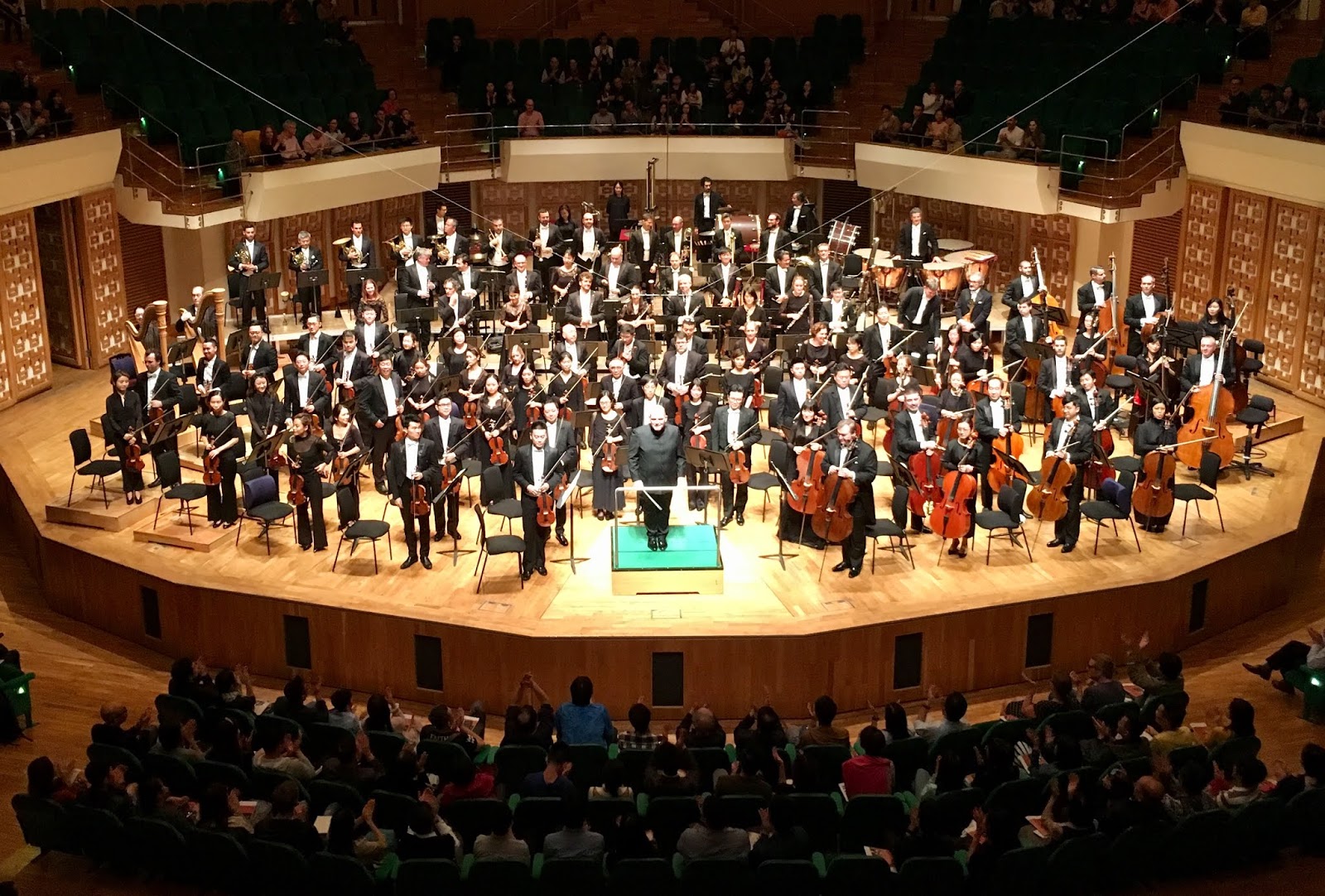
Hong Kong Cultural Centre Concert Hall, 27 April 2019
Symphony no. 9 (Mahler)
Hong Kong Cultural Centre Concert Hall, 4 May 2019
Piano Concerto no. 20 (Mozart)
Symphony no. 7 (Bruckner)
Khatia Buniatishvili (piano)
Hong Kong Cultural Centre Concert Hall, 18 May 2019
Christus factus est (Bruckner)
Ave Maria (Bruckner)
Symphony no. 2 (Mahler)
Ying Fang (soprano)
Karen Cargill (mezzo-soprano)
Netherlands Radio Choir
Hong Kong Philharmonic Chorus
Hong Kong Philharmonic Orchestra
Jaap van Zweden (conductor)
These three performances made an ambitious showcase of the late romantic symphonies during Jaap's spring residence with the philharmonic. The augmented orchestra with extras in brass, wind and percussion reminded us the large orchestration deployed in the Wagner ring project before. It was a demonstration how the orchestra has progressed technically and musically under the baton of Jaap. The produced tone was often meaty and confident. Though sometimes it has its temperament of inconsistency at the recent indifferent rendition of Nutcracker for the Hamburg Ballet. When it is on top form and knowing the direction, it was left to a matter of interpretation and execution.
Among the three symphonies, Mahler's ninth symphony was the most progressive and sophisticated of all. The composer probably found the ultimate resolution to his long obsession of repeated emotional struggle between love and traumatic abyss since symphonies at the Wunderhorn period. Bernstein suggested the last movement a gesture of farewell to the world, yet I thought it was Mahler finally parting away from the emotional negotiations he had been seeking so long.
Jaap emphasised the emotional contrast by adding a sheer sense of dramatic intensity, but sometimes overdoing it that felt too deliberate for a theatrical drama. A sticky start to the moody opening of first movement that led to the rocking lyric theme being playing passionately. The first climax was a crushing devastation, and the following ebb and flow remained vigorously expressive. Effective dynamic and emotional contrast that differentiated the mysterious tiptoed like transition passage and the third reappearance of the rocking theme.
The next climatic point was explosive with a rich and bold sound body, which was different from the mysterious bare sound landscape that followed. It felt more wholeheartedly triumphant as the orchestra developed another exuberant climax, but quickly vanished by a crushing blow from the brass that hinting a sense of last judgement. The main theme turned melancholy and became a march. A rhythmically tricky duet for the horn and flute and concluded with a flute solo that depicted darkness loomed in the atmosphere.
The second movement switched the emotional focus to the bold and coarse Landler dance. Jaap's interpretation was bombastic, hurried and flamboyant. It felt sticky at first and gradually gained more momentum. The gallop carried the sheer energy and swinging wildly. An audible slip from the clarinets though. The wildness grew to fullness in the grotesque third movement. The wind playing gave a mad impression of chaos throughout the complex fugal passage. The tender entry of the solo trumpet changed the atmosphere to another bold and exciting climax midway before the final recapitulation of madness.
The tutti strings began the last movement with an outpour of emotions. The warm tone made a rather positive impression before reaching the reflective mid section. The texture became leaner that carried a sorrow sense, and further reinforced by the horns on sustaining the emotional ebb and flow. A calm transition was played by the wind quartet before pushing towards a climatic point. The brass fanfare reinforced the strings to announce the radiance of love without any further reservation of irony. Jaap seems interpreted with more hope than bleakness. Towards the spellbinding end, it was felt alike the composer had found a resolve to his long search of question between hope, love, loss and death.
Despite the tender touch Khatia demonstrated in Mozart's twentieth piano concerto was elegant and seamless, her adopted tempo felt too slow at times. The orchestra and Jaap instead wanted to get it going than indulging too much. Khatia's playing carried a dense tragic colour in the first movement. Her weight on the keyboard not aggressive and carried the weight of colours. The cadenza was dramatic in contrast from the subtle impression before.
She redeployed the soft touch in the tender introduction of second movement. Though the same dynamic for the tempestuous mid section undermined the growing sentiments. The recapitulation even felt like a lullaby. It was increasingly frustrating to hear her holding the excitement further for a mysterious impression in the last movement. The cadenza filled with sentiments that felt odd to rush the coda at break neck tempo.
Compare to previous two encounters of Jaap conducting Bruckner's 4th and 8th symphony, the 7th emphasised on blazing sound but not so much a musical narration. The strings made a majestic introduction yet the upper strings were not quite together with the winds. Beautiful flute playing in the wind trio followed by a tragic passage in the lower strings. A complex sentimental negotiation of a vast sound world between heaven and earth went on. The brass ended it on a confident fanfare to create a long chord of a full blown pipe organ.
A huge sound of the majestic theme began the second movement emotionally forward. A lyrical part for the strings to play in unison with richness. The crescendo led to a climatic peak accompanied by another glorious brass fanfare before resetting to a bare landscape. It ended on a solemn announcement by the horns with a flute solo leading to a delicate pause.
A wild but bold gallop started the third movement which culminated the intensity for an explosive climax. The ebb and flow of emotion was followed by a pastoral mid section which the main theme was more romantic driven. The recapitulation was unhurried and grand. The introduction of the last movement became more witty and optimistic at first. The brass fanfare put the melancholy dialogue between the woodwind and strings aside. There was even a hint of recalling Wagner's music painting of the Rhine river yet the under grow development felt random. In contrast, the thundering brass theme added more confidence and certainty to the triumphant conclusion.
In the next programme, two familiar motets by Bruckner were sung by the Netherlands Radio Choir prior to Mahler's 'Resurrection' Symphony. Though I was puzzled why the Philharmonic Chorus was not performing the motets together with the Dutch choir. Klaas Stok, the choirmaster of the Radio Choir, took a rather vertical approach to 'christus factus est' with a dragging tempo. The dynamic contrast was effective from the choir yet not a dramatic execution of the music. Klaas's conducting also did not help to get the parts together and there were some untidy corners. 'Sancta Maria' was emphasised particularly through the diction in the 'Ave Maria'.
The orchestra felt far more confident in the second symphony than the ninth symphony before. The lower strings began the first movement in rage. It made a contrasting picture of hell and heaven when the upper strings played the heavenward theme with warmth. The wild tutti gallop which followed shattered the sweet pastoral picture before. Gradually it developed to a triumphant climax until the violent passage returned once again in sheer intensity. The brass played the theme bold and full in contrast to the calm and tender closing.
The dance in second movement was gentle and gracefully played in a warm tone. Jaap took the tempo on the fast side to keep the waltz elaborate and optimistic. Nervousness returned in the third movement and, despite carrying the forwardness in momentum, the upper strings were not tidy in the note heavy passage. The melancholy gallop culminated to a wild and explosive climax, which the percussions effectively built up the theatrical intensity. Karen Cargill phrased the fourth movement poetically yet the orchestra was not that responsive to her deployed rubato. Her diction was sometimes cloudy and a rather bright timbre for the part.
The musical narration of last judgement to resurrection was vividly portrayed in the final movement. After a brief recapitulation of the opening of the first movement, the brass announced the judgement theme steadily. The majestic impression left no room for cliche and a heavenward glimpse was gloriously rendered. In contrast, the tutti devastation that followed was crushingly loud and wild. The brass reinforced the climax continuously with explosive intensity until the chorus hushed entry. The combined choirs were uncertain at first with Zweden's conducting but grew more confident when the orchestra joined. Ying Fang sang with a clarion clear timbre and complimented Karen very well in their duet. The excitement was hold back until the final exultation, which was gloriously rendered for the ultimate salvation.
Showing posts with label Jaap van Zweden. Show all posts
Review - Symphony No. 7 (Mahler), Hong Kong Philharmonic Orchestra, 17 November 2018
Symphony No. 7 (Mahler)
Hong Kong Philharmonic Orchestra
Jaap van Zweden (conductor)
Among all the symphonies by Mahler, I felt the seventh musically most complex and experimental. This performance by HKPO was the second time I heard the symphony in live and like any revisit one was still awe by each new discovery. Jaap took a rather slow and steady tempo for the introduction of the first movement. It felt rather heavy and lacked forwardness. Though I was impressed by the bright and bodied from the brass and caught up more momentum as the orchestra galloped more. The thematic development was almost abstract to an extent and nothing fixed. It became a thick and raging gallop as the music piling up texturally.
In contrast, the picturesque image of lake and natural landscape were more apparent in the quiet passage. It was also more romantic and sentimental than before. Though the focus turned away to a sombre funeral march played by the lower strings and brass. It then grew into a flamboyant explosion of thematic repetitions, which the orchestra gave a weighty and dramatic built up. The climaxes were emotionally driven and wild howls thundering along to shake the world in sheer intensity.

The second movement instead turned to melancholy and recalling the wunderhorn symphonies. Texturally lighter with some hints of humour but sarcastic the same time. It felt alike a spirited ride in the countryside while waltzing along. The depiction of an unsettling night with cow bells and melancholy dance felt rather enigmatic.
There was more urgency and abstraction to the scherzo of the third movement. The dance patterns grew more grotesque and energetically motivated. Jaap let the music to lead the shape as the orchestra sailed the continuous change of musical shapes. It did not lose the energy and sustained the rhythmic activeness throughout. Though the thinking seems lacked some depth despite being musically driven.
Finally the strings and winds could play with more warmth in the scenic fourth movement. A gentle serenade to an extent but underneath increasingly nervous and unsettling. The ebbs and flows of emotion swelled, which the lyrical dance theme negotiates with sentiments. It was not a wholehearted happiness but a sudden surge of inner excitement.
The beginning of the fifth movement marked by the triumphant and majestic gallop that gloriously rendered. Jaap took a rather swift tempo to allow the orchestral excitement exploded in fullness. Structurally the last movement was more classically orientated and square in phrasing. The brass fanfare was decorated by elaborate winds' descant. It was another explosion of thematic and rhythmic experimentation, which culminated to madness with different parts clashing into a chaos. Yet it was Mahler in exuberant mode at the recapitulation of the opening triumphant theme by stamping hard and wildly driven. A virtuosic part for the timpanist with the orchestra built towards an explosive and intense conclusion. Most impressive performance as a whole and still amaze me that HKPO is continuing to perfect their playing.
Review - Jaap and Joshua Bell, Hong Kong Philharmonic Orchestra, 8 September 2018
Academic Festival Overture (Brahms)
Violin Concerto (Sibelius)
Symphony No. 41 "Jupiter" (Mozart)
Hong Kong Philharmonic Orchestra
Joshua Bell (violin)
Jaap van Zweden (conductor)
Like the season opening performance before, a festive symphonic overture is programmed for an uplifting start. Though the orchestra was too energetic throughout Brahm's Academic Festival Overture, and as a whole it felt lacking character and essence. Jaap probably felt the swift tempo would keep the momentum going than dragging along. Yet already restless than being mysterious at the tip toe like beginning. By reaching the first triumphant climax then the orchestra was more stable and let the music sang. Despite displaying the tonal contrast, it galloped in hurry and occasionally lost in details.
The first violin began Sibelius's Violin Concerto with a spellbinding pianissimo and set the stage for the solo violin. Bell's playing produced a sweet rich tone with clarity, but his bowing did not always have the smoothness to sustain the long line and sometimes felt abrupt. He approached from a sentimental perspective by employing a lot of vibrato. His playing was passionate and expressive on the ebbs and flows of emotions, rather than holding back the sentiments in stillness. Despite a challenging part to play, tuning on the double stops were noticeably a hit and miss Whereas the orchestra strings seems holding back their response to avoid being overpowering. Interestingly, I thought there was a brief moment alike the motive of Siegfried's assassination from Wagner's Götterdämmerung towards the end of the first movement.
Bell began the second movement beautifully on the lush expressive violin part, yet the horns' accompaniment did not sound convincing. Occasionally I felt Bell put too much weight on the bow that it felt too rich and sticky than allowing his playing to flow more. The orchestra achieved more charity and locating its voice in the tragic response. Yet the syncopated section not really able to build up the climax despite effective dynamic contrast.
A busy start into the third movement for the solo violin part, but Bell was driving the tempo so much that his phrasing not quite grasping the shape of the polonaise dance. Tuning was very good with the harmonics and not so with the arpeggio climbs to the high positions. As a whole I felt mixed by Bell's playing, but after learning from friend's past experience, Bell could have been experimenting different approaches than giving a straightforward interpretation.
I had not been impressed by Jaap's Mozart in the past but what he achieved from the orchestra on the "Jupiter" symphony changed my mind completely. Finally a more relaxing tempo was adopted for the first movement and the playing was very polished. Perhaps the violins could employ more accents in the down bow to give more rhythmic excitement than only sustaining the elegant impression. Contrast in tone colours at counterpoints was effective with beautiful tone at the majestic recapitulation. A flowing elegant impression was made at the beginning of the second movement. The sadness and solemnity at the tragic transition seems a reference to earlier piano concertos by Mozart. Later the landscape became smooth with a sweet and clean tone, while being sedate and slightly sentimental. The third movement became an elegant and majestic dance in thicker texture than the movement before. The orchestra was very responsive and immediate with the gallops in the last movement that kept the momentum forward. The brilliancy of Italian opera fanfare like section was effectively realised. The bright tone gave the dance like movement a flamboyant touch. The final gallop was energetic with the sheer rhythmic excitement that gave more audio satisfaction than the first half.
(Photo credit: Hong Kong Philharmonic Orchestra)
Violin Concerto (Sibelius)
Symphony No. 41 "Jupiter" (Mozart)
Hong Kong Philharmonic Orchestra
Joshua Bell (violin)
Jaap van Zweden (conductor)
Like the season opening performance before, a festive symphonic overture is programmed for an uplifting start. Though the orchestra was too energetic throughout Brahm's Academic Festival Overture, and as a whole it felt lacking character and essence. Jaap probably felt the swift tempo would keep the momentum going than dragging along. Yet already restless than being mysterious at the tip toe like beginning. By reaching the first triumphant climax then the orchestra was more stable and let the music sang. Despite displaying the tonal contrast, it galloped in hurry and occasionally lost in details.
The first violin began Sibelius's Violin Concerto with a spellbinding pianissimo and set the stage for the solo violin. Bell's playing produced a sweet rich tone with clarity, but his bowing did not always have the smoothness to sustain the long line and sometimes felt abrupt. He approached from a sentimental perspective by employing a lot of vibrato. His playing was passionate and expressive on the ebbs and flows of emotions, rather than holding back the sentiments in stillness. Despite a challenging part to play, tuning on the double stops were noticeably a hit and miss Whereas the orchestra strings seems holding back their response to avoid being overpowering. Interestingly, I thought there was a brief moment alike the motive of Siegfried's assassination from Wagner's Götterdämmerung towards the end of the first movement.
Bell began the second movement beautifully on the lush expressive violin part, yet the horns' accompaniment did not sound convincing. Occasionally I felt Bell put too much weight on the bow that it felt too rich and sticky than allowing his playing to flow more. The orchestra achieved more charity and locating its voice in the tragic response. Yet the syncopated section not really able to build up the climax despite effective dynamic contrast.
A busy start into the third movement for the solo violin part, but Bell was driving the tempo so much that his phrasing not quite grasping the shape of the polonaise dance. Tuning was very good with the harmonics and not so with the arpeggio climbs to the high positions. As a whole I felt mixed by Bell's playing, but after learning from friend's past experience, Bell could have been experimenting different approaches than giving a straightforward interpretation.
I had not been impressed by Jaap's Mozart in the past but what he achieved from the orchestra on the "Jupiter" symphony changed my mind completely. Finally a more relaxing tempo was adopted for the first movement and the playing was very polished. Perhaps the violins could employ more accents in the down bow to give more rhythmic excitement than only sustaining the elegant impression. Contrast in tone colours at counterpoints was effective with beautiful tone at the majestic recapitulation. A flowing elegant impression was made at the beginning of the second movement. The sadness and solemnity at the tragic transition seems a reference to earlier piano concertos by Mozart. Later the landscape became smooth with a sweet and clean tone, while being sedate and slightly sentimental. The third movement became an elegant and majestic dance in thicker texture than the movement before. The orchestra was very responsive and immediate with the gallops in the last movement that kept the momentum forward. The brilliancy of Italian opera fanfare like section was effectively realised. The bright tone gave the dance like movement a flamboyant touch. The final gallop was energetic with the sheer rhythmic excitement that gave more audio satisfaction than the first half.(Photo credit: Hong Kong Philharmonic Orchestra)
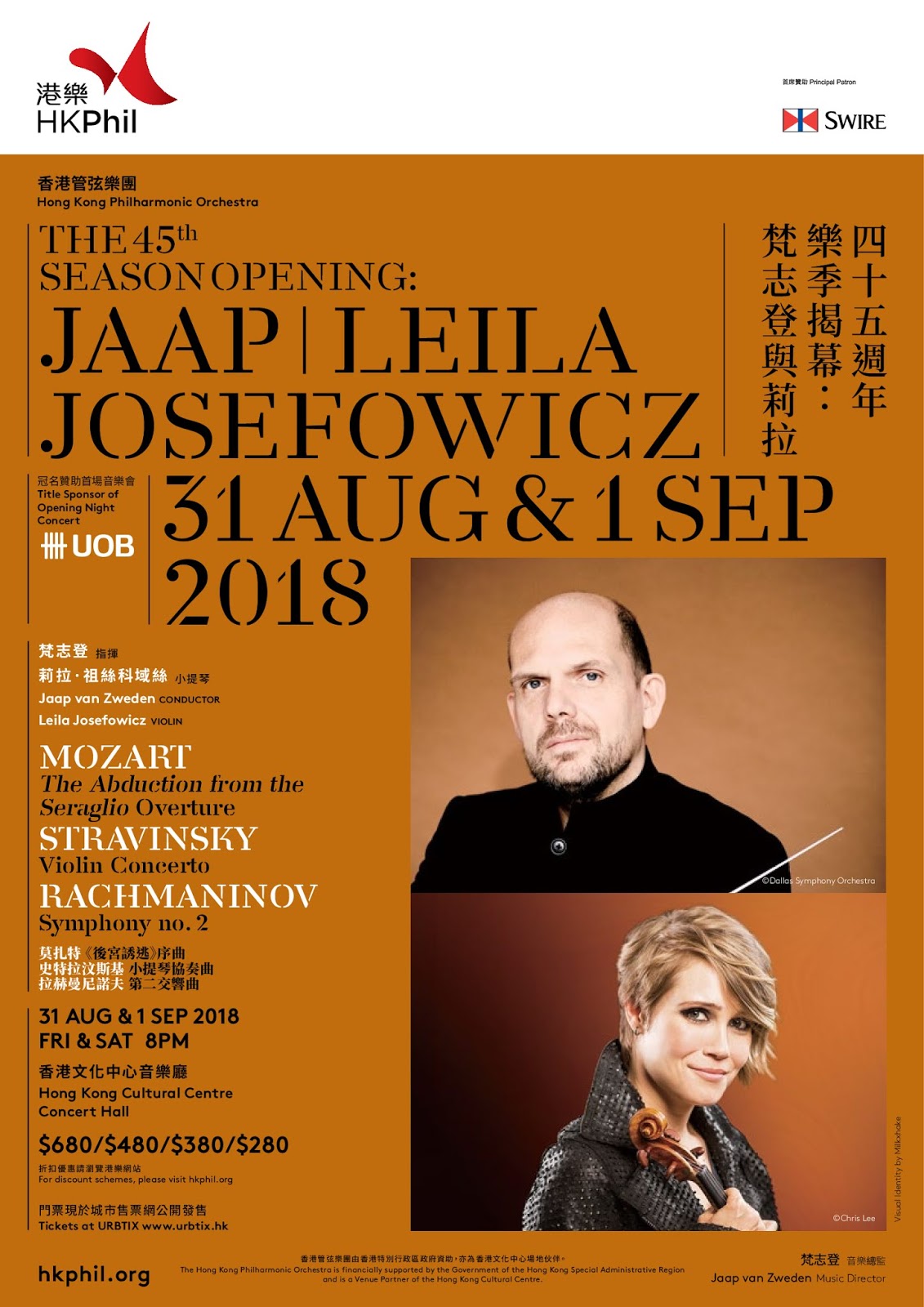
Review - The 45th season opening performance of Hong Kong Philharmonic Orchestra, 1 September 2018
Overture to the Abduction from the Seraglio (Mozart)
Violin Concerto (Stravinsky)
Symphony No. 2 (Rachmaninov)
Hong Kong Philharmonic Orchestra
Leila Josefowicz (violin)
Jaap van Zweden (conductor)
The overture to Mozart's exotic opera Die Entführung aus dem Serail is supposedly a lively curtain raiser by including a large battery of percussion with the strings and winds. Yet the philharmonic orchestra seems more indifferent to that idea and gave a lukewarm account in its rendition. Jaap took a steady tempo that aimed for refinement than after a dramatic interpretation. The strings particularly lacked dynamic contrast nor making the colour to enrich their playing. A friend thought perhaps to do with the orchestra being too big than the right formation, but I felt the heart and mind were not in place.
The orchestral playing was certainly more passionate in the Stravinsky and musically carried more contrast and interest. An energetic introduction was given between the winds and solo violin that felt alike a colourful country scene. Despite the two domains have different rhythmic patterns, Josefowicz executed the big jump on positions with ease and sustained a flowing impression in her playing. The music became more nervous and less optimistic in the second half of the first movement.
A melancholy or even bizarre start to the second movement by the solo violin. The music became rather abstract with the irregular music patterns and fragmented parts. Sentiments dominated the third movement and longer line in a phrase than previously. The main theme by a trumpet and two flutes made a tragic calling, but not knowing where the music was heading into than thematic repetition.
The last movement was more certain started with a syncopated gallop. A busy part for the solo violin while the bassoons provided the rhythmic backbone. Josefowicz sustained the energy in her playing with clarity, maintained the beauty in tone colour and allowed the music to breathe. The rhythmic patterns are ever changing and include some reference to Bach. Later even a reminder to the Rite of Spring as the music went tribal and exuberantly driven towards the end.
I was unsure at first whether this performance of Rachmaninov's second symphony would be as memorable as the one in the previous edition of Hong Kong Arts Festival by the Oslo Philharmonic. The climaxes is alike an endless musical orgasm from the start til the end. Though the beginning of the first movement is supposedly more gloomy and mysterious than the rest. Yet the philharmonic orchestra played with a warmer tone than the chilling landscape in mind. Romanticism already culminated in full swing even at the early climax. Lush strings' playing sustained the contrast in the ebbs and flows of emotions, but not as flowing as desired. The stormy transition also lacked the tension and bleakness. Only at reaching another big climax the sheer intensity gained weight. The return to the romantic theme was sweet and passionately driven, also more clarity among the strings. Interestingly the brass sounded rather like a military band at the closing of the movement.
Tempo for the descending start to the second movement was on the swift side and kept the momentum forward. Though more majestic and steady in its emotional response. The tempestuous gallop in turn was thundering throughout but not overtly wildly driven.
It took the orchestra some time to calm down than being restless in the sweet and tender opening of the third movement. Andrew Simon's clarinet solo was spellbinding and paced very well in the long line of phrase. The dialogue between oboes and cor anglais along rest of the orchestra carried a lot of energy in gearing towards another climatic peak. Calmness returned at the end yet the strings' playing not as silky and flowing as expected. Sentiments were felt again from the ebbs and flows of emotions.
An energetic start to the festive introduction of the last movement, but clarity and togetherness were not that effective among the strings. The outpour of romantic lushness was given in full and gloriously rendered. The transition from the nervous passage back to the brilliant opening theme was intense and filled with sheer excitement. The crescendo built into a majestic and triumphant lush conclusion. It certainly came close to the breathtaking impression I had previously.
Review - Shostakovich & Tchaikovsky, Hong Kong Philharmonic Orchestra, 16 June 2018
Variations on a Rococo Theme (Tchaikovsky)
Symphony No. 7 'Leningrad' (Shostakovich)
Encore: Overture to 'Die Fledermaus' (Johann Strauss II)
Hong Kong Philharmonic Orchestra
Wang Jian (cello)
Jaap van Zweden (conductor)
Pairing a light piece by Tchaikovsky as amuse-bouche with Shostakovich's Leningrad Symphony is lazy programming, neither does it makes much impression. The Fledermaus overture could have started the concert to form the tuneful progression, than serving as an anti climax after the symphony. Alike Tchaikovsky's ballet scores, sweet, tender and lyric are the features of the rococo variations. In the first part, extreme range on finger positions for the solo cello as it gets to the end of fingerboard with harmonics. Wang Jiang kept the music flowing and switched positions smoothly. Though sometimes too much vibrato on the long notes for my taste, and impatient with the tempo than sustaining the elegant impression. The repetition of the main theme was beautifully played by the flute solo, though composition style wise not dramatic at all. Melancholy made the sorrow response in the mid section before galloping at the coda, which rhythmically and audio more interesting than before.
Zweden's account of the Leningrad Symphony realised the graphical abstraction, yet a lot of warmth within that gave more hope than devastation. The majestic theme that began the first movement was muscular and sunny without any sign of doubt. Even in the following pastoral section, with flute solo playing folk tunes, felt rather sweet and sedate under the relaxing tempo. Then the march to battle reminded us the long crescendo of repetition from Ravel's Bolero. First pizzicato on tutti strings forms the rhythmic structure and harmonic foundation, duet between oboe and bassoon give the melodic tune, while the brass dramatise and thundering the tune in full force of power. The principal percussionist Aziz Luce kept the rhythmic momentum tight and consistent on the snare drum throughout, also effective progression from pianissimo up to the climatic violence then faded to a quiet end. Yet the second view of the landscape was colourless as the bassoon depicted, but the first violins were not that tidy in their lyrical response.
It also took few bars to agree on the tempo between the strings and oboe solo at the start of the second movement. The theme led by the clarinet was alike clock ticking, and became surreal with the energetic dance gave a grotesque outlook. One felt the recapitulation of the opening theme enigmatic that not sure where the music was trying to head to. Dialogue between bass clarinet, harp and flutes seems to lament the calmness and tranquility of normality prior the war. A spiritual start to the third movement with the winds playing a chorale theme, which the strings gave an emotional pouring response. Beautiful flute solo accompanied by pizzicato on the strings. Texturally it recalled the music landscape of Sibelius for the clearness and a heavenward glimpse.
Yet the elegant strings' passage before the last movement was calm before storm. The tense gallop and bombastic brass brought the violence of war back to the centre stage, which was muscular but flowing. Sorrow and hope negotiated, though more certain in direction that reassured by the majestic unison strings. The built up towards the thundering climax was less triumphant and naive compare to the one we heard in the first movement. It was turned into a wild dance with sheer dramatic intensity. The aftermath was bleak over the vast landscape, which was gloomy and mysterious that visually near disfigured. Instead horns' fanfares and strings culminated towards a blazing magnificent conclusion. Victory was unlikely the answer, but a conviction that manifestation of hope and glory would triumph over doubts. The long struggle certain put the Fledermaus into an odd extra as to whether we needed more to reassure ourselves, even though the philharmonic was certainly energetic enough to deliver a fiery rendition.
Review - Das Lied von der Erde, Symphony No. 4 & 5 (Mahler), Hong Kong Philharmonic Orchestra
27 May 2017, Hong Kong Cultural Centre Concert Hall:
Overture 'A Midsummer Night's Dream' (Mendelssohn)
Piano Concerto No. 1 (Mendelssohn)
Symphony No. 4 (Mahler)
Lan Rao (soprano)
Serena Wang (piano)
Long Yu (conductor)
The ongoing Mahler cycle by the philharmonic orchestra now spread across three seasons, but not knowing whether the eighth symphony being planned for future performance or not. Two of the concerts in this review are long overdue for review, yet recent performance of Das Lied von der Erde provides the excuse to recall what happened. The 2016/17 season focused mainly on symphonies of the wunderhorn phase with the fourth symphony marked the conclusion.
Mendelssohn filled the first half for a lighter start supposedly, but reading my notes it seems impatient and aggressive playing created most of the impression. The strings hurried along the overture that the gallop was energetic but rough. There was hardly any shape in phrasing but the simply hurrying through. Whether to do Yu Long's unclear conducting, who just beating out in two than showing any shape, or an individual in the orchestra played ahead, the end of one line was audibly messy and wrong. The orchestral's wildness continued into the first movement of the piano concerto which too much energy expressed by the playing. Lyrical moment was not elegantly rendered and the orchestra began to shape the music on auto mode by ignoring the conductor. Serena Wong's playing on the piano was smooth and beautifully executed, particularly the second movement, which she allowed the space for the music to breathe and recalled the much needed calmness. The orchestral entry to the third movement was more relaxing with a flowing progression yet swift in tempo. Technically Serena Wong was precise with a good touch that never being aggressive, yet it would take her few more years to sophisticate and mature her thinking on the work.
Though the orchestra was impatient again at the start of Mahler's fourth symphony. It did not feel like a delicate dance and the dynamic contrast felt rather extreme. A rather awkward structure continued with too much rubato employed in the lyrical section and lacked direction during the melancholy transition. The crushing climax fell short of the violent effect, yet the return to the more happy looking expressive moment stayed very loud and muscular. These all created a heavy footed impression by being sticky and lacked contrast in colours. Focus was lost by the broad and steady tempo adopted in the second movement. The orchestra dragged along and failed to realise the atmospheric change from the grotesque outlook to the sweet coda.
Strings managed though to play more tenderly in the third movement but still very vertical progressed, which lost some momentum and turned it into fragments than continuation. It was probably why the climaxes lacked the weight of impact and the pastoral excitements felt extreme than naturally developed. Neither was the connection between ebbs and flows of emotions effectively created, but merely making an explosive sound or accelerando. To further dampen the appreciation, Rao Lan's singing was often inaudible with poor diction in the fourth movement. Vocally she did not carry the support in reaching the high register and at times not even together with the orchestra. The orchestral playing instead became over dramatic with the woodwinds being wild. Messy coordination again when Yu Long also forgot to indicate the rubato. After Gergiev's chaotic performance with the World Orchestra For Peace some years ago at the BBC proms, this added to another disappointing live experience onto the list.
9 September 2017, Hong Kong Cultural Centre Concert Hall:
Piano Concerto No. 2 (Beethoven)
Symphony No. 5 (Mahler)
Yuja Wang (piano)
Jaap van Zweden (conductor)
The game switched three months later with Zweden in charge of the fifth symphony. The first half continued the week long feature of Yuja Wang with Beethoven's second piano concerto. Despite textually it still bears the Mozartian features, the orchestra gave a rather vertical reading of the introduction than sustaining a forward momentum. Wang played tenderly on the lyrical passage but also impatient with the tempo. Later she was more even rhythmically in the arpeggios, while the orchestra ably made appropriate dynamic contrast to accompany her in the background.
Yet there was the tendency to rush through and made a muscular tone, instead of the majestic and silky sound that had in mind. The cadenza seems could not make up its mind how to develop than a labouring of notes in thick texture, which felt rather odd with the composition style. Wang and the orchestra hurried through the first half of the second movement, which also felt too energetic and too bold than the sweet gradual progression. Yet right hand playing at the pianissimo passage made a spellbinding effective and the orchestra finally allowed the music to sing with the space. Wang and the orchestra felt more at home in the third movement with the lightness to keep the direction with dynamic contrast.
After the interval, an explosive start to the fifth symphony after a confident and accurate trumpet solo, which was most effective compare to past performance of the same work by HKPO in my memory. Strings did not linger on the expressive theme and blazing tone from the brass. A violent climax was reached with sheer devastating cries in contrast to the gentle march later, which was sweeter than melancholy. The contrast in the second crushing climax was effective followed by attaca into the second movement with masculine brass entry being very crisp in tone colour. The tone of lower strings was thicker and tidier than the upper strings. Ebbs and flows of sound waves culminated for sheer intensity. Sadness drove between the negotiation of hope and sorrow. Explosion passage created a hurricane impression with emotional sentiments. The raw tone on strings recalled the chilling wind alongside war like percussion. Triumphant fanfare from the brass accelerated the impact to fullness before dying down to a mysterious close.
An energetic start to the third movement that strings played the accent exaggeratedly for a muscular dance. Flowing wind passage compare to the strings' complex fugal dialogue. The horn solo sustained a bright tone and stayed swift in momentum. Soon a chamber like dialogue made a change from the loud and violent beginning. Each part seamlessly connected with the others, and the dance had more bite and energy this round to create an exuberant swing even at quick tempo. The horn solo took the risk for sheer excitement in the gallop and aimed for a resounding end.
Whereas the depth of emotions poured out in full at the fourth movement. Zweden even managed to keep the climax flowing like a song without word that was magical in many ways. Dynamic difference at the ebbs and flows was big in the leap, followed by a heartbreaking fade on the violins. A majestic entrance to the fifth movement from the horn and woodwind. The following fugue was energetically driven in full bodied tone, though at points it also felt rushing along. Though there was the intention to slow down in order to build up the climax for a resounding impact. The sound of wall, machine gun like, marked hope triumphantly over sorrow by the brass fanfare. A highly dramatic finale from the abyss of melancholy to the wholehearted celebration of positivism. It was surely the most dramatic account of the fifth symphony I experienced so far.
28 April 2018, Hong Kong Cultural Centre Concert Hall:
The Song of the Earth (Ye Xiaogang)
Das Lied von der Erde (Mahler)
Yu Guanqun (soprano)
Ildikó Komlósi (mezzo-soprano)
Klaus Florian Vogt (tenor)
Yuan Chenye (baritone)
Long Yu (conductor)
Instead of the usual programme formula with works from the classical period, the performance of Das Lied von der Erde was paired with Ye Xiaogang's composition that based on the original Chinese poems in the first half. A colourful introduction to the first movement with woodwind imitating tides and waves. Despite diction was not that clearly articulate at the first hearing of Yu Guanqun's singing, her intonation was secured and carried the projection. The reach to top notes was smooth and flexible in switching between registers. Vocal style recalled those in Elektra but harmonically simpler and less violent. It tried to be broad and majestic in style. The second movement was rhythmically more energetic especially among the percussion, but was not quite the shyness that depicted in the text. It was festive enough to visual a lively scene but the soprano vocal part was less sophisticated comparing to the first.
A broad sound world that captures the atmospheric beauty of night music in the third movement, with bells chiming in the background like clock ticking. The baritone finally appeared in the fourth movement for the violent and tense opening. The composition style was similar to a mixture of Peter Grimes and Turandot. Yuan Chenye sang dramatically throughout but lacked the vocal body. The drum rolls towards the end of the movement felt abrupt and should have been continued into the fifth movement. A return to the vast and deep sound world, but Yuan's line was not that smoothly executed. The brass fanfare gave a positive outlook to the exuberant fantasia, though lacked some sonic impact. Mysterious finale in the last movement while being tranquil. The heroic climax was ironic for the first time, yet the return to the calm and sedate atmosphere was awkwardly developed. It recalled the night music of Mahler's seventh symphony to some extend, but the coda with clashing gongs and bass drum fading away was completely opposite.
An exuberant start in swift tempo to Das Lied von der Erde, which the orchestral playing was so wild and aggressive that nearly drowned out the singing. Though Vogt's singing still managed to filled the hall and kept the tender impression. Yu Long seems lost control of the orchestra and the playing felt rather unsettling throughout the first movement. He was not able to get the depth out of the orchestral playing than an energetic chase. Same being felt in the next movement with the oboe led theme, which was rather out of shape and simply galloping along. Komlósi sounded uncertain how to fit her singing within the restless progression. Her diction was unclear too and employed heavy vibrato in the higher vocal range. Yu Long's conducting also looked all over the place that flicking the baton aimlessly.
While Vogt tried hard to stay soft in the third movement, Yu Long did not able to slow down the orchestra from hurrying the tempo of the festive March. It created further hurdle to Komlósi who struggled to fit the sung text while the tempo was pushed to extreme in the fourth movement. No musical shape at all but a mechanical galloping to jump leaps. The festive wildness went too far and created chaos, which the return to lyrical part was abruptl. The coordination throughout the fifth movement was better than before with the orchestra more responsive to Vogt's word painting. He continued to keep the vowels bright and kept the projection forward. It felt sweeter even in such excitement.
The white hot orchestral colour carried too much brightness for the mysterious opening of the last movement. Komlósi's phrasing was out of shape again and not able to sustain the long vocal line, also audibly employed too much vibrato. Flute solo was beautiful and enchanting at the tranquil transition into the calm and expressive moment. Yet the swift tempo followed was in great hurry and difficult to understand what she was singing. Only at the climax then Komlósi able to sing more than speaking the text early on, and conveyed the emotions, but her mid vocal range was insecured with poor tuning. The full sense of sorrow was finally realised in the moody and melancholy second half. Sadness was expressed in the funeral march but lacked some direction of a slow dance. Though again it needed to hold back the forwardness to allow more space and broad tempo for the dream like conclusion.
Review - Götterdämmerung (Wagner), Hong Kong Philharmonic Orchestra, 21 January 2018
Gun-Brit Barkmin (Brünnhilde)
Daniel Brenna (Siegfried)
Shenyang (Gunther)
Eric Halfvarson (Hagen)
Michelle DeYoung (Waltraute)
Amanda Majeski (Gutrune)
Peter Kálmán (Alberich)
Eri Nakamura, Aurhelia Varak, Hermine Haselböck (the Rhinemaidens)
Sarah Castle, Stephanie Houtzeel, Jenufa Gleich (the Norns)
Hong Kong Philharmonic Chorus
Bamberg Symphony Chorus
State Choir Latvija
Hong Kong Philharmonic Orchestra
Jaap van Zweden (conductor)
The philharmonic orchestra ring cycle project since 2015 finally reached its finale. In between I saw other ring cycles in Melbourne and Berlin, but theatrical experience was different from the setting as a concert presentation. Since there was no staging, the audio appreciation became the focus inevitably. Yet one could not ignore the ideology, philosophy and symbolism, and the contemporary relevancy. Like Rheingold, the theme of cunning plans, lies, greed and violence was revisited extensively in Götterdämmerung. Despite the solution to end all woes was already known at the beginning, which to give up the ring and return to the rhinemaidens. It was not until Brünnhilde made the unexpected move by sacrificing herself, which put an end to the old establishment.
To stay true and honest seems more difficult than exercising self interest, selfishness and manipulation. Such paradox still happens in our society, and never fail to amaze us of how much excuse one can deploy to legitimise mistakes. Though it is too simplistic to make Hagen solely as an example of evilness, who was also a by-product of Alberich and inherited that loveless power driven desire. Siegfried too failed to be a total hero as he did not realise the bigger picture, also stubborn enough not to give up the ring at the advice of rhinemaidens and warned him that death looming. Neither the ring nor the tarnheim brought the promised power and protection, instead those desired or possessed the two items brought themselves to destruction. Yet unorthodox partnerships and father-daughter reconciliation sometimes broke off the cruel world by celebrating the power of love and humanity, which gave us hopes that the world could change for a better future. The ring told a painful lesson, but only until Die Meistersinger and Parsifal that Wagner suggested for social transformation only through arts and ideological transformation would succeed.
Musically this performance of Götterdämmerung had successfully delivered the full package. Arguably the best display of the entire cycle and also most satisfying concert experience of the current season so far. The vocal line up were more pleasant for the ears than previous instalments, and technically outstanding that exceeded the expectation. Although the work was lengthy in duration, the orchestra never lose shape under the baton of Jaap van Zweden and every line being phrased meaningfully. It was also worth breaking the bank to augment the choir with reinforcements from abroad. Despite lacking a sonic depth and could have accented more on the chords, a polished and majestic orchestral entry was given at the prologue. Sarah Castle, the first Norn, sang poetically and injected much colour to her diction, yet the lower register seems slightly soft for the vast acoustic. Stephanie Houtzeel, in the role of second Norn, improved her diction and tuning as her voice warmed up. As she sang the passage that described Loge's involvement and fate, her singing tone was richer and gave a colourful painting of the text. The third Norn had the highest vocal range of the three and texturally more fluid. Though Jenufa Gleich would need to articulate consonants more to improve her diction and flexibility in switching registers.
The orchestra kept the momentum forward and responsive to the thematic transitions between the breaking of the thread and the sunrise scene. The devastation was felt with sheer intensity and urgency as the thread broke, followed by a still and mysterious passage on the cellos that depicted the break of dawn, and reached the climatic exultation of passionate love and sunrise brilliancy as the tutti excitement culminated in full. Gun-Brit Barkmin debut as Brünnhilde surprised me by her rich mezzo soprano timbre and still could reach the rather higher vocal range. She was steady with tempo at first and carefully phrased the lines. As she warmed up, her singing became more relaxed and opened up that enhanced the clarity in diction. Daniel Brenna, who already several stage experience as Siegfried, carried more space and warmth in tone, also acting out the role for interaction. His timbre made a pleasant impression of his line but vocal weight slightly light for the hall acoustic. He too was cautious with the words and the register changes. The pair maintained the passionate exuberance, and showed no sign of vocal strain to reach the climatic top notes. The thickened strings' layers during Siegfried's Rhine journey was rhythmically energetic and excited, but slips were audible from the horn solo. It all built into a majestic and polished tutti bold moment with dynamic contrast, but could swing more to lighten up the thick texture.
The orchestral introduction of Gibichung Hall was less eerie and dense than expected. Shenyang's Gunther felt very commanding than a puppet by his confident singing, whereas Eric Halfvarson's dense and rich bass tone recalled Fafner than the cunning Hagen. Both made the impression that they were in command of the situation even before Siegfried's arrival, which added the chilling weight as the assassination plot gradually unfolded. As Gutrune, Amanda Majeski had the right timbre for the role and stayed fluid in her singing despite tuning on high register not that secured. At Siegfried's entrance, the brass produced a crushing chord that seems marking the beginning of the end for the hero. Yet at the description of treasures that Siegfried had, Halfvarson lacked the urgency in portraying Hagen's underlying desire and some stage realisation would have given some visual context. The orchestra again responded vividly to the emotional changes as Siegfried took the potion that Gutrune had prepared. Brenna and Shenyang too delivered a dramatic interaction on the adventure to Brünnhilde's rock, and marked the swearing of brotherhood more daunting as what to follow. The brass ably produced the youthful excitement yet could have loosen up more to unleash the wildness. In contrast, the orchestral playing could be more chilling and bleak as Hagen narrated his cunning plan alone. Instead the lower brass created the atmospheric heaviness of curse by its tragic and gloomy tone colour.
The tender love theme in reintroducing Brünnhilde on the rock was short-lived, but horns were muddy at announcing the arrival of Waltraute. Barkmin interpreted the sisters' reunion as an emotional charge with a dramatic reception, while Zweden drove the orchestra to celebrate the joy of recalling the past. As always, Michelle DeYoung phrased the music poetically with very clear text and her voice filled the space effortlessly. Her narration of the fall of ash tree and Wotan's preparation for final destruction realised the varied emotions of horror and sadness. Here Barkmin carried more warmth in the her lower register and clear with her diction. She also effectively conveyed the ebbs and flows of emotional response with colourful contrast in the words. Upon Siegfried's return, the orchestral transition was warlike and tense in opposite to Brünnhilde in rapture. Though disguised Siegfried in tarnheim and confrontation between the pair would be more vivid with stage actions than solely relied on music narration. Instead the orchestra gave an eerie accompaniment as Brünnhilde was devastated by the betrayal and cried in horror.
Instead of an eerie dreamy impression, the orchestral introduction of act two carried more warmth than expected. Visually Peter Kálmán made a youthful Alberich compared to Halfvarson's Hagen, yet his baritone like timbre lacked the same resonance and richness. Though the portrayal was accurate as Alberich was eager on retrieving the ring, whereas Hagen stayed dreamy and uninterested to his father's urge. The bass clarinetist gave a subtle and smooth account of Hagen's awakening, but Siegfried's return seems slightly soft in presence on the orchestra part. Perhaps the intention was to leave room for the war like summon as Hagen sounded the alarm, in turn the combined male chorus thundered with a wall of sound. It gave the much desired dramatic intensity and the choral singing stayed bright and ringing. Gunther's announcement of the marriages was clear and definite, whereas Barkmin portrayed herself as an emotional Brünnhilde, who questioned the confused Siegfried and raged over the betrayal. Her vocal entries carried the urgency and furious impression, which was achieved by colourful word painting that conveyed the emotions. The orchestral underlay responded along by some raw playing on the strings, and increasingly violent as the misunderstanding and hostility deepened. The chorus also gave a bombastic questioning over the confusion and sounded very big in body. As the assassination plot was drawn up, the orchestra gave a devastating and dramatic finish.
The horns gave a blazing account of Siegfried's hunting calls that began the last act. Again the orchestra was able to intertwine between the witty playful part of the rhinemaidens and the chromatic recalling of curse and destruction. The three sopranos as rhinemaidens blended well together with a lot of active vocal energy on high tessitura passages. They drove the momentum forward with great intensity, which was in contrast to Brenna rather fluid and light timbre. It made a contrasting portrayal of the rhinemaidens being very noisy in their complains against Siegfried's disbelief of their warnings and his arrogance. Later when Siegfried recalled his past memory at Hagen's suggestion, Brenna gave a colourful account of his part. Yet he began to struggle in sustaining the legato at the thematic imitation of the woodbird, and swelled in order to reach the top notes. Even so, he managed to sustain the vocal energy and kept the tuning by giving his all. In turn, the orchestra made a crushing built up towards the assassination point, responded with a lush and sentimental transition to mark Siegfried's last declaration of his love to Brünnhilde.
For whatever reason, I was very moved for the first time by the funeral march, which was rendered majestically and bold. Perhaps the orchestra's tone colour carried more the tragic sentiments than solemnity, or truth was finally revealed after all the preceded lies and chaos, which allowed emotions to pour out in full. Hagen's terrifying announcement of Siegfried's death and the blaming game with Gunther and Gutrune were as expectingly tense, but only stage action could realise the visual bloodshed. Zweden adopted an unhurried tempo for the immolation scene that aimed for a monumental and emotional end. Although Barkmin's higher register lacked the warmth of her lower vocal range, she phrased the music poetically and stayed smooth in her vocal switch. One felt particularly poignant and emotional when Brünnhilde recounted the past wrongdoings and betrayal, yet the moment of destruction and cleansing had arrived finally to undo it all. Along with radiant brass playing, the long crescendo built into a highly moving conclusion of this landmark project. The philharmonic orchestra had demonstrated it had reached a new musical height, and delivered an exceptional memorable performance.
Review - Symphony No. 8 (Bruckner), Hong Kong Philharmonic Orchestra & Jaap van Zweden, 13 October 2017
Symphony No. 8 (Bruckner)
Hong Kong Philharmonic Orchestra
Jaap van Zweden (conductor)
Despite the one and half hour long performance was greeted by an enthusiastic reception, Zweden did not appear satisfy as some previous performances like the Mahler fifth. Prior to the orchestra's Beijing tour, this one off account of the composer's spiritual journey on death and transfiguration for the hometown audience felt like a work in progress than a full understanding. The blame was equally shared between the orchestra and also Zweden himself. They have to go back to the drawing board and adjust for a more all rounding results.
After being used to the rich and full bodied playing by the Lucerne Festival Orchestra in Tokyo, it took few minutes for my ears to adjust back to the orchestra's colour. Although upper strings played tidily in a beautiful tone, the sound body was slightly thin even for the soft beginning. Same happened to the horns too and sluggish woodwind playing without a clear direction. After the first round of ebb and flow of climatic moments, the violins were more able to shape the lyrical theme. It was confidently answered by a muscular brass fanfare upon another climax. Megan Sterling's flute solo responded beautifully and carried more direction than her colleagues. Further sentimental playing from the strings that gradually built up another crushing climatic point before the music faded away in its leanest sound body.
The strings knew the road map well enough in the Scherzo of the second movement, which had more urgency in its playing and galloped through with great energy. In contrast, the woodwind was not responsive and neither crisp. Brass was slightly polite at the triumphant gallop while upper strings made a raw sound to response emotionally. The horns' duet was supposedly a sublime and majesty passage, but it was the weakest moment of the evening and rough edged along with the harps and strings. The lyrical theme also lost focus and messy among the brass, which lacked smoothness while playing tenderly. Lower strings also needed to play the notes in fuller value to let the line sings more. Direction and confidence regained at recapitulation with the upper strings realised the accelerando with sheer intensity, though woodwind was rather impatient with the tempo.
Zweden seems preferred a rather swift tempo for the lengthy third movement but that sacrificed the space for the music to sing. The sentimental theme which began the movement was not devastating enough. Upper strings somehow lost its focus and gave a rather mechanical rendition than keeping the line flowing. Instead the lower strings was more able to create the colours through the ebb and flow of emotions. Later the woodwind sextet did not really click together as an ensemble and lacked the chemistry. The broad expressive theme then developed into a magnificent climax with sentiments, but the playing again felt vertically progressed and lost energy. A quick ascend to the next climax that felt in hurry than enjoying the big moment. Perhaps Zweden saw the focus was the inner emotions later expressed mysteriously than the triumphant peaks. The tender revolve seems too energetic and not idiomatic with the movement's broad impression. It needs to be more patient and phrased the line longer for a calm and relax closing.
Blazing brass fanfare made a wild and crushing entrance into the fourth movement, responded by an emotional expressive theme on the strings in rich tone. Whereas the strings increasingly employed more rawness in their playing, the woodwind answered subtly alike a walk in the woods. Then a bold chorale theme was majestically rendered responded by a sweet tune on the solo oboe. The muscular fanfare returned again at fortissimo and strings gave a warm and expressive response. Horns' solo line again not beautifully played neither majestic, though another devastating climax became the focus. It became a classic struggle between triumph and melancholy that searched endlessly for a resolve. Harmonically the recapitulation developed into a new sound world and became more confident to overcome the uncertainty. It developed a complex of emotions through brass bombardment against sentimental strings' motive. Sorrow seems prevailed but the finale finally reached a triumphant resolve against an epic struggle in grandeur. No wonder the audience could not hold back their appreciations even it was not a resounding success.
Review - Siegfried (Wagner), Hong Kong Philharmonic Orchestra, 19 Jan 2017 & 22 Jan 2017
Siegfried - Simon O'Neill
Wanderer - Matthias Goerne
Mime - David Cangelosi
Brünnhilde - Heidi Melton
Alberich - Werner van Mechelen
Erda - Deborah Humble
Woodbird - Valentina Farcas
Fafner - Falk Struckmann
Hong Kong Philharmonic Orchestra
Jaap van Zweden (Conductor)
Siegfried, the scherzo of the monumental ring cycle, is often overlooked by its fairy tale outlook. Wagner spent fifteen years to complete the work, and the plot is more complex, challenging and progressive than Rheingold and Walküre. On surface a hero appears for an adventure, learning fear after meeting his opposite sex for the first time and eventually falls in love with her. Though arguably it is about Wotan being the master planner, who nearly succeeds in saving his legacy by all means but ultimately the consequence turns against his will. Whether Siegfried is an unconscious slave of fulfilling Wotan's objectives or a child of nature forging his own path is debatable. He learnt from the forest and befriended with animals as an orphan, instead of Mime who took him in at Sieglinde's request before she died. But later Siegfried destroyed Wotan's staff in half with the sword Notung, which released Wotan from all bindings and promises after a careful engineered sequence of events. The unorthodox affection between Siegfried as nephew in love with his aunt Brünnhilde, promises to bring change and free will that conventional relationship cannot not in Wagner's ideology. However, Siegfried fearless self-confidence set himself to trap later in Götterdämmerung. The ring never return to Wotan as planned and Brünnhilde, who promised to guide Siegfried to the goal, allows the free hero to seek his adventure further into the Rhineland. The high risk strategy, which Wotan adopted to save himself, runs offtrack and Brünnhilde's revenge on Siegfried's betrayal leads to the final destruction. Vocally it is also a demanding role for the protagonist, who has to be capable both dramatic and lyrical singing, maintaining the stamina for four hours long and ideally possess a pleasant timbre for the ears.
Surprisingly, it was Cangelosi's Mime who nearly stole the show for being so brilliantly sung with vivid characterisation. He had the right timbre for the role, clear diction and effective phrasing of the music and the text. His bright tone and more projected voice gave more colours and dramatic contrast to the lengthy dialogues. A poignant impression when Mime recalled the past, accused Siegfried being ungrateful of his care and vowed for revenge. Mime was also felt to cunning, intelligent and more greedy than Alberich in these performances. Their fierce argument over the sharing of treasures was dramatically intense, but more successfully realised at the Thursday performance. Mime was no longer a minor role and held the fate of events that triggered the course of actions. The downfall of Mime was his arrogance and covetous of power, than because of Siegfried learnt the true intention after covering in dragon's blood. The only moment Cangelosi could not penetrate through the thick orchestral texture was the crushing crescendo, when Wotan left Mime in horror with flickering flames growing in his hut. He seems also developed a cold and sometimes lacked the vocal weight in the Sunday performance.
Simon O'Neill should be credited for his professionalism in covering Mime's part briefly on Thursday. Cangelosi was visibly struggled with coughs at the ironic moment when Mime attempted to poison Siegfried. O'Neill seems more appreciative of the orchestra and tried very hard to portray the role. Though his timbre and vocal weight were not ideal for the role of Siegfried but better as Mime. In both performances one felt underwhelmed by his voice in the exuberant and masculine passage of the first act. The nasal tone was not appealing for the ears and sounded thin in body. Diction was often muffled and difficult to understand. It did not have the youthful energetic tone colour but the impression of an elderly man instead. The interruption and humiliation of Siegfried at Mime was tame and ineffective. Orchestra had to hold back the volume during the forging scene of Notung to accommodate the balance, which reduced the sheer brilliancy and excitement of the music. Although later his was more audibly detected over the leaner orchestral accompaniment of act two and three, the tone colour was bland and lacked any emotional intention. Siegfried's challenge to Wotan also fell short from the hostile intensity. Later the discovery of Brünnhilde was more a dreamy awakening scene, than the life changing sensation when Siegfried finally learnt fear at last. Even so, the lyric moments were more suited to his rather legato singing style. Projection improved at the call of entering Brünnhilde's rock, timbre was more pleasant and refined during the exchange of affection. Though the outcome still made an impression of Siegfried as a supporting character than on equal partnership, which was supposedly in reverse.
Matthias Goerne improved vocally with better characterisation of Wanderer/Wotan compare to Rheingold and Walküre previously, but still work in progress. Despite a better sense of phrasing, projection and vocal presence, he had a coordination problem with the orchestra at the first attempt. During Wotan's test on Mime regarding giants and gods, Goerne sang dangerously ahead of the orchestra. The problem was rectified in the second attempt with a more fluid progression. Though his rather covered way of singing style produced a cloudy sound than a ringing tone. Diction was often unclear, lacked the vocal richness nor the authoritative impression of Wotan as the master planner. Interestingly, Wotan's summon of Erda was his best moment I reckon. Brightening the vowels and opened up his voice helped the projection and injected more emotion to the singing. It was more attractive to listen to and a sense that he was in command of the situation.
Although Brünnhilde only appears in the later part of act three, it demands the soprano to meet the wide vocal range with limited space of time to warm up the voice. The best part of Heidi Melton's timbre was her rich and creamy mid range with warmth. Her voice filled the hall nicely with a ringing tone, and captured Brünnhilde's negotiations between doubt, fear of change and her affection for Siegfried effectively. Though problematic as her tessitura reaching the higher register and the reach to top notes were not always accurate. The first performance was often a forceful cry that hit and miss with tuning. She was more steady with the tempo in the Sunday performance and more successful at the climbs. Though the switch between registers lacked the smoothness and sounded rough sometimes.
Lesser roles further confirmed that villains had the upper hand with their singing than the goodies in these performances. Pleasant and refined singing from Werner van Mechelen as Alberich. Diction was clear and words were appropriately stressed to flow naturally with the music. The confrontation between Alberich and Wagner before waking Fafner was dramatically delivered. But I am convinced that Mechelen's voice is more suited to Wotan than being a villain, which requires the roughness in timbre than a noble colour. Falk Struckmann, who had recorded Wotan before, carried the depth and vocal weight in his ringing bass tone. The battle between Fafner and Siegfried was dramatically realised when he inserted mockery laughters and painful cries. Mixed results with Valentina Farcas's Woodbird though that her singing lacked the flexibility and direction. Tuning was flat the first time but rectified in the second performance. Beautiful legato singing from Deborah Humble with a rich mellow alto voice. Erda's heated exchange with Wotan was fierce that she was indifferent to his claims nor desires. Though to capture the dreamy state of Erda, a cool tone would have been more effective than passionate.
Jaap van Zweden continued to draw magnificent playing from the Philharmonic Orchestra, and lifted the performance level to a high standard that more than an achievement. Probably due to the performing hours and energy levels, tempo was swift on Thursday compare to Sunday. The bassoon and tuba opening in both occasions though sounded moody and tired than creating a haunting forest scene. Lower strings' built up with tutti brass would need more bites for the violent effect. Tuning among the horns were much better and more confident on Sunday. Strings were particularly alert and responsive to the ebbs and flows of emotions in act one. It would have been dramatically exciting and energetic at the forging scene of Notung if the orchestra did not have to sacrifice for the balance. The spooky and chilling introduction of act two was also more successfully produced on Sunday, particularly the ring motive that made a crushing and devastating effect. Cor anglais's mimic of birdsong was slightly too refined than the out of tune intention in mind. French horn solo of Siegfried's call was accurately rendered but the finishing diminuendo seems exaggerated than a natural recline. Polished woodwinds' playing to evoke the sweet and beautiful forest scene, which Siegfried was excited by the woodbird foretelling the prospect of meeting Brünnhilde finally.
The majesty and masculine introduction of the third act was magnificent rendered on Thursday, which the brass playing was wild in its fullness sense. Though signs of tiredness began to surface on Sunday when the concentration began to lose and drag with the tempo. In both performances the orchestra still managed to elevate the hostile exchange between Wotan and Erda with dramatic playing above the ebbs and flows of emotions, despite the singing lacked dramatic intensity. Later the lush upper strings' playing produced a magical sensation and wonderment at Siegfried's discovery of Brünnhilde. The music spoke for its beauty and tenderness when the idyll theme was played. A magnificent conclusion as the orchestra sent out the ecstatic state of affection in full. The naive hope of love and joy put smile on our face and the sheer thrilling excitement, even after wrongdoings and evil plans are ongoing in this epic tale.
Wanderer - Matthias Goerne
Mime - David Cangelosi
Brünnhilde - Heidi Melton
Alberich - Werner van Mechelen
Erda - Deborah Humble
Woodbird - Valentina Farcas
Fafner - Falk Struckmann
Hong Kong Philharmonic Orchestra
Jaap van Zweden (Conductor)
Siegfried, the scherzo of the monumental ring cycle, is often overlooked by its fairy tale outlook. Wagner spent fifteen years to complete the work, and the plot is more complex, challenging and progressive than Rheingold and Walküre. On surface a hero appears for an adventure, learning fear after meeting his opposite sex for the first time and eventually falls in love with her. Though arguably it is about Wotan being the master planner, who nearly succeeds in saving his legacy by all means but ultimately the consequence turns against his will. Whether Siegfried is an unconscious slave of fulfilling Wotan's objectives or a child of nature forging his own path is debatable. He learnt from the forest and befriended with animals as an orphan, instead of Mime who took him in at Sieglinde's request before she died. But later Siegfried destroyed Wotan's staff in half with the sword Notung, which released Wotan from all bindings and promises after a careful engineered sequence of events. The unorthodox affection between Siegfried as nephew in love with his aunt Brünnhilde, promises to bring change and free will that conventional relationship cannot not in Wagner's ideology. However, Siegfried fearless self-confidence set himself to trap later in Götterdämmerung. The ring never return to Wotan as planned and Brünnhilde, who promised to guide Siegfried to the goal, allows the free hero to seek his adventure further into the Rhineland. The high risk strategy, which Wotan adopted to save himself, runs offtrack and Brünnhilde's revenge on Siegfried's betrayal leads to the final destruction. Vocally it is also a demanding role for the protagonist, who has to be capable both dramatic and lyrical singing, maintaining the stamina for four hours long and ideally possess a pleasant timbre for the ears.
Surprisingly, it was Cangelosi's Mime who nearly stole the show for being so brilliantly sung with vivid characterisation. He had the right timbre for the role, clear diction and effective phrasing of the music and the text. His bright tone and more projected voice gave more colours and dramatic contrast to the lengthy dialogues. A poignant impression when Mime recalled the past, accused Siegfried being ungrateful of his care and vowed for revenge. Mime was also felt to cunning, intelligent and more greedy than Alberich in these performances. Their fierce argument over the sharing of treasures was dramatically intense, but more successfully realised at the Thursday performance. Mime was no longer a minor role and held the fate of events that triggered the course of actions. The downfall of Mime was his arrogance and covetous of power, than because of Siegfried learnt the true intention after covering in dragon's blood. The only moment Cangelosi could not penetrate through the thick orchestral texture was the crushing crescendo, when Wotan left Mime in horror with flickering flames growing in his hut. He seems also developed a cold and sometimes lacked the vocal weight in the Sunday performance.
Simon O'Neill should be credited for his professionalism in covering Mime's part briefly on Thursday. Cangelosi was visibly struggled with coughs at the ironic moment when Mime attempted to poison Siegfried. O'Neill seems more appreciative of the orchestra and tried very hard to portray the role. Though his timbre and vocal weight were not ideal for the role of Siegfried but better as Mime. In both performances one felt underwhelmed by his voice in the exuberant and masculine passage of the first act. The nasal tone was not appealing for the ears and sounded thin in body. Diction was often muffled and difficult to understand. It did not have the youthful energetic tone colour but the impression of an elderly man instead. The interruption and humiliation of Siegfried at Mime was tame and ineffective. Orchestra had to hold back the volume during the forging scene of Notung to accommodate the balance, which reduced the sheer brilliancy and excitement of the music. Although later his was more audibly detected over the leaner orchestral accompaniment of act two and three, the tone colour was bland and lacked any emotional intention. Siegfried's challenge to Wotan also fell short from the hostile intensity. Later the discovery of Brünnhilde was more a dreamy awakening scene, than the life changing sensation when Siegfried finally learnt fear at last. Even so, the lyric moments were more suited to his rather legato singing style. Projection improved at the call of entering Brünnhilde's rock, timbre was more pleasant and refined during the exchange of affection. Though the outcome still made an impression of Siegfried as a supporting character than on equal partnership, which was supposedly in reverse.
Matthias Goerne improved vocally with better characterisation of Wanderer/Wotan compare to Rheingold and Walküre previously, but still work in progress. Despite a better sense of phrasing, projection and vocal presence, he had a coordination problem with the orchestra at the first attempt. During Wotan's test on Mime regarding giants and gods, Goerne sang dangerously ahead of the orchestra. The problem was rectified in the second attempt with a more fluid progression. Though his rather covered way of singing style produced a cloudy sound than a ringing tone. Diction was often unclear, lacked the vocal richness nor the authoritative impression of Wotan as the master planner. Interestingly, Wotan's summon of Erda was his best moment I reckon. Brightening the vowels and opened up his voice helped the projection and injected more emotion to the singing. It was more attractive to listen to and a sense that he was in command of the situation.
Although Brünnhilde only appears in the later part of act three, it demands the soprano to meet the wide vocal range with limited space of time to warm up the voice. The best part of Heidi Melton's timbre was her rich and creamy mid range with warmth. Her voice filled the hall nicely with a ringing tone, and captured Brünnhilde's negotiations between doubt, fear of change and her affection for Siegfried effectively. Though problematic as her tessitura reaching the higher register and the reach to top notes were not always accurate. The first performance was often a forceful cry that hit and miss with tuning. She was more steady with the tempo in the Sunday performance and more successful at the climbs. Though the switch between registers lacked the smoothness and sounded rough sometimes.
Jaap van Zweden continued to draw magnificent playing from the Philharmonic Orchestra, and lifted the performance level to a high standard that more than an achievement. Probably due to the performing hours and energy levels, tempo was swift on Thursday compare to Sunday. The bassoon and tuba opening in both occasions though sounded moody and tired than creating a haunting forest scene. Lower strings' built up with tutti brass would need more bites for the violent effect. Tuning among the horns were much better and more confident on Sunday. Strings were particularly alert and responsive to the ebbs and flows of emotions in act one. It would have been dramatically exciting and energetic at the forging scene of Notung if the orchestra did not have to sacrifice for the balance. The spooky and chilling introduction of act two was also more successfully produced on Sunday, particularly the ring motive that made a crushing and devastating effect. Cor anglais's mimic of birdsong was slightly too refined than the out of tune intention in mind. French horn solo of Siegfried's call was accurately rendered but the finishing diminuendo seems exaggerated than a natural recline. Polished woodwinds' playing to evoke the sweet and beautiful forest scene, which Siegfried was excited by the woodbird foretelling the prospect of meeting Brünnhilde finally.
Review - Symphony No. 3 (Mahler), Hong Kong Philharmonic Orchestra, Hong Kong Cultural Centre Concert Hall, 10 December 2016
Symphony No. 3 (Mahler)
The Hong Kong Children's Choir
Ladies of the Hong Kong Philharmonic Chorus
Kelley O'Connor (Mezzo-Soprano)
Hong Kong Philharmonic Orchestra
Jaap van Zweden (Conductor)
Mahler's third symphony is a rich and colourful depiction of nature and humanity. The music makes one excite, uplift and even emotional. What marked this performance by the philharmonic a memorable more was the strong musical sense and sublime playing, particularly of the last movement. It had demonstrated the composer's struggle in negotiating between a personal triumph and tragic with fate effectively. The orchestra managed to paint the dramatic colours, which gave more meaning and purpose to the centre message of this monumental work. Zweden had a far better grip and road map in his conducting compare to the performance of the first symphony back in October.
Reinforced horns section gave a muscular and bold entry of the first movement, which later matched by the confident brass section and full bodied strings' playing. Woodwinds at first far from producing the tragic impression while playing soft, but the horns continued to impress and produced the devastating effect. Beautiful violin solo followed at the pastoral and sweet section, followed by the woodwinds gave the chilling and grotesque impression in full effect. The trombone solo was secured, confident and definite by intention, which gradually led the meditative section back onto the playful mode. The woodwinds were cautious than to sustain the grotesque passage as wild as before. Despite the timpani seems under weight in dynamics during the energetic march, the orchestral playing danced well with the music and in shape. The sheer energy made an impact towards the triumphal climax but the tragic sentiment returned after a heavy blow. An energetic transition followed to another triumphal climax but lacked the same resounding impact and being careful. The trombone solo vividly captured the sense of dilemma and more inclined towards the loss feeling in a tragic sense.
The transition into the pastoral passage was rather mechanical in style and then a chase between the strings and winds hurrying along as result. The lower strings and woodwinds would need to swing with the music more at the grotesque passage, so the built up of intention and music direction would have been more contrasting impact when triumph and tragic negotiated again. The horns' entry remained muscular and reassuring at the recapitulation. Tempo stayed on the swift side to keep the music flow with a direction. Solo trombone ably captured the change of emotions followed by a dramatic swift, which the lower strings from a moody fade out sprung back to the spirited mode. It was answered by an uplifting and energetic dance of celebration in the orchestral playing. Rubato was well executed to phrase the music into shape and magnificent sound produced by the horns. All created the sheer dramatic intensity geared towards the final triumphal coda.
Zweden adopted a swift tempo to sustain the momentum in the second movement. The orchestra mostly responded but some parts sometimes slightly behind for being sluggish. Some might find it a risky strategy but the music flowed with a better direction. Fluid playing from the upper strings with a sweet tone for an effective ebbs and flows. Dialogues between sections in vast dynamic contrast highlighted fragments of happiness intertwined with lush orchestration for intimacy and energy. Upper strings' lighthearted opening of the third movement recalled the scene of fairy dance in Mendelssohn's incident music for the Midsummer Night's Dream. It was quickly followed by a muscular tutti movement alike a majesty ride in the field. The humorous dialogues made the playful and tipsy impression of a folk dance. Woodwinds and strings were highly spirited and in exuberant mode swinging along. The offstage posthorn solo was beautifully played but insecure tuning with the top notes. Horns and clarinets could take more time with the long notes at the transition that would allow the elegant impression to last longer. The return to the wild and energetic dance had the intention of momentum by building up the long crescendo. Though the solo trumpet and strings again would need to enjoy the sweet heavenward passage than being impatience. Thus, the crescendo could make the impact at the return to the march like section even the music maintained with direction.
Despite Kelley O'Connor did not possess a rich timbre, her voice had the depth and colour for the part. She phrased the sung text poetically in both fourth and fifth movement, also vibrato free to secure good intonation. The strings' transition was tender and romantic, with the right balance in dynamics. One was captivated by the emotions for being still and meditative the same time. The chorus was on a fine form in projection and diction. Bright vowels were employed to sing the text in clarity, but the sopranos were slightly flat with tuning as they reached the higher vocal register. Balance was good that the orchestral accompaniment did not drown the singing out and accommodating when the alto solo took her time with the music.
The tender and expressive strings' beginning of the sixth movement flowed fluidly and in a radiant tone colour towards the first climatic point. The tragic passage was emotional and lower string's playing was more inward looking at the second section. Upper strings captured the right momentum and phrased the music beautifully. This followed by a sublime flute solo above the tutti strings that made the music highly moving. At the return of tragic passage, Zweden's conducting aimed to drive the music forward than dwelling too much on emotions. Expressive strings' moment in the second climax and recalled the negotiation between tragic and triumph in fate. Brilliant winds in magnificent full bodied tone for the sheer devastation of the third climax. Spellbinding flute solo followed by the trumpet solo at the majestic love theme. A triumphant resounding coda with the full orchestra in glorious tone to repel any doubt and reached the wholehearted triumphal finale. The performance was undoubtedly one of the best displays this year by the philharmonic orchestra.
Review - Ozno, Haydn, Dvořák, Hong Kong Philharmonic Orchestra, Hong Kong Cultural Centre Concert Hall, 3 December 2016
Oikogneia, Book 1 (Ozno)
Sinfonia Concertante (Haydn)
Symphony No. 7 (Dvořák)
Hong Kong Philharmonic Orchestra
Michael Wilson (Oboist)
Benjamin Moermond (Bassoonist)
Jing Wang (Violinist)
Richard Bamping (Cellist)
Jaap van Zweden (Conductor)
Oikogneia consists of music fragments associate with the composer's family members, and subsequently orchestrated from the original MIDI version. The set has referenced to 20th century film music style but also quirky with originality. The first movement is alike a grand exotic ceremonial march similar like Rózsa's works for Hollywood Roman films. The percussions plays a prominent role to generate the rhythmic pulses while high notes for the woodwinds. It is loud in dynamics and finishes abruptly. A light hearted mood follows in the second movement alike the dance sequences of Bernstein's West Side Story, even to do with golf as described by the composer. The third movement is more conventional for being formal and square in patterns. Flourish from the brass while the strings play the melodic lines. The music has a vibrant colour and stays loud throughout, and again a sudden finish off with handclaps.
Rhythmic momentum marks the fourth movement with a narrower music range. The bass clarinet has its solo moment and with an impression of hurrying along the road. The fifth movement reminds the Japanese animation music in Miyazaki's works. Tutti moments has a relatively grandeur outlook and colourful playings from the percussions, with an enigmatic ending that nothing definite. More inward looking in the sixth movement like a military band retreating in distance. It gradually builds up to a slow dance follows by repetitive passages in the brass playing. The last movement is more varied and experimental than before. Glissando on the strings, follows by another Latin dance passage for the brass and percussions, then returns to some plain melodic woodwinds' playing. The music turns into a chase with syncopated rhythmic patterns excitedly marks by the percussions. The dynamic increases to fortissimo or more, with the brass gives a concluding lead and finishes abruptly like previous movements. The set is appropriately programmed to begin this performance, and desirably the rest will perform in future for a better understanding structurally.
After featuring the orchestra lead percussionist as a composer, Haydn's Sinfonia Concertante is an interesting showcase for the principal players of the upper and lower parts in strings and woodwinds. The first movement is regal and majestic in style. The orchestra was able to switch from the energetic Oikogneia into stylish and elegant for the Haydn. Fluid playing among the four soloists with the music flowed with direction and sweet in tone. The violin solo led the melodic line mostly but tuning was not secure as the range went up the fingerboard. The pastoral and sedate like second movement has the violin, oboe and cello take turns in solos. The ensemble achieved the right balance with the soloists and a ringing tone produced by the violin and cello in their duet. It was a pity though that the French horn was flat when finishing off the movement. Structurally the last movement is strange and fluctuated, which Haydn's experimental intention as an operatic showcase for instruments is a work in progress and rather indecisive on tonality. The solo violin was heavy on bow weight and far from producing the thrill of a coloratura flourish. A demanding climb to the very end of the fingerboard for the cellist and the tuning was far from ideal again. The bizarre format left a mixed impression and one not sure whether a future revisit is desirable.
Poor intonation in the horns' introduction of Dvořák seventh symphony, but the strings redeemed the disappointment with their full bodied tone and responded to the style change after the Haydn. The tragic impact would be even more devastating if more weight in the strings' playing. In turn, the produced sound was more suited in the positive outlooking expressive section. Confident horns' playing at loud dynamics, but the woodwinds dragged the tempo slightly and reduced the driving momentum. The crescendo to the climatic expressive moment carried the sheer dramatic impact. Though grainy tone in the horns did not make a refine coda when the music died away slowly. A polished sound from the woodwinds in the pastoral opening of the second movement, but the employed rubato not really able to phrase the music in the right shape and articulate the contrasting moods. In contrast, the strings were better in phrasing even though the tempo would need to be swifter. Beautiful playing from the woodwinds, except the horns, in the lyrical end.
The orchestra would need to dance more in the third movement instead of being rigid and heavy footed. Tempo was on the broad side, and the horns did not match the tone quality of the woodwinds and lower strings. A good bodied of sound from the strings but it could bite more to produce the wildness more effectively. The last movement was dramatically intense in a swift tempo. Brass and strings vividly produced the tempestuous effect and danced with the music in the lyrical expressive passage. The horns were at its best when playing loud in long notes. The contrast in dynamics ably to reflect the ever changing emotions in negotiation between the tragical sense against the heroic force galloping gloriously. The brilliancy sent the audience in enthusiastic reception but the middle movements would need a rethink for a more successful outcome.
Review - Mahler & Mozart, Hong Kong Philharmonic Orchestra, Hong Kong Cultural Centre Concert Hall, 20 October 2016
Violin Concerto No. 4 (Mozart)
Encore: Presto from Violin Sonata No. 4 (Ysaÿe)
The ländler dance in the second movement would be more effective, if the orchestral playing was more wild and gave more attacks than being careful. The waltz was on a steady side too that it did not quite drive the momentum forward. The volume was appropriately double at the recapitulation but the horn section would need to give more than holding back. Tempo was right for the funeral march in the double bass solo at the beginning of the third movement. Woodwinds were too nice though that lacked the bites to articulate their entries and made the dynamic contrast. In turn, the lyric section was dreamy enough and polished. The muted trumpets would also need to move more than dragging the tempo at the recapitulation, which the spell for a fading march was somehow lost into the attaca of fourth movement.
Encore: Presto from Violin Sonata No. 4 (Ysaÿe)
Symphony No. 1 (Mahler)
Hong Kong Philharmonic Orchestra
Tianwa Yang (Violinist)
Jaap van Zweden (Conductor)
This is my first concert of the new season by the philharmonic orchestra, also a start to the two years long Mahler cycle. Like many previous programme featuring late romantic symphonic works, Mozart occupies the first half for a conservative choice instead of offering works from the second Viennese school or later. Any dissonance and experimentalism is shelved on the wall for the sake of comfort. Moreover, Tianwa Yang is a technical orientated violinist than on lyricism, a mismatch I reckon for Mozart's fourth violin concerto which greatly emphasis on exquisite tone quality. Acoustically at where I sat under the balcony, the general tutti sound from stage seems rather distance but the raw quality of the first violins' playing were also noticeable. Zweden took a rather swift tempo for a fluid orchestra introduction in the concerto and balance with the soloist is well controlled. Despite Yang's rather exaggerate posture, her playing produced a pleasant tone and could have employed more hairs to sustain the legato than accenting so abruptly. Though the tuning in the double stopping entry at the first cadenza was shaky and the technical display was styled beyond the classical period.
In the second movement, Yang should employ less vibrato and smoothen the tone on the bow, which was detached and heavy handed on position changes. Intonation was often insecure and some awkward phrasing that the music increasingly went out of shape. The second cadenza sounded more like an improvised one with the harmonic progression went very distanced, before turning to an abrupt coda that took the orchestra by surprise. Although the third movement is more well suited to her technique, the bow attacks were rather aggressive with too much weights. The final cadenza again a technical showcase but ended with an upward climb to the highest finger positions seems an incomplete finish. She was more in home territory showcasing an impressive encore of the presto movement from Ysaÿe's fourth violin sonata.
The philharmonic orchestra had delivered many quality and memorable performances last season, including the Beethoven's symphonies cycle and Bruckner's fourth symphony. Though whether this time to do with limited rehearsal time and preparing a tour to China, the rendition of Mahler's first symphony required more thinking and bites for a more successful outcome. Zweden's conducting was rather metric in the mysterious opening, which resulted an angular reading of the music than a natural progression. The joyful pastoral section would need more space to breathe and sing than rushing it through, whereas rather slow tempo for the bird calls' dialogues among the woodwinds. The transition to the dark and solemn part was more success in tempo control and produced that mysterious feeling than a tragic overtone. Though later some intonation problems among the horns, trumpets and clarinets, and that the produced sound was often muffled. The recalling to the pastoral image also needed to dance more, and the orchestra lacked the weight in sound body at the muscular transition. The triumphant coda was polished and solid enough to redeem from a lesser impressive start.
The long crescendo in the violent opening of the last movement made an impression and structurally clear. Though Zweden adapted a very broad tempo in the first emotionally expressive passage, which the music was in danger losing the effect of emotion outpour. Even so, the orchestra finally came together at the mysterious return to the violent stormy part. It produced the sheer dramatic impact and unleashing the energy with depth in its playing. The horn produced a magnificent sound at the triumphant climax along with the energetic percussions. Tempo changes for the second tender and expressive moment was more accurately captured and better phrased. Though the crescendo would need to sustain more and in volume for the contrast. Poor horns' tuning again at the transition before reaching the triumphant conclusion, which the music spoke for itself to display all brilliancy.
(Photo credit: HKphil website, Jonathan Ng)
Subscribe to:
Posts (Atom)