Showing posts with label Brahms. Show all posts

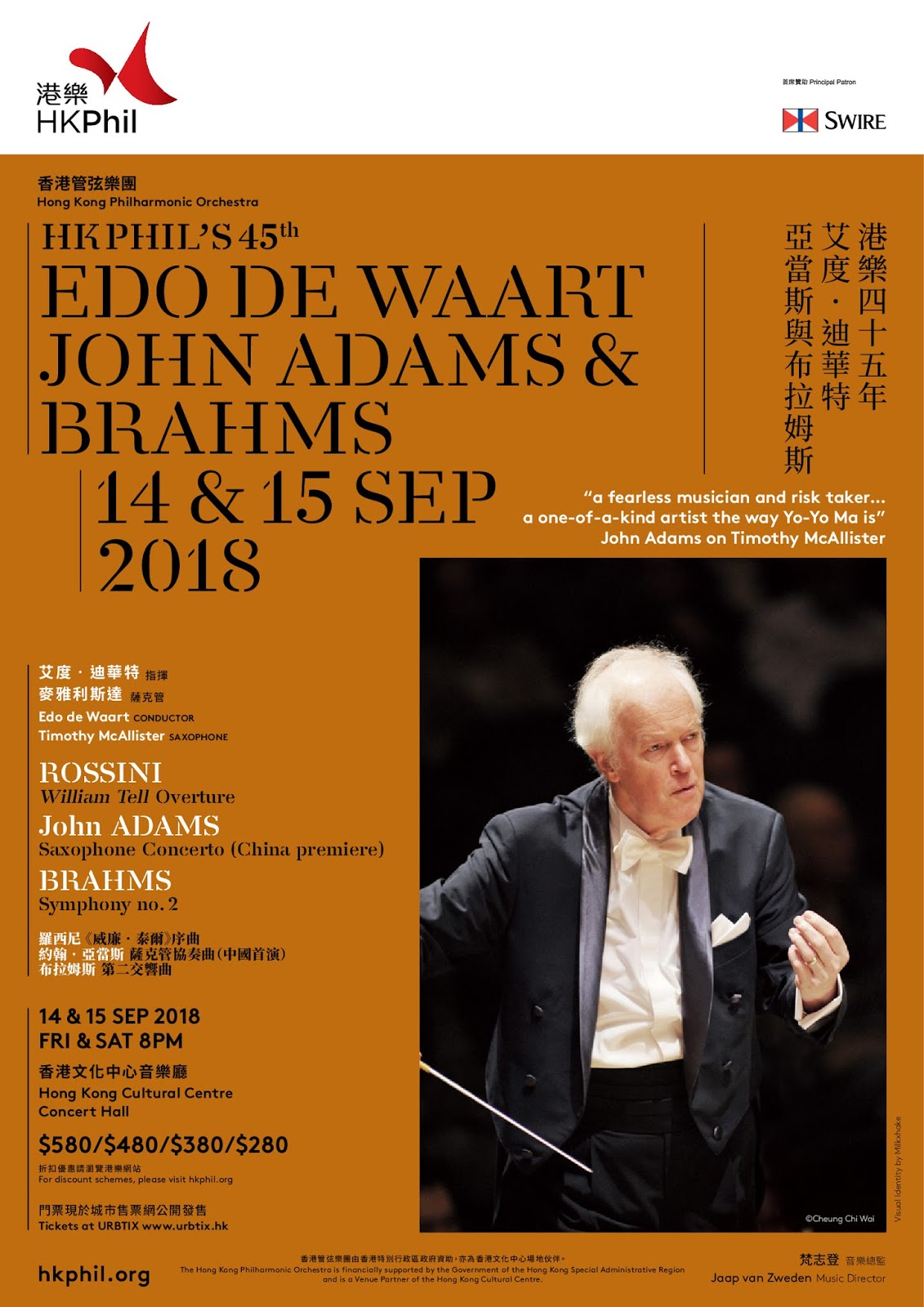
Review - Edo de Waart, Hong Kong Philharmonic Orchestra, 15 September 2018

Overture to William Tell (Rossini)
Saxophone Concerto (John Adams)
Symphony No. 2 (Brahms)

Hong Kong Philharmonic Orchestra
Timothy McAllister (saxophone)
Edo de Waart (conductor)

It was an interesting to hear how the orchestra responded to its former music director on the podium again. The cello solo employed a broad tempo to begin the overture with a lot of vibrato in rich tone. A quiet start to the storm section before exploding into a full thundering climax. Though under a steady tempo the impact was not as terrifying as expected. Beautiful duet between the cor anglais and flute during the pastoral scene. The closing gallop was tidy and majestic, also effective accelerando geared towards a triumphant close.

John Adams's saxophone concert felt alike a busy rhythmic exercise for the soloist. Fragmented patterns jointed jazz and blues together for a hurry and restless ride. The brass kept the momentum going but hard to tell where the music was sailing to. At reaching the middle of the first movement then the orchestra played without the soloist. The dreamy transition was enigmatic yet the saxophone solo had a more lyrical part than previously. The music landscape became flatter and calmer before returning to fierce gallop, and then retreated to a quiet end.

The second movement dominated by syncopated patterns and stayed vigorous on momentum. It was a tight dance in irregular phrases but also abstract as to where the music was heading to. Timothy McAllister sustained the energy throughout in his playing and kept the music flowing naturally. Though the dynamic and emotion contrast were more able to display in his encore.

The orchestra kept the dawn awakening like introduction to Brahms's second symphony flowed with a warm gentle tone and not too weighty in body. Neither aggressive at the climatic exuberance and stayed bright with a lot of legato to sustain the line. Though whether to do with de Waart's conducting style, the winds sometimes felt a fraction behind the strings. Tempo was rather laid back for a gentle and unhurried gallop at the end of the first movement.

The cellos began the noble theme of the second movement in a mellow warm tone that gave a tender and sunny impression. A misty respond from the winds against the emotional outpouring from the strings. Yet as in Brahms's style sentimental negotiation never reach a full answer but hold back by the recapitulation of the noble theme. The tragic sentiments gained more weight before resolving to a quiet end.

The winds began the pastoral scene of the third movement with a busy strings' part underlaid. Rhythmically it gained momentum yet carried more lyricism within.

An explosive start to the last movement in an energetic gallop. The transitions felt rather enigmatic though, which the lines would have been more effective if there was an aim than a mere shape. The majestic theme was passionately rendered in a warm tone. After a long negotiation the music finally located the end in certain with a glorious triumphant conclusion.


Review - Jaap and Joshua Bell, Hong Kong Philharmonic Orchestra, 8 September 2018

Academic Festival Overture (Brahms)
Violin Concerto (Sibelius)
Symphony No. 41 "Jupiter" (Mozart)

Hong Kong Philharmonic Orchestra
Joshua Bell (violin)
Jaap van Zweden (conductor)

Like the season opening performance before, a festive symphonic overture is programmed for an uplifting start. Though the orchestra was too energetic throughout Brahm's Academic Festival Overture, and as a whole it felt lacking character and essence. Jaap probably felt the swift tempo would keep the momentum going than dragging along. Yet already restless than being mysterious at the tip toe like beginning. By reaching the first triumphant climax then the orchestra was more stable and let the music sang. Despite displaying the tonal contrast, it galloped in hurry and occasionally lost in details.

The first violin began Sibelius's Violin Concerto with a spellbinding pianissimo and set the stage for the solo violin. Bell's playing produced a sweet rich tone with clarity, but his bowing did not always have the smoothness to sustain the long line and sometimes felt abrupt. He approached from a sentimental perspective by employing a lot of vibrato. His playing was passionate and expressive on the ebbs and flows of emotions, rather than holding back the sentiments in stillness. Despite a challenging part to play, tuning on the double stops were noticeably a hit and miss Whereas the orchestra strings seems holding back their response to avoid being overpowering. Interestingly, I thought there was a brief moment alike the motive of Siegfried's assassination from Wagner's Götterdämmerung towards the end of the first movement.

Bell began the second movement beautifully on the lush expressive violin part, yet the horns' accompaniment did not sound convincing. Occasionally I felt Bell put too much weight on the bow that it felt too rich and sticky than allowing his playing to flow more. The orchestra achieved more charity and locating its voice in the tragic response. Yet the syncopated section not really able to build up the climax despite effective dynamic contrast.

A busy start into the third movement for the solo violin part, but Bell was driving the tempo so much that his phrasing not quite grasping the shape of the polonaise dance. Tuning was very good with the harmonics and not so with the arpeggio climbs to the high positions. As a whole I felt mixed by Bell's playing, but after learning from friend's past experience, Bell could have been experimenting different approaches than giving a  straightforward interpretation.

I had not been impressed by Jaap's Mozart in the past but what he achieved from the orchestra on the "Jupiter" symphony changed my mind completely. Finally a more relaxing tempo was adopted for the first movement and the playing was very polished. Perhaps the violins could employ more accents in the down bow to give more rhythmic excitement than only sustaining the elegant impression. Contrast in tone colours at counterpoints was effective with beautiful tone at the majestic recapitulation. A flowing elegant impression was made at the beginning of the second movement. The sadness and solemnity at the tragic transition seems a reference to earlier piano concertos by Mozart. Later the landscape became smooth with a sweet and clean tone, while being sedate and slightly sentimental. The third movement became an elegant and majestic dance in thicker texture than the movement before. The orchestra was very responsive and immediate with the gallops in the last movement that kept the momentum forward. The brilliancy of Italian opera fanfare like section was effectively realised. The bright tone gave the dance like movement a flamboyant touch. The final gallop was energetic with the sheer rhythmic excitement that gave more audio satisfaction than the first half.

(Photo credit: Hong Kong Philharmonic Orchestra)

Review - Simon Rattle, Seong-Jin Cho & Berliner Philharmoniker, Hong Kong Cultural Centre, 10 November 2017

Don Juan (Richard Strauss)
Piano Concerto in G (Ravel)
Encore: Clair de lune (Debussy)
Symphony No. 4 (Brahms)

Seong-Jin Cho (piano)
Sir Simon Rattle (conductor)
Berliner Philharmoniker


The revisit of Berlin Philharmonic to Hong Kong marked the final Asian tour with Simon Rattle as its chief conductor, before Kirill Petrenko to assume the role in 2019. Besides local public screenings of both performances across the city, orchestra principals like Emmanuel Pahud and Amihai Grosz also gave their own recitals in town. Despite steep ticket price, with the top category charging nearly four hundred US dollars, the performance quality was as high as expected with many memorable moments. Over the two days a diverse programme was given ranging from Russian to Korean, though the first evening focused on the core German repertoire with Ravel's piano concerto sandwiched in between.

The full bodied sound, at the dramatic opening of the symphonic tone poem 'Don Juan', made a thrilling sonic impression. With such great energy, swift tempo continued at the following soft passage before rubato culminated the built up to a crushing climax. The intensity stayed throughout the gallop, but lacked some dynamic contrast at the mysterious flute leading interlude. The lyric like oboe solo was beautifully played while the strings sustained the soft and ethereal impression. The horns responded with a majestic and confident announcement of the main theme. During the thick and expressive transition, the orchestra managed not to create a vigorously violent tone. Rich tutti playing with sheer momentum drove the energy forward at the recapitulation of the highly romantic expressive theme. Though it could have been more patient with the tempo at the moody coda than too eager in reaching the end.

Probably due to where I sat behind the orchestra, the hall acoustic did not help to project the solo piano too well in the Ravel and sounded rather distant. Seong-Jin Cho's playing was rather stiff at first, in contrast to the energetic orchestral playing which was crisp and carried more direction. One felt the orchestra had a clear road map in mind and produced much colourful playing to the witty and jazzy passages. Elegant harp solo at first and Cho began to play with more momentum towards the end of the first movement . He finally sank into the performance when the lyrically expressive piano solo was given at the start of the second movement. His touch and dynamic achieved a fine balance with the vast space and carried the direction. Sublime winds' solo followed in their entrances and maintained a flowing impression that the tempo neither drag nor in hurry. The cor anglais played its solo beautifully and accompanied by the piano for a sweet and dreamy song without words.

Slick playing began the third movement with woodwind being smooth and secured in their jazzy passages. A rather playful piano part for Cho who maintained the lightness yet also the weight to keep the direction forward in the gallop. Excitement continued among the orchestral playing with transitions seamlessly woven together and accommodated the soloist with consideration on dynamics. For encore, Cho selected Clair de lune to continue the French theme and also a foretaste for his forthcoming album on piano works by Debussy. Not only he played elegantly, but also a good musical sense of phrasing the line naturally that never lose the intention. Even at the elaborated development that his playing was not aggressive and the smoothness sustained throughout. His exquisite touch on the tranquil music held me spellbound and deserved a second hearing in future.


Despite I generally had difficulty to appreciate Brahms's symphonic work generally, the high music standard that being set at the first half kept me interested in what to follow after the intermission. The fourth symphony itself was one that I struggled to understand. Like Tchaikovsky's sixth symphony, the composer would have a rather cheerful third movement but followed by a rather gloomy ending for the sake of seriousness. The first movement was also enigmatic and far from having a clear expression. Instead, the performance gave a rather different approach to the symphony than what I expected. It convinced me that the composer could have been less restrain on his emotions after all. Yet the orchestra took some time to settle at first by being uncertain and untidy in the syncopated entries. There was a level of eagerness to hurry the tempo along, while the strings were heavy footed with the pizzicatos and vibrato heavy. Structurally dialogues between strings and winds did not synchronise naturally and lacked the seamless connection that was effectively executed early on. Momentum gradually regained when reaching the lengthy echo of suspended main theme between parts. The lush tutti sound poured out the emotional tragic sentiments in full and crushingly violent at the coda.

In contrast, the second movement began with the winds playing a broad and majestic dance motive. Sectional entries were seamlessly woven together and stayed on the same dynamic level throughout. The strings entered confidently and expressive on emotions, which carried the sonic intensity but not explosive. It gradually built up the sentimental climax into a rich and vast sound world. The sonic depth gloriously rang out in the hall before calmness hold the emotions back once again. The overall approach to the third movement focused on romanticism than the celebratory mode. Sunshine and positivism broke through the cloudy closing of the previous movement, yet the playing remained majestic and lush than hastening through. Entries were closely connected, and the music was phrased into one long breath so that the intensity was kept throughout.

These all left room for a natural development when the tragic bleakness returned at the beginning of the last movement. Heavy vibrato on strings might not be the current fashionable performing style, but it had expressed the emotions effectively in full at this point. Yet the orchestra did not indulge with the sentiments but kept the momentum forward. Exquisite flute solo on the sorrowful theme answered by some hopeful glimpse from the brass. Violent respond on the strings instead, and was breathtaking to hear the crescendo being built in seven steps as one progressively more intense than before. Ebbs and flows of emotional tides in contrasting dynamic aimed for a tense coda, which culminated the wall of sound into a rich sonic ocean with depth. It took the breath away and worth even the expensive cost to hear this great orchestra on another musical inspirational high point.


(Photo credits: Berliner Philharmoniker; Cultural Presentations Section of Hong Kong)

Review - Piano Recitals by Daniil Trifonov and Rafał Blechacz, 26 September 2017 & 12 October 2017

26 Septebmer 2017, Hong Kong Cultural Centre Concert Hall:
Variations on a Theme of Chopin (Mompou)
'Chopin' from Carnaval, Op. 9 (Schumann)
Studie 'Hommage à Chopin' from Stimmungen, Op. 73 (Grieg)
Nocturne, Op. 33 (Barber)
Un poco di Chopin from 18 Pieces, Op. 72 (Tchaikovsky)
Variations on a Theme of Chopin, Op. 22 (Rachmaninov)
Variations on theme from Mozart's Don Giovanni, Op. 2 (Chopin)
Sonata No. 2 in b-flat minor, Op. 35 (Chopin)
Encore: Fantasy-Impromptu in C-Sharp Minor, Op. 66 (Chopin)
Largo from Cello Sonata (Chopin, arr. Cortot)

Daniil Trifonov (piano)

12 October 2017, Hong Kong City Hall Concert Hall:
4 Duettos, BWV 802-805 (Bach)
Rondon in G, Op. 51, No. 2 (Beethoven)
Sonata No. 3 in C, Op. 2, No. 3 (Beethoven)
Fantaisie, Op. 49 (Chopin)
Nocturne in f-sharp minor, No. 48, No. 2 (Chopin)
Sonata No. 2 in b-flat minor, Op. 35 (Chopin)
Encore: Intermezzo in A, Op. 118, No. 2 (Brahms)

Rafał Blechacz (piano)

Less than a month after Daniil Trifonov's Chopin themed recital, Chopin's works again filled the second half of Rafał Blechacz's programme. Both had the second piano sonata as the concluding item, yet the two approached differently. One felt Trifonov was rather expressive and romantically driven, whereas intimacy and inner emotions marked in Blechacz's playing.

When Blechacz played the short prelude in A major as his final encore, it reminded us of Mompou's theme and variations that Trifonov began his recital. Despite the vast acoustic of cultural centre concert hall, one enjoyed the soft and sedate opening. It led to a lyrical passage marked by contrasting dynamics before resolving to the dreamy state again. The dotted passage felt pondering than carrying a direction though, and became rather cloudy in the tender and tuneful theme. At reaching the expressive and passionate climax, Rachmaninov seems more in mind by the harmonic colours and rhythmic patterns. Trifonov restrained from keyboard bombardment in the fantasia like gallop but instead gave a rather feminine touch to it. The four short pieces by Schumann, Grieg, Barber and Tchaikovsky as hommage to Chopin was an interesting selection. Grieg's approach reminded me of Rachmaninov than Chopin by the expressive arpeggios, whereas Barber harmonically was rather modern looking with the mysterious outlook that gone very distanced from Chopin. Tchaikovsky though lacked a definite outlook but only soft and tuneful.

Despite Rachmaninov referenced the funeral march from the third movement of Chopin's second sonata in his theme and variations, his idea went beyond the original with a rather symphonic sound world in mind. Trifonov kept the slow march flowing than indulging on the tragic sentiments. A mysterious and sorrow start to the fugue,which then developed into a lively and complex progression. Spread chords were expressively played and not aggressively hammer. A brief romantically driven passage followed by a crushing and wild gallop. Contrasting dynamics created immense emotional contrast and later it developed into another mysterious and unsettling transition. Then it galloped into a broad and muscular sound world with sheer intensity, in contrast to the fantasia like development that later lightened up by a lyrical theme. A triumphant and exuberant climax was given yet Trifonov rightly so to play the return of funeral march as devastating and bold than before.

The second half though lacked the brilliancy and lost focus. Variations on the theme from Mozart's Don Giovanni recalled those technical showcase piece by Liszt, but it did not feel right for Trifonov. His playing became untidy and phrasing seems random. Gallops were sometimes out of shape and sounded blurry by being sticky on the pedal. Later he was impatient in the first movement of the second sonata by hurrying through. It felt like a tense pressing after a lyrical resolve but never reach. Employing the same approach became dull for the ears and lacked contrast in colours. Questionable phrasing again in the second movement that did not carry the dance momentum but only as a rhythmic exercise. Nevertheless, he regained the calm and submissive touch in the tender interlude that at times was spellbinding and effective. Cloudy tone resurfaced at recapitulation even it was energetically driven. The funeral march of the third movement recalled the Russian context alike Rachmaninov early on. Trifonov seems more at home in building up the majestic crescendo in contrast to the still and lullaby like passage, which the softness magically stayed on the same level without losing the intention. As the funeral march returned, the emotions culminated again for the sheer devastation. Twice I listened to the short and chromatic styled fourth movement, one still could not understand by its purpose. Perhaps I was tired by then or Trifonov employed too much rubato without a clear intention, neither the Fantasy-Impromptu or arrangement of the cello sonata interested me anymore.

The acoustic of City hall concert hall is more ideal for solo instrumental recital with a warmer sound, and more in proportion by the smaller performing space than the cultural centre. It elevated Blechacz's smooth and delicate playing into a beautiful tone throughout. He began the Bach tidily and aimed for the counterpoint in the first movement. Each thematic entry at the fugue of second movement was introduced clearly and structurally transparent. The good work continued into the third movement and kept the momentum flowing. His ornamentation sank naturally into the tricky rhythmic patterns of the fourth movement with the dynamic differentiation that created a colourful sound world. However, I did not enjoy his interpretation of Beethoven's Rondo in G as much as the other works. It felt he was hurrying along and rather mechanical in approach, which pushed the tempo too quickly than letting the music to sing. The attacks were rather sudden and shapeless by his playing being impatient.

In turn, he had shown more thoughts and interest for Beethoven's third piano sonata. A muscular flourish opened the piece and the progression flowed tightly that had the intention to move forward. Though he could have been more relax in the soft passage by being more tender than tense It would have allowed more dynamic contrast from the dense and bold interlude followed. Composition wise it seems Beethoven wanted to experiment new harmonic language and those thoughts were given a quick glimpse. Blechacz maintained the smoothness and clarity as the music descended to the lowest range before repeating the opening theme. The second movement was romantically driven at first but at the end the classical style returned, which was more optimistic than the tragic sentiment in first place. Spellbinding tenderness during the quiet and soft passage that sustained the textual silkiness. Scherzo of the third movement was probably the most experimental of the whole work. Harmonically complex and structurally dense but leaving an open end without a clear resolve. Blechacz kept the rhythmic excitement by aiming at the spring board to the next phrase that began the fourth movement. The heavily scaled passage carried the sheer intensity with forward momentum and again Beethoven experimented ideas before a conventional closing.

Chopin's Fantaisie began rather mysteriously and moody. It was rather inward looking before a climatic built up from the soft and lyrical theme into a vigorous dance. Blechacz's left hand was sometimes heavier than the right but still able to maintain the clarity. He preferred a tidy and unhurried playing in the flourish than a technical run off with bold gesture. Nocturne in f sharp minor is a more typical Chopin piece with the subtlety and calmness more familiar with. Tenderness and the intimate sentiment were sustained throughout that a grand overview.

Compare to Trifonov's interpretation, Blechacz approached the first movement of the second piano sonata with a more sustained and legato playing. Even the expressive gallop stayed subtle which lightened the emotional flourish. Yet the progression stayed tightly and maintained the direction. Structural clarity was achieved even at romantically driven passage than over expressing. This time the second movement still had the virtuosic impression but managed to carry in a rich tone. It was gentler and more sedate through articulating the contrast between intimacy and rhythmic excitement. Funeral march of the third march was also given a lighter touch and flowed in boldness. Dynamic contrast was more faithfully observed to avoid being dense and over sentimental. The lyrical theme was highly moving by the sensitive touch with lightness, before the funeral march reappeared majestically. Intermezzo in A by Brahms put the smile back on the face and ended this performance on a satisfying high point. 
Review - Violin Recital by Kyung Wha Chung, Hong Kong City Hall, 17 September 2017

Debussy: Sonata in G Minor, L. 140
Fauré: Sonata No. 1 in A, Op. 13
Brahms: Scherzo in C Minor, WoO 2
Brahms: Sonata No. 3 in D Minor, Op. 108
Fauré: Berceuse, Op.16 (encore)
Debussy: ‘La fille aux cheveux de lin’ from Préludes (transcribed; encore)

Kevin Kenner (Piano)
Kyung Wha Chung (Violin)

Kyung Wha Chung made her long-awaited return to Hong Kong at age sixty-nine with pianist Kevin Kenner after her last recital here four years ago. As a child prodigy who entered the international hall of fame at the age of nineteen and very soon stepped in for Itzhak Perlman to play Tchaikovsky’s Violin Concerto with André Previn and the LSO, the South Korean star quickly gained renown as one of the foremost violinists of her generation and is primarily known for her highly sensitive and stylistic playing. Her career was however abruptly stalled by an accident in 2005 and it was said that she could only spend the next 10 years practising the violin in her head. The ambitious concert on Sunday therefore truly marked the return of a giant.

Traces of her former glory could still be found in her expressive rendition of the three most intimate sonatas for the violin. The Debussy sonata is an artistically challenging piece calling for an impressionist understanding of the often times ambiguous and highly nuanced musical language. Chung’s interpretation was graced with beautiful phrasing and a strong tone, although occasionally erring on the side of conservatism as some dynamic extremes were left unexplored. Her 1988 recording with Radu Lupu was probably superior in terms of the general clarity and cleanness of left hand passageworks.

The Fauré sonata was generally well-played, with a well-controlled sense of urgency in the first movement, an introspective and melancholic shade in the second, a vivid and youthful touch in the third, and unapologetically romantic ardour in the last. Her fluid playing was skilfully matched by the sense of freedom in Kenner’s piano accompaniment, never at any point losing any connection or coherence. That said, the major critique of the performance is that, in addition to occasionally unfocussed intonation, Chung’s often aggressive right-hand techniques such as bow slamming and accented retakes detracted much from the smooth and salonish quality of the sonata. Artistically speaking, the lilting theme of the barcarolle-like Andante was handled too plainly, and the general abstinence of portamento reduced much of the tension which could otherwise have been brought out in the broad syncopations. The tempo of the finale was also a bit rushed, and its passionate lyricism was stifled by a rather coarse tone and an uneven register whenever higher positions on lower strings were used. Chung’s habit of swelling excessively on notes also reduced the charm of the long cantilenas most beautifully written for the first movement.

Boisterous and stormy as they are, the Brahms Scherzo and the D minor sonata seem to be Chung’s strongest suit in the concert. Despite tiny lapses of intonation, she played with unflagging verve and incisive rhythmic precision throughout, overwhelming the audience (appropriately) with the agitating and heavy texture of the work. At the same time, lighter and more exquisite passages were handled with much sensitivity, especially the second movement of the sonata.

In stark contrast to the disquiet of Brahms, the two encores by Fauré and Debussy, both performed with a mute, provided some welcome respite for the audience. Each carrying a mesmerising appeal, they may perhaps be seen as a summary of Chung’s most personal and nostalgic reflections on the past fifty years of her career. In these two simple encores, one catches a glimpse of Chung’s true mastery and her delicately warm voice which distinguishes her from all other violinists of her time. Without a doubt her next recital will be eagerly awaited by many.


(Photo credits: Instagram and Facebook)

Review - The Choir of King’s College (Cambridge), Stephen Cleobury, Louise Kwong, Hugo Herman-Wilson, Grand Hall of Lee Shau Kee Lecture Centre (The University of Hong Kong), 27 July 2016

Laudibus in sanctions (Byrd)
Loquebantur variis linguis (Tallis)
Hymn to St Cecilia (Britten)
Ein Deutsches Requiem, version with piano four hands accompaniment (Brahms)

The Choir of King’s College (Cambridge)
Louise Kwong (Soprano solo)
Hugo Herman-Wilson (Baritone solo)
Stephen Cleobury (Conductor)


King's revisit of Hong Kong this time gave a shockingly disappointing performance and did not live up to its reputation. Although one should not dampen the spirit and confidence of young aspiring choristers with strong criticism, any excuse could not hide the fact that the choir has some fundamental problems in singing technique, blending, ensembleship and even the musical leadership. The programme of the first half struck a right balance with the Brahms Requiem later. It began with Byrd's outward jubilant god praising psalm 150, followed by Tallis vesperal response for Pentecost to celebrate the descent of holy spirit upon the apostles, then Britten's intimate and inward praying of St Cecilia, patron saint of music, before a personal dealing of grief and death in the non liturgical requiem.

Basses delivered confident singing with support in the Byrd and voices blended well, but trebles were feeble and lacked presence. Poor intonation throughout and sluggish in tempo. The upper voice parts sung in variety of pitches and all over the place. Generally failed to craft the structure of the piece neither any sense of sectional dialogue. The beginning of the Tallis was chaotic and coordination problems happened among choir. There was no direction in the singing and structurally shapeless. It was alike showering with notes but no communication among parts. Cleobury's conducting did not indicate phrasing but rhythmic counting only. Trebles remained very breathy in their timbre and underwhelming in vocal projection. The men's chanting had the right flow with words and more unified in diction.

Shaky start with pitch problems in the first few notes of the Britten and vowels were not homogeneous. A rather vertical reading of the score and strangely, alike the trebles, the tenors and altos sounded thin and lacked presence in projection. Diction in the second section was poor and trebles struggled with intonation. Again the singing lacked direction and rushing through the text without singing the full value of notes. It neither manage to build up the momentum and crescendo for the climax. The treble solo did not possess a radiant tone and timid in projection. Towards the end tempo gradually became sluggish again, and part solos failed to deliver some quality individual singing and technically insecure.

The piano solo opening of the requiem would probably need more urgency than being steady. The choir entry did not deliver the body of sound and trebles remained timid in their singing. Although arguably a collegiate choir differed from large choral groups with a leaner and lighter sound texture, vocal projection was problematic here that far from filling the hall. Tenors' timbre were noticeably not complimenting each other and did not blend with rest of the choir. Intonation improved in the second movement 'Denn alles Fleisch ist wie Gras' and the choir found itsfeet here. Though the body of sound still failed to make an impact and individual voices sticking out. Their diction in German was presentable but slightly wet for my taste. Energy and direction did not always sustain in the fugue, and far from building the exuberant climatic calling for eternal joy over sorrow.

Beautiful singing from the baritone solo and gave a poetic reading of the third movement 'Herr, lehre doch mich', but tenors simply could not blend together in their singing. Intonation towards the end of the movement gradually worsened as the vocal range went up. Everything went downhill from the fourth movement onward. The better known fourth movement 'Wie lieblich sind deine Wohnungen' sounded very dull here and also lazy in diction, which affected the tuning. The score reading was vertical again and the choir not singing through the line. Cleobury might have assumed the music would speak for itself, but that would require him to signal the phrasing than being economical and vague in his conducting.

Despite one would prefer a lyric soprano than dramatic one, Louise Kwong gave the best live account of the fifth movement 'Ihr habt nun Traurigkeit' I had encountered in live so far. The part tessitura was vocally demanding for the soloist to sing rather high with only a short build up from mid range. She was secured with intonation and delivered the desired projection, though slightly forceful to nail the top notes and rather muddy in diction. The choir also began to sound tired and sometimes fraction behind the piano playing, which later turned into one chasing the another. The focus and energy faded as the sixth movement went on. The judgement day passage was not dramatically realised by the singing and trebles were flat at the cry of death. The fugue conclusion was chaotic with poor intonation and choppy singing. Tenors were not confident in their entry and inaccurate with notes. The choir again failed to blend together nor manage to maintain the momentum.

One suspect the choir did not prepare well enough to familiarise itself with the music in the end. Diction was completely out of the window at the supposed emotional last movement 'Selig sind die Toten', and neither the singing was radiant nor memorable. Trebles struggled with intonation throughout and as a whole it failed to make any impression. It did not work when the vocal colour remained bright only throughout, but lacked differentiation and musical shape. Words failed me to conclude how unconvincing this performance went, and the tickets were overpriced judging by the poor artistic quality being given, except the two soloists redeemed it from further disaster.

Review - Yannick Nézet-Séguin and The Philadelphia Orchestra, Hong Kong Cultural Centre Concert Hall, 19 May 2016 & 20 May 2016

19 May 2016
Symphony No. 2 (Brahms)
Scheherazade (Rimsky-Korsakov)
Encore: Petit adagio from 'Autumn' from The Seasons (Glazunov)

20 May 2016
String Quartet No. 11 'Serioso' (Beethoven, arranged by Mahler)
Symphony No. 4 (Bruckner)
Encore: 'Sheep may safely graze' (Bach, orchestrated by Stokowski)

The Philadelphia Orchestra
Yannick Nézet-Séguin (Conductor)


The Philadelphia Orchestra two day residency in Hong Kong compensated the underwhelming orchestral offers during the arts festival in March. No concerto in the programme but we were treated with three substantial symphonic works and an arranged chamber work for string orchestra. It was also my first to see Yannick Nézet-Séguin in live action. I had some expectation since there was a rumour that he would be the next music director of the Metropolitan Opera in New Year. As a whole the showcase was memorable to an extent and the Bruckner fourth symphony made a stunning conclusion.

The first evening was a mixed affair. I suspected orchestra members were still recovering from the jet lag and adjusting to the acoustics. The first movement of Brahms second symphony was an unending song from beginning to end. There were some occasional similarity to Mendelssohn's overture 'The Herbrides'. Both lower strings and horns seems uncertain in direction at the mysterious fog heavy opening. Soon the passionate tutti put the playing back on track. Amidst the contrasting passages in dynamic, texture and pattern, there were some beautiful playing from the woodwinds and the cellos. The orchestra was responsive to the dynamic indication and retained the presence even at pianissimo. Yannick never over phrase the music in his conducting and had the confident in the band to do its own work. The articulation was natural with momentum and gradually built up the climax in the fugal passage. The only weak part was the solo horn player, which the tone sounded muffled and remained a let down throughout rest of the concerts.

Although a promising start, I did not find the orchestra managed to find the direction in rest of the symphony. The cello solo at the opening of second movement lacked shape in the playing. Dialogues between sections also would need the space to let the music breathe instead of hurrying along in swift tempo. It all sounded moody and unsure where sailing into. The cor anglais pastoral passage at the beginning of the third movement would need to dance more with the music. There were merits though in the peasant dance like presto passage that being unhurried and highly disciplined on rhythmical precision. Strings were rather messy in the fourth movement and did not match the same sense of momentum as in the first movement. It was only until the finale that the playing improved as a body and the brass produced some blazing tone.

During interval, I spotted three non occupied seats in middle of the stall and decided to move there. The orchestra balance was better than where I originally sat behind a wall of double basses. Though I neither enjoy nor dislike the objective approach of Scheherzade in the second half. The violin solo at the beginning produced a silvery tone but the concertmaster seems uncertain with the bowing directions and sight reading like. The upper strings sustained the same colour but sounded rather thin in body with less bow hairs being employed. The flute solo again stood out with some exquisite playing. Dialogue between wind players produced a better sense of music direction and unhurried in momentum in comparison. Radiant playing from the lower strings, particularly the cellos, with a mellow rich tone and I found it moving.

Though the lyrical passages could have allow more time to indulge the music more. Sectional dialogues were still far from connecting as a body and lacked the fluidness. Both the trombone and horn duet were capable technical wise, but the produced sound were again muddy and far from making an impression. The rhythmically robust passage in the fourth movement would have been more successful if more bites from the upper strings with the urge and attack. Again only at the finale the orchestra produced a more muscular and passionate body of sound. The final violin solo was more secured in bow directions and more hairs on the strings, though intonation was shaky as the positions went up. I felt the closing could have taken the tempo slower for a spellbinding conclusion. Yannick was probably not that familiar with the music as he looked at the score more often. A polish account of the work, but holding back the emotion and not indulge in some rubato moment seems taking away the expression and distinctive colour.

The second evening began with a lesser known Mahler arrangement of the last quartet from Beethoven's middle period. It was an intellectual choice to showcase the strings with a time relevancy to the Bruckner fourth symphony. The work itself seems telling Beethoven could not settle on a logical modulations but abrupt jump in keys instead. The fluctuation in mood changes were often enigmatic, moody or sarcastic. Tempo wise the ensemble would not have the same flexibility as a string quartet but a different sound texture that interested me. Compare to previous evening, strings players employed more hairs on the bow to produce a richer sound. They had a better sense in crafting the structure and more intimate dialogue between sections. The lower strings gave the rhythmic punch and intention in the violent passage of the first movement. It would have been effective if the upper strings could match with better phrasing. The horse galloping like third movement was successfully visualised with the sheer sense of energy and bites on the bows. There were even moments I thought in texture echoing the first movement of Beethoven ninth symphony. The allegretto of the fourth movement would still need more space and patient for the music to sing more. The presto ending was thrilling though with the impact of momentum but one could detect the composer was not wholeheartedly commit to the positivism. I was also impressed by how well Yannick knew the work and guided the musicians with appropriate indications. The playing was never heavy and dragged. His non interventionist conducting kept the music flowing and the structure being naturally shaped. Small gestures were effective and marking the differentiation in what he wanted dynamic wise or where the focus should be at the spot.


If high marks for the first half, his execution of Bruckner fourth symphony was even better and memorable with many magnificent moments. I felt the performance helped me to visualise the scenes or expressions that the composer had in mind. One would imagine the first movement was a long search journey whether walking or riding along the hills next to a great river, perhaps the Rhine or Danube. The horn solo at the beginning was slightly shaky but soon the tutti crescendo culminated a rich body of sound pushing towards the first climax. Smooth climbs in the arpeggio passage between the quiet moment and violent climatic point. The brass section then made a brilliant muscular tone with warmth to mark a contrast in dynamics and atmosphere. Upper strings were technically capable but the playing was rather cloudy in the expressive passage followed. The trio between solo flue, trumpets and horns maintained a good direction though. As a whole the orchestral playing was more together as a body than before. Sections responded to each other and kept the music refreshing, which produced the motivation to look forward to the next development.

Radiant playing from the cellos opened the second movement. The lower strings produced a beautiful and mellow tone in the melodic passage with pizzicatos from the upper strings on top. Finally the tempo of slow movement was not in hurry and had the space for the music to breathe. Though the horns did not quite match the mark set by the strings in the wind dialogue. Phrasing was not its forte and some notes sounded to me were not in its full value. A dramatic transition from a muscular rich tutti to the quietest moment alike walking on tiptoe. The cellos was not over sentimental with its playing in the third solo passage, and at the same time captured the tragic feeling where the music was heading into. The final part felt like clock ticking forever. Triumphant climax from the brass did not brighten up the atmosphere but only the music became more mysterious at the end.

In opposite, the third movement could be imagined as a pastoral hunting scene. The trombones and trumpets were brilliant and confident in the hunting calls, but again the horns' playing were muffled and notes were not differentiated clear enough. The muscular scherzo was answered by an elegant trio by the woodwinds. There were more facial expressions from Yannick at the recapitulation, and could sense the orchestral playing more playful than the first round.

The final movement again recalled the long search journey in the beginning but this time the walking pace was in hurried than before. It was neither definite in message as the third movement as what to look for in actual, or the composer struggled to find a satisfactory conclusion. The orchestral playing showed no sign of tiredness or boredom though and kept the interest going. Energetic tutti started off the violent and dramatic opening. A brief moment of triumphant outburst before the strings and woodwinds played the enigmatic minuet dance passage. The brass again brilliantly played in the tempestuous response and as section had the flexibility to capture the atmospheric contrast. Objective playing had been the norm to this point but sentiments were finally allowed. The strings poured out the emotions accompanied by majestic brass playing to aim for another triumphant climax. Yet the exquisite flute solo marked it was only a transition but a long way before reaching the end, which was to recall the opening of first movement. Emotions were accumulated and the orchestra sounded very different than before. A radiant body of sound by being more dense and richer in tone. It found its way how to integrate into the music with character than merely playing the notes. The ending was spellbinding and took the breath away by its intensity.

If one has to look out for superlative Bruckner symphonic experience in future, Yannick is the conductor to go after and to be amazed by how he conducted the music by heart and hardly looking at the score. He gives whatever necessary to articulate and the same time to let the musicians do its work. Nothing exaggerate or dictatorship from the podium but clear, simple and effective indications to command. To maintain such balance could be high risk if the band is not capable or not always able to deliver. This performance confirmed the trust and partnership could deliver some wonderful music making and that matter most. 

Review - 2016 Hong Kong Arts Festival - Rundfunkchor Berlin, Human Requiem (2 March 2016) & Lover (5 March 2016)

"Human Requiem", 2 March 2016, Loke Yew Hall, The University of Hong Kong

A German Requiem (Johannes Brahms), version for soloists, choir and piano four-hands arranged by Phillip Moll from the original transcription

Berlin Radio Choir
Soprano soloist - Sylvia Schwartz
Baritone soloist - Konrad Jarnot
Pianists - Angela Gassenhuber, Philip Mayers
Directors - Ilka Seifert, Sasha Waltz
Conductors - Nicolas Fink, Andreas Felber

"Lover", 5 March 2016, Hong Kong Cultural Centre Grand Theatre

Lover (Christian Jost), music-dance-theatre for choir and percussions

U-Theatre (Taiwan) and Berlin Radio Choir
Director - Liu Ruo-yu
Drumming Choreography - Huang Chih-chun
Conductor - Nicolas Fink

I never been a great fan of Brahms except his chamber works. His symphonic and choral works made an impression that being restrain on expressing his inner emotions and creative ideas. Nevertheless, I found this superlative performance of Brahms's Requiem by the Berlin Radio Choir, in a conceptual production of Sasha Waltz & Guests, a powerful and moving experience.

The stage choreography and light effects set up a visual interpretation of life and death in regard to the emotions and abstract visions of the religious sung text. Audience were encouraged to participate and involve while surrounded by musicians on the ground floor. Though I had taken the option to watch the performance from the balcony for acoustic balance and visual impression how it all came together. The first movement 'Selig sind, die da Leid tragen' began with choir members in circular flow among the standing audience. It was a mobile meditation to enact the life cycle in between sadness and happiness. The hall turned into darkness as the second movement began. A funeral procession was formed with the chorus carrying a lady in white lying on top of a pyre and pushing the piano on a mobile platform. The highly dramatic 'ritual' realised the sequence of death and gradually built up the climatic moment when receiving hope over sorrow.

The stage light then flooded on the altar where the lady in white lying in the fourth movement. The procession returned to a slower flow while the baritone narrated at the end of life souls and mind were given to the custody of god. At this point the chorus entered the stage platform at the other end of the hall. A playground with swings formed a metaphorical representation of garden Eden for eternal joy, which echoed the verses of psalm 84. Audience stood again and all looked at the representation of 'heaven'. The lady in white was resurrected and became the angelic figure telling the comfort and peace she found in the after life. The sixth movement then turned away from the journey of life, death and reborn to dwell more on the second coming of Christ. Bleak lighting was employed when the baritone sang passages of the judgement day from the first book of Corinthians from the balcony. The chilling surrounding gradually faded away when a lone stage light lit up directly at us. While the choir formed two long lines separating the audience, children processed out through a door to represent the power of creation and hopefulness. Then the hall gradually returned to darkness as the choir formed a square surrounding the audience to sing the epilogue that the faithful would receive the reward and blessing.


Towards the end, I understood more why the composer selected these biblical texts and the relation with the music. One could argue the staging was one way putting us into context but importantly it highlighted that delicate relationship between the human desires before and after death, whereas christian beliefs would provide that 'vision' whether one being religious or not. The text itself would also not make the same impact to bring out the sentimental emotions without the music and visual realisation of the concept. It was 'human' after all since we participated, and for centuries endlessly seeking after the same idealistic ritual and aftermath, thus, no surprise that I felt satisfied and fulfilled however naive the thought might be.

Musically, this chamber version offered a leaner sound texture that was refreshing for the ears and allowed the music to flow more vertically with directions. Impeccable clarity in diction and the rich body of sound produced many spellbinding moments of beautiful choral singing, particularly the sheer force of musical momentum in the second movement 'Denn alles Fleisch, es ist wie Gras', unaccompanied passage of the fifth movement 'Ihr habt nun Traurigkeit' and 'Herr, du bist wuerdig' in the sixth movement. Generally the male voice parts were better by using less vibrato and produced radiant tone colour. It took female voice parts, the sopranos especially, some time to coordinate tempos and intonation as a section. As a whole, the choir should be credited for not only acting around the hall while performing, but also sang the whole work from memory without the score. The two conductors managed to hold everything together despite the complexity of choreography, which was not easy for the sightline. They mostly kept the musical shape well enough except some chaotic moments in the fugue of second movement. Vocally the two soloists were disappointing though. Konrad Jarnot somehow lost the sense of phrasing and being unsettled with tempo in the third movement 'Herr, lehre doch mich'. I felt he improved later in the sixth movement, 'Denn wir haben hie keine bleibende Statt', with the desired darkness in timbre and vocal volume for the authoritative opening. Sylvia Schwartz was the weakest link of the evening. Heavy vibrato in her timbre and wobble through the supposed angelic first half of the fifth movement 'Ihr habt nun Trauigkeit'. Diction was muddled as result and only her outlook redeemed the visual expectation. Polished and sensitive playing from the two pianists maintained the musical momentum throughout. They responded to the change of atmosphere by being tender or building climatic moments with flexibility.


'Lover' by Christian Jost was an attempt of intercultural art collaborations through Chinese martian arts and percussions, western choral singing, poems from ancient China and the American poet E. E. Cummings from first half of 20th century.

The evening began with a white man in blind, the protagonist, first came on stage while male dancers in black performing a ritual dance. It partially realised the scene of crying ospreys surrounding a lost man struggled to see the reality, but not so much magnifying the pain from longing a woman that far from reaching. Musically the next movement, based on Cummings' 'May I feel said he', was the most colourful of all. Drums, gongs, xylophone and guqin produced percussion effects to depict hesitations and psychological confusions when couple fell into love. The choral passage in contrast was more lyrical and tonal. Women in red dress joined in the dance but the blind man in white was sailing with long stick and holding a fish net. It was more a mind game of affections than physically passionate. The third movement, 'I like my body when it is with your body', was supposedly more body graphical vivid, though the stage choreography turned out to be a refined 'kung fu' demonstration. The white man unfolded his blind and became acrobatic in movements. Vigorous drumming was given but the lullaby like choral passage was most enigmatic. An abstract theme followed by lamenting the memories in bed at the day of doom. The singing became a form of meditation in the style of Tavener, slow, simple but surreal. Though I found the following drum solo a technical showcase rather than a devastation. Nonetheless, many would probably find it entertaining and provided some musical direction than the previous cloudy choral movement. Staging wise the last movement was most elaborate with big white plants hanging from the roof to realise the image of heaven, which the poem 'Shang Ya' specify the protagonist would merge altogether with earth. The white man wore a rich red coloured dress and finally reunited with the 'lady', but we could not be sure whether it was a human love or more.

I felt abstraction and simplicity would have worked when each domain connecting to each other rather than performing its conventional function in fullness. A storyline was not necessary but stage choreography often became a demonstration of artistic beauty than realising the abstract psychological states of the sung texts. It was also a pity to be restrained on physical contact even the imaginations were expressive on it. The underlined message, from physical desire of love and affection between man and woman magnified into the philosophical embrace of nature, was grand but randomness in context vaguely connected the poems as a whole. It was a good intercultural art experiment but lacked logical progression to make the message a powerful one.

The Berlin choir was positioned differently for the Hong Kong performance, which they sang from the orchestra pit than behind the percussion units. This might to do with the acoustic balance in the grand theatre but it left the backstage rather bare in darkness. Another problem was related to diction, which I felt the choir generally fell short from articulating both the Chinese and English sung text understandable for the ears. Despite more tonal than Philip Glass, musical textures mainly stuck with repetitive patterns and certain sound range in each movement. I hardly remembered if there were any corners with dramatic choral effects to emphasise certain words. It was no surprise that the choral singing hardly able to shape the music except every time an endless narration with many words. The impression might have been better if the sopranos would employ less vibratos, more secured intonation and younger voices to refresh the music for a clear sound structure. Christian Jost's conducting was more to keep everything together but nowhere near to that superlative Human Requiem performance three evenings ago.