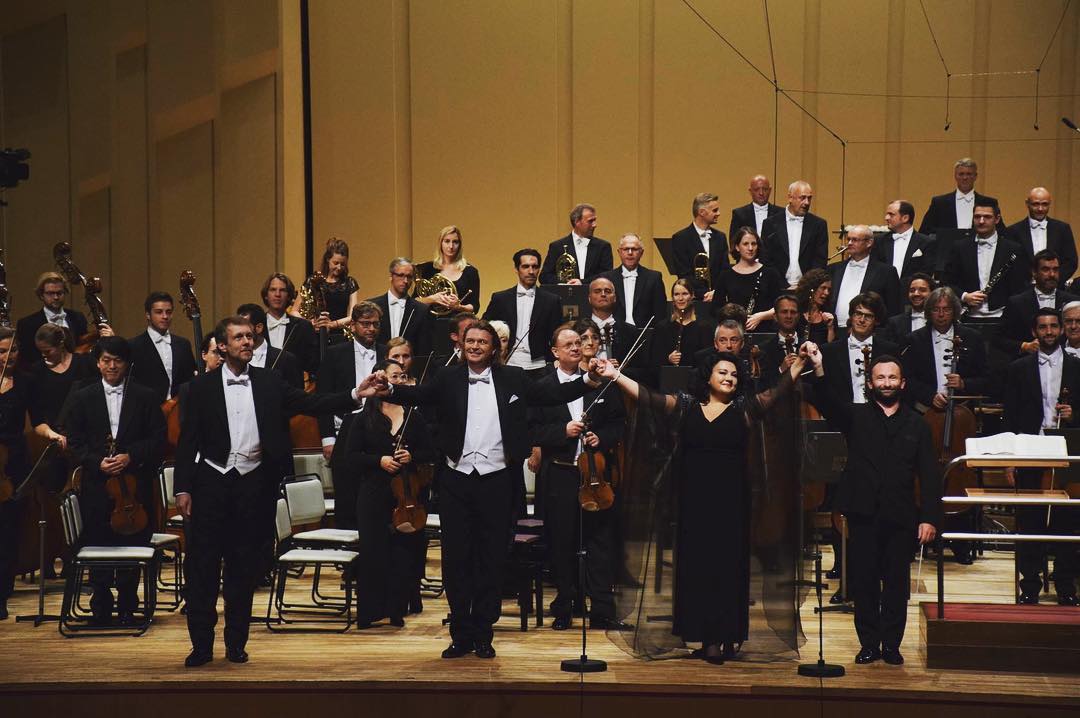
27 May 2017, Hong Kong Cultural Centre Concert Hall:
Overture 'A Midsummer Night's Dream' (Mendelssohn)
Piano Concerto No. 1 (Mendelssohn)
Symphony No. 4 (Mahler)
Lan Rao (soprano)
Serena Wang (piano)
Long Yu (conductor)
The ongoing Mahler cycle by the philharmonic orchestra now spread across three seasons, but not knowing whether the eighth symphony being planned for future performance or not. Two of the concerts in this review are long overdue for review, yet recent performance of Das Lied von der Erde provides the excuse to recall what happened. The 2016/17 season focused mainly on symphonies of the wunderhorn phase with the fourth symphony marked the conclusion.
Mendelssohn filled the first half for a lighter start supposedly, but reading my notes it seems impatient and aggressive playing created most of the impression. The strings hurried along the overture that the gallop was energetic but rough. There was hardly any shape in phrasing but the simply hurrying through. Whether to do Yu Long's unclear conducting, who just beating out in two than showing any shape, or an individual in the orchestra played ahead, the end of one line was audibly messy and wrong. The orchestral's wildness continued into the first movement of the piano concerto which too much energy expressed by the playing. Lyrical moment was not elegantly rendered and the orchestra began to shape the music on auto mode by ignoring the conductor. Serena Wong's playing on the piano was smooth and beautifully executed, particularly the second movement, which she allowed the space for the music to breathe and recalled the much needed calmness. The orchestral entry to the third movement was more relaxing with a flowing progression yet swift in tempo. Technically Serena Wong was precise with a good touch that never being aggressive, yet it would take her few more years to sophisticate and mature her thinking on the work.
Though the orchestra was impatient again at the start of Mahler's fourth symphony. It did not feel like a delicate dance and the dynamic contrast felt rather extreme. A rather awkward structure continued with too much rubato employed in the lyrical section and lacked direction during the melancholy transition. The crushing climax fell short of the violent effect, yet the return to the more happy looking expressive moment stayed very loud and muscular. These all created a heavy footed impression by being sticky and lacked contrast in colours. Focus was lost by the broad and steady tempo adopted in the second movement. The orchestra dragged along and failed to realise the atmospheric change from the grotesque outlook to the sweet coda.
Strings managed though to play more tenderly in the third movement but still very vertical progressed, which lost some momentum and turned it into fragments than continuation. It was probably why the climaxes lacked the weight of impact and the pastoral excitements felt extreme than naturally developed. Neither was the connection between ebbs and flows of emotions effectively created, but merely making an explosive sound or accelerando. To further dampen the appreciation, Rao Lan's singing was often inaudible with poor diction in the fourth movement. Vocally she did not carry the support in reaching the high register and at times not even together with the orchestra. The orchestral playing instead became over dramatic with the woodwinds being wild. Messy coordination again when Yu Long also forgot to indicate the rubato. After Gergiev's chaotic performance with the World Orchestra For Peace some years ago at the BBC proms, this added to another disappointing live experience onto the list.
9 September 2017, Hong Kong Cultural Centre Concert Hall:
Piano Concerto No. 2 (Beethoven)
Symphony No. 5 (Mahler)
Yuja Wang (piano)
Jaap van Zweden (conductor)
The game switched three months later with Zweden in charge of the fifth symphony. The first half continued the week long feature of Yuja Wang with Beethoven's second piano concerto. Despite textually it still bears the Mozartian features, the orchestra gave a rather vertical reading of the introduction than sustaining a forward momentum. Wang played tenderly on the lyrical passage but also impatient with the tempo. Later she was more even rhythmically in the arpeggios, while the orchestra ably made appropriate dynamic contrast to accompany her in the background.
Yet there was the tendency to rush through and made a muscular tone, instead of the majestic and silky sound that had in mind. The cadenza seems could not make up its mind how to develop than a labouring of notes in thick texture, which felt rather odd with the composition style. Wang and the orchestra hurried through the first half of the second movement, which also felt too energetic and too bold than the sweet gradual progression. Yet right hand playing at the pianissimo passage made a spellbinding effective and the orchestra finally allowed the music to sing with the space. Wang and the orchestra felt more at home in the third movement with the lightness to keep the direction with dynamic contrast.
After the interval, an explosive start to the fifth symphony after a confident and accurate trumpet solo, which was most effective compare to past performance of the same work by HKPO in my memory. Strings did not linger on the expressive theme and blazing tone from the brass. A violent climax was reached with sheer devastating cries in contrast to the gentle march later, which was sweeter than melancholy. The contrast in the second crushing climax was effective followed by attaca into the second movement with masculine brass entry being very crisp in tone colour. The tone of lower strings was thicker and tidier than the upper strings. Ebbs and flows of sound waves culminated for sheer intensity. Sadness drove between the negotiation of hope and sorrow. Explosion passage created a hurricane impression with emotional sentiments. The raw tone on strings recalled the chilling wind alongside war like percussion. Triumphant fanfare from the brass accelerated the impact to fullness before dying down to a mysterious close.
An energetic start to the third movement that strings played the accent exaggeratedly for a muscular dance. Flowing wind passage compare to the strings' complex fugal dialogue. The horn solo sustained a bright tone and stayed swift in momentum. Soon a chamber like dialogue made a change from the loud and violent beginning. Each part seamlessly connected with the others, and the dance had more bite and energy this round to create an exuberant swing even at quick tempo. The horn solo took the risk for sheer excitement in the gallop and aimed for a resounding end.
Whereas the depth of emotions poured out in full at the fourth movement. Zweden even managed to keep the climax flowing like a song without word that was magical in many ways. Dynamic difference at the ebbs and flows was big in the leap, followed by a heartbreaking fade on the violins. A majestic entrance to the fifth movement from the horn and woodwind. The following fugue was energetically driven in full bodied tone, though at points it also felt rushing along. Though there was the intention to slow down in order to build up the climax for a resounding impact. The sound of wall, machine gun like, marked hope triumphantly over sorrow by the brass fanfare. A highly dramatic finale from the abyss of melancholy to the wholehearted celebration of positivism. It was surely the most dramatic account of the fifth symphony I experienced so far.
28 April 2018, Hong Kong Cultural Centre Concert Hall:
The Song of the Earth (Ye Xiaogang)
Das Lied von der Erde (Mahler)
Yu Guanqun (soprano)
Ildikó Komlósi (mezzo-soprano)
Klaus Florian Vogt (tenor)
Yuan Chenye (baritone)
Long Yu (conductor)
Instead of the usual programme formula with works from the classical period, the performance of Das Lied von der Erde was paired with Ye Xiaogang's composition that based on the original Chinese poems in the first half. A colourful introduction to the first movement with woodwind imitating tides and waves. Despite diction was not that clearly articulate at the first hearing of Yu Guanqun's singing, her intonation was secured and carried the projection. The reach to top notes was smooth and flexible in switching between registers. Vocal style recalled those in Elektra but harmonically simpler and less violent. It tried to be broad and majestic in style. The second movement was rhythmically more energetic especially among the percussion, but was not quite the shyness that depicted in the text. It was festive enough to visual a lively scene but the soprano vocal part was less sophisticated comparing to the first.
A broad sound world that captures the atmospheric beauty of night music in the third movement, with bells chiming in the background like clock ticking. The baritone finally appeared in the fourth movement for the violent and tense opening. The composition style was similar to a mixture of Peter Grimes and Turandot. Yuan Chenye sang dramatically throughout but lacked the vocal body. The drum rolls towards the end of the movement felt abrupt and should have been continued into the fifth movement. A return to the vast and deep sound world, but Yuan's line was not that smoothly executed. The brass fanfare gave a positive outlook to the exuberant fantasia, though lacked some sonic impact. Mysterious finale in the last movement while being tranquil. The heroic climax was ironic for the first time, yet the return to the calm and sedate atmosphere was awkwardly developed. It recalled the night music of Mahler's seventh symphony to some extend, but the coda with clashing gongs and bass drum fading away was completely opposite.
An exuberant start in swift tempo to Das Lied von der Erde, which the orchestral playing was so wild and aggressive that nearly drowned out the singing. Though Vogt's singing still managed to filled the hall and kept the tender impression. Yu Long seems lost control of the orchestra and the playing felt rather unsettling throughout the first movement. He was not able to get the depth out of the orchestral playing than an energetic chase. Same being felt in the next movement with the oboe led theme, which was rather out of shape and simply galloping along. Komlósi sounded uncertain how to fit her singing within the restless progression. Her diction was unclear too and employed heavy vibrato in the higher vocal range. Yu Long's conducting also looked all over the place that flicking the baton aimlessly.
While Vogt tried hard to stay soft in the third movement, Yu Long did not able to slow down the orchestra from hurrying the tempo of the festive March. It created further hurdle to Komlósi who struggled to fit the sung text while the tempo was pushed to extreme in the fourth movement. No musical shape at all but a mechanical galloping to jump leaps. The festive wildness went too far and created chaos, which the return to lyrical part was abruptl. The coordination throughout the fifth movement was better than before with the orchestra more responsive to Vogt's word painting. He continued to keep the vowels bright and kept the projection forward. It felt sweeter even in such excitement.
The white hot orchestral colour carried too much brightness for the mysterious opening of the last movement. Komlósi's phrasing was out of shape again and not able to sustain the long vocal line, also audibly employed too much vibrato. Flute solo was beautiful and enchanting at the tranquil transition into the calm and expressive moment. Yet the swift tempo followed was in great hurry and difficult to understand what she was singing. Only at the climax then Komlósi able to sing more than speaking the text early on, and conveyed the emotions, but her mid vocal range was insecured with poor tuning. The full sense of sorrow was finally realised in the moody and melancholy second half. Sadness was expressed in the funeral march but lacked some direction of a slow dance. Though again it needed to hold back the forwardness to allow more space and broad tempo for the dream like conclusion.
Showing posts with label Klaus Florian Vogt. Show all posts
Review - Kirill Petrenko and the Bavarian State Orchestra, NHK Concert Hall Tokyo, 1 October 2017
Das Knaben Wunderhorn (Mahler)
Act 1 from Die Walküre (Wagner)
Matthias Goerne (Baritone)
Klaus Florian Vogt (Siegmund)
Elena Pankratova (Sieglinde)
Georg Zeppenfeld (Hunding)
Bayerisches Staatsorchester
Kirill Petrenko (Conductor)
This concert marked the end of this year Munich Opera's tour in Tokyo, which staged performances of Tannhaüser and Magic Flute were given the week prior. First half featured Mahler's songs set to poems from the youth's magic horn, which contemplate between melancholy, death and afterlife. A fine selection but not always favourable to Goerne's timbre, and some questionable whether
effective at such lower vocal range. The orchestral playing was fraction behind Petrenko's conducting in the slow danced Rheinlegenchen. It felt rather out of place when the phrasing and coordination did not come together naturally. The second song, Wo die schönen Trompeten blasen, showed the best side of Goerne's singing through the tender and lyrical vocal lines. The strings flowed better than the winds, which still not together under Petrenko's indication. Fanfare from horns and trumpets at the coda was sight reading like and the produced sound felt uncertain.
Though the other way round in the third song, Das irdische Leben, which Goerne dragged behind the dramatic yet melancholy orchestral accompaniment. His tone colour was dense for the majestic and more positive 'Urlicht'. Despite the orchestra gave a warm and sweet playing, Goerne adopted a rather slower tempo than with the forward momentum Petrenko tried to indicate in his conducting. The orchestra became rather restrained during the witty waltz driving 'Verlor'ne Müh', whereas Goerne gave a more humorous rendition in a brighter tone than before. The rather uplifting 'Revelge' in the style of a march was the most symphonic and loudness of the selections. Here both orchestral and vocal had more grip to the performing style. Goerne brightened up his singing to enhance the vocal clarity, whereas the orchestra gave a majestic and lively rendition. Musically the last movement, Der Tamboursg'sell, was the most gloomy of all. Vocal range was rather low, and Goerne changed his timbre into a rather dark and covered tone. The woodwinds instead sustained more warmth in contrast with some beautiful duets from the cor anglais and oboe.
The dramatic orchestral introduction to Die Walküre was played tidily but lacked intensity due to the vast hall acoustic. Intonation of Elena Pankratova's entry at first was on the verge of going flat but as the vocal range climbed her tuning improved. Though she employed a rather covered tone and heavy vibrato on the top notes in compare to Klaus Florian Vogt, who sang much brighter vowels in a relaxed voice. He phrased the music poetically and carried the projection that rang throughout the hall. The cello trios played the affection theme beautifully and gradually drove the emotions forward. Despite not much to sing, Georg Zeppenfeld sang in a ringing bass tone with the clarity in diction. He gave the authoritative impression of Hunding to force Siegmund actual identity. Vogt in turn conveyed the emotions through Siegmund' s recalling the past and developed into a dramatic response. The cello and bass gave a clean and precise attacks to create the climatic tension of the men hunt motive.
Gloominess was lightened by the appearance of Notung motive and the music became more hopeful as it went. The return of Sieglinde saw Pankratova's improvement in her intonation but diction still not clear compare to her two colleagues. As music became more intensive and exciting, she seems far from able to sustain the vocal energy. At Winterstürme, Vogt's singing flowed naturally in the ebb and flow of emotions than the orchestra. As the ecstasy of affection between the Wölsung grew, the orchestra played gloriously along including some majestic horns' passages. Vogt sang with even more confidence and crystal clear on the text compare to Pankratova's worrying Sieglinde. Blazing brass when Siegmund pulled Notung out of the tree and Vogt displayed endlessly vocal power for a resounding finale. As a whole, I felt Petrenko had more grip and thoughts in conducting the Wagner than the Mahler in first half. The orchestra too sounded more focused in shaping the music at the second half. In sum, a very polished performance but far from a dramatic deliverance.
Act 1 from Die Walküre (Wagner)
Matthias Goerne (Baritone)
Klaus Florian Vogt (Siegmund)
Elena Pankratova (Sieglinde)
Georg Zeppenfeld (Hunding)
Bayerisches Staatsorchester
Kirill Petrenko (Conductor)
This concert marked the end of this year Munich Opera's tour in Tokyo, which staged performances of Tannhaüser and Magic Flute were given the week prior. First half featured Mahler's songs set to poems from the youth's magic horn, which contemplate between melancholy, death and afterlife. A fine selection but not always favourable to Goerne's timbre, and some questionable whether
effective at such lower vocal range. The orchestral playing was fraction behind Petrenko's conducting in the slow danced Rheinlegenchen. It felt rather out of place when the phrasing and coordination did not come together naturally. The second song, Wo die schönen Trompeten blasen, showed the best side of Goerne's singing through the tender and lyrical vocal lines. The strings flowed better than the winds, which still not together under Petrenko's indication. Fanfare from horns and trumpets at the coda was sight reading like and the produced sound felt uncertain.
Though the other way round in the third song, Das irdische Leben, which Goerne dragged behind the dramatic yet melancholy orchestral accompaniment. His tone colour was dense for the majestic and more positive 'Urlicht'. Despite the orchestra gave a warm and sweet playing, Goerne adopted a rather slower tempo than with the forward momentum Petrenko tried to indicate in his conducting. The orchestra became rather restrained during the witty waltz driving 'Verlor'ne Müh', whereas Goerne gave a more humorous rendition in a brighter tone than before. The rather uplifting 'Revelge' in the style of a march was the most symphonic and loudness of the selections. Here both orchestral and vocal had more grip to the performing style. Goerne brightened up his singing to enhance the vocal clarity, whereas the orchestra gave a majestic and lively rendition. Musically the last movement, Der Tamboursg'sell, was the most gloomy of all. Vocal range was rather low, and Goerne changed his timbre into a rather dark and covered tone. The woodwinds instead sustained more warmth in contrast with some beautiful duets from the cor anglais and oboe.
The dramatic orchestral introduction to Die Walküre was played tidily but lacked intensity due to the vast hall acoustic. Intonation of Elena Pankratova's entry at first was on the verge of going flat but as the vocal range climbed her tuning improved. Though she employed a rather covered tone and heavy vibrato on the top notes in compare to Klaus Florian Vogt, who sang much brighter vowels in a relaxed voice. He phrased the music poetically and carried the projection that rang throughout the hall. The cello trios played the affection theme beautifully and gradually drove the emotions forward. Despite not much to sing, Georg Zeppenfeld sang in a ringing bass tone with the clarity in diction. He gave the authoritative impression of Hunding to force Siegmund actual identity. Vogt in turn conveyed the emotions through Siegmund' s recalling the past and developed into a dramatic response. The cello and bass gave a clean and precise attacks to create the climatic tension of the men hunt motive.
Gloominess was lightened by the appearance of Notung motive and the music became more hopeful as it went. The return of Sieglinde saw Pankratova's improvement in her intonation but diction still not clear compare to her two colleagues. As music became more intensive and exciting, she seems far from able to sustain the vocal energy. At Winterstürme, Vogt's singing flowed naturally in the ebb and flow of emotions than the orchestra. As the ecstasy of affection between the Wölsung grew, the orchestra played gloriously along including some majestic horns' passages. Vogt sang with even more confidence and crystal clear on the text compare to Pankratova's worrying Sieglinde. Blazing brass when Siegmund pulled Notung out of the tree and Vogt displayed endlessly vocal power for a resounding finale. As a whole, I felt Petrenko had more grip and thoughts in conducting the Wagner than the Mahler in first half. The orchestra too sounded more focused in shaping the music at the second half. In sum, a very polished performance but far from a dramatic deliverance.
Review - Parsifal (Wagner), Teatro Real Madrid, 18 April 2016 & 21 April 2016
Gurnemanz - Franz-Josef Selig
Parsifal - Klaus Florian Vogt
Kundry - Anja Kampe
Amfortas - Detlef Roth
Klingsor - Evgeny Nikitin
Titurel - Ante Jerkunica
Bailarín - Joaquín Fernández
Coro y Orquesta Titulares del Teatro Real
Director - Claus Guth
Conductor - Semyon Bychkov
I had chosen to see the performances of Parsifal in Madrid twice not only because of the attractive casting, but a second viewing was essential for a thorough understanding of Claus Guth's insightful staging. My past experience of Guth's stagings of Der Rosenkavalier for Frankfurt opera and Fidelio at Salzburg Festival not always straight forward at first viewing. It took some time to digest and think on the directorial approach to make sense of the underlying messages and intentions. Although Guth's staging of Parsifal visually not always a beauty for the eyes, the interpretation seems conventional in sight but always there is a twist. Inevitably three debatable questions arose from discussions with my friends, which whether the directorial approach suggesting the work itself was religiously symbolic in the context of Christianity, the relationship between Amfortas and Klingsor a family one or brotherhood within an institution, why Amfortas struggled or even refused to perform the holy ritual and only Parsifal became the redeemer. The work itself had created endless interpretations but this review would address Guth's approach in context than making other assumptions, otherwise it would lose the focus and fail from a logical reflection.
Instead of a castle surrounding, the first act was set in a hospital for wounded soldiers, a reference to act three mentioning the casualties of wars. Guth's trademark of stage turntable showed us a reception area with staircase, another room in two floors and the other a large hall with balcony. Each section of the space has its defined purpose and points of actions. The messages were clear in scenes and circular movements of the turntable made a statement. The reception was on purposefully to be bleak and unwelcoming. Its purpose was what triggered off the story development, often the platform for Gurnemanz's narration of the past and preaching his thoughts. The hall was a display of members and large scene in scale.
The room separated in two half was most interesting with cases of the holy spear and grail on the upper level, in contrast to ground level where all woes and wrongdoings happened. Symbolically it associated with the paradigm of upper room: the last supper, washing of the feets, resurrection and Pentecost, which centred on the christian core belief in redemption of sins through the death and resurrection sequence of Christ. The room was not only for storage and display of mystical wonder, but importantly presenting the causes of what went wrong inside the institution among its leadership, and the pains Amfortas suffered from performing the ritual that supposedly to save the knights from destruction. The absence of either the holy item would bring harm by its power than doing good.
Gurnemanz's narration in first act saw Kundry being hapless to heal nor improve the situation. Even the herbs she brought from Arabia would only relieve Amfortas's sufferings but not improving. The scene of holy bath was not shown but one could assume nothing extraordinary. She was also trapped by her loyalties to both evils and goods. She saw the decline but ironically brought the destruction upon the Knights on behalf of Klingsor, as revenge on being treated unfairly by Titurel. Her seduction of Amfortas made him weak in flesh even as lord of lineage to the supposed powerful keeper of the sacred vessels. It was no wonder she laughed sarcastically by seeing wounded soldiers suffered on bed and the falling was destined as no one could prevent the destruction of themselves. Interestingly the doctors and nurses were supposedly to heal and care for the suffering ones, but their blind following of orders and rules indirectly accelerate the destruction.
I thought by portraying Gurnemanz as a ordained Christian priest was an indirect statement from Guth, which suggesting dated beliefs and ritualistic performance of the church were ineffective to renew this organisation. Forcing soldiers to sing hymns, falling to their knees to pray and worshipping were seen as abstract and alien, neither to inspire the members where they should be going forward to. He also did not prevent other soldiers nor the medical staffs to bully the dancer, who represented the pains and agony suffered by Amfortas by physical expression in movements. It was as the character just an ordinary soldier driven to madness by wounds from war, but we as spectator understood who he was portraying in actual.
Various approaches differed on who demanded Amfortas to perform the ritual and its purpose. For example from Munich, the Konwitschny's production saw the knights blaming Amfortas for not able to revive the tree of life and the life in bunker. The recent Viennese version saw a frantic male religious organisation put women and children as sacrificial prisoners in the dark dungeon but Amfortas was a character to perform. Guth saw differently by emphasising the role of Titurel more important than the other two. In reference to the close relation between the old King and Klingsor, the extra scene during the playing of prelude we saw Klingsor was visibly upset and crushed the wine glass when Titurel favoured Amfortas over a meal. Later the old king created the suffering by forcing Amfortas to perform the tortuous ceremony and opened his wounds for the supposed blood for eucharist. The ritual was an obsession/madness for desire than any miracle for the fragile souls and body.
I felt Parsifal's silence response to Gurnemanz's demand of answer was not foolish or incapable here, but shocked by the awfulness of the cruel ritual as witness. Amfortas desired for death to release himself from the burden made the point someone else would need another way to become a redeemer to bring upon the salvation. Parsifal understood to save the organisation from deterioration was to experience the sufferings and conquered the temptations. The holy tools were to be united for its divine power and he himself by experiencing holy wars would be one answer, just as Christ went to test in the wilderness for forty days and resisting temptations.
Though whether Parsifal acts as a copy of Christ's death and resurrection for redemption was not the the point Guth probably felt on the composer's objective in creating work. Salvation here was not at all spiritual but rather a management rescue process. Also to become the redeemer of a new belief it required three core elements: knowing his actual background and released himself from the past, which Kundry nor Amfortas failed to do so as they were trapped by the situation; the mentioned task to unite the holy tools but not using to wield power in wars and a physical endurance to overcome at hard condition; also the ability to resist physical and emotional affections.
Nowhere was the last point being mentioned as a sin, but love would not help the leader to stay strong and protect the institution from decay, which was a direct response to the ring cycle that Siegfried and Brunnhilde brought the downfall of gods than saving it. Thus, Parsifal would need to experience by resisting the temptation of falling in love with Kundry and remain celibacy for purity in order to become the redeemer. Instead of a colourful garden, Guth set act two like a ball in the fashion of Edwardian era. The realism made an intimate setting for the flower maidens and Kundry with flamboyant outlooks to keep the men falling under their spells. It was not a demonstration for lust or physical satisfaction, but guiding us through the process to search the purpose and role for the protagonist. Despite Parsifal and Kundry had moments of intense affections, in the end he realised it would require himself to release everyone from their agony by going one step forward than enjoying the earthly satisfaction.
Act three then presented the ultimate vision of what Guth felt the composer was experimenting with his philosophical construction for the new religion. Resisting the temptation of affection did not mean a total rejection of companionship. Parsifal had the silenced Kundry cleansed with water from the holy fountain after he received it from Gurnemanz. The baptism was a symbolic moment that a new way was found and received to transform the deserted hospital in a dilapidated state, which Gurnemanz still guarding for the foretold restoration and the expected new leader. Kundry in return cleaned Parsifal's feet with hair and rubbed with oil. While he blamed himself for their sufferings, he recovered the insane soldiers to sanity and stopped their agony. The implicit biblical references to the acts of Mary Magdalene at last supper and performance of miracles by Christ reinforced the argument that Guth saw the composer the biblical reference to construct his belief/new religion from the core Christian beliefs. One could not separate the two as it was the basis which Wagner built his theory on before evolving into a new ideology. Though the materials might be similiar but one could feel the difference in which two ideology develop.
The whole institution lost its direction and driven to illogical madness at Titurel's death and his funeral. The crowd themselves now demanding Amfortas the performance of the ritual, who would prefer dying to relieve his suffering instead, and thought it would save them all as the mad king thought. The entry of Parsifal with holy spear came to an unexpected development as result. It was odd and unexpected when Guth portrayed the protagonist to become the new military leader of the institute, a respond to Parsifal asking to be crowded king of all. The soldiers recovered from their wartime shadow, strengthened, atmospherically proud and glorified the renewed military might. Perhaps it was on purpose that we should feel uncomfortable by what perceived as an outcome, in parallel towards the end of First World War that celebration came first than a sorrow remembrance. We would find it politically incorrect for our time but one should be mindful back then it was the norm. The development was logical within the historical time frame and nothing shocking. Guth seems suggesting Wagner's search to construct his new religion actually a dangerous idea at the end, and in broad religion itself would create problematic idea like nationalism. We were also left with the open question as whether Klingsor and Amfortas, as they sat next to each other in the end, reconciled on what relation level? Could now Parsifal restore the glory or it was only the end of everything?

Musically in general the Thursday performance was better than Monday in terms of coordination and tempo. Semyon Bychkov knew better how to conduct the work than the disastrous performance of Beethoven fourth symphony I experienced in Rome few years ago. There were enough space in the playing that neither hurried or too slow. The Teatro Real orchestra could produce a magnificent sound particularly during climatic tutti moments with choral singing. Act two was most satisfactory by keeping a good momentum in shaping the music but sluggish sometimes in other two acts. That was probably why I felt the playing not always making the emotional impact despite refined playing. Board tempo was not a problem for this work but it needed some direction than suspending too much. There were also two obvious slips on Thursday with a cello entered too early after a fermata and the brass playing wrong notes in act one. Despite the mistakes, the hall acoustic should be credited for a good sound balance, which the orchestral sound never drowned out the singer and neither the singers had to be forceful with volumes.
I was not as critical as my friends about Detlef Roth's Amfortas that vocally he was capable and pleasant for ears despite losing some focus with phrasing towards the end probably due to tiredness. Ante Jerkunica made an impression as Titurel not only because of the role emphasis more in Guth's staying, but also his voice delivered the impact of a rich sound filling the hall very well. Franz-Josef Selig might not be the most radiant Gurnemanz I heard so far because of his timbre not always had the warmth nor rich, nonetheless, he phrased the singing line in a good shape. Klaus Florian Vogt's Parsifal was probably the best available tenor at the moment that the tenderness and legato in his timbre still maintained the vocal presence and a wonderful sense with phrasing. He also did not have problem with the words for those who remembered him struggled with the prize song in Der Meistersinger from Staatsoper Berlin last year. Evgeny Nikitin was again vocally an underwhelming experience that he sang beautifully but lacked the projection like the rest. Anja Kempe was so far the better sung Kundry I heard so far in live. She had a healthy voice and could be beautiful from time to time. Her tessitura was more secured to nail the high notes at the dramatic moment in second act on Thursday than Monday. It seems Bychkov had adopted a quicker tempo to accommodate those texting and challenging vocal passages. The female vocal ensemble delivered probably the best sung version of flower maidens scene in my memory. Individual voices complemented each other very much and technically all capable without slips or making any ugly sound. The male chorus delivered a better sound of wall on Thursday than Monday. The German diction was clearly understood and maintained good intonation throughout. On Monday the amplification of female choral singing was problematic by being too loud and imbalance with the live singing. Intonation on high vocal registers were better though compare to Thursday which often went flat noticeably. In sum, very fine performances of Parsifal from Teatro Real that musically more even together with a well matched vocal cast.
Parsifal - Klaus Florian Vogt
Kundry - Anja Kampe
Amfortas - Detlef Roth
Klingsor - Evgeny Nikitin
Titurel - Ante Jerkunica
Bailarín - Joaquín Fernández
Coro y Orquesta Titulares del Teatro Real
Director - Claus Guth
Conductor - Semyon Bychkov
I had chosen to see the performances of Parsifal in Madrid twice not only because of the attractive casting, but a second viewing was essential for a thorough understanding of Claus Guth's insightful staging. My past experience of Guth's stagings of Der Rosenkavalier for Frankfurt opera and Fidelio at Salzburg Festival not always straight forward at first viewing. It took some time to digest and think on the directorial approach to make sense of the underlying messages and intentions. Although Guth's staging of Parsifal visually not always a beauty for the eyes, the interpretation seems conventional in sight but always there is a twist. Inevitably three debatable questions arose from discussions with my friends, which whether the directorial approach suggesting the work itself was religiously symbolic in the context of Christianity, the relationship between Amfortas and Klingsor a family one or brotherhood within an institution, why Amfortas struggled or even refused to perform the holy ritual and only Parsifal became the redeemer. The work itself had created endless interpretations but this review would address Guth's approach in context than making other assumptions, otherwise it would lose the focus and fail from a logical reflection.
Instead of a castle surrounding, the first act was set in a hospital for wounded soldiers, a reference to act three mentioning the casualties of wars. Guth's trademark of stage turntable showed us a reception area with staircase, another room in two floors and the other a large hall with balcony. Each section of the space has its defined purpose and points of actions. The messages were clear in scenes and circular movements of the turntable made a statement. The reception was on purposefully to be bleak and unwelcoming. Its purpose was what triggered off the story development, often the platform for Gurnemanz's narration of the past and preaching his thoughts. The hall was a display of members and large scene in scale.
The room separated in two half was most interesting with cases of the holy spear and grail on the upper level, in contrast to ground level where all woes and wrongdoings happened. Symbolically it associated with the paradigm of upper room: the last supper, washing of the feets, resurrection and Pentecost, which centred on the christian core belief in redemption of sins through the death and resurrection sequence of Christ. The room was not only for storage and display of mystical wonder, but importantly presenting the causes of what went wrong inside the institution among its leadership, and the pains Amfortas suffered from performing the ritual that supposedly to save the knights from destruction. The absence of either the holy item would bring harm by its power than doing good.
Gurnemanz's narration in first act saw Kundry being hapless to heal nor improve the situation. Even the herbs she brought from Arabia would only relieve Amfortas's sufferings but not improving. The scene of holy bath was not shown but one could assume nothing extraordinary. She was also trapped by her loyalties to both evils and goods. She saw the decline but ironically brought the destruction upon the Knights on behalf of Klingsor, as revenge on being treated unfairly by Titurel. Her seduction of Amfortas made him weak in flesh even as lord of lineage to the supposed powerful keeper of the sacred vessels. It was no wonder she laughed sarcastically by seeing wounded soldiers suffered on bed and the falling was destined as no one could prevent the destruction of themselves. Interestingly the doctors and nurses were supposedly to heal and care for the suffering ones, but their blind following of orders and rules indirectly accelerate the destruction.
I thought by portraying Gurnemanz as a ordained Christian priest was an indirect statement from Guth, which suggesting dated beliefs and ritualistic performance of the church were ineffective to renew this organisation. Forcing soldiers to sing hymns, falling to their knees to pray and worshipping were seen as abstract and alien, neither to inspire the members where they should be going forward to. He also did not prevent other soldiers nor the medical staffs to bully the dancer, who represented the pains and agony suffered by Amfortas by physical expression in movements. It was as the character just an ordinary soldier driven to madness by wounds from war, but we as spectator understood who he was portraying in actual.
Various approaches differed on who demanded Amfortas to perform the ritual and its purpose. For example from Munich, the Konwitschny's production saw the knights blaming Amfortas for not able to revive the tree of life and the life in bunker. The recent Viennese version saw a frantic male religious organisation put women and children as sacrificial prisoners in the dark dungeon but Amfortas was a character to perform. Guth saw differently by emphasising the role of Titurel more important than the other two. In reference to the close relation between the old King and Klingsor, the extra scene during the playing of prelude we saw Klingsor was visibly upset and crushed the wine glass when Titurel favoured Amfortas over a meal. Later the old king created the suffering by forcing Amfortas to perform the tortuous ceremony and opened his wounds for the supposed blood for eucharist. The ritual was an obsession/madness for desire than any miracle for the fragile souls and body.
I felt Parsifal's silence response to Gurnemanz's demand of answer was not foolish or incapable here, but shocked by the awfulness of the cruel ritual as witness. Amfortas desired for death to release himself from the burden made the point someone else would need another way to become a redeemer to bring upon the salvation. Parsifal understood to save the organisation from deterioration was to experience the sufferings and conquered the temptations. The holy tools were to be united for its divine power and he himself by experiencing holy wars would be one answer, just as Christ went to test in the wilderness for forty days and resisting temptations.
Though whether Parsifal acts as a copy of Christ's death and resurrection for redemption was not the the point Guth probably felt on the composer's objective in creating work. Salvation here was not at all spiritual but rather a management rescue process. Also to become the redeemer of a new belief it required three core elements: knowing his actual background and released himself from the past, which Kundry nor Amfortas failed to do so as they were trapped by the situation; the mentioned task to unite the holy tools but not using to wield power in wars and a physical endurance to overcome at hard condition; also the ability to resist physical and emotional affections.
Nowhere was the last point being mentioned as a sin, but love would not help the leader to stay strong and protect the institution from decay, which was a direct response to the ring cycle that Siegfried and Brunnhilde brought the downfall of gods than saving it. Thus, Parsifal would need to experience by resisting the temptation of falling in love with Kundry and remain celibacy for purity in order to become the redeemer. Instead of a colourful garden, Guth set act two like a ball in the fashion of Edwardian era. The realism made an intimate setting for the flower maidens and Kundry with flamboyant outlooks to keep the men falling under their spells. It was not a demonstration for lust or physical satisfaction, but guiding us through the process to search the purpose and role for the protagonist. Despite Parsifal and Kundry had moments of intense affections, in the end he realised it would require himself to release everyone from their agony by going one step forward than enjoying the earthly satisfaction.
Act three then presented the ultimate vision of what Guth felt the composer was experimenting with his philosophical construction for the new religion. Resisting the temptation of affection did not mean a total rejection of companionship. Parsifal had the silenced Kundry cleansed with water from the holy fountain after he received it from Gurnemanz. The baptism was a symbolic moment that a new way was found and received to transform the deserted hospital in a dilapidated state, which Gurnemanz still guarding for the foretold restoration and the expected new leader. Kundry in return cleaned Parsifal's feet with hair and rubbed with oil. While he blamed himself for their sufferings, he recovered the insane soldiers to sanity and stopped their agony. The implicit biblical references to the acts of Mary Magdalene at last supper and performance of miracles by Christ reinforced the argument that Guth saw the composer the biblical reference to construct his belief/new religion from the core Christian beliefs. One could not separate the two as it was the basis which Wagner built his theory on before evolving into a new ideology. Though the materials might be similiar but one could feel the difference in which two ideology develop.
The whole institution lost its direction and driven to illogical madness at Titurel's death and his funeral. The crowd themselves now demanding Amfortas the performance of the ritual, who would prefer dying to relieve his suffering instead, and thought it would save them all as the mad king thought. The entry of Parsifal with holy spear came to an unexpected development as result. It was odd and unexpected when Guth portrayed the protagonist to become the new military leader of the institute, a respond to Parsifal asking to be crowded king of all. The soldiers recovered from their wartime shadow, strengthened, atmospherically proud and glorified the renewed military might. Perhaps it was on purpose that we should feel uncomfortable by what perceived as an outcome, in parallel towards the end of First World War that celebration came first than a sorrow remembrance. We would find it politically incorrect for our time but one should be mindful back then it was the norm. The development was logical within the historical time frame and nothing shocking. Guth seems suggesting Wagner's search to construct his new religion actually a dangerous idea at the end, and in broad religion itself would create problematic idea like nationalism. We were also left with the open question as whether Klingsor and Amfortas, as they sat next to each other in the end, reconciled on what relation level? Could now Parsifal restore the glory or it was only the end of everything?

Musically in general the Thursday performance was better than Monday in terms of coordination and tempo. Semyon Bychkov knew better how to conduct the work than the disastrous performance of Beethoven fourth symphony I experienced in Rome few years ago. There were enough space in the playing that neither hurried or too slow. The Teatro Real orchestra could produce a magnificent sound particularly during climatic tutti moments with choral singing. Act two was most satisfactory by keeping a good momentum in shaping the music but sluggish sometimes in other two acts. That was probably why I felt the playing not always making the emotional impact despite refined playing. Board tempo was not a problem for this work but it needed some direction than suspending too much. There were also two obvious slips on Thursday with a cello entered too early after a fermata and the brass playing wrong notes in act one. Despite the mistakes, the hall acoustic should be credited for a good sound balance, which the orchestral sound never drowned out the singer and neither the singers had to be forceful with volumes.
I was not as critical as my friends about Detlef Roth's Amfortas that vocally he was capable and pleasant for ears despite losing some focus with phrasing towards the end probably due to tiredness. Ante Jerkunica made an impression as Titurel not only because of the role emphasis more in Guth's staying, but also his voice delivered the impact of a rich sound filling the hall very well. Franz-Josef Selig might not be the most radiant Gurnemanz I heard so far because of his timbre not always had the warmth nor rich, nonetheless, he phrased the singing line in a good shape. Klaus Florian Vogt's Parsifal was probably the best available tenor at the moment that the tenderness and legato in his timbre still maintained the vocal presence and a wonderful sense with phrasing. He also did not have problem with the words for those who remembered him struggled with the prize song in Der Meistersinger from Staatsoper Berlin last year. Evgeny Nikitin was again vocally an underwhelming experience that he sang beautifully but lacked the projection like the rest. Anja Kempe was so far the better sung Kundry I heard so far in live. She had a healthy voice and could be beautiful from time to time. Her tessitura was more secured to nail the high notes at the dramatic moment in second act on Thursday than Monday. It seems Bychkov had adopted a quicker tempo to accommodate those texting and challenging vocal passages. The female vocal ensemble delivered probably the best sung version of flower maidens scene in my memory. Individual voices complemented each other very much and technically all capable without slips or making any ugly sound. The male chorus delivered a better sound of wall on Thursday than Monday. The German diction was clearly understood and maintained good intonation throughout. On Monday the amplification of female choral singing was problematic by being too loud and imbalance with the live singing. Intonation on high vocal registers were better though compare to Thursday which often went flat noticeably. In sum, very fine performances of Parsifal from Teatro Real that musically more even together with a well matched vocal cast.
Subscribe to:
Posts (Atom)