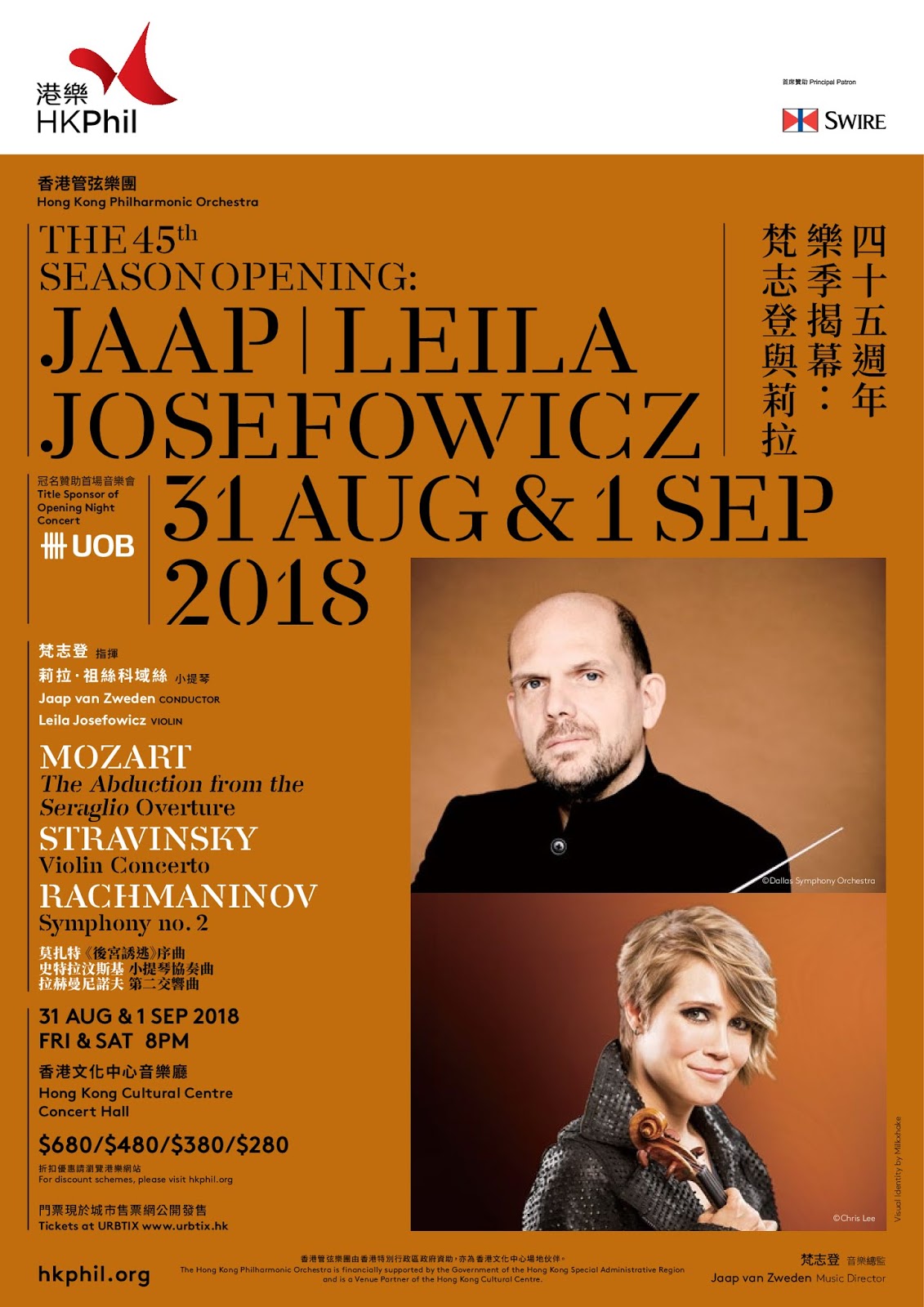
Overture to the Abduction from the Seraglio (Mozart)
Violin Concerto (Stravinsky)
Symphony No. 2 (Rachmaninov)
Hong Kong Philharmonic Orchestra
Leila Josefowicz (violin)
Jaap van Zweden (conductor)
The overture to Mozart's exotic opera Die Entführung aus dem Serail is supposedly a lively curtain raiser by including a large battery of percussion with the strings and winds. Yet the philharmonic orchestra seems more indifferent to that idea and gave a lukewarm account in its rendition. Jaap took a steady tempo that aimed for refinement than after a dramatic interpretation. The strings particularly lacked dynamic contrast nor making the colour to enrich their playing. A friend thought perhaps to do with the orchestra being too big than the right formation, but I felt the heart and mind were not in place.
The orchestral playing was certainly more passionate in the Stravinsky and musically carried more contrast and interest. An energetic introduction was given between the winds and solo violin that felt alike a colourful country scene. Despite the two domains have different rhythmic patterns, Josefowicz executed the big jump on positions with ease and sustained a flowing impression in her playing. The music became more nervous and less optimistic in the second half of the first movement.
A melancholy or even bizarre start to the second movement by the solo violin. The music became rather abstract with the irregular music patterns and fragmented parts. Sentiments dominated the third movement and longer line in a phrase than previously. The main theme by a trumpet and two flutes made a tragic calling, but not knowing where the music was heading into than thematic repetition.
The last movement was more certain started with a syncopated gallop. A busy part for the solo violin while the bassoons provided the rhythmic backbone. Josefowicz sustained the energy in her playing with clarity, maintained the beauty in tone colour and allowed the music to breathe. The rhythmic patterns are ever changing and include some reference to Bach. Later even a reminder to the Rite of Spring as the music went tribal and exuberantly driven towards the end.
I was unsure at first whether this performance of Rachmaninov's second symphony would be as memorable as the one in the previous edition of Hong Kong Arts Festival by the Oslo Philharmonic. The climaxes is alike an endless musical orgasm from the start til the end. Though the beginning of the first movement is supposedly more gloomy and mysterious than the rest. Yet the philharmonic orchestra played with a warmer tone than the chilling landscape in mind. Romanticism already culminated in full swing even at the early climax. Lush strings' playing sustained the contrast in the ebbs and flows of emotions, but not as flowing as desired. The stormy transition also lacked the tension and bleakness. Only at reaching another big climax the sheer intensity gained weight. The return to the romantic theme was sweet and passionately driven, also more clarity among the strings. Interestingly the brass sounded rather like a military band at the closing of the movement.
Tempo for the descending start to the second movement was on the swift side and kept the momentum forward. Though more majestic and steady in its emotional response. The tempestuous gallop in turn was thundering throughout but not overtly wildly driven.
It took the orchestra some time to calm down than being restless in the sweet and tender opening of the third movement. Andrew Simon's clarinet solo was spellbinding and paced very well in the long line of phrase. The dialogue between oboes and cor anglais along rest of the orchestra carried a lot of energy in gearing towards another climatic peak. Calmness returned at the end yet the strings' playing not as silky and flowing as expected. Sentiments were felt again from the ebbs and flows of emotions.
An energetic start to the festive introduction of the last movement, but clarity and togetherness were not that effective among the strings. The outpour of romantic lushness was given in full and gloriously rendered. The transition from the nervous passage back to the brilliant opening theme was intense and filled with sheer excitement. The crescendo built into a majestic and triumphant lush conclusion. It certainly came close to the breathtaking impression I had previously.
Showing posts with label Stravinsky. Show all posts
Review - Charles Dutoit, Nikolai Lugansky & Hong Kong Philharmonic Orchestra, Hong Kong Cultural Centre, 18 November 2017
Roman Carnival Overture (Berlioz)
Piano Concerto no. 3 (Rachmaninov)
Encore: Prelude op. 23 no. 7 (Rachmaninov)
The Song of the Nightingale (Stravinsky)
Daphnis and Chloe Suite no. 2 (Ravel)
Nikolai Lugansky (piano)
Charles Dutoit (conductor)
Hong Kong Philharmonic Orchestra
Despite an attractive programme with a reputable conductor and pianist, the performance was far from a success and even some shockingly disastrous moments. Though the problem was not apparent at first in the festive and lively Roman Carnival overture, which Kwan Sheung-fung played the cor anglais solo beautifully after an electrifying introduction by the strings. Yet Dutoit's conducting was rather square and not indicating the line, and let the orchestra to phrase the line on its own. Soon the playing lost focus and rather vertically looking. The strings produced a warm tone and Italianate in style, but too polite overall than carrying the dramatic urgency in mind. They were also sluggish and lacked the bite on the attacks until the winds gave a crushing entry at the time change. The brass fanfare added the wildness and intensity to the tone colour, which lacked before at the presto ending by merely being full and broad.
Compare to other works on the programme, Rachmaninov's third piano concerto is more symphonic and arguably the more familiar to the audience. A flowing start but already signs of untidiness among the orchestral playing. Lugansky preferred a rather swift tempo in the tranquil theme but Dutoit's indication on the pulse was rather random with his right hand, which seems confused the orchestra. Despite the piano solo was majestic, the thick descending passage did not stay together with the winds. Lugansky also placed a lot of weight in his left hand playing and rather cloudy on the pedal that produced a dense tone. The phrasing felt rather out of shape at the rhythmic tricky part and also some wrong notes on the piano playing. Yet the duet between the flute and oboe were played beautifully with a bell like tone. The recapitulation was relaxing and played at a soft dynamic but odd when Dutoit suddenly speed up the tempo to reach the coda.
The orchestral playing of the second movement introduction was uncertain, which Dutoit was unclear in his conducting and even at times followed the players' tempo. Lugansky's left hand was heavy on the touch again and created a dense colour on the sentimental theme that lacked contrast. Then the pianist and orchestra were dangerously out of synchronisation for few bars when Dutoit seems at lost. Despite Lugansky tried to hide the disaster by being very expressive on his part and possibly improvised, the music was structurally out of shape and randomly developed. Although a virtuosic and muscular start to the third movement on the piano, the orchestra was still lost and confused by Dutoit's conducting. Strangely enough everything got back together in the dream like section, but the concentration and focus were lost already with the slow tempo. Heavy handed playing at the heroic and exuberant passage, but tempo suddenly gone slow by half, and it was a surprise that everything finished together in the end. One was also amazed by the rather enthusiastic reception to such chaotic performance.
Luckily everything was back on track in the second half that Dutoit's conducting seems more in place even the orchestra was leading the direction. Percussions and winds made an explosive entry to Stravinsky's rather colourful score of the song of the Nightingale. The harmonic language imitated festive Chinese instruments but fragmented. Megan Sterling's flute solo carried the rhythmic energy by being crisp in her playing, but the music became abstract and moody as the dialogues of night music dominated. It sprang back to the excitement half way onward with the winds' energetic playing and kept the rhythmic momentum forward. Emperor's nightmarish vision was realised by the sudden cry on the strings and shapeless dances on the woodwind part. At coda it became even more mysterious with a grotesque slow march on the strings, but jazzy blue solo on the trumpet that sounded certain among the cloudy music that being built upon.
The soft blurry impression continued into the dreamy opening of Ravel's second ballet suite of Daphnis and Chloe. The calm image of ocean with ripples was tenderly realised, and one felt the vastness of sound when the strings built up the sunrise climax. Megan Sterling again gave a confident lead between the lyric expressive part and the energetic rhythmic driven section. The impressionistic sound landscape was played in a broad sense as waves but cloudy. All was clear up when the winds played the gallop wildly and explosive during the exuberant dance section. The orchestra had more bites in its playing finally that added to the desired dramatic intensity and became an energetic beast. It seems the leaner orchestral parts had the upper hand this evening and sentiments failed to excel as in the Rachmaninov.
Piano Concerto no. 3 (Rachmaninov)
Encore: Prelude op. 23 no. 7 (Rachmaninov)
The Song of the Nightingale (Stravinsky)
Daphnis and Chloe Suite no. 2 (Ravel)
Nikolai Lugansky (piano)
Charles Dutoit (conductor)
Hong Kong Philharmonic Orchestra
Despite an attractive programme with a reputable conductor and pianist, the performance was far from a success and even some shockingly disastrous moments. Though the problem was not apparent at first in the festive and lively Roman Carnival overture, which Kwan Sheung-fung played the cor anglais solo beautifully after an electrifying introduction by the strings. Yet Dutoit's conducting was rather square and not indicating the line, and let the orchestra to phrase the line on its own. Soon the playing lost focus and rather vertically looking. The strings produced a warm tone and Italianate in style, but too polite overall than carrying the dramatic urgency in mind. They were also sluggish and lacked the bite on the attacks until the winds gave a crushing entry at the time change. The brass fanfare added the wildness and intensity to the tone colour, which lacked before at the presto ending by merely being full and broad.
Compare to other works on the programme, Rachmaninov's third piano concerto is more symphonic and arguably the more familiar to the audience. A flowing start but already signs of untidiness among the orchestral playing. Lugansky preferred a rather swift tempo in the tranquil theme but Dutoit's indication on the pulse was rather random with his right hand, which seems confused the orchestra. Despite the piano solo was majestic, the thick descending passage did not stay together with the winds. Lugansky also placed a lot of weight in his left hand playing and rather cloudy on the pedal that produced a dense tone. The phrasing felt rather out of shape at the rhythmic tricky part and also some wrong notes on the piano playing. Yet the duet between the flute and oboe were played beautifully with a bell like tone. The recapitulation was relaxing and played at a soft dynamic but odd when Dutoit suddenly speed up the tempo to reach the coda.
The orchestral playing of the second movement introduction was uncertain, which Dutoit was unclear in his conducting and even at times followed the players' tempo. Lugansky's left hand was heavy on the touch again and created a dense colour on the sentimental theme that lacked contrast. Then the pianist and orchestra were dangerously out of synchronisation for few bars when Dutoit seems at lost. Despite Lugansky tried to hide the disaster by being very expressive on his part and possibly improvised, the music was structurally out of shape and randomly developed. Although a virtuosic and muscular start to the third movement on the piano, the orchestra was still lost and confused by Dutoit's conducting. Strangely enough everything got back together in the dream like section, but the concentration and focus were lost already with the slow tempo. Heavy handed playing at the heroic and exuberant passage, but tempo suddenly gone slow by half, and it was a surprise that everything finished together in the end. One was also amazed by the rather enthusiastic reception to such chaotic performance.
Luckily everything was back on track in the second half that Dutoit's conducting seems more in place even the orchestra was leading the direction. Percussions and winds made an explosive entry to Stravinsky's rather colourful score of the song of the Nightingale. The harmonic language imitated festive Chinese instruments but fragmented. Megan Sterling's flute solo carried the rhythmic energy by being crisp in her playing, but the music became abstract and moody as the dialogues of night music dominated. It sprang back to the excitement half way onward with the winds' energetic playing and kept the rhythmic momentum forward. Emperor's nightmarish vision was realised by the sudden cry on the strings and shapeless dances on the woodwind part. At coda it became even more mysterious with a grotesque slow march on the strings, but jazzy blue solo on the trumpet that sounded certain among the cloudy music that being built upon.
The soft blurry impression continued into the dreamy opening of Ravel's second ballet suite of Daphnis and Chloe. The calm image of ocean with ripples was tenderly realised, and one felt the vastness of sound when the strings built up the sunrise climax. Megan Sterling again gave a confident lead between the lyric expressive part and the energetic rhythmic driven section. The impressionistic sound landscape was played in a broad sense as waves but cloudy. All was clear up when the winds played the gallop wildly and explosive during the exuberant dance section. The orchestra had more bites in its playing finally that added to the desired dramatic intensity and became an energetic beast. It seems the leaner orchestral parts had the upper hand this evening and sentiments failed to excel as in the Rachmaninov.
Review - Lucerne Festival Orchestra 2017 Asian Tour, Tokyo Suntory Hall, 6 & 7 October 2017
6 October 2017:
'Egmont' Overture (Beethoven)
Symphony No. 8 (Beethoven)
The Rite of Spring (Stravinsky)
Infernal dance from Firebird (Stravinsky)
7 October 2017:
Also sprach Zarathustra (Richard Strauss)
Tod und Verklärung (Richard Strauss)
Till Eulenspiegels lustige Streiche (Richard Strauss)
Dance of the seven veils from Salome (Richard Strauss)
Lucerne Festival Orchestra
Riccardo Chailly (Conductor)
This Asian tour was an overdue revisit for the orchestra since Abbado's death and the change of leadership to Riccardo Chailly. The two pairing programmes showcase how versatile this orchestra is, which the members are top notch musicians from various leading European orchestras. Though the two performances were not a total success and Chailly hold some responsibility for the shortfall of insight in his conducting. Beethoven's Egmont overture provided a foretaste of the full bodied rich tone colour from the orchestra. It made a confident start with some tidy and polished strings' playing. Legato was sustained through the line for a flowing impression. Despite first half of the work was in minor key, the produced colour was bold and rich rather than sentimental by impression. However, the thick strings' body affected the balance and the trumpets were drowned by them. Another issue was the lack of focus in phrasing that the Allegro passage was rushed through than shaping the music to build up a climatic finale.
The lack of phrasing continued into the first movement of Beethoven's eighth symphony, which the majestic gallop did not have enough edge for the rhythmic drive. There were also too many desks of strings that tutti playing not being tidy and dense in colour. The tempestuous crescendo felt alike a noise bombardment but lacked colour and dynamic contrast. In turn, the orchestra carried more shape in the playful second movement. Though it again hurried along the minuet of the third movement, and felt like a heavy dance than with the lightness in mind. Blazing sound from the horns' graceful playing but not too exciting to hear for long. It eventually found its foot in the fourth movement which marked with Allegro Vivace. Tempo maintained at the right momentum and restrained from galloping towards the coda. It also had a sweeter and more optimistic outlook. However, the full and rich playing did not feel crispy and details again lost to the heavy handed rendition. Chailly's conducting did not either suggest he had in mind how to shape the music more effectively but simply hurrying along.
A sedate bassoon solo began the surreal sound world of the Rite of Spring in the second half. Though the adopted tempo was too broad and did not carry the flowing momentum. As it reached the tribal dance passage, instrumental cries had the wildness and excitement in place. Yet soon the slow march dragged too much and lost sense of direction again. Later the playing regained some forwardness at the climax, followed by a calm and flowing solo clarinet passage in the transitional section. Structurally clear even during the thick and complex passages. The explosive infinite coda of part one carried sheer excitement of wildness. However, tempo was too broad again in the eerie introduction to the second part. Transitional passages were cloudy in connections and lost direction at the softest moment of the whole work. It felt like sitting on the music than carrying the forward momentum. Radiant horns' entry before returning to the exuberant dance climax and followed by a majestic march. The orchestra had more direction finally towards the end as the music went evermore brilliant. Screaming winds against the exuberant strings' playing created the sheer dramatic excitement. Infernal dance from Stravinsky's Firebird, which had a film score composition style, was given as the first encore. The orchestra played tenderly in the lyrical opening and later gradually went wild for an explosive end.
The second performance predominantly featured tone poems by Richard Strauss, which filled the gap between early romantic period and twentieth century of the first programme. The sunrise scene of Also sprach Zarathustra was glorious rendered with a wall of sound from the orchestra and the Suntory Hall's pipe organ in full blast. Strings' front desks then gave a legato and warm playing for the lyrical depiction of the mountain when it was revealed. Tutti strings built up from there for a sweet, expressive and lush melodic theme. Though Chailly still phrased the music vertically than driving the momentum forward. A muscular and thick bodied sound was made at the crescendo of the storm passage, but the playing did not carry the intention. Lower strings played aimlessly than painting the music, while the woodwinds far from creating the humorous impression at the transitional interlude. Instead, blazing brass took the attention in another stormy passage with a crushing wall of sound. Solo winds were able to sustain the connection in the challenging dialogue passage, but rather messy when the solo violin responded with a folk dance passage. Phrasing and structural clarity improved as the orchestra reached the energetic waltz like passage. Strings played beautifully and knew how to flow between the ebb and flow of emotions naturally. The triumphant theme was gloriously rendered and the orchestra built towards another climax until the bell tolled. Delicate playing from the upper strings and woodwinds for a spellbinding heavenward conclusion.
'Tod und Verklärung' is another typical Strauss's work that searching endlessly for climatic resolves. The orchestra played in a silky tone throughout and displayed the best tone quality it could produce. A flowing impression began the mysterious and sorrow opening. Strings and winds introduced the themes alternatively yet the tone colour was dreamy. It was followed by a violent passage that filled with sentiments and emotions. Resolve to the sweet and lyrical state was beautifully rendered particularly on the melodic theme led by the flute. The dream like soft theme recalled those alike later in Die Frau Ohne Schatten. A muscular and triumphant theme was repeatedly given against the return of the tragic motive. It reached another climax for an optimistic resolve, but the tragic devastation struck again and led to a zen like meditation. Finally a radiant hymn like theme was given at the coda and emotions poured out in full to finish on a romantic high point.
'Till Eulenspiegels lustige Streiche' in turn had more dramatic contrast compare to 'Tod und Verklärung'. Strings effectively conjured the witty impression and galloped in great momentum. Lower strings then playing with a full rich tone on the waltz theme. The ever evolving rhythmic patterns did not pose a challenge and the orchestra had in mind how to shape the music meaningfully. It could also play wildly to create a crushing impact then returned to the naive like response. Blazing tone colour sustained throughout the brilliant heroic gallop for sheer dramatic intensity. Rhythmic momentum and dynamic changes also created a lot of musical excitements. Winds' piercing cries responded by brass solemn theme made a devastating impact on the tragic development. Yet the thrill at the coda was brilliantly executed with an exuberant crescendo. Dance of the seven veils from Salome gave a colourful middle eastern flair for a fitting conclusion to the orchestra's Tokyo visit.
'Egmont' Overture (Beethoven)
Symphony No. 8 (Beethoven)
The Rite of Spring (Stravinsky)
Infernal dance from Firebird (Stravinsky)
7 October 2017:
Also sprach Zarathustra (Richard Strauss)
Tod und Verklärung (Richard Strauss)
Till Eulenspiegels lustige Streiche (Richard Strauss)
Dance of the seven veils from Salome (Richard Strauss)
Lucerne Festival Orchestra
Riccardo Chailly (Conductor)
This Asian tour was an overdue revisit for the orchestra since Abbado's death and the change of leadership to Riccardo Chailly. The two pairing programmes showcase how versatile this orchestra is, which the members are top notch musicians from various leading European orchestras. Though the two performances were not a total success and Chailly hold some responsibility for the shortfall of insight in his conducting. Beethoven's Egmont overture provided a foretaste of the full bodied rich tone colour from the orchestra. It made a confident start with some tidy and polished strings' playing. Legato was sustained through the line for a flowing impression. Despite first half of the work was in minor key, the produced colour was bold and rich rather than sentimental by impression. However, the thick strings' body affected the balance and the trumpets were drowned by them. Another issue was the lack of focus in phrasing that the Allegro passage was rushed through than shaping the music to build up a climatic finale.
The lack of phrasing continued into the first movement of Beethoven's eighth symphony, which the majestic gallop did not have enough edge for the rhythmic drive. There were also too many desks of strings that tutti playing not being tidy and dense in colour. The tempestuous crescendo felt alike a noise bombardment but lacked colour and dynamic contrast. In turn, the orchestra carried more shape in the playful second movement. Though it again hurried along the minuet of the third movement, and felt like a heavy dance than with the lightness in mind. Blazing sound from the horns' graceful playing but not too exciting to hear for long. It eventually found its foot in the fourth movement which marked with Allegro Vivace. Tempo maintained at the right momentum and restrained from galloping towards the coda. It also had a sweeter and more optimistic outlook. However, the full and rich playing did not feel crispy and details again lost to the heavy handed rendition. Chailly's conducting did not either suggest he had in mind how to shape the music more effectively but simply hurrying along.
A sedate bassoon solo began the surreal sound world of the Rite of Spring in the second half. Though the adopted tempo was too broad and did not carry the flowing momentum. As it reached the tribal dance passage, instrumental cries had the wildness and excitement in place. Yet soon the slow march dragged too much and lost sense of direction again. Later the playing regained some forwardness at the climax, followed by a calm and flowing solo clarinet passage in the transitional section. Structurally clear even during the thick and complex passages. The explosive infinite coda of part one carried sheer excitement of wildness. However, tempo was too broad again in the eerie introduction to the second part. Transitional passages were cloudy in connections and lost direction at the softest moment of the whole work. It felt like sitting on the music than carrying the forward momentum. Radiant horns' entry before returning to the exuberant dance climax and followed by a majestic march. The orchestra had more direction finally towards the end as the music went evermore brilliant. Screaming winds against the exuberant strings' playing created the sheer dramatic excitement. Infernal dance from Stravinsky's Firebird, which had a film score composition style, was given as the first encore. The orchestra played tenderly in the lyrical opening and later gradually went wild for an explosive end.
The second performance predominantly featured tone poems by Richard Strauss, which filled the gap between early romantic period and twentieth century of the first programme. The sunrise scene of Also sprach Zarathustra was glorious rendered with a wall of sound from the orchestra and the Suntory Hall's pipe organ in full blast. Strings' front desks then gave a legato and warm playing for the lyrical depiction of the mountain when it was revealed. Tutti strings built up from there for a sweet, expressive and lush melodic theme. Though Chailly still phrased the music vertically than driving the momentum forward. A muscular and thick bodied sound was made at the crescendo of the storm passage, but the playing did not carry the intention. Lower strings played aimlessly than painting the music, while the woodwinds far from creating the humorous impression at the transitional interlude. Instead, blazing brass took the attention in another stormy passage with a crushing wall of sound. Solo winds were able to sustain the connection in the challenging dialogue passage, but rather messy when the solo violin responded with a folk dance passage. Phrasing and structural clarity improved as the orchestra reached the energetic waltz like passage. Strings played beautifully and knew how to flow between the ebb and flow of emotions naturally. The triumphant theme was gloriously rendered and the orchestra built towards another climax until the bell tolled. Delicate playing from the upper strings and woodwinds for a spellbinding heavenward conclusion.
'Tod und Verklärung' is another typical Strauss's work that searching endlessly for climatic resolves. The orchestra played in a silky tone throughout and displayed the best tone quality it could produce. A flowing impression began the mysterious and sorrow opening. Strings and winds introduced the themes alternatively yet the tone colour was dreamy. It was followed by a violent passage that filled with sentiments and emotions. Resolve to the sweet and lyrical state was beautifully rendered particularly on the melodic theme led by the flute. The dream like soft theme recalled those alike later in Die Frau Ohne Schatten. A muscular and triumphant theme was repeatedly given against the return of the tragic motive. It reached another climax for an optimistic resolve, but the tragic devastation struck again and led to a zen like meditation. Finally a radiant hymn like theme was given at the coda and emotions poured out in full to finish on a romantic high point.
'Till Eulenspiegels lustige Streiche' in turn had more dramatic contrast compare to 'Tod und Verklärung'. Strings effectively conjured the witty impression and galloped in great momentum. Lower strings then playing with a full rich tone on the waltz theme. The ever evolving rhythmic patterns did not pose a challenge and the orchestra had in mind how to shape the music meaningfully. It could also play wildly to create a crushing impact then returned to the naive like response. Blazing tone colour sustained throughout the brilliant heroic gallop for sheer dramatic intensity. Rhythmic momentum and dynamic changes also created a lot of musical excitements. Winds' piercing cries responded by brass solemn theme made a devastating impact on the tragic development. Yet the thrill at the coda was brilliantly executed with an exuberant crescendo. Dance of the seven veils from Salome gave a colourful middle eastern flair for a fitting conclusion to the orchestra's Tokyo visit.
(Photo credit: Geoffroy Schied and Instagram)
Subscribe to:
Posts (Atom)


