Showing posts with label Opera Hong Kong. Show all posts

Review - Turandot (Puccini), Opera Hong Kong, 12 October 2018

Oksana Dyka (Turandot)
Alfred Kim (Calaf)
Valeria Sepe (Liu)
George Andguladze (Timur)
Sammy Chien (Ping)
Chen Chen (Pang)
Chen Yong (Pong)
Apollo Wong (Mandarin)
Alexander Chen (Emperor)

Edge 'n Pointe Dance Centre
Opera Hong Kong Chorus and Children Chorus
Hong Kong Philharmonic Orchestra
Paolo Olmi (conductor)
Michael Capasso (director)

For its 15th anniversary celebration, Opera Hong Kong puts out a lavish production of Turandot that heavily decorates with gold and red, auspicious colours for prosperity and happiness in Chinese culture. John Farrell's stage set looks grand and would have satisfied those after an elaborate visual spectacle. The opera topic also feeds those fascinate by imperial China from the past as drama topic with a touch of western opera.

Yet the narrative approach, for all things look bright and beautiful, is naive and uninspiring by dressing up with a comfort blanket than addressing some questionable aspects. Despite the director's claim of not creating a faithful historical realisation and some kind of European perspective, the purpose of costume style for the crowd and ministers resembling stock characters in Pantomime is unclear. With Venetian long nose mask, Panama hat and slim fit disco glitter shirt, Ping Pang Pong seems more at home if they are at a broadway show. Whereas the lead characters are in some sort of traditional Chinese costume mixing with middle Asia outlook that not really defining their roles among the crowd. These all feel like a random visual twist yet no insight reflects by the dramaturgy nor any directorial indication. Although adding dancers enhance the mobility of the choreography, the routine is mostly conventional with many 'park and sing' moments for the singers and the chorus.

Capasso is also more concerned about the scene locations than, more importantly, exploring Puccini's dilemma on Liu and Turandot. In this production, Liu's innocent sacrifice feels rather sudden since there are not many moments to support why she is so determined to keep the secret for Calaf. Whereas Calaf is no hero but a forceful predator to make Turandot succumbs to his knees for the love union that so bizarrely celebrates. While male dominance and power progression are presented, the women are left to be a subordinate body and obedient to the populist demands that bend them to their knees. The mise-en-scène lacks the level of insight and depth, neither entirely success in its visual spectacle portrayal as explains above.


Yet the most problematic part I found was the conductor Paolo Olmi, who did not really able to get the orchestra and singing on stage together until the third act. His window washing conducting style not able to give a clear indication to keep the everyone together but uncertainty instead. There were moments that he followed the orchestra rather leading them the way, which resulted in some dangerous corners for the singers as how to synchronise with the orchestral playing. The busy trio by Ping Pang Pong went ahead of the orchestra for several bars in act one. The oboe solo sounded always behind during Liu's tender solo 'signore, ascolta!'.

Turandot's riddles for Calaf were rather unnaturally sung and Oksana Dyka did not quite knowing how to finish a phrase while the orchestra dragged behind. She managed to secure the top notes with ease but her timbre sounded grainy and thin in body. Her portrayal of Turandot felt rather unimaginative than the icy tough impression I would have in mind. Alfred Kim possessed a more powerful voice with the energy to sustain his lines in full, which helped the orchestra to stay more together with he was singing. Though his lower range nearly disappeared like Valeria Sepe that resulted in some inaudible moments.

Sepe carried more warmth in her timbre and her less forceful singing style suited the tenderness in Liu's part very well. George Andguladze was rather muddy in his diction and not really connecting the vocal lines. The three local singers for Ping Pang Pong coordinated more successfully in act two than the confusion they had in the first act. The chorus might have a hard time with the director from some rumour I heard, yet one did not find they had a difficult choreography to master. Diction was marginally clear and the tenors sounded rather thin on the top. Perhaps due to tiredness the choral energy dwindled slightly after two evenings, the blending was good but dramatically underwhelming.


(Photo credit: Opera Hong Kong)

Review - Carmen (Bizet), Opera Hong Kong, 16 May 2018


Varduhi Abrahamyan (Carmen)
Jean-François Borras (Don José)
Li Yang (Micaëla)
Vittorio Vitelli (Escamillo)
Apollo Wong (Zuniga)
Joyce Wong (Frasquita)
Bobbie Zhang (Mercédès)
Albert Lim (Dancairo)
Chen Chen (Remendado)
Alexander Chen (Moralès)

The Song and Dance Troupe of Fujian Opera Dance and Drama Theatre
Opera Hong Kong chorus and children chorus
Hong Kong Sinfonietta
Yves Abel (conductor)
Jean-Romain Vesperini (director)

Besides Carmen is very audience friendly with the hearty and tuneful music, it also provides opportunity to showcase the house emerging singers, children choir and the dancers. Along music visualisation of dance movements, Spanish bullfighting spirits and gypsies' carefree lifestyle, the stage focus is easily turned to celebrate cliches alike a cabaret show. This new production by Jean-Romain Vesperini attempted to avoid such trend of approach, and reminded us that death was the final outcome. Video projections of animal skulls with extras wearing ghost masks and the atmospheric bleakness, all suggested a sad finale. The rotating stage set was simple yet effectively to transform spaces into the city walls, bull ring and even tavern. It fitted well in proportion to the grand theatre stage, which simplicity preferred than cramping too many things in a tight box. Stylish visual design and stage lights scheme, by Christophe Chaupin and Etinenne Guiol, set the scenes for many pretty visual moments.

Nevertheless, the dramaturgy was sometimes cardboard like only to look good for the moment but far from enhancing the narrative flow. Such as the chorus flooded the stage at the beginning of act three with lanterns but nothing to relate with their smugglers' activities. Yet the chaos arose from the fight between Carmen and factory girls, also the final scene where Don José murdered Carmen in an empty arena, were rather effective in conveying the tension and emotions. Whether it was Vesperini's idea or the company's preference, the special placing of children's choir never fit with rest of the choreography. The march of the street children in act one felt to be a separate entity to please the parents and patrons seeing them performing on stage, but ignoring the underlying message that women and children worked and lived at the tobacco factory to stay away from the streets. Then in the last act again positioning them in front of the main chorus rather than mixing. Their colourful outfits and cheerful dance undermined the growing intensity as death haunted the scene.


Sometimes an action also lacked a natural happening and one could predict what would happen next. Such as the first appearance of Carmen descending the staircase alike the entrance of a star, but lacked the carefree wildness to draw the attention of Don José. His introduction also felt intentional rather than emerging from the crowd. Same with Carmen's escape without a struggle or chaos when the factory girls surrounded the officers. Moreover, part of the conceptual idea lacked development than a brief suggestion. For example, the theme of death with extras in death masks and animal skulls disappeared after the overture and not to be seen until the last act at the bull ring. It could have been more eerie and haunting at the telling of fortune from cards on Carmen's fate. There is also the question on which performing version to be used. The adopted format in this performance favours  musical flow with big numbers following one another. Though the significant reduction of dialogues, which would have been practiced by the original opera comique structure, reduce the psychological insight and depth as the tale unfolds. Although one understand the stubbornness of Don José's feelings towards Carmen clearly, her change in feeling for him is abrupt than a gradual progression.

Though importantly, the music quality of this performance added further excitement on top of the visual appreciation. Varduhi Abrahamyan possessed the rich smoky timbre that very much ideal for the role of Carmen. Her vocal colour stayed same and smooth when changing registers. She was a good actress too that demonstrating the confidence, independence and seductive side of Carmen. Vocally she and Jean-François Borras both delivered a good projection that filled the hall effectively, and also flexible to match lighter voices such as the trio with Frasquita and Mercédès. In comparison, Borras was not as consistent as Abrahamyan. Probably because he and conductor had different ideas on the tempo, the flower song in act two was not very legato. He was swelling through and not able to sustain the vocal lines. Yet the duet with Micaela, Parle-moi de ma mere, also later confrontation with Carmen, he sang with much better flow and confidence that carried the dramatic intention, and brought out the vocal richness of his timbre. Li Yang was more successful in the duet 'Parle-moi de ma mere' than her solo item later in act three 'Je dis que rien ne mepouvante'. Diction was clear, but her vocal projection was more effective at higher register than in the chest voice, which nearly inaudible at times.

Mixed impressions from Vittorio Vitelli that oddly he hesitated with muddy diction in the supposedly majestic toreador song, but far more natural later in the teasing and confrontation with Don José at act three. Confident singing and clear diction from Apollo Wong even though slightly stiff in his acting. Among the minor roles, Joyce Wong and Bobbie Zhang lacked the vocal richness and felt underweight when singing along with Abrahamyan. Albert Lim made a good start with the desired vocal colour but like Chen Chen their diction did not sound convincing. The sinfonietta played better with a more spirited tone and better intention than some past occasions I encountered. They were responsive to Yves Abel's conducting, but he sometimes seems impatient with the tempo. The swiftness kept the momentum forward but not necessarily accommodating the singers' rubato. Otherwise, choral singing was on a high standard by maintaining good intonation and projection throughout, vibrato free, also clear with the text. The ladies had demonstrated they could manage complicated choreography while singing together in act one. A huge improvement than past productions, which credited to Alex Tam for his good work.

(Photo credits: Opera Hong Kong)

Review - Aida (Verdi), Opera Hong Kong, 12 October 2017


Aida - Marjorie Owens
Radames - Riccardo Massi
Amneris - Violeta Urmana
Amonasro - Reginald Smith Jr
Ramfis - Hao Jiang Tian
Pharaoh - Igor Durlovki
Messenger - Chen Chen
Priestess - Li Yang

Opera Hong Kong Chorus
Shanghai Opera House Orchestra and Suzhou Symphony Orchestra
Xu Zhong (conductor)
Jean Louis Grinda (director)

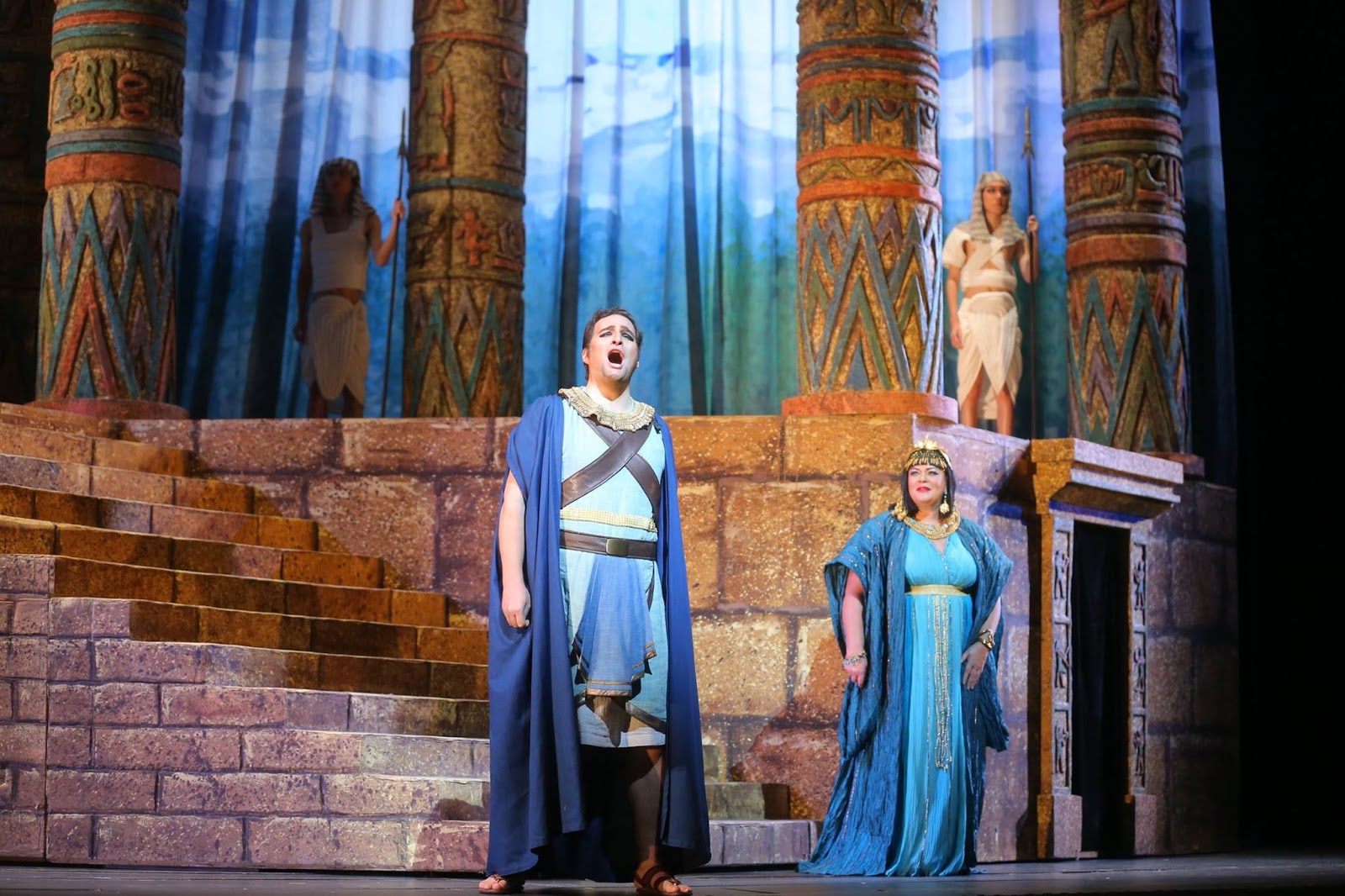
Opera Hong Kong and the Shanghai Opera House staged a grand and creditable performance this evening by reviving the general conservative appeal of Verdi’s timeless classic which delves into the difficult themes of fate, conflict of obligations, patriotism, and the salvific eternity of love.

Featuring stars such as Kristin Lewis, He Hui and Riccardo Massi, the all-star cast in this co-production is formidable to say the least. Marjorie Owens who sang the title role tonight was exceptional in many respects. Possessing a rich and substantial dramatic voice easily capable of filling the theatre, she offered an acoustic alternative to the other two renowned lyrical-spinto sopranos. ‘O Patria Mia’ was beautifully sung with ravishing phrasing, lush crescendos and a finely controlled pianissimo towards the end.

The role of Amneris seems to require much more versatility than that of Aida as her character is instilled with much more pathos and emotional changes. One sometimes wonders if Amneris is the real victim in the opera. From being a venomously jealous rival of Aida to being a repentant intercessor for Ramades, Violeta Urmana pulled off the role convincingly, striking the audience with her forthright but heartfelt vocalism.

Tenor Riccardo Massi came in strong with a stunning ‘Celeste Aida’, sung effortlessly with fervor and finesse. His tone was however a tad too light to complete Radames’s supremely heroic and domineering aura in Act I, as one who has heard Franco Corelli’s robust interpretation might agree. By contrast, his acting suggested a stout and headstrong Radames who would ultimately find himself defenseless before the dictates of fate.

Worthy of special mention are Hao Jiang Tian who sang Ramfis and Reginald Smith Jr who sang Amonasro, both possessing a round, orotund and fruity voice. Brilliant acting contributed to a climactic scene in Act III where Amonasro brazenly confronted Aida and hurled her to the ground.

By contrast, the Opera Chorus was disappointing to say the least. Consonants and entrances were very untidy. Intonation was questionable, especially during the sacrificial scene of Act I at the Temple of Vulcan. Tone was bland and lacked depth. There was also a problem with taking the sound out too early in the last syllables of many a phrase.


Whilst the quality of singing (apart from the Chorus) was generally undeniable, more doubts loom over the Jean Louis Grinda’s cinema-inspired setting. Despite the originality of the idea of mixing the contemporary with the ancient and of presenting the plot as an imaginary film, the final stage result was nothing short of uncomfortable and odd. The awkward presence of a redundant and messy film crew fussing around on both sides of the stage endured way beyond the introductory setting of the scene and gradually became a nuisance which served only to pull the audience away from the otherwise impeccable force of the drama. It irrevocably distanced the audience from the tragic impact of the plot every time the crew intruded into the scene to remind everyone that the whole thing was just a figment of imagination. Even worse was when the director lost courage to sustain his cinematic vision and apologetically called the film crew to retreat in the last Act.

Although the production was certainly not low-rent, many artistic details were glaringly overlooked, or worse still, tolerated. The grandeur of the Egyptian court in Act I was severely diminished by the poorly aligned soldiers, most of whom in their half-exposed state looked either unpleasantly flaccid or utterly skeletal. Costumes were uninspiring and mediocre – one would certainly be forgiven to ask if the great Pharaoh was actually one of the slaves during his first appearance. Make-up was subpar – there were one or two in Pharaoh’s entourage who liked like drifting ghosts. The otherwise deeply romantic secret meeting scene at the Nile in Act III felt shortchanged as one saw grotesque and coarse metal installations on what were meant to be lush lawns with beautiful flowers. Despite the well-choreographed dance in the sacrificial scene in Act I, everything and everyone looked dead and conveyed neither exoticism nor mysticism. Such a scene would probably have benefitted from the use of dimmer lighting and candle fire. That said, the pageantry of Act II, the choreography and the sets were generally commendable.

Overall, this was a fine and under-applauded production which could nevertheless have used more attention to detail and better on-stage actors.


(Photo credit: Opera Hong Kong Facebook page)

Review - Il barbiere di Siviglia (Rossini), Opera Hong Kong, 6 May 2017


Figaro - Steven LaBrie
Rosina - Stephanie Lauricella
Il Conte D’Almaviva - Edoardo Milletti
Dr. Bartolo - Kevin Glavin
Don Basilio - Kevin Thompson
Bertha - Bobbie Zhang
Fiorello - Zhou Jian Kun
Ambrogio - Frankie Fung

Hong Kong Sinfonietta
Hong Kong Dance Company
Opera Hong Kong Chorus
Roberto Gianola (Conductor)
Lorenzo Mariani (Director)


Director Lorenzo Mariani’s light-hearted and action-packed reinterpretation of the much loved opera is doubtless a creative innovation. Drawing on the parallels between flamboyant Rossinian dramatics and the creative elegance of 1930s American musicals, Mariani set the opera against the glitzy background of Hollywood. The stage was filled with bright costumes and objects inspired by musicals and films of that time. Scenes and arias were also interwoven with ceaseless flows of action which served to enliven and emphasise the sung text - especially during Don Basilio’s ‘La Calunnia’, the ‘All'idea di quel metallo’ duet and the ‘Don Basilio – Cosa veggo’ quintet. A particularly memorable scene was towards the end of Act I where Mariani courageously broke the mould of traditional narratives of how Count Almaviva was released: instead of revealing to the officers his identity, Count Almaviva bribed them, and the officers began to distribute the cash amongst themselves surreptitiously.

That said, there were times when Mariani's explicit sense of humour fell flat and turned trite. For example, it was not entirely easy to make out why there were swimsuit figures on the top of a pool slide in Dr Bartolo’s mansion or why Figaro’s shop resembled a phallic structure with a large bulb on top. There were also other times, often after repetition of long sequences and excessive action, when less would actually have been more. Finally, although the production should not be analysed in terms of strict logic, Mariani’s rather abstract reconceptualisation had the tendency of compromising the very physical and chronological details which made the opera comical and exhilarating in the first place. For example, the disappearance of the massive cage in which Rosina was locked after the first scene created a bit of spatial confusion as to where Rosina actually was. Similarly, the highly abstract escape scene at the end of Act II failed to bring out clearly how the ladders were intended to be a means of escape or how they were ultimately removed to frustrate Figaro’s plan. At those places a more conventional and conscious treatment would have probably enhanced the drama and its hilarity. While the creative aspects of this production were generally admirable, they became counterproductive when overdone as the opera gradually devolved into hammy acting and choreographed singing.


The cast was overall a strong one. Figaro was sung by Steven LaBrie with swashbuckling bravado

and an air of effortlessness, but his character had considerably less stage presence than the rest of the cast. ‘Largo al factotum’ was executed perfectly and was accompanied by an amusing choreography. Mezzo-soprano Stephanie Lauricella made a strong impression as the love-struck, baffled, bitter but endearing Rosina, and sang the runs and coloratura with remarkable precision and stunning agility. Though well supported, her lower register is less pleasant and lacks the velvety quality of her upper range. A solid bass with a resonant and gathered tone, Kevin Glavin breathed life into the irascible and scheming Dr Bartolo with compelling presence and believable acting. Yet his voice was slightly drowned out in the presto passages of Dr Bartolo’s signature aria 'A un dottor della mia sorte’ – one which could have merited a more comical treatment in general.


Edoardo Milletti as Count Almaviva was underwhelming. Initially struggling with intonation in his first few solo arias, Milletti carried the legato lyrical lines disappointingly and often brought them to abrupt and unpleasant brakes – a persistent problem in ‘Ecco, ridente in cielo’. Phrasings reflected poor taste and his voice is insufficiently agile to traverse the florid passages with confidence. Constantly brandishing his baton, Kevin Thompson’s Don Basilio was perhaps the oddest of all characters whose repeated antics became more of an annoyance towards the end. Thompson has a massive and extremely resonant voice but unfortunately suffers from a rather bland tone. The orchestra was generally satisfactory but missed the opportunity to bring Rossini’s animated music to life, certainly coming off as lacklustre and vapid in the Overture, only to be marginally rescued by the choreography on stage. It was also very obviously out of sync with the entry of Fiorello in the first scene. Overall, while credit must be given to Mariani's visually exhilarating and dynamic production, the whole Hollywood concept ran the risk of turning the opera into a one-dimensional slapstick drama with over-the-top Americanised humour.


Photo credit: Opera Hong Kong Facebook Page

Review - Otello (Verdi), Opera Hong Kong, Hong Kong Cultural Centre Grand Theatre, 16 October 2016

Otello - Carl Tanner
Desdemona - Valeria Sepe
Iago - Matias Tosi
Cassio - Chen Chen
Emilia - Samantha Chong
Roderigo - Frankie Liu
Lodovico - Gong Dongjian
Montano - Sammy Chien
Herald - Frankie Fung

Opera Hong Kong Chorus and Children Chorus
Hong Kong Philharmonic Orchestra
Maurizio di Mattia (Director and Lighting)
Gianluca Martinenghi (Conductor)


To commemorate the 400th anniversary of Shakespeare's death, Opera Hong Kong mounts a new production of Otello, which is one of Verdi's most dramatic and musically progressive grand operas. The winged lion of St Mark, a notable symbol of Venice, makes a bold visual image on the safety curtain. The new staging by Mattia, in collaboration with Rome opera, attempts to bridge convention stage directions with conceptual approaches of psychology and atmosphere. Though as a whole the idea far from a developed one that often being random, inconsistent and far from making a statement.

Instead of a black and white imagery, lightning effects along orange-red-blue stage lights do not make an effective representation of the opening stormy scene. The choir choreography at first is alike a chaotic revolution scene than a nervous observation of the naval battle from afar. Neither circular blocks that dominate the centred stage are unable to create the physical sense of a public space but only tall structures. The quasi Islamic costume and drunken actions have some similarities of the pirate town portrays in the Hollywood blockbuster Pirates of the Caribbean. The outfit of Iago also resembles captain Jack Sparrow in the film. Whether the director is suggesting the two are similar, Iago is supposedly a more cunning and terrifying figure. The silenced dancers, later as metaphorical representation of evilness and temptation, are introduced as seductive figures during the celebration of military victory.

When the blocks turn into an oval courtyard with a hanging city gate in act two, it becomes a rather gentle and soft as backdrop, not really able to produce the platform for Iago's declaration of revenge and sinister remarks. The dance choreography is entertaining to see and captures the pastoral rhythmic movement of the music, but far from portraying the bad spirits that probably in mind at first place. The stage direction is then at the basic level with the chorus forming a cardboard human wall. It may be an opportunity to display a full and happy choir with children members, but the dramaturgy is lost that not realising the atmospheric change in line of Otello's diminishing faith, poisoned mind and jealousy towards Desdemona. The purpose of a man dies after kissing a woman, behind a transparent screen at the beginning of act three, is again unclear except foretelling the tragic outcome. Though the stage set should be credited for its beautiful appearance of the evening as Otello's exotic decorated study, with Islamic lanterns and a hanging crucifix. Upon the arrival of Lodovico, the Venetian ambassador, his outlook with powdered wig and silver coat strangely recall the presentation scene of silver rose by Octavian in Otto Schenk's staging of Der Rosenkavalier.


Reference to classic stagings continues further into the last act with ballet blanc, which silenced figures wear veils and dress in full white bell shaped skirts. This leaves us to puzzle whether these are spirits or supernatural beings congregate in a murder scene and if their purposes are spectators or metaphor of death. The murder and confession moment is also dramatically underwhelming. The bedroom stage set is atmospheric on its own, but the dramaturgy far from creating the crushing emotional breakdown of Otello before his suicide. Singers seems on their own device in figuring out the death sequence than delivering a natural progression.  In sum, the staging can be more coherent and focus without too much references since any directorial approach is to articulate and develop the key aspects. It also needs to develop a style of its own than a mixture of borrowed ideas.

Acoustically the grand theatre is not that dry, but the projection of produced sound does not carry to the hall in full even I am hearing eight rows away from the stage. The orchestra does not produce the wall of sound at the suppose violent and tempestuous passage in the beginning, though the chorus is heard more prominently in terms of balance. Throughout the performance, voices of the adult choir blend well together with a healthy vocal volume. Diction fares better at tutti moments and long vowels, but the men hurry at the heavy texting passage in act one, which results a sudden drop in vocal volume and untidy entries.

Among all soloists, the dramatic tenor Carl Tanner as the protagonist is vocally most consistent and technically capable. A full tone with the sheer body of sound and projection. Many thoughts put in phrasing and diction is convincing enough to sound Italianate. His voice never sound tired, ably to sustain the energy and comfortable with the tessitura throughout. There is a differentiation in his vocal colours that make it interesting to appreciate and enjoy. Although some coordination issues with the orchestra in the beginning of act three, that is quickly rectified and back in place again. His role portrayal is a classic one to display the war hero in jealousy, rage and nervous breakdown, but the stage direction does not help to make a strong impression is unfortunate.


One have mixed feelings for Valeria Sepe, who sings the role of Desdemona. Her voice condition is healthy, especially soaring upwards for higher vocal range with a ringing tone, but diction is surprisingly poor as native speaker and often shaky with intonation. It takes some time to settle with tuning in her first entry of act one and at the danger in out of sync with the orchestra. The passionate duet with Otello is all loud in volume but vocal richness is in absence. The most bothering part is she uses this undesirable approach to close up and darken the vowels. The method produces a worn out voice alike an elderly woman singing quality and greatly reduces the vocal support in projection. The lack of phrasing is also why she struggles to coordinate with the orchestra, especially the Ave Maria in last act which is neither moving and a mess. Otherwise, she looks beautiful and youthful for the role, also the singing is more comfortable in act three when Desdemona asks for forgiveness from Otello.

Matias Tosi is better with his dance moves as a young and cunning Iago, resembling the eccentric Johnny Depp as Captain Jack Sparrow, than in his singing. Vocally he lacks a differentiation in tone and belting out the notes without any phrasing. Then tiredness sinks in and unable to sustain the vocal energy at the duet with Otello on disloyalty in act two. The projection diminishes to a barely audible level and becomes throaty that struggles to complete a phrase. He also sounds more as a baritone than bass baritone that struggles to produce low notes and lacks the depth of richness. Diction is very often muddled and the voice is not an exciting one to hear repeatedly. One is more convinced that Gong Dongjian would have made a capable alternate Iago with the right vocal colour and volume. Chen Chen convinces me as an oratorio singer than in opera by being too polish and underwhelming in projection as Cassio. Other minor roles are presentable but generally need to improve the diction to sound more Italianate. Gianluca Martinenghi appropriately employs a rather broad tempo in his conducting that the music playing is neither rush nor drag. The very capable philharmonic orchestra produces many fine moments and saves the performance with good musical directions and maintains dramatic impulse.


(Photos: Opera Hong Kong Facebook Page)

Review - Madama Butterfly (Puccini), Opera Hong Kong, Hong Kong City Hall, 16th & 17th August, 2016

[Do bear with me for a rather long review!]


Cio-cio San: Nancy Yuen (16 Aug), Louise Kwong (17 Aug)
Pinkerton: Adam Diegel
Sharpless: Corey Mckern

Fujian Symphony Orchestra
Opera Hong Kong Chorus
Warren Mok (Producer)
Tsung Yeh (Conductor)
Pamela Recinella (Director)

As one of Giacomo Puccini’s masterpieces, Madama Butterfly has captured the hearts of many in the past century with the heart-breaking story and moving music; and has become a staple in the operatic repertoire across the world.  The recent Opera Hong Kong offering of a semi-staged version was on the whole convincing and well-received, with a full house of audience on both nights.

Nancy Yuen and Louise Kwong, who shared the demanding title role of Cio-cio San on different nights, were undoubtedly the highlights of the performances.  With Cio-cio San being her signature role for over two decades across the world, Yuen impressed the audience as soon as she appeared with the dulcet tones at a high tessitura singing of her joys to be married to Pinkerton.  However, as the performance went on, one could not help but notice the huge contrast between the two registers of her voice.  Whilst the ringing head tone was particularly projected, the chest tones sounded coarse, which took away from the performance. 

Yuen’s rich experience of the character undeniably helped bring across the character confidently with crisp and clear diction. Having said that, Yuen is perhaps more used to fully staged versions, and the present semi-staged setting proved to be a slight hindrance to her acting.  She collaborated well with Carol Lin, who was Suzuki; and their “Flower Duet” was well-balanced and appropriately joyful. 

On the following night, Kwong gave a powerful rendition of Cio-cio San as an innocent, hopelessly in love, yet stubborn 15-year-old Japanese girl and was applauded the moment she started singing.  The faith in Pinkerton Kwong conveyed, the desperation when talking about her son, the outpour of emotions when singing the line “has he forgotten me?”, and the exhilaration when she saw the return of Pinkerton’s ship drew the audience into Cio-cio San’s own emotional world.  One could almost feel her heartbreak. 

She also impressively made the pianissimo top B and C sound as if they were effortless to sing.  The unified tone across her vocal range when singing the famed “Un Bel Di” and the intensity she invested in it made it very touching. 

However, on the whole, Kwong’s diction could be clearer which would help communicate with the audience.  At one point, she also gave off an impression of a mistake in blocking when asking Pinkerton whether people in the West pin up butterflies in her singing.  In any case, it was overall an excellent first performance as Cio-cio San for Kwong.


Generally speaking, the Fujian Symphony Orchestra and the conductor Tusng Yeh did a fantastic job not only in accompanying the singers but also in providing drive and support to the emotions of the storyline.  For example, the opening entries were tight and clear, which gives the opera the urgency needed.  The “humming chorus” in the orchestra when Sharpless read Cio-cio San Pinkerton’s letter was very delicately played.  Throughout the performances, the orchestra set the scenes well with the underlying uneasiness and tension that has been building up for the audience before the anagnorisis of Cio-cio San that Pinkerton never intended to move back to Nagasaki for good. 

On the other hand, there were occasional balance problems, which was exacerbated by the very projected voice of Pinkerton’s.  His voice made other singers seemed relatively quiet at points, in particular the trio shared among Pinkerton, Sharpless and Suzuki towards the end of the opera.  The conductor turned around rather frequently, which occasionally helped to rescued the singers and orchestra from being out of sync.  However, the high frequency of turning back and forth was distracting and unnecessary from the audience’s point of view. 

Although the chorus played a relatively small part in the opera, their voices were well-blended and the difficult “humming chorus” which requires singers to hum on a high B-flat was well-executed. Credits to the Chorus Director Alex Tam. 


Directed by Pamela Recinella, the staging was perhaps the most disappointing part of the two shows.  It must be pointed out that it was very baffling for the audience that the costume of Prince Yomodori resembled a Chinese magua from the Qing Dynasty or the early Republic days.  The choice of the child actor was neither blue-eyed nor blonde, as stated in the libretto, which was also rather confusing.  The audience was pleasantly surprised when Cio-cio San and the train of ladies, as well as Sharpless, made their entrances from the back.  Yet, it looked bizarre and unnatural when the chorus members took out flower petals from their trouser pockets to strew the way for Cio-cio San.  It felt that they could at least do with a basket.  Their white faces also looked slightly eerie.  The female family members of Cio-cio San (As shown in the picture) who had several lines of solo had their straight hair down which did not fit the rest of the cast, especially that of Cio-cio San’s and Suzuki’s which were done up nicely in Japanese style; and this could have been easily solved by YouTube hairstyle tutorials. 

Nevertheless, the effective use of simple lighting on a very limited stage for the cast helped to bring the story across.  The various light changes conveyed the time of the setting (e.g. morning after Cio-cio San’s long overnight wait for Pinkerton) or the emotions (red lights for the Bonze’s fury).  The change in furniture from tatami to an iron-wrought bed, and Japanese style to Western style coffee tables and chairs was also a clear symbol for Cio-cio San’s changes to “an American home”. 

Corey Mckern’s Sharpless (Far right) stood out among the cast.  As the American Consul, he had been very concerned about Cio-cio San’s fate from the start.  His warm tone and sincere acting granted the character a calming and compassionate personality which touched the audience.  Adam Diegel’s Pinkerton delivered the difficult passages with much sensitivity.  The comfortable high notes and the projected lower ranged in a clear tone were a pleasure to listen to.  However, his acting did not quite match up to the level of singing and it felt slightly awkward at points. 

To a large extent, the performance ran smoothly, but not without several hiccoughs.  On the second night, when Goro introduced Suzuki, the cook and butler to Pinkerton, none of the three were on stage.  The orchestra and singers on stage came to a short pause before Suzuki appeared on stage to continue with the opera.  There were also camera noises of the official photographer throughout the two performances, and was especially audible at quiet parts, such as the introduction to the “humming chorus”.  This could be resolved by having pictures taken at the dress rehearsal and could avoid distracting the audience from appreciating the show.

To sum up, the two performances were of high standard in terms of music with the singers and players, but there is perhaps room for improvement for staging, even when in a semi-staged setting, as well as other organisational aspects.  We look forward to Opera Hong Kong’s upcoming Otello by Verdi for more delights and surprises for the audience. 

Photo credits: Opera Hong Kong Facebook Page