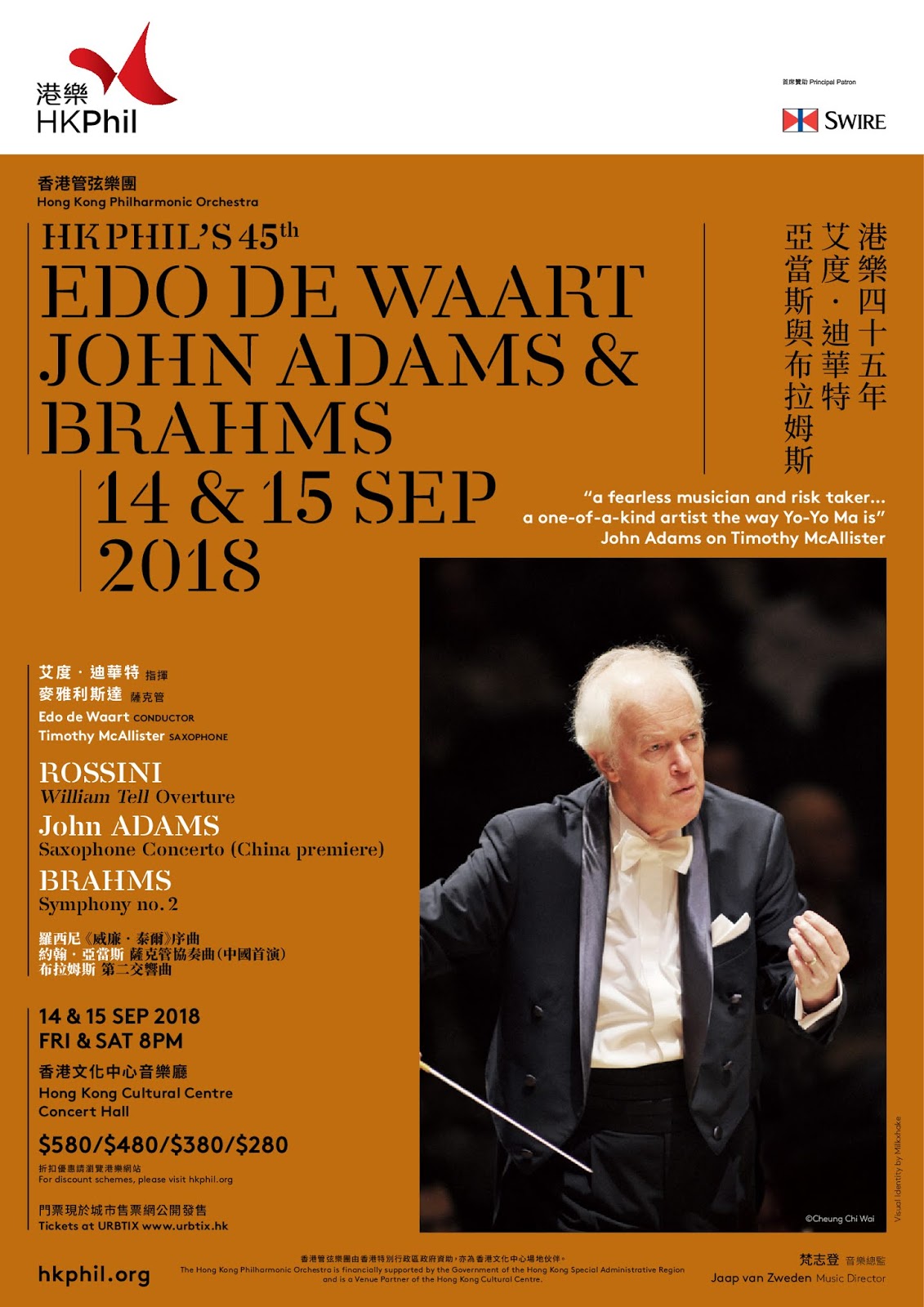
Review - Edo de Waart, Hong Kong Philharmonic Orchestra, 15 September 2018

Overture to William Tell (Rossini)
Saxophone Concerto (John Adams)
Symphony No. 2 (Brahms)

Hong Kong Philharmonic Orchestra
Timothy McAllister (saxophone)
Edo de Waart (conductor)

It was an interesting to hear how the orchestra responded to its former music director on the podium again. The cello solo employed a broad tempo to begin the overture with a lot of vibrato in rich tone. A quiet start to the storm section before exploding into a full thundering climax. Though under a steady tempo the impact was not as terrifying as expected. Beautiful duet between the cor anglais and flute during the pastoral scene. The closing gallop was tidy and majestic, also effective accelerando geared towards a triumphant close.

John Adams's saxophone concert felt alike a busy rhythmic exercise for the soloist. Fragmented patterns jointed jazz and blues together for a hurry and restless ride. The brass kept the momentum going but hard to tell where the music was sailing to. At reaching the middle of the first movement then the orchestra played without the soloist. The dreamy transition was enigmatic yet the saxophone solo had a more lyrical part than previously. The music landscape became flatter and calmer before returning to fierce gallop, and then retreated to a quiet end.

The second movement dominated by syncopated patterns and stayed vigorous on momentum. It was a tight dance in irregular phrases but also abstract as to where the music was heading to. Timothy McAllister sustained the energy throughout in his playing and kept the music flowing naturally. Though the dynamic and emotion contrast were more able to display in his encore.

The orchestra kept the dawn awakening like introduction to Brahms's second symphony flowed with a warm gentle tone and not too weighty in body. Neither aggressive at the climatic exuberance and stayed bright with a lot of legato to sustain the line. Though whether to do with de Waart's conducting style, the winds sometimes felt a fraction behind the strings. Tempo was rather laid back for a gentle and unhurried gallop at the end of the first movement.

The cellos began the noble theme of the second movement in a mellow warm tone that gave a tender and sunny impression. A misty respond from the winds against the emotional outpouring from the strings. Yet as in Brahms's style sentimental negotiation never reach a full answer but hold back by the recapitulation of the noble theme. The tragic sentiments gained more weight before resolving to a quiet end.

The winds began the pastoral scene of the third movement with a busy strings' part underlaid. Rhythmically it gained momentum yet carried more lyricism within.

An explosive start to the last movement in an energetic gallop. The transitions felt rather enigmatic though, which the lines would have been more effective if there was an aim than a mere shape. The majestic theme was passionately rendered in a warm tone. After a long negotiation the music finally located the end in certain with a glorious triumphant conclusion.


Review - Jaap and Joshua Bell, Hong Kong Philharmonic Orchestra, 8 September 2018

Academic Festival Overture (Brahms)
Violin Concerto (Sibelius)
Symphony No. 41 "Jupiter" (Mozart)

Hong Kong Philharmonic Orchestra
Joshua Bell (violin)
Jaap van Zweden (conductor)

Like the season opening performance before, a festive symphonic overture is programmed for an uplifting start. Though the orchestra was too energetic throughout Brahm's Academic Festival Overture, and as a whole it felt lacking character and essence. Jaap probably felt the swift tempo would keep the momentum going than dragging along. Yet already restless than being mysterious at the tip toe like beginning. By reaching the first triumphant climax then the orchestra was more stable and let the music sang. Despite displaying the tonal contrast, it galloped in hurry and occasionally lost in details.

The first violin began Sibelius's Violin Concerto with a spellbinding pianissimo and set the stage for the solo violin. Bell's playing produced a sweet rich tone with clarity, but his bowing did not always have the smoothness to sustain the long line and sometimes felt abrupt. He approached from a sentimental perspective by employing a lot of vibrato. His playing was passionate and expressive on the ebbs and flows of emotions, rather than holding back the sentiments in stillness. Despite a challenging part to play, tuning on the double stops were noticeably a hit and miss Whereas the orchestra strings seems holding back their response to avoid being overpowering. Interestingly, I thought there was a brief moment alike the motive of Siegfried's assassination from Wagner's Götterdämmerung towards the end of the first movement.

Bell began the second movement beautifully on the lush expressive violin part, yet the horns' accompaniment did not sound convincing. Occasionally I felt Bell put too much weight on the bow that it felt too rich and sticky than allowing his playing to flow more. The orchestra achieved more charity and locating its voice in the tragic response. Yet the syncopated section not really able to build up the climax despite effective dynamic contrast.

A busy start into the third movement for the solo violin part, but Bell was driving the tempo so much that his phrasing not quite grasping the shape of the polonaise dance. Tuning was very good with the harmonics and not so with the arpeggio climbs to the high positions. As a whole I felt mixed by Bell's playing, but after learning from friend's past experience, Bell could have been experimenting different approaches than giving a  straightforward interpretation.

I had not been impressed by Jaap's Mozart in the past but what he achieved from the orchestra on the "Jupiter" symphony changed my mind completely. Finally a more relaxing tempo was adopted for the first movement and the playing was very polished. Perhaps the violins could employ more accents in the down bow to give more rhythmic excitement than only sustaining the elegant impression. Contrast in tone colours at counterpoints was effective with beautiful tone at the majestic recapitulation. A flowing elegant impression was made at the beginning of the second movement. The sadness and solemnity at the tragic transition seems a reference to earlier piano concertos by Mozart. Later the landscape became smooth with a sweet and clean tone, while being sedate and slightly sentimental. The third movement became an elegant and majestic dance in thicker texture than the movement before. The orchestra was very responsive and immediate with the gallops in the last movement that kept the momentum forward. The brilliancy of Italian opera fanfare like section was effectively realised. The bright tone gave the dance like movement a flamboyant touch. The final gallop was energetic with the sheer rhythmic excitement that gave more audio satisfaction than the first half.

(Photo credit: Hong Kong Philharmonic Orchestra)

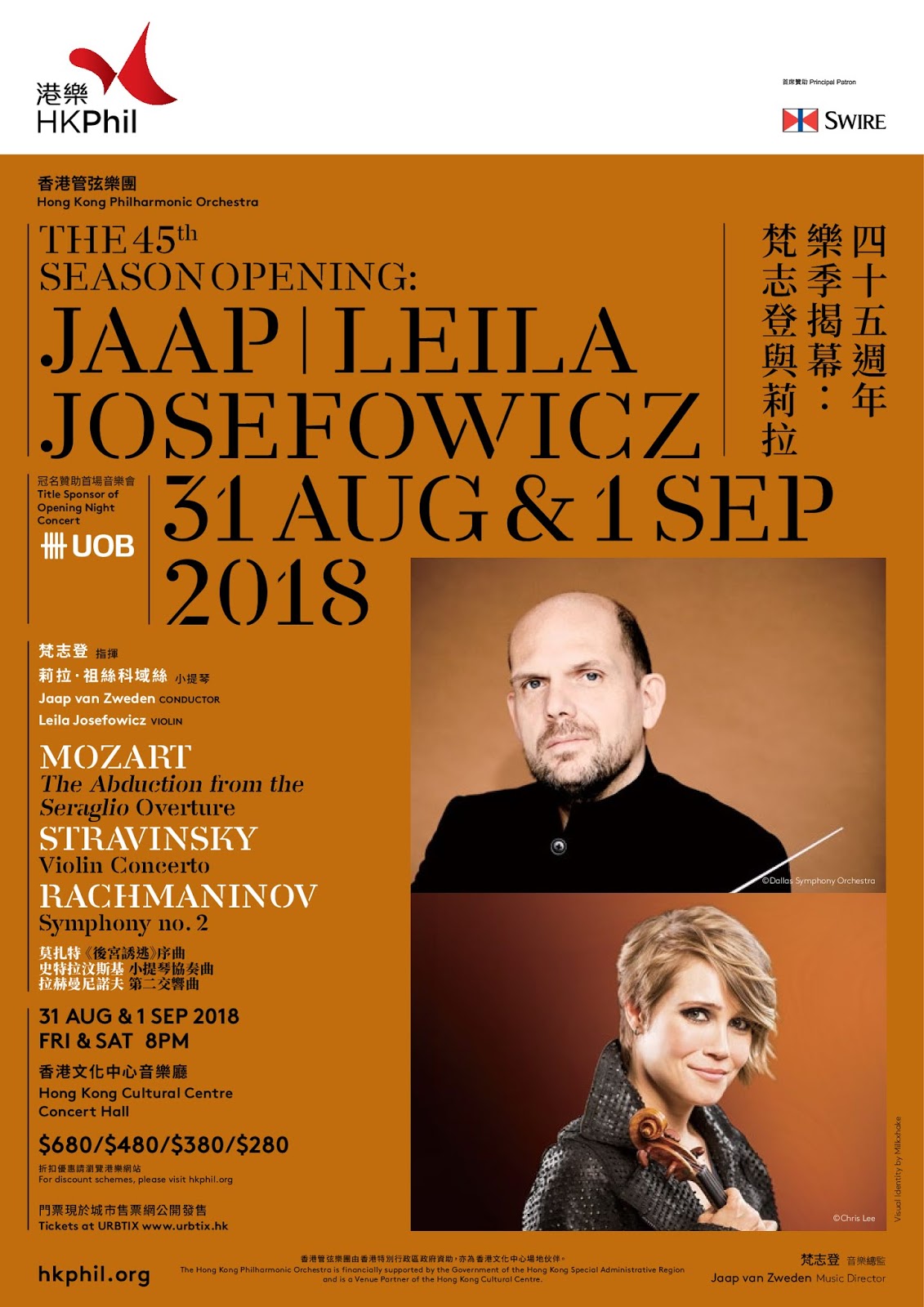
Review - The 45th season opening performance of Hong Kong Philharmonic Orchestra, 1 September 2018

Overture to the Abduction from the Seraglio (Mozart)
Violin Concerto (Stravinsky)
Symphony No. 2 (Rachmaninov)

Hong Kong Philharmonic Orchestra
Leila Josefowicz (violin)
Jaap van Zweden (conductor)

The overture to Mozart's exotic opera Die Entführung aus dem Serail is supposedly a lively curtain raiser by including a large battery of percussion with the strings and winds. Yet the philharmonic orchestra seems more indifferent to that idea and gave a lukewarm account in its rendition. Jaap took a steady tempo that aimed for refinement than after a dramatic interpretation. The strings particularly lacked dynamic contrast nor making the colour to enrich their playing. A friend thought perhaps to do with the orchestra being too big than the right formation, but I felt the heart and mind were not in place.

The orchestral playing was certainly more passionate in the Stravinsky and musically carried more contrast and interest. An energetic introduction was given between the winds and solo violin that felt alike a colourful country scene. Despite the two domains have different rhythmic patterns, Josefowicz executed the big jump on positions with ease and sustained a flowing impression in her playing. The music became more nervous and less optimistic in the second half of the first movement.

A melancholy or even bizarre start to the second movement by the solo violin. The music became rather abstract with the irregular music patterns and fragmented parts. Sentiments dominated the third movement and longer line in a phrase than previously. The main theme by a trumpet and two flutes made a tragic calling, but not knowing where the music was heading into than thematic repetition.

The last movement was more certain started with a syncopated gallop. A busy part for the solo violin while the bassoons provided the rhythmic backbone. Josefowicz sustained the energy in her playing with clarity, maintained the beauty in tone colour and allowed the music to breathe. The rhythmic patterns are ever changing and include some reference to Bach. Later even a reminder to the Rite of Spring as the music went tribal and exuberantly driven towards the end.

I was unsure at first whether this performance of Rachmaninov's second symphony would be as memorable as the one in the previous edition of Hong Kong Arts Festival by the Oslo Philharmonic. The climaxes is alike an endless musical orgasm from the start til the end. Though the beginning of the first movement is supposedly more gloomy and mysterious than the rest. Yet the philharmonic orchestra played with a warmer tone than the chilling landscape in mind. Romanticism already culminated in full swing even at the early climax. Lush strings' playing sustained the contrast in the ebbs and flows of emotions, but not as flowing as desired. The stormy transition also lacked the tension and bleakness. Only at reaching another big climax the sheer intensity gained weight. The return to the romantic theme was sweet and passionately driven, also more clarity among the strings. Interestingly the brass sounded rather like a military band at the closing of the movement.

Tempo for the descending start to the second movement was on the swift side and kept the momentum forward. Though more majestic and steady in its emotional response. The tempestuous gallop in turn was thundering throughout but not overtly wildly driven.

It took the orchestra some time to calm down than being restless in the sweet and tender opening of the third movement. Andrew Simon's clarinet solo was spellbinding and paced very well in the long line of phrase. The dialogue between oboes and cor anglais along rest of the orchestra carried a lot of energy in gearing towards another climatic peak. Calmness returned at the end yet the strings' playing not as silky and flowing as expected. Sentiments were felt again from the ebbs and flows of emotions.

An energetic start to the festive introduction of the last movement, but clarity and togetherness were not that effective among the strings. The outpour of romantic lushness was given in full and gloriously rendered. The transition from the nervous passage back to the brilliant opening theme was intense and filled with sheer excitement. The crescendo built into a majestic and triumphant lush conclusion. It certainly came close to the breathtaking impression I had previously.


Review - Bluebeard's Castle & The Miraculous Mandarin (Bartok), La Monnaie, Webcast

Ante Jerkunica (Bluebeard)
Nora Gubisch (Judith)
Vincent Clavaguera-Pratx (first prostitute)
Merche Romero (second prostitute)
Brigitta Skarpalezos (third prostitute)
Dan Mussett (the pimp)
Norbert De Loecker (an old man)
Amergo Delli Bove (a young man)
James Vu Anh Pham (a mandarin)

La Monnaie Symphony Orchestra and Chorus
Alain Altinoglu (conductor)
Christophe Coppens (director)


Like Lohengrin, the story of Bluebeard and Judith retells the discourse of the wife asking her husband the forbidden question that reveal a hidden past. It references the biblical tale of Eve consuming the forbidden fruit in parallel, yet the punishment in Bluebeard differs from Lohengrin. Whereas the prince in swan form resumes human as Lohengrin leaving Elsa,  Judith instead joins other wives of Bluebeard to be trapped in the dungeon forever. Judith's curiosity is also self motivated yet Elsa partly lures by Ortrud forcing Lohengrin to reveal his identity eventually. The end of Bluebeard is more tragic as darkness consumes the whole castle and marks Judith's mission to bring light inside a failure.

In this production by Christophe Coppens, Bluebeard is paired with the ballet The Miraculous Mandarin. A cross section of Bluebeard's castle is shown throughout. Judith's curiosity causes her to explore the rooms on upper level, but discovers each one stained with blood even however magical and wonderful the treasures are. Bluebeard, occupies the centre room, in his wheelchair at first attempts to persuade the curious wife not to explore further, though her refusal to listen changes his mind. Bluebeard eventually can stand and walk without the wheelchair, and leads Judith to the dungeon and locks her away.

Ante Jerkunica portrays Bluebeard as a lonely yet commanding figure. He does not give direct reception to his new wife, and allows her to explore the castle to find out who he really is. Jubith, plays by Nora Gubisch, is at first innocent and naive. The surrounding darkness and curiosity motivates her to find out her husband, yet does not know she will become his prey. By becoming the lady of the night, she occupies the final place of the wives that make up the day. It also marks the end of Bluebeard as perpetual darkness looms over the castle and no more search for companion. Vocally both singers were strong with the vocal body to match and also the colour to convey the emotions.

The Miraculous Mandarin instead uses as a source to suggest how other wives of Bluebeard come together. The castle transforms to a colourful and erotic brothel with drag prostitutes seducing their guests until they are thrown out by the pimp. Though the mandarin and the third prostitute are passionate about each other from the beginning. After the pimp murders the mandarin, the transfigured protagonist embarks on an emotional reunion with the prostitute. This differs from the original plot as a bizarre horror tale, but a genuine love tale instead. A dramatic end with the brothel consumes in flames, while Bluebeard reappears in distance gazing at the left behind prostitutes.

Despite a mostly straight forward narration, the set quality and contrast in strong colours creates a magical atmosphere throughout. The props bear the design style of Coppens and eye catching outfits that realise the fantasy wonderfully. The video projection of the Mandarin's spirit in 3D effect is especially impressive. Rest of the use of technology is also much applauded for the effective execution. Alain Altinoglu has also transformed the Monnaie orchestra by improving the togetherness and quality in tone colour. The playing is more musically driven with the shape and phrasing in place. It certainly gave more dramatic intensity and the momentum to the performance as a whole.


Review - Celebrate Bernstein on Broadway, Hong Kong Philharmonic Orchestra, 7 July 2018

On the Town: New York New York; Lonely town; I can cook, top
Peter Pan: Dream with me
Wonderful Town: A little bit in love; One hundred easy ways to lose a man; Wrong note rag
On the waterfront Suite
Candide: Overture; I am easily assimilated; Nothing more than this; Glitter and be gay
1600 Pennsylvania Avenue: Take care of this house
West Side Story: Dance at the Gym; Maria; Tonight
Trouble in Tahiti: Island Magic

Hong Kong Philharmonic Orchestra
Lorina Gore
Louise Dearman
Nathaniel Hackmann
Nadim Naaman
John Wilson (conductor)

Since 2009, John Wilson and his orchestra are a regular feature at the annual BBC Proms that gives quality and memorable performances of film music and musicals. As an arranger and musicologist, Wilson always came up with a programme that in good musical sequence and mixture of styles. The same to be said of this concert featuring Bernstein's works for the broadway productions, which the first half was more serious than the entertaining second half.

The curtain rose with On the Town which gave a taster for what to come later: big band, jazz and lyric song. Yet due to the hall layout and acoustic, the balance between orchestra and vocalist not always ideal that the singing was often drowned out even miked up. Lorine Gore took a rather operatic approach in Dream with me from Peter Pan. Her tuning was not too good though and employed vibrato seems excessive for my taste. Louise Dearman brilliantly realised the humorous lyrics in One hundred easy ways to lose a man Wonderful Town.

The orchestral suite of On the waterfront showing Bernstein's more serious compositional style. After a gentle horn solo, it grows into a vigorous tribal dance with the large battery of percussions thundering along. A beautiful flute solo accompanied by harp and winds answer alike calm after storm. Then the sentiments built into a long climax but the thematic repetition was enigmatic. A slow march in pentatonic style creates further dreamy impression until the brass fanfare gives an explosive coda. Though I was not sure if Wilson enjoyed the work as his conducting not very clear sometimes in coordinating the parts. Rhythmic tricky sections were not very tidy and some slips were audibly noticed.

The overture to Candide was robust and bombastic but also has a majestic theme. 'I am easily assimilated' was seductive by impression, though more sentimental in 'Nothing more than this'. Hackmann's singing style felt alike from the back of throat that did not enhance his clarity of the text. 'Glitter and be gay' was melancholy at first then transformed into a operatic firework that brilliantly rendered by Lorina Gore in all exaggeration. 'Take care of this house' instead was more emotional and soft.

The Dance at the Gym from West Side Story demonstrated the colourful scoring and energetic momentum, which the percussions and brass went wild in sheer excitements. Hackmann was more successful in Maria especially in capturing the tenderness and beauty of his timbre. Island Magic from Trouble in Tahiti again calling a noisy diva role, which Gore sustained her unflagging vocal energy throughout. The lush music and swings in Wrong note rag reached a lively conclusion, and two more encores were given including Tonight from West Side Story. Wilson certainly looked more cheerful and satisfied than the first half.


Review - Shostakovich & Tchaikovsky, Hong Kong Philharmonic Orchestra, 16 June 2018

Variations on a Rococo Theme (Tchaikovsky)
Symphony No. 7 'Leningrad' (Shostakovich)
Encore: Overture to 'Die Fledermaus' (Johann Strauss II)

Hong Kong Philharmonic Orchestra
Wang Jian (cello)
Jaap van Zweden (conductor)

Pairing a light piece by Tchaikovsky as amuse-bouche with Shostakovich's Leningrad Symphony is lazy programming, neither does it makes much impression. The Fledermaus overture could have started the concert to form the tuneful progression, than serving as an anti climax after the symphony. Alike Tchaikovsky's ballet scores, sweet, tender and lyric are the features of the rococo variations. In the first part, extreme range on finger positions for the solo cello as it gets to the end of fingerboard with harmonics. Wang Jiang kept the music flowing and switched positions smoothly. Though sometimes too much vibrato on the long notes for my taste, and impatient with the tempo than sustaining the elegant impression. The repetition of the main theme was beautifully played by the flute solo, though composition style wise not dramatic at all. Melancholy made the sorrow response in the mid section before galloping at the coda, which rhythmically and audio more interesting than before.

Zweden's account of the Leningrad Symphony realised the graphical abstraction, yet a lot of warmth within that gave more hope than devastation. The majestic theme that began the first movement was muscular and sunny without any sign of doubt. Even in the following pastoral section, with flute solo playing folk tunes, felt rather sweet and sedate under the relaxing tempo. Then the march to battle reminded us the long crescendo of repetition from Ravel's Bolero. First pizzicato on tutti strings forms the rhythmic structure and harmonic foundation, duet between oboe and bassoon give the melodic tune, while the brass dramatise and thundering the tune in full force of power. The principal percussionist Aziz Luce kept the rhythmic momentum tight and consistent on the snare drum throughout, also effective progression from pianissimo up to the climatic violence then faded to a quiet end. Yet the second view of the landscape was colourless as the bassoon depicted, but the first violins were not that tidy in their lyrical response.

It also took few bars to agree on the tempo between the strings and oboe solo at the start of the second movement. The theme led by the clarinet was alike clock ticking, and became surreal with the energetic dance gave a grotesque outlook. One felt the recapitulation of the opening theme enigmatic that not sure where the music was trying to head to. Dialogue between bass clarinet, harp and flutes seems to lament the calmness and tranquility of normality prior the war. A spiritual start to the third movement with the winds playing a chorale theme, which the strings gave an emotional pouring response. Beautiful flute solo accompanied by pizzicato on the strings. Texturally it recalled the music landscape of Sibelius for the clearness and a heavenward glimpse.

Yet the elegant strings' passage before the last movement was calm before storm. The tense gallop and bombastic brass brought the violence of war back to the centre stage, which was muscular but flowing. Sorrow and hope negotiated, though more certain in direction that reassured by the majestic unison strings. The built up towards the thundering climax was less triumphant and naive compare to the one we heard in the first movement. It was turned into a wild dance with sheer dramatic intensity. The aftermath was bleak over the vast landscape, which was gloomy and mysterious that visually near disfigured. Instead horns' fanfares and strings culminated towards a blazing magnificent conclusion. Victory was unlikely the answer, but a conviction that manifestation of hope and glory would triumph over doubts. The long struggle certain put the Fledermaus into an odd extra as to whether we needed more to reassure ourselves, even though the philharmonic was certainly energetic enough to deliver a fiery rendition.


Review - Geneva Camerata & Viktoria Mullova, The University of Hong Kong, 14 June 2018

Fireworks (Debussy, arr. Keren)
Violin Concerto in e minor (Mendelssohn)
Variations on themes from Porgy and Bess (Gershwin, arr. Keren)
Symphony No. 8 (Beethoven)

Geneva Camerata
Viktoria Mullova (violin)
David Greilsammer (conductor)


Despite energetic playing and displays of chamber virtuosity marked the debut of Geneva Camerata in Hong Kong, there was a noticeable balance problem between strings and winds. The tone colour of middle and lower part were rich, but the upper felt relatively thin on top. More upper strings would be desirable in the Debussy to be more able bringing out the theme and counter the weight. It was better in the Beethoven with the full team of violins, yet a silky tone would be more effective to penetrate the thick texture than a raw sound. The employment of period horns and trumpets certainly helped with the balance, yet rest of the woodwind remained in modern gears was sometimes overpowering for the current formation.

Greilsammer also preferred to keep the tempo on the swift side, which kept the momentum flowing with rhythmical excitement. He gave some interesting insight in the fashion of the current period informed practice. His approach of the Mendelssohn as a dance marked an opposite to the romantic indulgence one normally encountered. It certainly created a brighter tone colour and shape to the longer phrase. The dotted rhythm in the first movement of the Beethoven was exaggeratedly rendered, which felt more fiery and urgent. Same with the accented notes in the third movement that turned into a flamboyant dance and rhythmically bouncing. Instead the last movement of the symphony became an exuberant hunting gallop with the winds turning into a lively military band. He probably saw the work as a drama and reminiscence of the Napoleonic war than an Indian summer preceding the ninth.

Yet under such robust forwardness, it did not leave much room for the built up of intensity towards climax. In Debussy, the culmination of tension fell short from the sedate slow march preceding the ebbs and flows of waves alike in La Mer. The tempest in Beethoven’s first movement also lacked the impact but roaring through. Although some minor tuning glitches, Viktoria Mullova delivered the technical expectations and very natural in her playing. If one has to be fussy, perhaps less weight on the slides between positions, but nonetheless that would allow the swifts easier to nail the right notes. Jonathan Keren’s arrangements of the Debussy were more colourful and interesting than the Gershwin, which the latter seems lacked some memorable features than a medley of excerpts.

Review - Das Lied von der Erde, Symphony No. 4 & 5 (Mahler), Hong Kong Philharmonic Orchestra

27 May 2017, Hong Kong Cultural Centre Concert Hall:
Overture 'A Midsummer Night's Dream' (Mendelssohn)
Piano Concerto No. 1 (Mendelssohn)
Symphony No. 4 (Mahler)

Lan Rao (soprano)
Serena Wang (piano)
Long Yu (conductor)

The ongoing Mahler cycle by the philharmonic orchestra now spread across three seasons, but not knowing whether the eighth symphony being planned for future performance or not. Two of the concerts in this review are long overdue for review, yet recent performance of Das Lied von der Erde provides the excuse to recall what happened. The 2016/17 season focused mainly on symphonies of the wunderhorn phase with the fourth symphony marked the conclusion.

Mendelssohn filled the first half for a lighter start supposedly, but reading my notes it seems impatient and aggressive playing created most of the impression. The strings hurried along the overture that the gallop was energetic but rough. There was hardly any shape in phrasing but the simply hurrying through. Whether to do Yu Long's unclear conducting, who just beating out in two than showing any shape, or an individual in the orchestra played ahead, the end of one line was audibly messy and wrong. The orchestral's wildness continued into the first movement of the piano concerto which too much energy expressed by the playing. Lyrical moment was not elegantly rendered and the orchestra began to shape the music on auto mode by ignoring the conductor. Serena Wong's playing on the piano was smooth and beautifully executed, particularly the second movement, which she allowed the space for the music to breathe and recalled the much needed calmness. The orchestral entry to the third movement was more relaxing with a flowing progression yet swift in tempo. Technically Serena Wong was precise with a good touch that never being aggressive, yet it would take her few more years to sophisticate and mature her thinking on the work.


Though the orchestra was impatient again at the start of Mahler's fourth symphony. It did not feel like a delicate dance and the dynamic contrast felt rather extreme. A rather awkward structure continued with too much rubato employed in the lyrical section and lacked direction during the melancholy transition. The crushing climax fell short of the violent effect, yet the return to the more happy looking expressive moment stayed very loud and muscular. These all created a heavy footed impression by being sticky and lacked contrast in colours. Focus was lost by the broad and steady tempo adopted in the second movement. The orchestra dragged along and failed to realise the atmospheric change from the grotesque outlook to the sweet coda.

Strings managed though to play more tenderly in the third movement but still very vertical progressed, which lost some momentum and turned it into fragments than continuation. It was probably why the climaxes lacked the weight of impact and the pastoral excitements felt extreme than naturally developed. Neither was the connection between ebbs and flows of emotions effectively created, but merely making an explosive sound or accelerando. To further dampen the appreciation, Rao Lan's singing was often inaudible with poor diction in the fourth movement. Vocally she did not carry the support in reaching the high register and at times not even together with the orchestra. The orchestral playing instead became over dramatic with the woodwinds being wild. Messy coordination again when Yu Long also forgot to indicate the rubato. After Gergiev's chaotic performance with the World Orchestra For Peace some years ago at the BBC proms, this added to another disappointing live experience onto the list.


9 September 2017, Hong Kong Cultural Centre Concert Hall:

Piano Concerto No. 2 (Beethoven)
Symphony No. 5 (Mahler)

Yuja Wang (piano)
Jaap van Zweden (conductor)

The game switched three months later with Zweden in charge of the fifth symphony. The first half continued the week long feature of Yuja Wang with Beethoven's second piano concerto. Despite textually it still bears the Mozartian features, the orchestra gave a rather vertical reading of the introduction than sustaining a forward momentum. Wang played tenderly on the lyrical passage but also impatient with the tempo. Later she was more even rhythmically in the arpeggios, while the orchestra ably made appropriate dynamic contrast to accompany her in the background.

Yet there was the tendency to rush through and made a muscular tone, instead of the majestic and silky sound that had in mind. The cadenza seems could not make up its mind how to develop than a labouring of notes in thick texture, which felt rather odd with the composition style. Wang and the orchestra hurried through the first half of the second movement, which also felt too energetic and too bold than the sweet gradual progression. Yet right hand playing at the pianissimo passage made a spellbinding effective and the orchestra finally allowed the music to sing with the space. Wang and the orchestra felt more at home in the third movement with the lightness to keep the direction with dynamic contrast.

After the interval, an explosive start to the fifth symphony after a confident and accurate trumpet solo, which was most effective compare to past performance of the same work by HKPO in my memory. Strings did not linger on the expressive theme and blazing tone from the brass. A violent climax was reached with sheer devastating cries in contrast to the gentle march later, which was sweeter than melancholy. The contrast in the second crushing climax was effective followed by attaca into the second movement with masculine brass entry being very crisp in tone colour. The tone of lower strings was thicker and tidier than the upper strings. Ebbs and flows of sound waves culminated for sheer intensity. Sadness drove between the negotiation of hope and sorrow. Explosion passage created a hurricane impression with emotional sentiments. The raw tone on strings recalled the chilling wind alongside war like percussion. Triumphant fanfare from the brass accelerated the impact to fullness before dying down to a mysterious close.

An energetic start to the third movement that strings played the accent exaggeratedly for a muscular dance. Flowing wind passage compare to the strings' complex fugal dialogue. The horn solo sustained a bright tone and stayed swift in momentum. Soon a chamber like dialogue made a change from the loud and violent beginning. Each part seamlessly connected with the others, and the dance had more bite and energy this round to create an exuberant swing even at quick tempo. The horn solo took the risk for sheer excitement in the gallop and aimed for a resounding end.

Whereas the depth of emotions poured out in full at the fourth movement. Zweden even managed to keep the climax flowing like a song without word that was magical in many ways. Dynamic difference at the ebbs and flows was big in the leap, followed by a heartbreaking fade on the violins. A majestic entrance to the fifth movement from the horn and woodwind. The following fugue was energetically driven in full bodied tone, though at points it also felt rushing along. Though there was the intention to slow down in order to build up the climax for a resounding impact. The sound of wall, machine gun like, marked hope triumphantly over sorrow by the brass fanfare. A highly dramatic finale from the abyss of melancholy to the wholehearted celebration of positivism. It was surely the most dramatic account of the fifth symphony I experienced so far.


28 April 2018, Hong Kong Cultural Centre Concert Hall:
The Song of the Earth (Ye Xiaogang)
Das Lied von der Erde (Mahler)

Yu Guanqun (soprano)
Ildikó Komlósi (mezzo-soprano)
Klaus Florian Vogt (tenor)
Yuan Chenye (baritone)
Long Yu (conductor)

Instead of the usual programme formula with works from the classical period, the performance of Das Lied von der Erde was paired with Ye Xiaogang's composition that based on the original Chinese poems in the first half. A colourful introduction to the first movement with woodwind imitating tides and waves. Despite diction was not that clearly articulate at the first hearing of Yu Guanqun's singing, her intonation was secured and carried the projection. The reach to top notes was smooth and flexible in switching between registers. Vocal style recalled those in Elektra but harmonically simpler and less violent. It tried to be broad and majestic in style. The second movement was rhythmically more energetic especially among the percussion, but was not quite the shyness that depicted in the text. It was festive enough to visual a lively scene but the soprano vocal part was less sophisticated comparing to the first.

A broad sound world that captures the atmospheric beauty of night music in the third movement, with bells chiming in the background like clock ticking. The baritone finally appeared in the fourth movement for the violent and tense opening. The composition style was similar to a mixture of Peter Grimes and Turandot. Yuan Chenye sang dramatically throughout but lacked the vocal body. The drum rolls towards the end of the movement felt abrupt and should have been continued into the fifth movement. A return to the vast and deep sound world, but Yuan's line was not that smoothly executed. The brass fanfare gave a positive outlook to the exuberant fantasia, though lacked some sonic impact. Mysterious finale in the last movement while being tranquil. The heroic climax was ironic for the first time, yet the return to the calm and sedate atmosphere was awkwardly developed. It recalled the night music of Mahler's seventh symphony to some extend, but the coda with clashing gongs and bass drum fading away was completely opposite.

An exuberant start in swift tempo to Das Lied von der Erde, which the orchestral playing was so wild and aggressive that nearly drowned out the singing. Though Vogt's singing still managed to filled the hall and kept the tender impression. Yu Long seems lost control of the orchestra and the playing felt rather unsettling throughout the first movement. He was not able to get the depth out of the orchestral playing than an energetic chase. Same being felt in the next movement with the oboe led theme, which was rather out of shape and simply galloping along. Komlósi sounded uncertain how to fit her singing within the restless progression. Her diction was unclear too and employed heavy vibrato in the higher vocal range. Yu Long's conducting also looked all over the place that flicking the baton aimlessly.


While Vogt tried hard to stay soft in the third movement, Yu Long did not able to slow down the orchestra from hurrying the tempo of the festive March. It created further hurdle to Komlósi who struggled to fit the sung text while the tempo was pushed to extreme in the fourth movement. No musical shape at all but a mechanical galloping to jump leaps. The festive wildness went too far and created chaos, which the return to lyrical part was abruptl. The coordination throughout the fifth movement was better than before with the orchestra more responsive to Vogt's word painting. He continued to keep the vowels bright and kept the projection forward. It felt sweeter even in such excitement.

The white hot orchestral colour carried too much brightness for the mysterious opening of the last movement. Komlósi's phrasing was out of shape again and not able to sustain the long vocal line, also audibly employed too much vibrato. Flute solo was beautiful and enchanting at the tranquil transition into the calm and expressive moment. Yet the swift tempo followed was in great hurry and difficult to understand what she was singing. Only at the climax then Komlósi able to sing more than speaking the text early on, and conveyed the emotions, but her mid vocal range was insecured with poor tuning. The full sense of sorrow was finally realised in the moody and melancholy second half. Sadness was expressed in the funeral march but lacked some direction of a slow dance. Though again it needed to hold back the forwardness to allow more space and broad tempo for the dream like conclusion.
Review - Symphony No. 2 (Mahler), Taiwan National Symphony Orchestra 台灣國家交響樂團, 19 May 2018

Taipei Philharmonic Chorus 台北愛樂合唱團
National Symphony Orchestra (Taiwan) 國家交響樂團(台灣)
Chen Mei-Ling 陳美玲 (soprano)
Shin I-Chiao 石易巧 (mezzo-soprano)
Günther Herbig (conductor)

I often appreciate Mahler's second symphony less than other symphonies, which probably because as a work the composer was still locating his voice despite structurally mature no doubt. Yet this performance at a broad tempo and the restrain from unleashing the sheer sonic excitements til the end, made a different impression from my past encounters. One was impressed by the acoustics of the national concert hall in Taipei at my first visit. The double bass entry at the first movement resonated in a beautiful tone with the depth. Though the woodwind was rather polite with the accents than the confident brass. The horns were unsure in coordinating with the strings, whose produced a brighter tone and more ably carried the forward momentum.

The tempo slowed to walking pace alike pondering, which made the ethereal theme less flowing yet delicate texturally. Interestingly the horns had more confidently playing at loud dynamics than soft. Herbig hold the orchestra from being bombastic at the tense climax and stayed polish only. The flute solo gathered more direction than before, but the recapitulation of the opening theme was lesser devastating than expected. It left no room for sentiments at another violent climax yet steady and blazingly bright. Dramatic intensity gradually built up with screaming parts from the brass, but losing momentum again at the return of the lyrical theme. Pondering was the impression at the coda of first movement, which also lacked the sonic depth and rather mysterious where it was heading into.

Herbig took a rather steady tempo for ländler in the second movement, but very shaky when the woodwinds nearly missed their entries. It became uncertain and soft, which was not quite the majestic impression in mind. The building of nervous tension gathered more pace but still rather loosely driven throughout the pizzicato only passage. Perhaps Herbig approached from an inward looking perspective than a lively dance. The introvert approach continued into the gallop at the beginning of third movement, which hold back the masculine and heroic excitement. There was not much differentiation in dynamics either and felt stiffly robotic. Brass fanfare restrained excitement and the following ethereal theme also was out of shape. The culmination into the devastating climax also lacked impact but a big polished sound. Again the playing felt lost when the strings had the rocking theme.


Shin I-Chiao's tender, majestic and beautiful singing in the fourth movement gathered more interest for the audio appreciation. Her switching between vocal register was smooth and seamless. Effective projection that ably filled the hall, also sustained a long phrase with good breathe control. Attaca to the explosive opening of the final movement was swift, though holding back the intensity so soon was questionable from Herbig. Then came the weakest moment of the entire evening when the woodwind made wrong entry and being sluggish. Tuning of the off stage horn was not good and on stage the winds' coordination at the syncopated passage was very messy. The produced tone became very loose while the brass played the solemn theme heavily and not flowing. Surprisingly the triumphant climax gave a reassuring lead out of the foggy playing, which the orchestra carried a better road map by playing loud than quiet. Thundering percussion with the triumphant brass gave a confident statement against death. In turn, the strings expressed sentiments on the tragic theme against the screaming winds that depicted the horror scene in last judgement.

Herbig's conducting seems pulling the orchestra away from its wildness, but it knew where heading to finally and unleashed the energy in full. The brass dialogue on the last judgment antiphons were smooth and coordinated very well with the piccolo. The chorus entry experienced a quick swell to sink into the right pitch, and some tendency to go flat while singing softly. Chen Mei-Ling's timbre lacked the youthful tone in mind and the tendency to go below the pitch. A broad tempo for the tender lyrical theme while the choir's diction was audibly covered. With such long negotiation between salvation and death it began to become repetitive and seems forever not reaching the shore. Though the vocal duet broke the cloud finally and developed into an exuberant climax. The emotions finally poured out wholeheartedly without restrain and gave a radiant finale. 

Review - Carmen (Bizet), Opera Hong Kong, 16 May 2018


Varduhi Abrahamyan (Carmen)
Jean-François Borras (Don José)
Li Yang (Micaëla)
Vittorio Vitelli (Escamillo)
Apollo Wong (Zuniga)
Joyce Wong (Frasquita)
Bobbie Zhang (Mercédès)
Albert Lim (Dancairo)
Chen Chen (Remendado)
Alexander Chen (Moralès)

The Song and Dance Troupe of Fujian Opera Dance and Drama Theatre
Opera Hong Kong chorus and children chorus
Hong Kong Sinfonietta
Yves Abel (conductor)
Jean-Romain Vesperini (director)

Besides Carmen is very audience friendly with the hearty and tuneful music, it also provides opportunity to showcase the house emerging singers, children choir and the dancers. Along music visualisation of dance movements, Spanish bullfighting spirits and gypsies' carefree lifestyle, the stage focus is easily turned to celebrate cliches alike a cabaret show. This new production by Jean-Romain Vesperini attempted to avoid such trend of approach, and reminded us that death was the final outcome. Video projections of animal skulls with extras wearing ghost masks and the atmospheric bleakness, all suggested a sad finale. The rotating stage set was simple yet effectively to transform spaces into the city walls, bull ring and even tavern. It fitted well in proportion to the grand theatre stage, which simplicity preferred than cramping too many things in a tight box. Stylish visual design and stage lights scheme, by Christophe Chaupin and Etinenne Guiol, set the scenes for many pretty visual moments.

Nevertheless, the dramaturgy was sometimes cardboard like only to look good for the moment but far from enhancing the narrative flow. Such as the chorus flooded the stage at the beginning of act three with lanterns but nothing to relate with their smugglers' activities. Yet the chaos arose from the fight between Carmen and factory girls, also the final scene where Don José murdered Carmen in an empty arena, were rather effective in conveying the tension and emotions. Whether it was Vesperini's idea or the company's preference, the special placing of children's choir never fit with rest of the choreography. The march of the street children in act one felt to be a separate entity to please the parents and patrons seeing them performing on stage, but ignoring the underlying message that women and children worked and lived at the tobacco factory to stay away from the streets. Then in the last act again positioning them in front of the main chorus rather than mixing. Their colourful outfits and cheerful dance undermined the growing intensity as death haunted the scene.


Sometimes an action also lacked a natural happening and one could predict what would happen next. Such as the first appearance of Carmen descending the staircase alike the entrance of a star, but lacked the carefree wildness to draw the attention of Don José. His introduction also felt intentional rather than emerging from the crowd. Same with Carmen's escape without a struggle or chaos when the factory girls surrounded the officers. Moreover, part of the conceptual idea lacked development than a brief suggestion. For example, the theme of death with extras in death masks and animal skulls disappeared after the overture and not to be seen until the last act at the bull ring. It could have been more eerie and haunting at the telling of fortune from cards on Carmen's fate. There is also the question on which performing version to be used. The adopted format in this performance favours  musical flow with big numbers following one another. Though the significant reduction of dialogues, which would have been practiced by the original opera comique structure, reduce the psychological insight and depth as the tale unfolds. Although one understand the stubbornness of Don José's feelings towards Carmen clearly, her change in feeling for him is abrupt than a gradual progression.

Though importantly, the music quality of this performance added further excitement on top of the visual appreciation. Varduhi Abrahamyan possessed the rich smoky timbre that very much ideal for the role of Carmen. Her vocal colour stayed same and smooth when changing registers. She was a good actress too that demonstrating the confidence, independence and seductive side of Carmen. Vocally she and Jean-François Borras both delivered a good projection that filled the hall effectively, and also flexible to match lighter voices such as the trio with Frasquita and Mercédès. In comparison, Borras was not as consistent as Abrahamyan. Probably because he and conductor had different ideas on the tempo, the flower song in act two was not very legato. He was swelling through and not able to sustain the vocal lines. Yet the duet with Micaela, Parle-moi de ma mere, also later confrontation with Carmen, he sang with much better flow and confidence that carried the dramatic intention, and brought out the vocal richness of his timbre. Li Yang was more successful in the duet 'Parle-moi de ma mere' than her solo item later in act three 'Je dis que rien ne mepouvante'. Diction was clear, but her vocal projection was more effective at higher register than in the chest voice, which nearly inaudible at times.

Mixed impressions from Vittorio Vitelli that oddly he hesitated with muddy diction in the supposedly majestic toreador song, but far more natural later in the teasing and confrontation with Don José at act three. Confident singing and clear diction from Apollo Wong even though slightly stiff in his acting. Among the minor roles, Joyce Wong and Bobbie Zhang lacked the vocal richness and felt underweight when singing along with Abrahamyan. Albert Lim made a good start with the desired vocal colour but like Chen Chen their diction did not sound convincing. The sinfonietta played better with a more spirited tone and better intention than some past occasions I encountered. They were responsive to Yves Abel's conducting, but he sometimes seems impatient with the tempo. The swiftness kept the momentum forward but not necessarily accommodating the singers' rubato. Otherwise, choral singing was on a high standard by maintaining good intonation and projection throughout, vibrato free, also clear with the text. The ladies had demonstrated they could manage complicated choreography while singing together in act one. A huge improvement than past productions, which credited to Alex Tam for his good work.

(Photo credits: Opera Hong Kong)

Review - Hosokawa, Falla, Mendelssohn, Debussy, Hong Kong Philharmonic Orchestra, 31 March 2018

Circulating Ocean (Hosokawa)
Nights in the Gardens of Spain (Falla)
The Hebrides (Mendelssohn)
La mer (Debussy)

Hong Kong Philharmonic Orchestra
Ingrid Fliter (piano)
Jun Märkl (conductor)

This mostly sea themed programme displayed vivid imagery of landscape and movements. A sequence from darkness to light was also carefully planned. Hosokawa's circulating ocean began the concert with its slow grow and weighty outlook. A vast space, probably describing a long shoreline, set the beginning with bells chiming in distance and long notes sustaining among strings. Further tension added to the mysterious impression with crushing bass drum alike roaring tides. The raging percussion effects created an eerie impression, while brass and winds made chilling cries of a tempest.

The bleak landscape marked a contrast from the warmth and rhythmic activeness later in Falla's musically painting of Spanish gardens. The first movement, which depicted the Generalife at the Alhambra in Granada, had the brightness in tone though the ebb and flow felt like waves. The orchestra made a blazing sound, while the solo piano seems accompanying with an improvisation part than carrying a leading theme. The orchestra galloped in the second movement rather than a vigorous dance with dynamics swelling throughout. The run speed up in the last movement with an explosive entry of horn fanfare. It was more symphonic with the thick texture but occasionally heavy footed that lost some of the dance quality. Towards the end it became more lyrical and emotionally expressive, which the majestic coda recalled the fantasia like second movement.

Märkl adopted a rather swift tempo in the Mendelssohn. The misty opening was clear up by the tempest with sheer intensity in the strings' tremolo. The orchestra responded well to the changing moods in tone colour and dynamics, which ably built the momentum forward.

Among all four works, Debussy's la mer was arguably most vivid in scenic depiction and musically sophisticated. Märkl continued the swift tempo in keeping the motion forward and urgency to float. The colour bloomed and rhythmically exciting as the sunrise scene was gloriously portrayed by the brass. It was alike an ecstasy in celebrating a blazing moment. Dialogues between parts were seamless in the second movement. Märkl was able to draw them to articulate their parts and employed rubato effectively. The contrast in dynamic and rhythmic changes again produced a colour image with excitement. Though the brass seems less focused and intense than the lower strings in the stormy scene of the third movement. The growing emotions nonetheless maintained the heroic and majestic impression, which was memorable as a whole. 

2018 Hong Kong Arts Festival - Danish National Symphony Orchestra, Hong Kong Cultural Centre Concert Hall, 20 March 2018

Overture to The Flying Dutchman (Wagner)
The Rite of Mountains: Concerto for Percussion and Orchestra (Wenjing)
Don Juan (Richard Strauss)
Symphony No 5 (Nielsen)

Danish National Symphony Orchestra
Li Biao (percussion)
Fabio Luisi (conductor)

Under the direction of Fabio Luisi, the Danish National Symphony Orchestra gave an explosive start to their sole performance this time in Hong Kong. It made a crushing full sound that realised the stormy scenes in Wagner's The Flying Dutchman. The brass sustained a bright tone throughout whereas the woodwind managed to hold back for the soft and sweet passages. Though Luisi sometimes indicated randomly and his conducting did not help to coordinate the sectional solos. The crescendo was also suddenly progressed in such hurry that the rubato followed felt odd. The resolve from the triumphant climax too felt too slow after the bombastic built up.

The orchestra's big noise continued into the first movement of Wenjing's The Rite of Mountains, a percussion concerto that commemorated the devastating Sichuan earthquake of 2008. Despite a depiction of the crushing noise when the ground was broken up, whether to do with Luisi's robotic conducting, I felt the clashing chords rather heavy footed and tiring to hear after several bombardments. Interestingly it also made the impression of a roaring crowd being definite than the screaming in horror. Even so, the marimba part was gentle and more flowing. Solo violin and woodwind interchanged to decorate above. In contrast, soft gongs began the second movement quietly. Clarinet played only with mouth piece that imitated the sound of an ocarina and pizzicato on untuned string instruments. It seems to suggest a village festival in the countryside. Tempo gained momentum from a walking pace before an outburst of wild noise. The end again recalled the opening surreal sound effects and faded away. A taiko introduction on the bass drum marked the opening of the third movement. There were violent moments with drums played in furore and the orchestral part turned into a wild tribal dance alike the Rite of Spring. It developed into a nightmarish climax before the drum gave a virtuosic cadenza. An impressive conclusion with the orchestra timpanist and Li Biao played together in fiendish rhythmic tempo.

Interestingly I thought Luisi's rather impatient tempo on romantic repertoire worked rather well in Strauss's symphonic poem 'Don Juan'. The orchestra did not linger on the fantasia like passages and kept the music very lively. The lyrical response was romantically expressive and flowed smoothly. In contrast, the triumphant climax was in exuberant mode with great momentum to sustain forwardness in the playing. It was followed by a lovely oboe solo moment that was tender and beautifully rendered. At the recapitulation of the heroic theme the musical intensity and brilliancy maintained. Probably because it had been so positive throughout that the tragic ending seems lacked the poignancy.

I had mixed feeling by Nielsen's fifth symphony that it had many sonic glorious moments, yet harmonically restrained from making emotions and repetitive on rhythmic patterns. The extensive first movement began an extended description of landscape but not as vivid as Sibelius. Then there were the marches that suggested a military scene, but not as bleak as or carried a political message as in Shostakovich nor Prokofiev. There was no big gesture on creating an emotional charge but a blazing sonic outburst with brass fanfare. A rich and vigorous tutti began the second movement but rhythmically spacious with repetition from the winds. The fugue developed in a peculiar way that the gallop gradually became a wild climax. The strings reset the fugue on higher notes but this time it finally felt more tormented. An abrupt transition set for the ultimate glorious end in blazing sound.


2018 Hong Kong Arts Festival - Pelléas et Mélisande (Debussy), Hong Kong Cultural Centre Grand Theatre, 15 March 2018

Pelléas - Jacques Imbrailo
Mélisande - Jurgita Adamonyté
Golaud - Christopher Purves
Geneviève - Leah-Marian Jones
Arkel - Alfred Reiter
Yniold - Rebecca Bottone

Die Konzertisten
Orchestra and chorus of the Welsh National Opera
Lothar Koenigs (conductor)
David Pountney (director)


Death and torment were the recurring themes in this production of Debussy’s operatic response to Wagner’s Tristan and Isolde. Pountney probably found the moment when Golaud moaned about the dead surrounded them poignant. A large circular metal cage in skeleton shape dominated the stage surrounded by a pond, possibly a reference to Debussy’s orchestral colour associated with the movement of sea. The set made a daunting appearance alike a prison trapping its residents and haunted them in an eerie environment. The old men in the sea cave became ghost to the horror of Pelléas, a nightmarish illusion when Mélisande was first frightened by their sudden presence. Later in the dungeon, Pelléas saw the zombies and terrified by what he saw.

Yet beautiful light effects and starry backdrop could transform into a romantic setting where the protagonists exchanged their affections. The sublime revealing of Melisande’s beauty in the moonlight created the sensual attraction that not only Pelléas was madly in love with her, Arkel too as he later marvelled the beauty of his daughter in law. This was very different from Golaud, brilliantly portrayed by Christopher Purves, who was driven by jealousy and obsessed with domestic violence. His wife, brother and son were treated as his properties like sheep and he felt as he was their shepherd, as Yniold metaphorically described during act three. In rage, Golaud shaked Mélisande violently in the pond and pulled her hairs, in prior told Yniold off as he lost temper when the spying came to no prove of fidelity, and later threatened Pelléas in the dungeon telling him to stay away from Mélisande. Even at Mélisande’s deathbed, Golaud could not come around as she confessed she did not love him yet he felt guilty by killing Pelléas.

Although the inner plot was about the introvert romance between Pelléas and Mélisande, I felt the outer plot had more weight in this performance, which became a frantic investigation of Mélisande’s infidelity by Golaud and his self-conflict madness within. One could still sense the passionate emotions on surface but there seems lacking a level of depth in displaying the more complex inner psychological connections. Perhaps the portrayal was so realist and plainly symbolic, it did not leave much room for the mysterious and surreal portrayal. Such was the red outfits that Pelléas and Mélisande wore before the murder, which seems suggested both the climatic affection between the two yet later the colour of their blood when Golaud stabbed.

It was strange to ask for more strangeness but the basis of this opera was to let the unspoken and silence provoked the feeling. Pountney probably saw it differently and left with few unexpected: the doctor resembled Debussy himself but he was there to justify Golaud's action and nothing musical; Geneviève throw the newborn child into the pond but became white powder on the surface; Mélisande died but her reappearance at the very end wrapped in white cloth got us back to the beginning. Like me and my colleague singing in the offstage chorus, we made a loud voice heard in distance but never appear on stage, despite the protagonists described us as the sailors sailed into a storm. There were no clear answer to all these puzzles, but created the enigma to indulge and continued guessing who were these people and their purpose after all.

Yet this was one of the best opera productions I experienced in Hong Kong since Fidelio by Komische Oper back in 2004. Besides the set looked spectacular, it was in the right size for the grand theatre stage. The brilliant light effects also produced many visual stirring moments. Dramaturgy was excellent throughout with the sheer dramatic intensity that sustained the theatrical excitement. Besides a great actor, vocally Christopher Purves filled the space of the auditorium with his full bodied voice, and he coloured the words so vividly. He kept the beauty in tone yet very flexible in switching the vocal colour while dramatising the text. Jacques Imbrailo had a warmer timbre than some other singers I experienced as Pelléas before, which often very bright and silvery by comparison. Both his singing and portrayal of the role carried more emotions that felt more human and passionate. Vocally Jurgita Adamonyté was lighter in body yet lyrically fluid. Diction probably could have been clear but acting wise Mélisande was the most challenging of all. She nonetheless very ably realised the vulnerability and sadness of Mélisande in front of Golaud, energetic and excited in seeing Pelléas, and the mysterious outlook when the character became an object. Rebecca Bottone carried the right timbre for Yniold and her struggle with Golaud was dramatically intense. The orchestra was very responsive to Lothar Koenigs's direction and delivered many silky playing. It neither overwhelmed the singers, but also provided the lyrical backbone as the main block of shaping the delicate harmonic colour. As a whole, this production worth a future revisit.


2018 Hong Kong Arts Festival - Tristan and Isolde, Bosch Dreams, Farewell My Concubine (霸王別姬)


Tristan and Isolde, Hong Kong City Hall Theatre, 10 March 2018

Tristan - Saburo Teshigawara
Isolde - Rihoko Sato

Teshigawara's take on Wagner's tale of separation and passion as a dance form reminded me the state of calm and clarity in Tai chi. The physical movement followed the music by beginning in a sensual yet still state until reaching the climatic liebestod. Harmony and emotion reservation slowly built into a free and expressive state. Technically it did not aim for an athletic display, but a repetitive process that cultivated an introvert display. In contrast to the opera, Tristan became focus throughout two third of the performance that his desire, illusion and frustration were magnified. Whereas towards the end then Isolde had the stage to her own and no longer merely accompanying Tristan. The differentiation of light and darkness in a surreal setting also created the enigmatic surrounding, and later developed an energy that beyond the oppressive surrounding could hold. These elements made up the beauty and fascination of this production, but would have felt underwhelmed if one was not familiar with the context and struggled to connect.


Bosch Dreams, Hong Kong Cultural Centre Grand Theatre, 11 March 2018

Les 7 Doigts
Theatre Republique

This circus production borrowed Hieronymus Bosch's unorthodox and exaggerated paintings, which highlighted religious metaphors and moral concepts, for the inspiration of a multimedia spectacle. There were some breathtaking technical display like the aerial act on a key ring holder, and visual stunning moments such as the kaleidoscope of mixing painting fragments and a pleasure garden filled with red balloons. It also highlighted some fascinating parts with the close up and reference to Dali. Though otherwise it lacked a clear development of story telling and action in most scenes was random with not much going on. There was also a sub plot with the daughter of a professor, a Bosch's specialist but not very inspiring, embarked an adventure in the fantasy. Though often there was no connection between scene changes and fell short from staying focus mostly. The circus part seems tame too and only demonstrated some level of talents than the wow factor. It certainly needed a rethink for better dramaturgy than a colourful appearance.

Farewell my concubine (霸王別姬), Hong Kong City Hall Concert Hall, 11 March 2018

Xiang Yu - Yau Sing Po, Law Kar-ying
Han Xin - Leung Siu Ming
Yu Ji - Wan Fei-yin
Xiao He - Yuen Siu-fai
A woman - Lam Po-Chu
Fan Zeng - Sun Kim-long
Fan Kuai - Song Hung-bo
Liu Bang - Liu Kwok-sum
Xiang Bo - Wan Yuk-yu

Despite the title, the actual farewell did not take place until the last scene. Unlike Tristan and Isolde that focused primarily on the emotions and agony of the protagonists, this Cantonese opera adaptation from the same title in Peking opera spent more time on the historical background. The purpose was to use dramatic scenes to keep the audience entertained and even a simplistic teaching of life lessons. First scene told why Han Xin was inspired and motivated to embark a military career; followed by a banquet between rival fractions that involved an attempted but unsuccessful assassination; the third saw Han Xin again and Xiao He persuaded him to stay loyal to his lord Liu Bang; the penultimate was a great battle demonstration and the last saw Yu Ji suicided as Xiang Yu faced ultimate defeat on the battlefield. All these scenes had a focused theme action wise or singing display. There were also sword dance and acrobatic imitation of an energetic horse. Even the music stayed lively and dramatic before turning lyrical in the sentimental last act. The cast had a good mix of veterans and emerging artists, yet one could detect the aged actors had their brief moments of not synchronising with the ensemble, and even some spontaneous make up of the text. The scenography was rather old fashioned with cardboard backdrop, but the exaggerated diction hold the attention throughout. Yet I enjoyed this revisit of cantonese opera thoroughly after not seeing one since the age of five, and the new Xiqu centre opening later this year is eagerly awaited.

2018 Hong Kong Arts Festival - Sacred and Profane - B'Rock Orchestra & Vox Clamantis


Sounding Stories, Hong Kong City Hall Concert Hall, 1 March 2018


Overture in d minor, N4 (Fux)
Battalia à 10 in D major, C61 (Biber)
Concerto in F major, RV569 (Vivaldi)
Concerto in A major, TWV51:A4 (Telemann)
Concerto in D major, E112 (Fux)
Concerto in D major, RV562 (Vivaldi)

B'Rock Orchestra
Dmitry Sinkovsky (director and violin)

The performance by B'Rock Orchestra was rather forward looking in terms of playing style and effects than other leading Baroque ensembles that I experienced in previous editions of the Arts Festival. The unconventional and exaggerated approach injected the much needed theatrical excitement than a pure technical display. The use of col legno and martellato, which meant using the bow stick to hit the strings, and making a hammered and accented effects, enhanced the rhythmic momentum and colour. I also had the benefit of sitting two rows from the stage with the full visual experience, and saw Dmitry Sinkovsky energetically signalled phrasing to the players through body movement, humming and even stamping the ground loudly.

The selected works too had their humorous jokes like the fugue in Biber's Battalia developed wrong deliberately with clashing harmony, and later pizzicato on the double bass made drumming effect answered by a playful solo violin above. The aria instead pretentiously graceful yet glissando employed on strings made the sound alike cat growls, finished by a coda in sentiments. Whereas Fux's concerto began with a chant played tutti in unison before bursting into a lively response but on a different harmonic key. Later the echoes between lower strings and oboes imitated snoring against the energetic parts on the upper strings. This was rather different from his French overture with heavy ornaments and even being serious musically.

The first and last movement of both Vivaldi's concertos made a flamboyant and heroic display. The winds played fanfare was alike introducing a celebrated singer in opera and the spotlight focused on the virtuosity of the solo violin. Such was the cadenza in the last movement of Vivaldi's concerto in D which Dmitry Sinkosky gave a brilliant technical display. Though the second movement in contrast was mysterious, tragic and even introvert. Sinkosky surprised the audience by singing as countertenor during encores to demonstrate his multi-talented musicianship. He, with Bart Aerbeydt's contribution on the natural horn, gave a fine account of 'Va tacito' from Handel's Giulio Cesare after playing the stormy first movement of Vivaldi's concerto 'summer'.


O Sacrum Convivium, Hong Kong City Hall Concert Hall, 3 March 2018


Ubi caritas et amor (Duruflé)
Pange lingua (Duruflé)
Psalm 141 (Kreek)
Kas on linnukesel muret (Kreek)
Le Lai de Nostre Dame (Machaut)
Quatre motets pour un temps de pénitence (Poulenc)
Leine Litanei (Pärt)
Morning Star (Pärt)
O sacrum convivium (Messiaen)

Vox Clamantis
Jaanika Kuusik (soprano)
Jaan-Eik Tulve (conductor)

The music style of Vox Clamantis was in opposite of what the B'Rock Orchestra did two evenings ago. Instead of dramatic excitement and virtuosic display, the beauty of blend voices and spiritual meditation formed the focus. The music landscape was vast, smooth and progressed gently. It also featured the root of western music with plainsong being sung between the motets by Duruflé and Poulenc. Machaut's poetic tribute to the Virgin Mary was the only solo item, and Jaanika Kuusik delivered a sublime account in her beautiful timbre with pure tone. The ensemble of 10 singers sustained great clarity and good intonation throughout. There were no sign of strain in the voices and the singing flowed naturally even in the harmonically challenging French works, especially the Poulenc and Messiaen. If one had to be picky, the adopted tempo for both Duruflé works were rather awkward. Ubi caritas was too swift whereas Pange lingua became a slow boiling of chord progression. Works by Cyrillus Kreek and Arvo Pärt instead being lyrical, close harmony and tuneful by comparison. Otherwise, I felt very moved towards the end and appreciated the alternate interpretation. 

2018 Hong Kong Arts Festival - The Russian Connection: Anna Karenina & Shukshin's Stories


Ballett Zürich: Anna Karenina, Hong Kong Cultural Centre Grand Theatre, 24 February 2018

Stiva - Kevin Pouzou
Dolly - Chinatsu Sugishima
Alexei - Manuel Renard
Anna - Anna Khamzina
Levin - Jesse Fraser
Vronsky - Alexander Jones

Christophe Barwinek (piano)
Lin Shi (mezzo-soprano)
Christian Spuck (choreography)

Since I am no expert in ballet dancing, a short impression will be shared instead of the usual full review. Compare to previous years, the Arts Festival found the right production to kick off the month long cultural gourmet. This relatively new production of Anna Karenina, adapted from Tolstoy's novel, by Christian Spuck focuses on fluid narration and multi art forms. The classical tradition is retained through costumes and part of the choreography, yet it also employs simply projection and contemporary body expressions to realise the complex emotions and chains of events. It manages a fine balance between physical elegance and inner psychological states than sheer technical display. The fine execution of dramaturgy synchronise complicated movements and lines into an integrated forward momentum. The minimal use of stage props provide more space and visual focus that fit to the theatre size, than filling it like a cramped storehouse as many other productions disproportionately did. As audience the first half is portrayed as if we also experience the confusion of multiple relations at the same time. Whereas the second half the spotlight turns onto the protagonist, who fallen from the prime moment of her love life to the sad state of suicide and being abandoned by those related or knew her personally. Though one felt the downfall was a rushed affair, that lacked a progressive pacing and also pasticcio of part one that so brilliantly captured the essence of the novel. Otherwise, the lighting, choreography, skills and sound control all contributed this promising and much enjoyable start.


Theatre of Nations (Moscow): Shukshin's Stories, Drama Theatre of HKAPA, 25 February 2018

Evgeny Mironov
Chulpan Khamatova
Yulia Svezhakova
Natalia Nozdrina
Dmitry Zhuravlev
Alexander Grishin
Alexander Novin
Pavel Akimkin

Alvis Hermanis (director)
Monica Pormale (photos)

Tolstoy felt the Russian countryside as a hardworking ground for the serf, also a place to transform oneself and against the unjust system imposed by the ruling class. Yet Vasily Shukshin saw village life beyond the romanticised scene of sowing and ploughing fields, and every story served as a portrayal of realism. The eight short tales touched wide ranging themes of humour, murder, family, age, education, city and village division, infidelity, obsession, eccentricity and mental illness. Though it was primarily based on a male perspective, a woman never play a role as protagonist that trigger the ripple in actions. Both half began with a light hearted sketch and finished on an emotional climax. In between it could be an inconclusive scenario that saw humanity struggled to negotiate with obsession or misunderstanding in relationship. Object, outfit or their physical expressions marked each scene in a memorable and unique way. Yet the last story, titled Stiopka, was most heartbreaking on a fugitive who missed his family so much, and his arrest saw the retarded sister fought hard for her dear brother from dragging away to prison. The love and emotions were raw and exhibited in full. Compare to aristocrat quarrel and pretence, here contemporary rural Russia was more direct, honest and human than their imperial past. The eight actors excelled themselves by playing multi roles and sustained the interest over the three hours long performance.