Review - Yannick Nézet-Séguin and The Philadelphia Orchestra, Hong Kong Cultural Centre Concert Hall, 19 May 2016 & 20 May 2016

19 May 2016
Symphony No. 2 (Brahms)
Scheherazade (Rimsky-Korsakov)
Encore: Petit adagio from 'Autumn' from The Seasons (Glazunov)

20 May 2016
String Quartet No. 11 'Serioso' (Beethoven, arranged by Mahler)
Symphony No. 4 (Bruckner)
Encore: 'Sheep may safely graze' (Bach, orchestrated by Stokowski)

The Philadelphia Orchestra
Yannick Nézet-Séguin (Conductor)


The Philadelphia Orchestra two day residency in Hong Kong compensated the underwhelming orchestral offers during the arts festival in March. No concerto in the programme but we were treated with three substantial symphonic works and an arranged chamber work for string orchestra. It was also my first to see Yannick Nézet-Séguin in live action. I had some expectation since there was a rumour that he would be the next music director of the Metropolitan Opera in New Year. As a whole the showcase was memorable to an extent and the Bruckner fourth symphony made a stunning conclusion.

The first evening was a mixed affair. I suspected orchestra members were still recovering from the jet lag and adjusting to the acoustics. The first movement of Brahms second symphony was an unending song from beginning to end. There were some occasional similarity to Mendelssohn's overture 'The Herbrides'. Both lower strings and horns seems uncertain in direction at the mysterious fog heavy opening. Soon the passionate tutti put the playing back on track. Amidst the contrasting passages in dynamic, texture and pattern, there were some beautiful playing from the woodwinds and the cellos. The orchestra was responsive to the dynamic indication and retained the presence even at pianissimo. Yannick never over phrase the music in his conducting and had the confident in the band to do its own work. The articulation was natural with momentum and gradually built up the climax in the fugal passage. The only weak part was the solo horn player, which the tone sounded muffled and remained a let down throughout rest of the concerts.

Although a promising start, I did not find the orchestra managed to find the direction in rest of the symphony. The cello solo at the opening of second movement lacked shape in the playing. Dialogues between sections also would need the space to let the music breathe instead of hurrying along in swift tempo. It all sounded moody and unsure where sailing into. The cor anglais pastoral passage at the beginning of the third movement would need to dance more with the music. There were merits though in the peasant dance like presto passage that being unhurried and highly disciplined on rhythmical precision. Strings were rather messy in the fourth movement and did not match the same sense of momentum as in the first movement. It was only until the finale that the playing improved as a body and the brass produced some blazing tone.

During interval, I spotted three non occupied seats in middle of the stall and decided to move there. The orchestra balance was better than where I originally sat behind a wall of double basses. Though I neither enjoy nor dislike the objective approach of Scheherzade in the second half. The violin solo at the beginning produced a silvery tone but the concertmaster seems uncertain with the bowing directions and sight reading like. The upper strings sustained the same colour but sounded rather thin in body with less bow hairs being employed. The flute solo again stood out with some exquisite playing. Dialogue between wind players produced a better sense of music direction and unhurried in momentum in comparison. Radiant playing from the lower strings, particularly the cellos, with a mellow rich tone and I found it moving.

Though the lyrical passages could have allow more time to indulge the music more. Sectional dialogues were still far from connecting as a body and lacked the fluidness. Both the trombone and horn duet were capable technical wise, but the produced sound were again muddy and far from making an impression. The rhythmically robust passage in the fourth movement would have been more successful if more bites from the upper strings with the urge and attack. Again only at the finale the orchestra produced a more muscular and passionate body of sound. The final violin solo was more secured in bow directions and more hairs on the strings, though intonation was shaky as the positions went up. I felt the closing could have taken the tempo slower for a spellbinding conclusion. Yannick was probably not that familiar with the music as he looked at the score more often. A polish account of the work, but holding back the emotion and not indulge in some rubato moment seems taking away the expression and distinctive colour.

The second evening began with a lesser known Mahler arrangement of the last quartet from Beethoven's middle period. It was an intellectual choice to showcase the strings with a time relevancy to the Bruckner fourth symphony. The work itself seems telling Beethoven could not settle on a logical modulations but abrupt jump in keys instead. The fluctuation in mood changes were often enigmatic, moody or sarcastic. Tempo wise the ensemble would not have the same flexibility as a string quartet but a different sound texture that interested me. Compare to previous evening, strings players employed more hairs on the bow to produce a richer sound. They had a better sense in crafting the structure and more intimate dialogue between sections. The lower strings gave the rhythmic punch and intention in the violent passage of the first movement. It would have been effective if the upper strings could match with better phrasing. The horse galloping like third movement was successfully visualised with the sheer sense of energy and bites on the bows. There were even moments I thought in texture echoing the first movement of Beethoven ninth symphony. The allegretto of the fourth movement would still need more space and patient for the music to sing more. The presto ending was thrilling though with the impact of momentum but one could detect the composer was not wholeheartedly commit to the positivism. I was also impressed by how well Yannick knew the work and guided the musicians with appropriate indications. The playing was never heavy and dragged. His non interventionist conducting kept the music flowing and the structure being naturally shaped. Small gestures were effective and marking the differentiation in what he wanted dynamic wise or where the focus should be at the spot.


If high marks for the first half, his execution of Bruckner fourth symphony was even better and memorable with many magnificent moments. I felt the performance helped me to visualise the scenes or expressions that the composer had in mind. One would imagine the first movement was a long search journey whether walking or riding along the hills next to a great river, perhaps the Rhine or Danube. The horn solo at the beginning was slightly shaky but soon the tutti crescendo culminated a rich body of sound pushing towards the first climax. Smooth climbs in the arpeggio passage between the quiet moment and violent climatic point. The brass section then made a brilliant muscular tone with warmth to mark a contrast in dynamics and atmosphere. Upper strings were technically capable but the playing was rather cloudy in the expressive passage followed. The trio between solo flue, trumpets and horns maintained a good direction though. As a whole the orchestral playing was more together as a body than before. Sections responded to each other and kept the music refreshing, which produced the motivation to look forward to the next development.

Radiant playing from the cellos opened the second movement. The lower strings produced a beautiful and mellow tone in the melodic passage with pizzicatos from the upper strings on top. Finally the tempo of slow movement was not in hurry and had the space for the music to breathe. Though the horns did not quite match the mark set by the strings in the wind dialogue. Phrasing was not its forte and some notes sounded to me were not in its full value. A dramatic transition from a muscular rich tutti to the quietest moment alike walking on tiptoe. The cellos was not over sentimental with its playing in the third solo passage, and at the same time captured the tragic feeling where the music was heading into. The final part felt like clock ticking forever. Triumphant climax from the brass did not brighten up the atmosphere but only the music became more mysterious at the end.

In opposite, the third movement could be imagined as a pastoral hunting scene. The trombones and trumpets were brilliant and confident in the hunting calls, but again the horns' playing were muffled and notes were not differentiated clear enough. The muscular scherzo was answered by an elegant trio by the woodwinds. There were more facial expressions from Yannick at the recapitulation, and could sense the orchestral playing more playful than the first round.

The final movement again recalled the long search journey in the beginning but this time the walking pace was in hurried than before. It was neither definite in message as the third movement as what to look for in actual, or the composer struggled to find a satisfactory conclusion. The orchestral playing showed no sign of tiredness or boredom though and kept the interest going. Energetic tutti started off the violent and dramatic opening. A brief moment of triumphant outburst before the strings and woodwinds played the enigmatic minuet dance passage. The brass again brilliantly played in the tempestuous response and as section had the flexibility to capture the atmospheric contrast. Objective playing had been the norm to this point but sentiments were finally allowed. The strings poured out the emotions accompanied by majestic brass playing to aim for another triumphant climax. Yet the exquisite flute solo marked it was only a transition but a long way before reaching the end, which was to recall the opening of first movement. Emotions were accumulated and the orchestra sounded very different than before. A radiant body of sound by being more dense and richer in tone. It found its way how to integrate into the music with character than merely playing the notes. The ending was spellbinding and took the breath away by its intensity.

If one has to look out for superlative Bruckner symphonic experience in future, Yannick is the conductor to go after and to be amazed by how he conducted the music by heart and hardly looking at the score. He gives whatever necessary to articulate and the same time to let the musicians do its work. Nothing exaggerate or dictatorship from the podium but clear, simple and effective indications to command. To maintain such balance could be high risk if the band is not capable or not always able to deliver. This performance confirmed the trust and partnership could deliver some wonderful music making and that matter most. 

Review - 25 Aniversario del Teatro de la Maestranza, 29 April 2016 & 30 April 2016

29 April 2016
Obertura de La muerte de Tasso (Garcia)
Danza no 1 de La vida breve (Falla)
Orgía de Danzas fantásticas (Turina)
Tiento del primer tono y Batalla Imperial (C. Halffter)
Carmina Burana (Orff)

Orquesta y Coro Nacionales de España
Escolanía de Los Palacios
Leonor Bonilla (Soprano solo)
Beñat Egiarte (Tenor solo)
Carlos Daza (Baritone solo)

30 April 2016
'Freudig begrüssen wir' from Tannhäuser (Wagner)
Excepts from Carmen (Bizet)
'Vilja Lied' from Die lustige Witwe (Lehár)
Coro di zingari from Il Trovatore (Verdi)
Te Deum from Tosca (Puccini)
Abridged version of act three from Götterdämmerung (Wagner, arranged by P. Halffter)
'Va, pensiero, sull'ali dorate' from Nabucco (Verdi)
'Heil! Heil! Der Gnade Wunder Heil!' from Tannhäuser (Wagner)

Real Orquesta Sinfónica de Sevilla
Coro de la Asociación de Amigos del Teatro de la Maestranza de Sevilla
María José Montiel (Mezzo-soprano solo)
Mariola Cantarero (Soprano solo)
Juan Pons (Baritone solo)

Pedro Halffter (Music Director)


Year 2016 marks the celebration of two significant cultural institutes in Spain. Teatro Real Madrid begins its three year-long bicentenary programme, and Teatro de la Maestranza of Seville celebrates its silver jubilee with two special concerts in consecutive evenings. The opera building in Seville is relatively recent with a circular auditorium to ensure a reasonable sightline of the stage from every seat in the house. A rather resonate acoustic that could hear echo from the balcony at where I sat on the first balcony. Though no bars served refreshments at the foyer and only a shop selling opera records and past house programmes. The theatre is also the city major performing art venue and gives a season programme with a mixture of genre from zarzuelas to symphonic concerts.

First evening of the celebration featured the national orchestra and choir. The programme consisted an anthology of orchestral works by four Spanish composers spanning from the 18th century to modern time before interval, then Carmina Burana by the combined force. Garcia's overture from his opera 'La muerte de Tasso' was heavily late Beethovenian in style and retained the slow (adagio) then fast (presto) tempo structure. A sophisticated imitation I reckon by composition, but the orchestra was probably still adjusting to the hall acoustic and had moments of sight reading like playing. Falla's interlude and Spanish dance still bear the late romantic feature of a tragic opening, and not too different from the general European musical language of the time. The orchestral playing again dragged and need to dance more. Perhaps it would benefit if Pedro Halffter conducts without a long baton and less rigid in phrasing the music for these sort of repertoire.

I felt Turina's Orgía de Danzas fantásticas was the only work on programme had a distinctive musical character with Andalusian influence. A wild, passionate and muscular opening followed by intimate woodwind solos and light hearted dance passages. Though phrasing was still questionable and sometimes too much rubato that not forming the right shape. Tiento del primer tono y Batalla Imperial by Cristóbal Halffter was a debatable choice to represent contemporary Spanish symphonic works. It was more interesting to hear the harmonic progression of the opening based on tientos by Cabezón. The fanfare like Batalla Imperial was a technique showcase for the brass section but for me musically the repetitive texture not inspiring.

Later the orchestra was more together and responsive joined by the chorus and soloists in Carmina Burana. It seems more rehearsal time was spent on polishing playing than items in the first half. The choir surprised me by maintaining good intonation throughout and the massed voices blended very well together with minimal vibrato. Not only produce a wall of sound and good rhythmic precision, it also had the differentiation in vocal colour and body weight between parts. Diction was generally good and one could understand the sung text easily. Despite the tempo was slightly on the board side, Pedro Halffter maintained a good momentum to allow space for the music to breath. Again I felt he could conduct without the baton so the music playing could flow more to avoid over indication, particular in 'Veris leta facies'. Beautiful timbre from the baritone soloist Carlos Daza with the desired richness in vocal colour and being healthy. He sang without strains nor barking out the demanding vocal range even sometimes underweight in volume. Leonor Bonilla was comfortable with the tessitura of her part and a flexible voice being secure along the wide vocal range. Diction was not always clear though probably because she was more focused on getting the notes right. Unfortunately the tenor Beñat Egiarte collapsed after singing the first half of roasted swan song, who looked pale since the beginning of the concert. The incident did not overshadow rest of the performance and a standing ovation was given at the end for this superlative performance of Carl Orff's best known choral work.

The second evening performance finally featured the the opera house own orchestra and chorus. A predominant German, Italian and French works formed the programme but surprisingly no zarzuela or bel canto works. The entrance song from Wagner's Tannhäuser made a masculine and jubilant opening. It confirmed that the musicians more used to the hall acoustic than their colleague from Madrid. The produced sound was thicker and more confident with the playing, particularly the strings. María José Montiel's Carmen was a full blooded affair in terms of her presence and the richness of her voice as mezzo. Though sometimes her rubato dragged the music so much that lost direction and the shape of line. Her French diction mostly muddled and sometimes difficult to understand the words she was singing. In contrast, Mariola Cantarero was slightly underweight in volume but a more pleasant voice with the right timbre in Lehar. Her phrasing of the music was natural and a flexible voice to sing the coloratura with ease. The choir gave a wall of sound in the anvil chorus from Trovatore and the vibrato among the soprano section was acceptable that still produced a clear melodic line. Rousing choral moments continued with the te deum scene from Tosca. Renowned baritone Juan Pons still could sing capably as Scarpia despite showing signs of age in terms of physical mobility and took some effort to sustain the breathing.

Halffter own bridged version of the final act from Wagner's Götterdämmerung dominated the second half. The arrangement was a sample of leitmotifs: the hunting motive, rheinmaiden, Siegfried horn calls, the song of woodbird, Siegfried's funeral match and immolation scene. A large battery of brass instruments dominating the centre stage made a visual impact and the sound filled the hall acoustic very well. The orchestral playing had a good start but soon coordination problems emerged. Strings dragged the tempo several times, brass was not always with intonation and lacked confident in some entries. Generally the band would need more experience with phrasing and also to locate the character in Wagner's works than only a mere rendition. Atmospherically the piece was also solemn and produced a sense of heaviness for the supposed celebration. It was no surprise that a more enthusiastic receptions were given after chorus of Hebrew slaves from Verdi's Nabucco and the rousing finale from Wagner's Tannhäuser, which marked the closing. The gala was bold on dramatic repertoire but next time the organiser should include some lyrical works for contrast, or simply too rich for one evening.


Review - Der König Kandaules (Zemlinsky), Opera Gent, 24 April 2016

Der König Kandaules - Dmitry Golovnin
Nyssia - Elisabet Strid
Gyges - Gidon Saks
Phedros - Vincenzo Neri

Symfonisch Orkest Opera Vlaanderen
Dimitri Jurowski (Conductor)


Salome and Elektra by Richard Strauss were supposedly hard acts to follow both musically and storytelling by gone as far advance and daring than its time. The esthetic of art nouveau to portray obsessed women in theatre could divide opinion, and one would question the purpose of presenting brutal tales and madness on stage. Though moral dimension should not be the focus or spending moment to judge, but allow the emotional impact of blood and drama to fascinate us. Despite Zemlinsky did not finish orchestrating the whole score of King Kandaules, which the challenge was understandable coupled with ill health, the 1993 completion by Antony Beaumont produced a convincing case why this work could match the other two in full.

To avoid focusing on a primary motive that triggered off the murder throughout the performance, Andrij Zholdak added a level of complexity by repeating murder scenes in different forms according to characters. Instead of portraying a gender generalisation, which on surface only Queen Nyssia had the utter motive to kill, the staging demonstrated how individual's obsession was driven by own desire, and to create different motives triggering off the bloodshed. Everything took place inside a modern house with three floors divided each level into two rooms. In the opening scene, we saw the queen frightened by the rebellious children in the dining room on ground level, and the king also being dominant and violent towards her. A young male cleaner in naked top walked across the top level of the house by being explicitly sexual. It probably suggested the queen fantasised sexual desires but suppressed herself because of the environment. The children carried a gutted salmon but no ring was seen. An unhappy life was shown but the queen failed to find any courage to kill and looking weak.

The next part saw courtiers congregated in the room above the kitchen and focused on an overheard television, which showed actions in other rooms. Nyssia hated the children and became nasty by telling them off. Although the king was thought highly in authority wearing his armour and sword, he seems to be haunted by visions of death and that his world falling apart. He saw Gyges killing his wife in the kitchen and exposed a ring from the vault. The children also interchanged to a boy and a girl after being two boys at the start. They were stopped when one tried to hang himself. Gyges was also sexually erotic for the queen but mentally unstable to control himself. The illusion deepened when Gyges's wife stood alive again but then beheaded by him again. It became a nightmare for Nyssia with what she saw and later fell dead on the dining table. The courtiers laughed in the room when the horror happened and their moments of singing was atmospherically judgemental.


Zholdak signalled a new start in the beginning of act two by children shooting all courtiers and symbolically ended their perception. King Kandaules' desires were presented finally. He probably seeking a more comfortable situation imagining everyone were satisfied and behaved orderly in his household. A garden was set up in front of the house. The dining room was decorated with flowers, family orientated kitchen with fridge, nice sitting room for television and even a tanning bed in the dining room. Servants enjoyed their food and drinks in the kitchen. Raw meats were even being scattered around the house. It was as if they enjoyed a good and abundant life, but were silenced and obedient compare to before. The children were two boys again as what Kandaules seems to prefer. He also sat in a tanning bed while interacting with Gyges. Displaying gadgets probably to show himself a wealthy and content lifestyle, and hoping Gyges to respect him. The rather cool Nyssia did not come into the room at first but observing from above. He seems desired her to love him eventually when they sang the duet passionately.

The discourse of good life fell apart as the focuses turned to the perceptions of Gyges and Nyssia, and from there the situation in the house went downward from there. Gyges was portrayed mentally unstable to provide reason why he killed his wife in the first place besides attracted to Nyssia. The queen destroyed the flowers in the dining room and ripped off the kitchen interior. Servants performed fetish acts with the black servant slapped the bottom of the nearly naked young guy, who was the seductive cleaner of Nyssia before. There were even two rats mating each other on the bed in the top floor. Kandaules was in agony when Gyges killed one of the children, wrapped in a pastry skin and Nyssia did not return affections to him. Though here Gyges did not intend to kill the king and neither Nyssia had the courage to kill. He saw himself being crowded as ruler instead.

Ironically towards the end, Nyssia turned to be the most violent and cruel of all characters compare to the beginning when she suffered from an unhappy life with Kandaules. She saw him nothing good but a tyrant with cruelty. Distorted images of Kandaules set herself motivation to turn towards the path of murder: servants mincing meat suggested hurting the flesh; the children brought the beheaded mouses around; and the black servant was instructed to kill an elderly servant, who was probably been serving a long time. She feared for the same fate like the others and had Gyges to be the executioner. He threatened the children and also requested the servants to bring the fish into the the house, then killed them all including Kandaules. That was not the end though as Nyssia saw his ambition to be king after the slaughter and decided it would be best he died on her knife too. The queen finally achieved what she had been struggled with: to kill and destroy the life she hated in her way.


Zholdak's staging might look confusing with various illusions and difficult to distinguish which represented the reality or imagination. It could be enigmatic and shocking to see Gyges's wife and Nyssia being killed and brought back to life, along with extra silenced characters walking around the house, creatures were shown too with rats and fish. The ring itself might not be the focus visually but horrible things began to emerge after Gyges unearthed it from the vault. Occasionally we saw lightning effects probably to mark a change or highlight particular moment. But I felt the staging was on purpose to portray opposites of the beginning when the queen was unhappy to our knowledge. Throughout the whole viewing presented different circumstances connecting to what the main character in that scene perceived of the situation. The feeling of randomness highlighted the complexity of inner emotion. The staging also connected to the musical language as the first half being objective and impersonal, which connected to the courtiers' sarcasm. Later more romantic and passionate in the second half until the use of snare drums alike a the death march to capture the violence between the trio.

Like Zemlinsky's Der Zwerg, music for the role of protagonist was demanding in vocal range and required a heldentenor for the volume. The tessitura of the part was comfortable for Dmitry Golovnin's vocal range but his diction in German was far from ideal. It also took some time to warm up his voice as timbre not always comfortable for the ears. He was also rather stiff in action compare to Elisabet Strid, who was more flexible and mobile on stage. Her intonation was good and a pleasant voice with body. Diction also not always clear like Golovnin and the vocal projection would only work in this not too big theater. Powerful voice from Gidon Saks as Gyges and he was better with the words than his colleagues. Baritone by timbre but not too light in richness. Courtiers were sung by house singers and there were several promising ones worth for future hearing. Acoustic on the first balcony where I sat was fine and not too loud for balance. The brass section improved as they warmed up to avoid being harsh and not focus. I found the orchestral playing slightly out of shape in the first act that Dimitri Jurowski seems not getting a grip with the phrasing. He was more able to find the way to conduct in the more romantic and tune orientated second half. The orchestral playing also lacked some contrast in dynamic levels but dramatically effective to build the climatic ending. I hope the intellectually stimulating production will be shown again in future.


Review - Parsifal (Wagner), Teatro Real Madrid, 18 April 2016 & 21 April 2016

Gurnemanz - Franz-Josef Selig
Parsifal - Klaus Florian Vogt
Kundry - Anja Kampe
Amfortas - Detlef Roth
Klingsor - Evgeny Nikitin
Titurel - Ante Jerkunica
Bailarín - Joaquín Fernández

Coro y Orquesta Titulares del Teatro Real
Director - Claus Guth
Conductor - Semyon Bychkov


I had chosen to see the performances of Parsifal in Madrid twice not only because of the attractive casting, but a second viewing was essential for a thorough understanding of Claus Guth's insightful staging. My past experience of Guth's stagings of Der Rosenkavalier for Frankfurt opera and Fidelio at Salzburg Festival not always straight forward at first viewing. It took some time to digest and think on the directorial approach to make sense of the underlying messages and intentions. Although Guth's staging of Parsifal visually not always a beauty for the eyes, the interpretation seems conventional in sight but always there is a twist. Inevitably three debatable questions arose from discussions with my friends, which whether the directorial approach suggesting the work itself was religiously symbolic in the context of Christianity, the relationship between Amfortas and Klingsor a family one or brotherhood within an institution, why Amfortas struggled or even refused to perform the holy ritual and only Parsifal became the redeemer. The work itself had created endless interpretations but this review would address Guth's approach in context than making other assumptions, otherwise it would lose the focus and fail from a logical reflection.

Instead of a castle surrounding, the first act was set in a hospital for wounded soldiers, a reference to act three mentioning the casualties of wars. Guth's trademark of stage turntable showed us a reception area with staircase, another room in two floors and the other a large hall with balcony. Each section of the space has its defined purpose and points of actions. The messages were clear in scenes and circular movements of the turntable made a statement. The reception was on purposefully to be bleak and unwelcoming. Its purpose was what triggered off the story development, often the platform for Gurnemanz's narration of the past and preaching his thoughts. The hall was a display of members and large scene in scale.

The room separated in two half was most interesting with cases of the holy spear and grail on the upper level, in contrast to ground level where all woes and wrongdoings happened. Symbolically it associated with the paradigm of upper room: the last supper, washing of the feets, resurrection and Pentecost, which centred on the christian core belief in redemption of sins through the death and resurrection sequence of Christ. The room was not only for storage and display of mystical wonder, but importantly presenting the causes of what went wrong inside the institution among its leadership, and the pains Amfortas suffered from performing the ritual that supposedly to save the knights from destruction. The absence of either the holy item would bring harm by its power than doing good.


Gurnemanz's narration in first act saw Kundry being hapless to heal nor improve the situation. Even the herbs she brought from Arabia would only relieve Amfortas's sufferings but not improving. The scene of holy bath was not shown but one could assume nothing extraordinary. She was also trapped by her loyalties to both evils and goods. She saw the decline but ironically brought the destruction upon the Knights on behalf of Klingsor, as revenge on being treated unfairly by Titurel. Her seduction of Amfortas made him weak in flesh even as lord of lineage to the supposed powerful keeper of the sacred vessels. It was no wonder she laughed sarcastically by seeing wounded soldiers suffered on bed and the falling was destined as no one could prevent the destruction of themselves. Interestingly the doctors and nurses were supposedly to heal and care for the suffering ones, but their blind following of orders and rules indirectly accelerate the destruction.

I thought by portraying Gurnemanz as a ordained Christian priest was an indirect statement from Guth, which suggesting dated beliefs and ritualistic performance of the church were ineffective to renew this organisation. Forcing soldiers to sing hymns, falling to their knees to pray and worshipping were seen as abstract and alien, neither to inspire the members where they should be going forward to. He also did not prevent other soldiers nor the medical staffs to bully the dancer, who represented the pains and agony suffered by Amfortas by physical expression in movements. It was as the character just an ordinary soldier driven to madness by wounds from war, but we as spectator understood who he was portraying in actual.

Various approaches differed on who demanded Amfortas to perform the ritual and its purpose. For example from Munich, the Konwitschny's production saw the knights blaming Amfortas for not able to revive the tree of life and the life in bunker. The recent Viennese version saw a frantic male religious organisation put women and children as sacrificial prisoners in the dark dungeon but Amfortas was a character to perform. Guth saw differently by emphasising the role of Titurel more important than the other two. In reference to the close relation between the old King and Klingsor, the extra scene during the playing of prelude we saw Klingsor was visibly upset and crushed the wine glass when Titurel favoured Amfortas over a meal. Later the old king created the suffering by forcing Amfortas to perform the tortuous ceremony and opened his wounds for the supposed blood for eucharist. The ritual was an obsession/madness for desire than any miracle for the fragile souls and body.

I felt Parsifal's silence response to Gurnemanz's demand of answer was not foolish or incapable here, but shocked by the awfulness of the cruel ritual as witness. Amfortas desired for death to release himself from the burden made the point someone else would need another way to become a redeemer to bring upon the salvation. Parsifal understood to save the organisation from deterioration was to experience the sufferings and conquered the temptations. The holy tools were to be united for its divine power and he himself by experiencing holy wars would be one answer, just as Christ went to test in the wilderness for forty days and resisting temptations.


Though whether Parsifal acts as a copy of Christ's death and resurrection for redemption was not the the point Guth probably felt on the composer's objective in creating work. Salvation here was not at all spiritual but rather a management rescue process. Also to become the redeemer of a new belief it required three core elements: knowing his actual background and released himself from the past, which Kundry nor Amfortas failed to do so as they were trapped by the situation; the mentioned task to unite the holy tools but not using to wield power in wars and a physical endurance to overcome at hard condition; also the ability to resist physical and emotional affections.

Nowhere was the last point being mentioned as a sin, but love would not help the leader to stay strong and protect the institution from decay, which was a direct response to the ring cycle that Siegfried and Brunnhilde brought the downfall of gods than saving it. Thus, Parsifal would need to experience by resisting the temptation of falling in love with Kundry and remain celibacy for purity in order to become the redeemer. Instead of a colourful garden, Guth set act two like a ball in the fashion of Edwardian era. The realism made an intimate setting for the flower maidens and Kundry with flamboyant outlooks to keep the men falling under their spells. It was not a demonstration for lust or physical satisfaction, but guiding us through the process to search the purpose and role for the protagonist. Despite Parsifal and Kundry had moments of intense affections, in the end he realised it would require himself to release everyone from their agony by going one step forward than enjoying the earthly satisfaction.

Act three then presented the ultimate vision of what Guth felt the composer was experimenting with his philosophical construction for the new religion. Resisting the temptation of affection did not mean a total rejection of companionship. Parsifal had the silenced Kundry cleansed with water from the holy fountain after he received it from Gurnemanz. The baptism was a symbolic moment that a new way was found and received to transform the deserted hospital in a dilapidated state, which Gurnemanz still guarding for the foretold restoration and the expected new leader. Kundry in return cleaned Parsifal's feet with hair and rubbed with oil. While he blamed himself for their sufferings, he recovered the insane soldiers to sanity and stopped their agony. The implicit biblical references to the acts of Mary Magdalene at last supper and performance of miracles by Christ reinforced the argument that Guth saw the composer the biblical reference to construct his belief/new religion from the core Christian beliefs. One could not separate the two as it was the basis which Wagner built his theory on before evolving into a new ideology. Though the materials might be similiar but one could feel the difference in which two ideology develop.

The whole institution lost its direction and driven to illogical madness at Titurel's death and his funeral. The crowd themselves now demanding Amfortas the performance of the ritual, who would prefer dying to relieve his suffering instead, and thought it would save them all as the mad king thought. The entry of Parsifal with holy spear came to an unexpected development as result. It was odd and unexpected when Guth portrayed the protagonist to become the new military leader of the institute, a respond to Parsifal asking to be crowded king of all. The soldiers recovered from their wartime shadow, strengthened, atmospherically proud and glorified the renewed military might. Perhaps it was on purpose that we should feel uncomfortable by what perceived as an outcome, in parallel towards the end of First World War that celebration came first than a sorrow remembrance. We would find it politically incorrect for our time but one should be mindful back then it was the norm. The development was logical within the historical time frame and nothing shocking. Guth seems suggesting Wagner's search to construct his new religion actually a dangerous idea at the end, and in broad religion itself would create problematic idea like nationalism. We were also left with the open question as whether Klingsor and Amfortas, as they sat next to each other in the end, reconciled on what relation level? Could now Parsifal restore the glory or it was only the end of everything?


Musically in general the Thursday performance was better than Monday in terms of coordination and tempo. Semyon Bychkov knew better how to conduct the work than the disastrous performance of Beethoven fourth symphony I experienced in Rome few years ago. There were enough space in the playing that neither hurried or too slow. The Teatro Real orchestra could produce a magnificent sound particularly during climatic tutti moments with choral singing. Act two was most satisfactory by keeping a good momentum in shaping the music but sluggish sometimes in other two acts. That was probably why I felt the playing not always making the emotional impact despite refined playing. Board tempo was not a problem for this work but it needed some direction than suspending too much. There were also two obvious slips on Thursday with a cello entered too early after a fermata and the brass playing wrong notes in act one. Despite the mistakes, the hall acoustic should be credited for a good sound balance, which the orchestral sound never drowned out the singer and neither the singers had to be forceful with volumes.

I was not as critical as my friends about Detlef Roth's Amfortas that vocally he was capable and pleasant for ears despite losing some focus with phrasing towards the end  probably due to tiredness. Ante Jerkunica made an impression as Titurel not only because of the role emphasis more in Guth's staying, but also his voice delivered the impact of a rich sound filling the hall very well. Franz-Josef Selig might not be the most radiant Gurnemanz I heard so far because of his timbre not always had the warmth nor rich, nonetheless, he phrased the singing line in a good shape. Klaus Florian Vogt's Parsifal was probably the best available tenor at the moment that the tenderness and legato in his timbre still maintained the vocal presence and a wonderful sense with phrasing. He also did not have problem with the words for those who remembered him struggled with the prize song in Der Meistersinger from Staatsoper Berlin last year. Evgeny Nikitin was again vocally an underwhelming experience that he sang beautifully but lacked the projection like the rest. Anja Kempe was so far the better sung Kundry I heard so far in live. She had a healthy voice and could be beautiful from time to time. Her tessitura was more secured to nail the high notes at the dramatic moment in second act on Thursday than Monday. It seems Bychkov had adopted a quicker tempo to accommodate those texting and challenging vocal passages. The female vocal ensemble delivered probably the best sung version of flower maidens scene in my memory. Individual voices complemented each other very much and technically all capable without slips or making any ugly sound. The male chorus delivered a better sound of wall on Thursday than Monday. The German diction was clearly understood and maintained good intonation throughout. On Monday the amplification of female choral singing was problematic by being too loud and imbalance with the live singing. Intonation on high vocal registers were better though compare to Thursday which often went flat noticeably. In sum, very fine performances of Parsifal from Teatro Real that musically more even together with a well matched vocal cast. 

Review - 2016 Hong Kong Arts Festival - Shostakovich's 24 Preludes and Fugues, Hong Kong City Hall Concert Hall, 19 March 2016


24 Preludes and Fugues, Op 87 (Shostakovich)
Alexander Melnikov (Pianist)

Performing the whole set of Shostakovich's preludes and fugues in live was a herculean task both physical and technical wise. Despite in duration the concert lasted nearly three and half hours long, the evening was a revelation of one of the composer's more complex and introvert creation. Melnikov devised the concert into three parts by chronological order. The first group, nos 1-12, tended to be experimental, unexpected and lighthearted. Atmospherically varied from a masculine like thick structured prelude (no 6), dreamlike lullaby in the A major prelude (no 7), rhythmically tricky fugue in B major (no 11) to the scene of tempest of the G-sharp minor fugue (no 12). The theme of the first prelude made an example of the unexpected, which harmonically the C major theme from Bach's Well-Tempered Clavier turned into dissonance passages before gradually returned to the calm and tonal opening.

The following group, nos 13-16, turned more inward and expressive on emotions. It was difficult to imagine the tenderness and lyricism in F-shape prelude and fugue (no 13) would progress into sarcasm, enigma and stormy chaos in the D-flat major fugue (no 15). The humour and progressive stance of the first group, playing with tricky rhythmic patterns and sometimes unusual sound textures like parallel octaves, were no longer there. Instead, it was moody and even strange at times how the music had developed, including the use of twelve tones out of the blue. In the last set, no 17-24, the composer gradually looking back into the orthodox church chants as basis for development. Patterns might be conventional but again turned into something different each time harmonically. The image became dream like and even surreal towards the end. Only the last one in D minor the music became very intense again to push for the ultimate climax in conclusion. It was also a statement that Russian traditional religious chants could become complex and intellectually sophisticated evolved like Bach fugues. The composer had found the voice, expressing his beliefs and discontent at the same time without reservation.

Since I sat in front of the pianist throughout the evening, one was captivated by his facial expression and the focus. Melnikov had a good touch in dynamic and wonderful sense how to phrase the music, not to mention the challenge to remember shaping all 48 sets of music in different forms and evolvements with directions. His concentration in the first group was at best and interestingly I remembered the sheer impact of momentum particularly when he built up the levels of crescendos. He was never aggressive even at loud moments or rhythmically challenged moments. The execution in transitions were always refined and the produced tone was appropriate to reflect the style of the music. Inevitably tiredness sunk in at the later groups and occasionally one could feel the physical demand and concentration fading away. Sometimes the playing was lost in shape for brief moment and even wrong notes happened as the pianist struggled for a fraction to archive what he wanted but the reaction was too late. I did not think pity though as it was an emotional journey and musical revelation of the composer's more intimate work after the symphonic ones. It could still have the depth and body of sound world even on a sole piano, not to mention the amazement how a simple religious chant could turn in sophistication musically.


Review - 2016 Hong Kong Arts Festival - Anna Netrebko & Yusif Eyvazov, Hong Kong Cultural Centre Concert Hall, 8 March 2016

Sinfonia from La Forza del Destino (Verdi)
'Ecco, respiro appena, lo son l'umile ancella' from Adiana Lecourvreur (Cilea)
'E la solita storia del pastore' from L'arlesiena (Cilea)
'Tacea la notte placida...Di tale amor che dirsi' from Il Trovatore (Verdi)
'Ah! si ben mio...Di quella pira' from Il Trovatore (Verdi)
Prelude from Attila (Verdi)
'Gia nella notte densa' from Otello (Verdi)
'Non ti scordar di me' (Curtis)
'Un bel di, vedremo' from Madama Butterfly (Puccini)
'Toute mon âme est là...Pourquoi me réveiller' from Werther (Massenet)
'O mio babbino caro' from Gianni Schicchi (Puccini)
'E lucevan le stelle' from Tosca (Puccini)
Intermezzo from Manon Lescaut (Puccini)
'O soave fanciulla' from La bohème (Puccini)
Encores:
'Heia, heia, in den Bergen ist mein Heimatland' from Die Csárdásfürstin (Kalman)
'Nessun dorma!' from Turandot (Puccini)
'Libiamo ne' lieti calici' from La Traviata (Verdi)

Anna Netrebko
Yusif Eyvazov
Jader Bignamini (Conductor)
The Hong Kong Philharmonic Orchestra


The expectation was high for this eagerly awaited performance by Anna Netrebko and her recently wedded husband Yusif Eyvazov as part of the tour to Asia. The length of the programme would have worth the ticket value at premium level, but mostly the diva herself made it a memorable evening whereas the rest did not always reach the same mark. Scenes from operas in verismo style filled the music list except one of Ernesto de Curtis's Neapolitan song. Interestingly, the majority were associated with intimate scenes of affections than violent ones, which hinting the honeymoon period of the couple was still in the air. First half of the programme was also a technical demonstration in compared to the second half, which consisted many short well known show-pieces.

Jader Bignamini took the risk to conduct the concert without scores throughout the evening, but his conducting style did not always justify the ability to do so. The overture from Verdi's La Forza del destino was structurally unsettling by rushing through that tutti strings were not always together. One suspected not much rehearsal time had been allowed to polish the music. Only until Netrebko came on stage and blown us away with her rich, powerful and radiant voice, also her dazzling stage presence and showmanship, which we could forget the conductor having the trouble to coordinate the tempo between the diva and the orchestra. The acoustic also helped her voice to fill the hall effortlessly and did not matter whether you sat in front of or behind. My first impression of Eyvazov was not a good one with his timbre lacked of warmth, hard, white hot in vocal colour and not much differentiation. One could credit him being able to sing a wide vocal range but a lot to think on phrasing when the tempo dragged a lot in the except from Cilea's L'arlesiena.

Another problem with Bignamini's conducting was he indicated the pulse on the beat than ahead. Inevitably when the orchestra responded it was already behind the targeted tempo and messy playing as result. The tempo he started the Cavatina 'Tacea la notte placida' from Verdi's Trovatore was too slow. It took some seconds before all parties gradually settled together and the diva took our breath away again with her beautiful singing. Her musical phrasing was unbelievably natural with impeccable breath control. In the Cabaletta 'Di tale amor che dirsi', she proved to have the vocal flexibility for dramatic coloratura despite a few slips in the top notes. I was not sure whether Eyvazov could make a spinto tenor as his timbre was too hard and thin for the lyrical passage in 'Ah! si ben mio' from Trovatore. The heroic moment 'Di quella pira' also sounded karaoke like that he was capable to sing it but barking top notes out did not make a good impression.


The ending scene from first act of Verdi's Otello was the weakest presentation of the evening. Eyvazov's timbre did not convince me he would be ideal to sing the protagonist part by lacking the vocal weight and richness in voice. Dodgy coordination moment again when the Bignamini took the tempo too slow at Netrebko's entry 'Mio superbo guerrier', and had to negotiate several bars before the singing and orchestral playing came together. Netrebko also sounded unsure how to put the phrasing in place and the singing lacked direction. The whole attempt fell short from producing a spellbinding end of the first half, and I reckon they need to go back to the drawing board for a rethink.

Second half of the concert began with an arrangement of 'Non ti scordar di me' by Curtis for duet, but a cheesy version being rather lively than the subtle rendition of the original. Then again Bignamini took a tempo too hurried at the start of 'Un bel di, vedremo' from Puccini's Madama Butterfly that only settled down when Netrebko started singing. Up to this point, he generally far from having a grip on what tempo should take each time. I felt most unsatisfactory when the stake of this concert was high and the conductor's quality did not match what the audience had paid for. The intermezzo from Manon Lescaut was the only item that he could lead the orchestra to play well, of course the music also spoke for itself with the sheer impact of emotions and glorious tunes.

Thankfully Netrebko's radiant singing turned our mind back to satisfaction again and again. The beautiful creamy rich voice took the breath away in 'O mio babbino caro' from Puccini's Gianni Schicchi. Eyvazov also sang much better in Cavaradossi's Romanza than his French attempt in 'Toute mon âme est là' from Massenet's Werther. His lower vocal range was more pleasant for the ears and some differentiation in tone colour, compare to the forceful upper range. He also seems more familiar with the works and more thoughtful with phrasing than belting out a song. It was an odd choice though to select the very end of La bohème first act for the supposed finale of the evening. I would have prefer to start from Rodolfo's 'Che gelida manina' all the way to the end of act one for conclusion than those in the encores. Overall it was a great evening to hear Anna in live but the rest far from a memorable experience.

Review - 2016 Hong Kong Arts Festival - Shostakovich and Prokofiev, Teatro Regio di Torino, Hong Kong Cultural Centre Concert Hall, 4 March 2016

Symphony No 9 (Shostakovich)
Alexander Nevsky (Prokofiev)
Encores:
'Va. pensiero' from Nabucco (Verdi)
Overture from Guillaume Tell (Rossini)

Orchestra & Chorus of Teatro Regio Torino
Daniela Barcellona (Mezzosoprano solo)
Gianandrea Noseda (Conductor)


Pairing two Russian works from before and after the Second World War make an interesting contrast. Alexander Nevsky is a bold statement of patriotism and dense in texture, whereas Shostakovich's ninth symphony being enigmatic and nothing definite. These works neither reflect the trademarks of the composers' compositional styles. Prokofiev turns into formalist and writing masculine angular music based on religious chants, in contrast, Shostakovich bears all the late Prokofiev style for being sarcastic, violent and ironic. Both works also bear a sense of being impersonal and not to stir up the inner emotion too much, but an objective reflection of the time. It is logically then to round off the concert with the two well know Italian pieces pouring out the long awaited sentiment and brilliant triumphal end as encores.

On the podium, Noseda always wanted to push the momentum but his conducting not always accurate with indications. The first movement of the ninth symphony emphasised on robust rhythm bites but with the orchestra rushing through it, the playing lacked structure and some untidy corners among the strings as results. Woodwinds were better in terms of tone quality and responsiveness as a section. They hold everything together even when Noseda was late to indicate entries and more natural in music phrasing, especially for the climatic end of the brutal and dark third movement. A battery of percussion later joined the chorus for Alexander Nevsky. The choir was slightly imbalance with the male parts more able to project the sound of wall than the ladies. Intonation was fine but the diction did not convince me, which I heard the vowels more than identifying each word. Daniela Barcellona had the right timbre for the mournful aria describing the field of the dead, though from where I sat at one side of the orchestra, she was underwhelming in vocal volume and difficult to understand her diction. The Guillaume Tell overture would have been brilliant if the flautist had rehearsed the tricky solo part beforehand than a quick sight reading on site. 

Review - 2016 Hong Kong Arts Festival - Rundfunkchor Berlin, Human Requiem (2 March 2016) & Lover (5 March 2016)

"Human Requiem", 2 March 2016, Loke Yew Hall, The University of Hong Kong

A German Requiem (Johannes Brahms), version for soloists, choir and piano four-hands arranged by Phillip Moll from the original transcription

Berlin Radio Choir
Soprano soloist - Sylvia Schwartz
Baritone soloist - Konrad Jarnot
Pianists - Angela Gassenhuber, Philip Mayers
Directors - Ilka Seifert, Sasha Waltz
Conductors - Nicolas Fink, Andreas Felber

"Lover", 5 March 2016, Hong Kong Cultural Centre Grand Theatre

Lover (Christian Jost), music-dance-theatre for choir and percussions

U-Theatre (Taiwan) and Berlin Radio Choir
Director - Liu Ruo-yu
Drumming Choreography - Huang Chih-chun
Conductor - Nicolas Fink

I never been a great fan of Brahms except his chamber works. His symphonic and choral works made an impression that being restrain on expressing his inner emotions and creative ideas. Nevertheless, I found this superlative performance of Brahms's Requiem by the Berlin Radio Choir, in a conceptual production of Sasha Waltz & Guests, a powerful and moving experience.

The stage choreography and light effects set up a visual interpretation of life and death in regard to the emotions and abstract visions of the religious sung text. Audience were encouraged to participate and involve while surrounded by musicians on the ground floor. Though I had taken the option to watch the performance from the balcony for acoustic balance and visual impression how it all came together. The first movement 'Selig sind, die da Leid tragen' began with choir members in circular flow among the standing audience. It was a mobile meditation to enact the life cycle in between sadness and happiness. The hall turned into darkness as the second movement began. A funeral procession was formed with the chorus carrying a lady in white lying on top of a pyre and pushing the piano on a mobile platform. The highly dramatic 'ritual' realised the sequence of death and gradually built up the climatic moment when receiving hope over sorrow.

The stage light then flooded on the altar where the lady in white lying in the fourth movement. The procession returned to a slower flow while the baritone narrated at the end of life souls and mind were given to the custody of god. At this point the chorus entered the stage platform at the other end of the hall. A playground with swings formed a metaphorical representation of garden Eden for eternal joy, which echoed the verses of psalm 84. Audience stood again and all looked at the representation of 'heaven'. The lady in white was resurrected and became the angelic figure telling the comfort and peace she found in the after life. The sixth movement then turned away from the journey of life, death and reborn to dwell more on the second coming of Christ. Bleak lighting was employed when the baritone sang passages of the judgement day from the first book of Corinthians from the balcony. The chilling surrounding gradually faded away when a lone stage light lit up directly at us. While the choir formed two long lines separating the audience, children processed out through a door to represent the power of creation and hopefulness. Then the hall gradually returned to darkness as the choir formed a square surrounding the audience to sing the epilogue that the faithful would receive the reward and blessing.


Towards the end, I understood more why the composer selected these biblical texts and the relation with the music. One could argue the staging was one way putting us into context but importantly it highlighted that delicate relationship between the human desires before and after death, whereas christian beliefs would provide that 'vision' whether one being religious or not. The text itself would also not make the same impact to bring out the sentimental emotions without the music and visual realisation of the concept. It was 'human' after all since we participated, and for centuries endlessly seeking after the same idealistic ritual and aftermath, thus, no surprise that I felt satisfied and fulfilled however naive the thought might be.

Musically, this chamber version offered a leaner sound texture that was refreshing for the ears and allowed the music to flow more vertically with directions. Impeccable clarity in diction and the rich body of sound produced many spellbinding moments of beautiful choral singing, particularly the sheer force of musical momentum in the second movement 'Denn alles Fleisch, es ist wie Gras', unaccompanied passage of the fifth movement 'Ihr habt nun Traurigkeit' and 'Herr, du bist wuerdig' in the sixth movement. Generally the male voice parts were better by using less vibrato and produced radiant tone colour. It took female voice parts, the sopranos especially, some time to coordinate tempos and intonation as a section. As a whole, the choir should be credited for not only acting around the hall while performing, but also sang the whole work from memory without the score. The two conductors managed to hold everything together despite the complexity of choreography, which was not easy for the sightline. They mostly kept the musical shape well enough except some chaotic moments in the fugue of second movement. Vocally the two soloists were disappointing though. Konrad Jarnot somehow lost the sense of phrasing and being unsettled with tempo in the third movement 'Herr, lehre doch mich'. I felt he improved later in the sixth movement, 'Denn wir haben hie keine bleibende Statt', with the desired darkness in timbre and vocal volume for the authoritative opening. Sylvia Schwartz was the weakest link of the evening. Heavy vibrato in her timbre and wobble through the supposed angelic first half of the fifth movement 'Ihr habt nun Trauigkeit'. Diction was muddled as result and only her outlook redeemed the visual expectation. Polished and sensitive playing from the two pianists maintained the musical momentum throughout. They responded to the change of atmosphere by being tender or building climatic moments with flexibility.


'Lover' by Christian Jost was an attempt of intercultural art collaborations through Chinese martian arts and percussions, western choral singing, poems from ancient China and the American poet E. E. Cummings from first half of 20th century.

The evening began with a white man in blind, the protagonist, first came on stage while male dancers in black performing a ritual dance. It partially realised the scene of crying ospreys surrounding a lost man struggled to see the reality, but not so much magnifying the pain from longing a woman that far from reaching. Musically the next movement, based on Cummings' 'May I feel said he', was the most colourful of all. Drums, gongs, xylophone and guqin produced percussion effects to depict hesitations and psychological confusions when couple fell into love. The choral passage in contrast was more lyrical and tonal. Women in red dress joined in the dance but the blind man in white was sailing with long stick and holding a fish net. It was more a mind game of affections than physically passionate. The third movement, 'I like my body when it is with your body', was supposedly more body graphical vivid, though the stage choreography turned out to be a refined 'kung fu' demonstration. The white man unfolded his blind and became acrobatic in movements. Vigorous drumming was given but the lullaby like choral passage was most enigmatic. An abstract theme followed by lamenting the memories in bed at the day of doom. The singing became a form of meditation in the style of Tavener, slow, simple but surreal. Though I found the following drum solo a technical showcase rather than a devastation. Nonetheless, many would probably find it entertaining and provided some musical direction than the previous cloudy choral movement. Staging wise the last movement was most elaborate with big white plants hanging from the roof to realise the image of heaven, which the poem 'Shang Ya' specify the protagonist would merge altogether with earth. The white man wore a rich red coloured dress and finally reunited with the 'lady', but we could not be sure whether it was a human love or more.

I felt abstraction and simplicity would have worked when each domain connecting to each other rather than performing its conventional function in fullness. A storyline was not necessary but stage choreography often became a demonstration of artistic beauty than realising the abstract psychological states of the sung texts. It was also a pity to be restrained on physical contact even the imaginations were expressive on it. The underlined message, from physical desire of love and affection between man and woman magnified into the philosophical embrace of nature, was grand but randomness in context vaguely connected the poems as a whole. It was a good intercultural art experiment but lacked logical progression to make the message a powerful one.

The Berlin choir was positioned differently for the Hong Kong performance, which they sang from the orchestra pit than behind the percussion units. This might to do with the acoustic balance in the grand theatre but it left the backstage rather bare in darkness. Another problem was related to diction, which I felt the choir generally fell short from articulating both the Chinese and English sung text understandable for the ears. Despite more tonal than Philip Glass, musical textures mainly stuck with repetitive patterns and certain sound range in each movement. I hardly remembered if there were any corners with dramatic choral effects to emphasise certain words. It was no surprise that the choral singing hardly able to shape the music except every time an endless narration with many words. The impression might have been better if the sopranos would employ less vibratos, more secured intonation and younger voices to refresh the music for a clear sound structure. Christian Jost's conducting was more to keep everything together but nowhere near to that superlative Human Requiem performance three evenings ago. 

Travel - Chicago to Emeryville on the California Zephyr

Hi everyone!  My name is David and this is my first post on the Opera Fantastique blog.  It is also the first post I know of that doesn’t have anything to do with opera, but hopefully it is no less fantastic than any of Thomas’.  My focus will be more on food and travel, as I have little knowledge about opera.  I am without a doubt a major foodie, but am also an enthusiastic traveler to places both old and new – 58 countries and counting! 

I’m currently based in Chicago, and since I was young, one of my dreams was to ride the train across the continental United States, and I was recently finally able to fulfill that dream. 
(As an aside, my first post is about 6 months late.  I was meant to write about another trip I made to Jordan, but things got in the way, and so my first post will be about a trip that’s only 1 month old, rather than 6 months old.  Sorry Thomas.  Better late than never, as they say.)

In any case, one of the most famous train rides in America is run by Amtrak and runs from Chicago to Emeryville (which is a town near San Francisco, on the other side of the bay).  It’s called the California Zephyr, and from the moment I heard the name, I knew that it was a train ride I wanted to do, not least because the train traverses some of the best scenery the continent has to offer. 
I bought the tickets about 2 weeks ahead of time from Amtrak’s website, and selected the Superliner Roomette option.  There are three options on a multi-day journey such as this one – a standard train car seat, the Superliner Roomette and the Superliner Bedroom.  The Superliner Roomette and Bedroom both include meals in the ticket and a lot more privacy, with the difference being the Roomette offers space for only two people, while the Bedroom can fit four and has its own private shower.  Since I was travelling by myself for 52 hours, the Roomette seemed like the best option.  Gotta treat yo’self once in a while. 

The dining car, which is surprisingly nice.  Food was decent as well - big hit were the crab cakes and American breakfast.  It's communal seating, so a solo traveller like myself gets lumped in with other strangers.  


I boarded the train in Chicago on Thursday afternoon and made my way to my car.  Each cabin has its own attendant whose job is to take care of any emergencies you have and to turn down the bed in the evening when you sleep.  The room was about 4 feet wide, so it was actually difficult to sit and fit my carryon in the space provided – the attendant took one look at my suitcase and asked me, “First time, huh?  I can tell.”  Thankfully, as I was travelling by myself, the space constraints weren’t that bad. 
On Thursday, the train makes its way through Illinois, Iowa, and arrives in Nebraska in the evening.  In terms of scenery, here is what you need to know:  there is none.  Let’s move on. 

(Just kidding.  But it’s mostly farmland.  I think I read a book in the car most of the afternoon.  We did pass the Continental Divide somewhere in Illinois, which is quite interesting.) 

Typical view from the train on Friday.


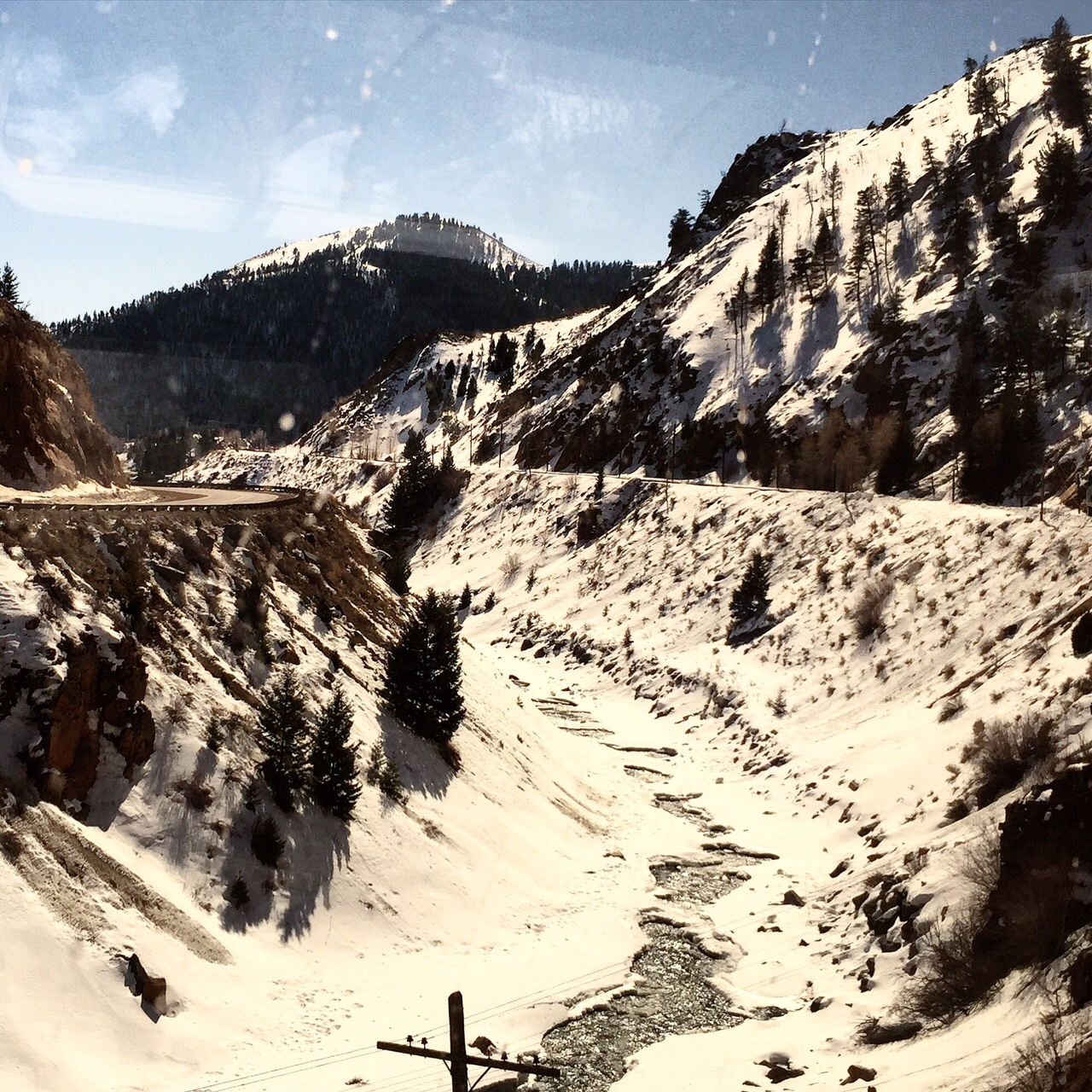
On Friday morning, we arrived in Denver and after picking up more passengers, we made our way up the Rockies, with the train coursing its way through canyon after canyon and following the Colorado River as the train makes it way up to 9,000 feet in elevation.  It was spectacular to say the least.  And this was only the morning scenery.  I highly recommend making the trip in the winter if you like snow as part of the scenery – I’m sure it looks amazing in the summer too with all the lushness of the forest, but there’s something magical about winter scenery for me. 

Making its way up the Rockies.


On these long train rides, there is a single car that is devoted to “sightseeing” – the lounge car.  It boasts floor to ceiling windows so you can see outside and appreciate the vastness and scale of the mountains and rivers around you.  I pretty much parked myself here all Friday.  There’s no wifi on the California Zephyr, and since you are in the mountains there’s no cell phone service either, but it hardly matters on a trip like this.  I was able to get over my lack of Instagramming abilities reasonably quickly. 


The train tracks are to the right, following the snow-covered Colorado River.


After lunch, the train then heads down the mountains and into Utah, which is where the scenery shifts dramatically and quickly from mountains to desert.  The train made its way through Ruby Canyon, which is just as spectacular as the Rockies but in a completely different way.  There’s something about the Western United States that is just magical.  In the afternoon, the conductor also came into the lounge car and started pointing landmarks to us along the way – without him, I wouldn’t have been able to spot Monument Valley and Arches National Park way in the distance.  Another time, perhaps. 

Typical view from Ruby Canyon.


By the evening, the train arrives in Salt Lake City, and I set myself down for the second night on the train.  The Roomette consists of two seats facing each other, which at night flatten to make a single bed that is for one person.  And I mean one person.  Like, don’t even try.  The room does fit two, though, because above the seats is a platform that can be pulled down to serve as the top bunk.  Feel sorry for that guy though. 

Also, bring an extension cord because there's only one plug in the entire Roomette.


When I woke up Saturday morning, we are already in Nevada, and stopping in Reno in the morning.  After that the scenery quickly shifted back from desert to mountains as the train made its way up the Sierra Nevadas, following the Truckee River.  It’s honestly hard to say which I found prettier – the Sierra Nevadas or the Rockies - but they are indeed different types of vistas and landscapes.  Whereas the train basically has 2 feet of space on either side while going through the Rockies, it hugs the cliffside for most of its trip through the Sierra Nevadas, and in that sense there is more open space to appreciate the vastness of the landscape.  There is no right or wrong in that sense, but just heaps and heaps of natural beauty. 

One of the best views I ever woke up to.  This is from my bedroom window.


By lunch, we had started descending the mountains and I arrived in Emeryville by 3 pm – 1 hour ahead of schedule.

Making our way up to the Sierra Nevadas, following the Truckee River.


The view near Donner Lake.


In retrospect, those looking for a shorter journey would do well to start in Denver instead, because that's when the scenery really starts.  But those who enjoy spending nights on trains should definitely do it end to end starting in Chicago.  52 hours on a train isn’t for everyone, but I definitely caught the train bug, and look forward to the next long-distance trip on Amtrak.


Review - 2016 Hong Kong Arts Festival - Simon Boccanegra (Verdi), Teatro Regio di Torino, Hong Kong Cultural Centre Grand Theatre, 28 February 2016 & 1 March 2016

Simon Boccanegra - Roberto Frontali (28 February 2016) / Alberto Gazale (1 March 2016)
Maria Boccanegra - Erika Grimaldi
Jacopo Fiesco - Michele Pertusi
Gabriele Adorno - Giorgio Berrugi
Paolo - Gevorg Hakobyan
Pietro - Fabrizio Beggi

Orchestra and Chorus of Teatro Regio Torino
Conductor - Roberto Abbado
Director - Sylvano Bussotti (Revival by Vittorio Borrelli)


I had encountered Simon Boccanegra in my opera going experience more than other popular works by Verdi like La Traviata, but the third viewing is still far from ideal. This revival of Bussotti's production from the 1970s with a recent revamp retain the feature of 'grand' scene settings and elaborate period costumes. Visually the staging made some impact in the council chamber scene with a rich blue mosaic backdrop alike the great hall of a Byzantine palace. Wave machine was employed to produce the coastline of Genoa in the background. Those after the grandeur of a stage set and argue opera should retain historical relevancy will probably applaud and enjoy.

However, I am not convince that the 'park and sing' choreography and stage set as backdrop would enhance the audience understanding of this opera. Genoa's ruling class is a microscope of the obstacles challenging Italy before and after unification. Unlike Rigoletto, it is also not so much about a class conflict but an ongoing bloodshed between local clad, which composer despised its existence into the unified Italy. Local hostile divisions and lacking the vision of a unified nation posed instability to the course of Risorgimento. One could argue the political tension is already demonstrated by the angry crowds in council chamber scene, councillor’s rivalry and plotted against the doge throughout the opera. But lavish costume and scene set are a display of quality workmanship than a visual realisation of the underlying message, neither establishing the theatrical atmosphere.

The complicated background of Amelia, or Maria, being kept away from knowing as the daughter of Simon, granddaughter of Simon's rival Jacopo, and Amelia's mother as the missing character, were also left to the audience doing detective work from the translated surtitles. I understand not everyone would enjoy the French opera director Olivier Py's approach in portraying every single details of the story in his production. Though his approach in Il Trovatore with extras to act out the troubled memory narrated by Manrico's mother fed the audience with background information, which I reckon is essential for staging Verdi's operas when we want to understand the recurring inner personal theme between father and daughter.

If theatrically the staging did not elevate an insight of the story, musically it would require a stellar vocal cast to keep the ears interesting. The line up from Turin Opera were generally technically competent and no ugly voice, but far from making an impression as a whole. Erika Grimaldi was so far the better Amelia I came across in live with the sheer impact in volume and note accuracy. But I found her timbre more a dramatic soprano than a spinto, which lacked the lyrical side of a soft spoken 'Gilda' in this tale. Giorgio Berrugi, who sang the role of Amelia's passionate lover Gabriele, was shaky with intonation in the second act big solo aria 'Cielo pietoso, rendila' and fell short from a climatic showcase. Same problem with singers as protagonist and Jacopo on different evenings that their timbre more suited in the dramatic first act, but lacked the warmth in tone desired in the expressive second half. I was disappointed by the baritone duet in the reconciliation scene that neither moving nor processing any radiant quality. Diction was generally passable though not Italianate enough, which probably suggested why the singing rather white hot in colour. Roberto Abbado should be credited for keeping the band together and very alert to the singer's rubato. The brass and wind sections were better than the strings for rhythmical precision and produced a rich body of sound. Tempo was generally on a broad side to keep tutti moments polished and elegant, but gradually sounded tiring for the ears and losing the momentum towards the end. 

Review - The Six Brandenburg Concertos (J S Bach), Hong Kong City Hall, 5th February 2016


Members of the Hong Kong Philharmonic Orchestra
Directed from the Harpsichord by Benjamin Bayl

Nearly a year apart after the performance by Berliner Barock Solisten in The University of Hong Kong, another demonstration of Bach's Brandenburg Concertos was given by the members of Philharmonic Orchestra. Except the harpsichord, no other period instrument such as recorder or baroque flute was used this time, neither baroque bows for the strings. Also less vibrato in playing to aim for a more silvery and pure tone. The sequence was also in reverse order starting with the second concerto and ended the concert with the first. Strings only third and sixth concertos filled the mid section of both half, leaving the leaner structured fifth and fourth concerts before and after the intermission. I felt it was the right order for the programme with a fanfare like concerto to open the concert, the mid section being intimate and pastoral orientated, rounded off with the concerto that had the largest instrumentation of all.

Instead of an earthy and percussive sound from a period instrumental group, generally this time ensemble produced a more refine tone and being transparent in structure. It would be unfair to compare which combination is better because different sets of tone colours. Though I would prefer to retain recorders for the fourth and viola da gambas for the sixth, which was not difficult to realise the composer intended these instruments for a colourful musical texture. The variety of instrumental colours would also keep the music more interesting for the ears.

Technically this around the musicians were more even and at ease than an effortful marathon. With the conductor directed from harpsichord, the solo violinist could concentrate on playing the solo passages and avoid tiredness than performing two roles at the same time, a notable problem in period instrument performances I experienced in recent years. Jing Wang's intonation on the violin improved as the evening went on and never aggressive on bow weight in technically demanding passages especially the fourth concerto. Benjamin Bayl excelled himself in the virtuosic cadenza on the keyboard at the first movement of the fifth concerto. His approach in keyboard playing was quite swift in tempo and the phrasing had a dramatic sense for musical direction.

In terms of the quality of playing, as I was told with limited rehearsals, there were highs and lows in result. To begin the concert with the sixth concerto was a challenge for the solo trumpeter Joshua MacCluer to nail the fiendish showcase passages, not to mention playing the piccolo trumpet in F. He played most of the notes accurately despite some slips in the top and appeared rather relieved when it was over. There was also some issue with balance that the upper strings being heavy handed in volume and overshadowed the soloists. More thought on phrasing and intonation were actually put into concertos with less instruments. Exquisite playing during the trio with violin, flute and harpsichord in the second movement of the fifth concerto, particularly from the flautist Megan Sterling. The first concerto was somehow an uneven display that the wind section were far more accurate and functioned as a group than the tutti strings. Few more rehearsals would have polished the rough corners for a better impression.