Showing posts with label Verdi. Show all posts

Review - Les Huguenots (Meyerbeer), Bérénice (Jarrell), Tristan und Isolde (Wagner), La Traviata (Verdi), The Paris Opera

Les Huguenots (Meyerbeer), Opéra Bastille, 1 October 2018
Marguerite de Valois - Lisette Oropesa
Raoul de Nangis - Yosep Kang
Valentine - Ermonela Jaho
Urbain - Karine Deshayes
Marcel - Nicola Teste
Le Comte de Saint-Bris - Paul Gay

Andreas Kriegenburg (director)
Michele Mariotti (conductor)

Bérénice (Jarrell), Palais Garnier, 2 October 2018
Titus - Bo Skovhus
Bérénice - Barbara Hannigan
Antiochus - Ivan Ludlow
Paulin - Alastair Miles
Arsace - Julien Behr
Phenice - Rina Schenfeld

Claus Guth (director)
Philippe Jordan (conductor)

Tristan und Isolde, Opéra Bastille, 3 October 2018
Tristan - Andreas Schager
Isolde - Martina Serafin
King Mark - Rene Pape
Kurwenal - Matthias Goerne
Brangäne - Ekaterina Gubanova
The Young Seaman - Nicky Spence

Peter Sellars (director)
Bill Viola (video)
Philippe Jordan (conductor)

La Traviata, Opéra Bastille, 5 October 2018
Violetta - Aleksandra Kurzak
Alfredo Germont - Jean‑François Borras
Giorgio Germont - George Gagnidze

Benoît Jacquot (director)
Giacomo Sagripanti (conductor)

(Tristan und Isolde)

A big thank you to all that has been following this blog since October 2015. Hopefully more reviews on opera performances and lifestyle too such as a recent champagne sampling of 28 labels.

For the hundredth post, a review of four opera performances I saw at my recent revisit to the Paris Opera. The question of 'loyal to whom' is certainly the common theme that these operas dealt with the question of identity. Social belonging and public duty disrupt the relationship of the protagonist and their love ones. Death is also inevitable in the end but not necessarily a sad ending.

In Les Huguenots, Raoul and Valentine belonged to the rival groups of Catholics and Protestants. Their affection for each other saw them together yet did not escape the religious massacre. Valentine's death served as a poignant reminder to her father that the slaughter came at a painful cost despite attempts to stall the escalation.

There were more complications in Bérénice that Tito tormented by the state rejection of a foreign queen and his affection for her. The love triangle relation with Antiochus as a friend and in knowledge his affection for Bérénice added further headache to the dilemma. Bérénice's frustration by Tito's indecisiveness followed by the hopeless situation showed the three bended to the wheel of the state.

The forbidden love between Tristan and Isolde betrayed the state as the latter supposed to be the wife of King Mark. Their death was a release from the loyal obligation and reunited in after life. Giorgio rejected Violetta because of her social status despite her love for Alfredo was genuine and deep. Her death released her from the unhappy life yet a loss to the Germonts.

In terms of staging, Andreas Kriegenburg's set was the biggest with a mobile structure alike many recent productions. The mass crowd deployed in his production of Rheingold for Munich reappeared at the court of Marguerite. Though as a whole the dramaturgy followed a narrative approach and seems so relax that lacked a build up towards the cruel massacre in the final scene. It did not carry the looming intensity nor effect like his Soldaten.

(Bérénice)

It was my second time to see Bill Viola's video filming as backdrop in Tristan and Isolde. Though I felt the screen size used in Paris was smaller than my first viewing at Birmingham. The artistic filming style gave more fluidness to the background than the often slow motion or even static stage choreography. There were some memorable moments such as the candlelit scene, the underwater shot and the naked male ascended in pouring rain. Some might find the filming distracting and too suggestive while the singers were on stage. Though the problem seems to be Sellar's choreography for the singers rather basic or even random than incorporation them into the film.

However, Benoît Jacquot's production of La Traviata was the most unimaginative of all four. The set was so economically presented that the stage looked rather bare with Violetta's bed station alone. Act three when Violetta and Alfredo confronted at the salon gathering was the only part more interesting to look at. If it was not the music excellence, the evening would have been rather boring to sit long.

The best of all was Claus Guth's production of Bérénice, which had more depth and visual interest. The presentation as a psychological thriller realised the tension, emotional conflict and surrealness vividly. It added the dramatic intensity in displaying the protagonists' vulnerability and torments. Alike Les Huguenots and Tristan und Isolde, there was a lengthy negotiation as the emotional states evolved. Even though it could be tedious and frustrated as the characters seem never able to make up their minds.

(Les Huguenots)

Musically, the male choral parts were magnificent in Les Huguenots, especially the tenors that never seems tired to nail all those top notes and gave a wall of sound that filled the hall with a lot of vocal excitements. At short notice, Lisette Oropesa sang far more successfully than Yosep Kang. Oropesa met the vocal demand with ease, technically confident and also had the sweetness in her timbre. Whereas Kang struggled with the tessitura and he was not comfortable at all in the high vocal range. Diction was also sloppy, and his singing lost the flexibility and brilliancy as he displayed in Lucia di Lammermoor at the Deutsche Oper Berlin few years ago. I was more impressed by Ermonela Jaho, who not only technical brilliancy but also showing Valentine's torment and agony in full.

As a brilliant actress and singer, Barbara Hannigan showed how frustrating and despair of Bérénice in her quarrel with Tito. With Bo Skovhus and Ivan Ludlow, their music phrasing and acting were very natural as if the roles had been sophisticatedly studied and well prepared.

Endless vocal energy from Andrew Schager as a full blooded Tristan. Yet he approached the role alike Siegfried was sometimes overpowering and lacked the dynamic contrast. His counterpart Martina Serafin had mixture of results in her execution of Isolde. She was rather wobble by employing too much vibrato, and sometimes struggled to keep the intonation and even sustaining a phrase. Her vocal energy lost after a rather presentable act one and the rest seems too much for her to handle. Rene Pape was an experienced veteran in the role of King Mark. Though probably due to the staging he and Ekaterina Gubanova seems lacked the attention and merely a singer on stage without much impression. Nicky Spence as the seaman showed vocal promise and worth future listening for his confident and commanding timbre. Though it was annoying that a member of the audience applauded inappropriately after the cor anglais beautiful solo in act three.

Besides Ermonela Jaho, Aleksandra Kurzak also impressed me by her effortless singing and wonderful portrayal of the vulnerable Violetta. Her creamy timbre sustained the vocal smoothness and momentum. Jean‑François Borras managed to match Kurzak's vocal confidence and the audience seems unfairly gave him less appreciation. I was less crazy about George Gagnidze as Giorgio as his voice showed tears and lacked the warmth and body I had in mind.

The Paris Opera orchestra knew the music very well and responded to the ebbs and flows in all four operas. In Tristan und Isolde the orchestra especially kept the music flowing while ably to adjust the tone colour to match the emotions. They shaped the music effectively with a wonderful sense of direction. It was definitely the best orchestral interpretation I encountered in live and kept the evening more memorable than the vocal cast.

(La Traviata)

Review - Aida (Verdi), Opera Hong Kong, 12 October 2017


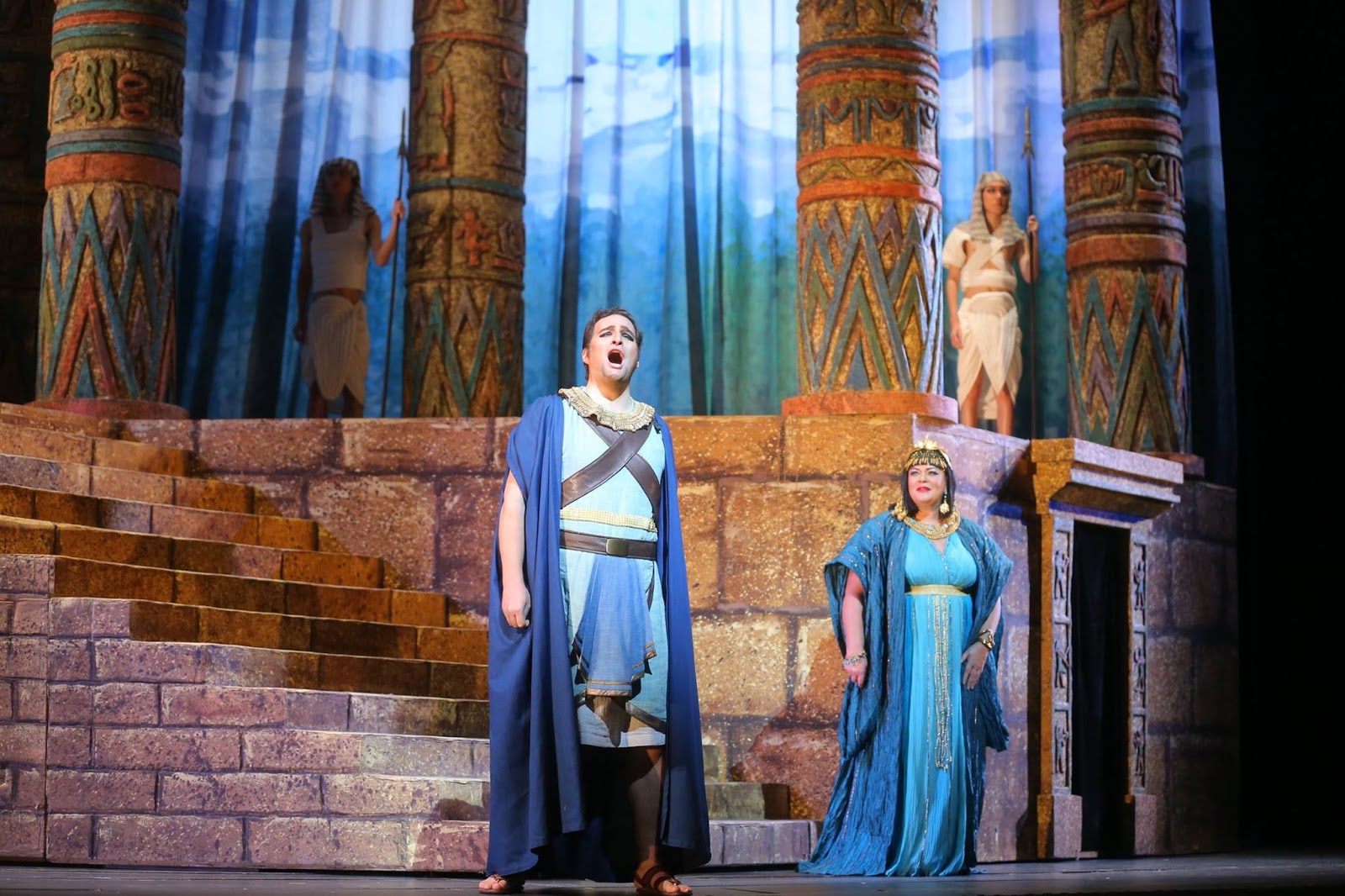
Aida - Marjorie Owens
Radames - Riccardo Massi
Amneris - Violeta Urmana
Amonasro - Reginald Smith Jr
Ramfis - Hao Jiang Tian
Pharaoh - Igor Durlovki
Messenger - Chen Chen
Priestess - Li Yang

Opera Hong Kong Chorus
Shanghai Opera House Orchestra and Suzhou Symphony Orchestra
Xu Zhong (conductor)
Jean Louis Grinda (director)

Opera Hong Kong and the Shanghai Opera House staged a grand and creditable performance this evening by reviving the general conservative appeal of Verdi’s timeless classic which delves into the difficult themes of fate, conflict of obligations, patriotism, and the salvific eternity of love.

Featuring stars such as Kristin Lewis, He Hui and Riccardo Massi, the all-star cast in this co-production is formidable to say the least. Marjorie Owens who sang the title role tonight was exceptional in many respects. Possessing a rich and substantial dramatic voice easily capable of filling the theatre, she offered an acoustic alternative to the other two renowned lyrical-spinto sopranos. ‘O Patria Mia’ was beautifully sung with ravishing phrasing, lush crescendos and a finely controlled pianissimo towards the end.

The role of Amneris seems to require much more versatility than that of Aida as her character is instilled with much more pathos and emotional changes. One sometimes wonders if Amneris is the real victim in the opera. From being a venomously jealous rival of Aida to being a repentant intercessor for Ramades, Violeta Urmana pulled off the role convincingly, striking the audience with her forthright but heartfelt vocalism.

Tenor Riccardo Massi came in strong with a stunning ‘Celeste Aida’, sung effortlessly with fervor and finesse. His tone was however a tad too light to complete Radames’s supremely heroic and domineering aura in Act I, as one who has heard Franco Corelli’s robust interpretation might agree. By contrast, his acting suggested a stout and headstrong Radames who would ultimately find himself defenseless before the dictates of fate.

Worthy of special mention are Hao Jiang Tian who sang Ramfis and Reginald Smith Jr who sang Amonasro, both possessing a round, orotund and fruity voice. Brilliant acting contributed to a climactic scene in Act III where Amonasro brazenly confronted Aida and hurled her to the ground.

By contrast, the Opera Chorus was disappointing to say the least. Consonants and entrances were very untidy. Intonation was questionable, especially during the sacrificial scene of Act I at the Temple of Vulcan. Tone was bland and lacked depth. There was also a problem with taking the sound out too early in the last syllables of many a phrase.


Whilst the quality of singing (apart from the Chorus) was generally undeniable, more doubts loom over the Jean Louis Grinda’s cinema-inspired setting. Despite the originality of the idea of mixing the contemporary with the ancient and of presenting the plot as an imaginary film, the final stage result was nothing short of uncomfortable and odd. The awkward presence of a redundant and messy film crew fussing around on both sides of the stage endured way beyond the introductory setting of the scene and gradually became a nuisance which served only to pull the audience away from the otherwise impeccable force of the drama. It irrevocably distanced the audience from the tragic impact of the plot every time the crew intruded into the scene to remind everyone that the whole thing was just a figment of imagination. Even worse was when the director lost courage to sustain his cinematic vision and apologetically called the film crew to retreat in the last Act.

Although the production was certainly not low-rent, many artistic details were glaringly overlooked, or worse still, tolerated. The grandeur of the Egyptian court in Act I was severely diminished by the poorly aligned soldiers, most of whom in their half-exposed state looked either unpleasantly flaccid or utterly skeletal. Costumes were uninspiring and mediocre – one would certainly be forgiven to ask if the great Pharaoh was actually one of the slaves during his first appearance. Make-up was subpar – there were one or two in Pharaoh’s entourage who liked like drifting ghosts. The otherwise deeply romantic secret meeting scene at the Nile in Act III felt shortchanged as one saw grotesque and coarse metal installations on what were meant to be lush lawns with beautiful flowers. Despite the well-choreographed dance in the sacrificial scene in Act I, everything and everyone looked dead and conveyed neither exoticism nor mysticism. Such a scene would probably have benefitted from the use of dimmer lighting and candle fire. That said, the pageantry of Act II, the choreography and the sets were generally commendable.

Overall, this was a fine and under-applauded production which could nevertheless have used more attention to detail and better on-stage actors.


(Photo credit: Opera Hong Kong Facebook page)

Review - Otello (Verdi), Opera Hong Kong, Hong Kong Cultural Centre Grand Theatre, 16 October 2016

Otello - Carl Tanner
Desdemona - Valeria Sepe
Iago - Matias Tosi
Cassio - Chen Chen
Emilia - Samantha Chong
Roderigo - Frankie Liu
Lodovico - Gong Dongjian
Montano - Sammy Chien
Herald - Frankie Fung

Opera Hong Kong Chorus and Children Chorus
Hong Kong Philharmonic Orchestra
Maurizio di Mattia (Director and Lighting)
Gianluca Martinenghi (Conductor)


To commemorate the 400th anniversary of Shakespeare's death, Opera Hong Kong mounts a new production of Otello, which is one of Verdi's most dramatic and musically progressive grand operas. The winged lion of St Mark, a notable symbol of Venice, makes a bold visual image on the safety curtain. The new staging by Mattia, in collaboration with Rome opera, attempts to bridge convention stage directions with conceptual approaches of psychology and atmosphere. Though as a whole the idea far from a developed one that often being random, inconsistent and far from making a statement.

Instead of a black and white imagery, lightning effects along orange-red-blue stage lights do not make an effective representation of the opening stormy scene. The choir choreography at first is alike a chaotic revolution scene than a nervous observation of the naval battle from afar. Neither circular blocks that dominate the centred stage are unable to create the physical sense of a public space but only tall structures. The quasi Islamic costume and drunken actions have some similarities of the pirate town portrays in the Hollywood blockbuster Pirates of the Caribbean. The outfit of Iago also resembles captain Jack Sparrow in the film. Whether the director is suggesting the two are similar, Iago is supposedly a more cunning and terrifying figure. The silenced dancers, later as metaphorical representation of evilness and temptation, are introduced as seductive figures during the celebration of military victory.

When the blocks turn into an oval courtyard with a hanging city gate in act two, it becomes a rather gentle and soft as backdrop, not really able to produce the platform for Iago's declaration of revenge and sinister remarks. The dance choreography is entertaining to see and captures the pastoral rhythmic movement of the music, but far from portraying the bad spirits that probably in mind at first place. The stage direction is then at the basic level with the chorus forming a cardboard human wall. It may be an opportunity to display a full and happy choir with children members, but the dramaturgy is lost that not realising the atmospheric change in line of Otello's diminishing faith, poisoned mind and jealousy towards Desdemona. The purpose of a man dies after kissing a woman, behind a transparent screen at the beginning of act three, is again unclear except foretelling the tragic outcome. Though the stage set should be credited for its beautiful appearance of the evening as Otello's exotic decorated study, with Islamic lanterns and a hanging crucifix. Upon the arrival of Lodovico, the Venetian ambassador, his outlook with powdered wig and silver coat strangely recall the presentation scene of silver rose by Octavian in Otto Schenk's staging of Der Rosenkavalier.


Reference to classic stagings continues further into the last act with ballet blanc, which silenced figures wear veils and dress in full white bell shaped skirts. This leaves us to puzzle whether these are spirits or supernatural beings congregate in a murder scene and if their purposes are spectators or metaphor of death. The murder and confession moment is also dramatically underwhelming. The bedroom stage set is atmospheric on its own, but the dramaturgy far from creating the crushing emotional breakdown of Otello before his suicide. Singers seems on their own device in figuring out the death sequence than delivering a natural progression.  In sum, the staging can be more coherent and focus without too much references since any directorial approach is to articulate and develop the key aspects. It also needs to develop a style of its own than a mixture of borrowed ideas.

Acoustically the grand theatre is not that dry, but the projection of produced sound does not carry to the hall in full even I am hearing eight rows away from the stage. The orchestra does not produce the wall of sound at the suppose violent and tempestuous passage in the beginning, though the chorus is heard more prominently in terms of balance. Throughout the performance, voices of the adult choir blend well together with a healthy vocal volume. Diction fares better at tutti moments and long vowels, but the men hurry at the heavy texting passage in act one, which results a sudden drop in vocal volume and untidy entries.

Among all soloists, the dramatic tenor Carl Tanner as the protagonist is vocally most consistent and technically capable. A full tone with the sheer body of sound and projection. Many thoughts put in phrasing and diction is convincing enough to sound Italianate. His voice never sound tired, ably to sustain the energy and comfortable with the tessitura throughout. There is a differentiation in his vocal colours that make it interesting to appreciate and enjoy. Although some coordination issues with the orchestra in the beginning of act three, that is quickly rectified and back in place again. His role portrayal is a classic one to display the war hero in jealousy, rage and nervous breakdown, but the stage direction does not help to make a strong impression is unfortunate.


One have mixed feelings for Valeria Sepe, who sings the role of Desdemona. Her voice condition is healthy, especially soaring upwards for higher vocal range with a ringing tone, but diction is surprisingly poor as native speaker and often shaky with intonation. It takes some time to settle with tuning in her first entry of act one and at the danger in out of sync with the orchestra. The passionate duet with Otello is all loud in volume but vocal richness is in absence. The most bothering part is she uses this undesirable approach to close up and darken the vowels. The method produces a worn out voice alike an elderly woman singing quality and greatly reduces the vocal support in projection. The lack of phrasing is also why she struggles to coordinate with the orchestra, especially the Ave Maria in last act which is neither moving and a mess. Otherwise, she looks beautiful and youthful for the role, also the singing is more comfortable in act three when Desdemona asks for forgiveness from Otello.

Matias Tosi is better with his dance moves as a young and cunning Iago, resembling the eccentric Johnny Depp as Captain Jack Sparrow, than in his singing. Vocally he lacks a differentiation in tone and belting out the notes without any phrasing. Then tiredness sinks in and unable to sustain the vocal energy at the duet with Otello on disloyalty in act two. The projection diminishes to a barely audible level and becomes throaty that struggles to complete a phrase. He also sounds more as a baritone than bass baritone that struggles to produce low notes and lacks the depth of richness. Diction is very often muddled and the voice is not an exciting one to hear repeatedly. One is more convinced that Gong Dongjian would have made a capable alternate Iago with the right vocal colour and volume. Chen Chen convinces me as an oratorio singer than in opera by being too polish and underwhelming in projection as Cassio. Other minor roles are presentable but generally need to improve the diction to sound more Italianate. Gianluca Martinenghi appropriately employs a rather broad tempo in his conducting that the music playing is neither rush nor drag. The very capable philharmonic orchestra produces many fine moments and saves the performance with good musical directions and maintains dramatic impulse.


(Photos: Opera Hong Kong Facebook Page)

Review - 2016 Hong Kong Arts Festival - Anna Netrebko & Yusif Eyvazov, Hong Kong Cultural Centre Concert Hall, 8 March 2016

Sinfonia from La Forza del Destino (Verdi)
'Ecco, respiro appena, lo son l'umile ancella' from Adiana Lecourvreur (Cilea)
'E la solita storia del pastore' from L'arlesiena (Cilea)
'Tacea la notte placida...Di tale amor che dirsi' from Il Trovatore (Verdi)
'Ah! si ben mio...Di quella pira' from Il Trovatore (Verdi)
Prelude from Attila (Verdi)
'Gia nella notte densa' from Otello (Verdi)
'Non ti scordar di me' (Curtis)
'Un bel di, vedremo' from Madama Butterfly (Puccini)
'Toute mon âme est là...Pourquoi me réveiller' from Werther (Massenet)
'O mio babbino caro' from Gianni Schicchi (Puccini)
'E lucevan le stelle' from Tosca (Puccini)
Intermezzo from Manon Lescaut (Puccini)
'O soave fanciulla' from La bohème (Puccini)
Encores:
'Heia, heia, in den Bergen ist mein Heimatland' from Die Csárdásfürstin (Kalman)
'Nessun dorma!' from Turandot (Puccini)
'Libiamo ne' lieti calici' from La Traviata (Verdi)

Anna Netrebko
Yusif Eyvazov
Jader Bignamini (Conductor)
The Hong Kong Philharmonic Orchestra


The expectation was high for this eagerly awaited performance by Anna Netrebko and her recently wedded husband Yusif Eyvazov as part of the tour to Asia. The length of the programme would have worth the ticket value at premium level, but mostly the diva herself made it a memorable evening whereas the rest did not always reach the same mark. Scenes from operas in verismo style filled the music list except one of Ernesto de Curtis's Neapolitan song. Interestingly, the majority were associated with intimate scenes of affections than violent ones, which hinting the honeymoon period of the couple was still in the air. First half of the programme was also a technical demonstration in compared to the second half, which consisted many short well known show-pieces.

Jader Bignamini took the risk to conduct the concert without scores throughout the evening, but his conducting style did not always justify the ability to do so. The overture from Verdi's La Forza del destino was structurally unsettling by rushing through that tutti strings were not always together. One suspected not much rehearsal time had been allowed to polish the music. Only until Netrebko came on stage and blown us away with her rich, powerful and radiant voice, also her dazzling stage presence and showmanship, which we could forget the conductor having the trouble to coordinate the tempo between the diva and the orchestra. The acoustic also helped her voice to fill the hall effortlessly and did not matter whether you sat in front of or behind. My first impression of Eyvazov was not a good one with his timbre lacked of warmth, hard, white hot in vocal colour and not much differentiation. One could credit him being able to sing a wide vocal range but a lot to think on phrasing when the tempo dragged a lot in the except from Cilea's L'arlesiena.

Another problem with Bignamini's conducting was he indicated the pulse on the beat than ahead. Inevitably when the orchestra responded it was already behind the targeted tempo and messy playing as result. The tempo he started the Cavatina 'Tacea la notte placida' from Verdi's Trovatore was too slow. It took some seconds before all parties gradually settled together and the diva took our breath away again with her beautiful singing. Her musical phrasing was unbelievably natural with impeccable breath control. In the Cabaletta 'Di tale amor che dirsi', she proved to have the vocal flexibility for dramatic coloratura despite a few slips in the top notes. I was not sure whether Eyvazov could make a spinto tenor as his timbre was too hard and thin for the lyrical passage in 'Ah! si ben mio' from Trovatore. The heroic moment 'Di quella pira' also sounded karaoke like that he was capable to sing it but barking top notes out did not make a good impression.


The ending scene from first act of Verdi's Otello was the weakest presentation of the evening. Eyvazov's timbre did not convince me he would be ideal to sing the protagonist part by lacking the vocal weight and richness in voice. Dodgy coordination moment again when the Bignamini took the tempo too slow at Netrebko's entry 'Mio superbo guerrier', and had to negotiate several bars before the singing and orchestral playing came together. Netrebko also sounded unsure how to put the phrasing in place and the singing lacked direction. The whole attempt fell short from producing a spellbinding end of the first half, and I reckon they need to go back to the drawing board for a rethink.

Second half of the concert began with an arrangement of 'Non ti scordar di me' by Curtis for duet, but a cheesy version being rather lively than the subtle rendition of the original. Then again Bignamini took a tempo too hurried at the start of 'Un bel di, vedremo' from Puccini's Madama Butterfly that only settled down when Netrebko started singing. Up to this point, he generally far from having a grip on what tempo should take each time. I felt most unsatisfactory when the stake of this concert was high and the conductor's quality did not match what the audience had paid for. The intermezzo from Manon Lescaut was the only item that he could lead the orchestra to play well, of course the music also spoke for itself with the sheer impact of emotions and glorious tunes.

Thankfully Netrebko's radiant singing turned our mind back to satisfaction again and again. The beautiful creamy rich voice took the breath away in 'O mio babbino caro' from Puccini's Gianni Schicchi. Eyvazov also sang much better in Cavaradossi's Romanza than his French attempt in 'Toute mon âme est là' from Massenet's Werther. His lower vocal range was more pleasant for the ears and some differentiation in tone colour, compare to the forceful upper range. He also seems more familiar with the works and more thoughtful with phrasing than belting out a song. It was an odd choice though to select the very end of La bohème first act for the supposed finale of the evening. I would have prefer to start from Rodolfo's 'Che gelida manina' all the way to the end of act one for conclusion than those in the encores. Overall it was a great evening to hear Anna in live but the rest far from a memorable experience.

Review - 2016 Hong Kong Arts Festival - Shostakovich and Prokofiev, Teatro Regio di Torino, Hong Kong Cultural Centre Concert Hall, 4 March 2016

Symphony No 9 (Shostakovich)
Alexander Nevsky (Prokofiev)
Encores:
'Va. pensiero' from Nabucco (Verdi)
Overture from Guillaume Tell (Rossini)

Orchestra & Chorus of Teatro Regio Torino
Daniela Barcellona (Mezzosoprano solo)
Gianandrea Noseda (Conductor)


Pairing two Russian works from before and after the Second World War make an interesting contrast. Alexander Nevsky is a bold statement of patriotism and dense in texture, whereas Shostakovich's ninth symphony being enigmatic and nothing definite. These works neither reflect the trademarks of the composers' compositional styles. Prokofiev turns into formalist and writing masculine angular music based on religious chants, in contrast, Shostakovich bears all the late Prokofiev style for being sarcastic, violent and ironic. Both works also bear a sense of being impersonal and not to stir up the inner emotion too much, but an objective reflection of the time. It is logically then to round off the concert with the two well know Italian pieces pouring out the long awaited sentiment and brilliant triumphal end as encores.

On the podium, Noseda always wanted to push the momentum but his conducting not always accurate with indications. The first movement of the ninth symphony emphasised on robust rhythm bites but with the orchestra rushing through it, the playing lacked structure and some untidy corners among the strings as results. Woodwinds were better in terms of tone quality and responsiveness as a section. They hold everything together even when Noseda was late to indicate entries and more natural in music phrasing, especially for the climatic end of the brutal and dark third movement. A battery of percussion later joined the chorus for Alexander Nevsky. The choir was slightly imbalance with the male parts more able to project the sound of wall than the ladies. Intonation was fine but the diction did not convince me, which I heard the vowels more than identifying each word. Daniela Barcellona had the right timbre for the mournful aria describing the field of the dead, though from where I sat at one side of the orchestra, she was underwhelming in vocal volume and difficult to understand her diction. The Guillaume Tell overture would have been brilliant if the flautist had rehearsed the tricky solo part beforehand than a quick sight reading on site. 

Review - 2016 Hong Kong Arts Festival - Simon Boccanegra (Verdi), Teatro Regio di Torino, Hong Kong Cultural Centre Grand Theatre, 28 February 2016 & 1 March 2016

Simon Boccanegra - Roberto Frontali (28 February 2016) / Alberto Gazale (1 March 2016)
Maria Boccanegra - Erika Grimaldi
Jacopo Fiesco - Michele Pertusi
Gabriele Adorno - Giorgio Berrugi
Paolo - Gevorg Hakobyan
Pietro - Fabrizio Beggi

Orchestra and Chorus of Teatro Regio Torino
Conductor - Roberto Abbado
Director - Sylvano Bussotti (Revival by Vittorio Borrelli)


I had encountered Simon Boccanegra in my opera going experience more than other popular works by Verdi like La Traviata, but the third viewing is still far from ideal. This revival of Bussotti's production from the 1970s with a recent revamp retain the feature of 'grand' scene settings and elaborate period costumes. Visually the staging made some impact in the council chamber scene with a rich blue mosaic backdrop alike the great hall of a Byzantine palace. Wave machine was employed to produce the coastline of Genoa in the background. Those after the grandeur of a stage set and argue opera should retain historical relevancy will probably applaud and enjoy.

However, I am not convince that the 'park and sing' choreography and stage set as backdrop would enhance the audience understanding of this opera. Genoa's ruling class is a microscope of the obstacles challenging Italy before and after unification. Unlike Rigoletto, it is also not so much about a class conflict but an ongoing bloodshed between local clad, which composer despised its existence into the unified Italy. Local hostile divisions and lacking the vision of a unified nation posed instability to the course of Risorgimento. One could argue the political tension is already demonstrated by the angry crowds in council chamber scene, councillor’s rivalry and plotted against the doge throughout the opera. But lavish costume and scene set are a display of quality workmanship than a visual realisation of the underlying message, neither establishing the theatrical atmosphere.

The complicated background of Amelia, or Maria, being kept away from knowing as the daughter of Simon, granddaughter of Simon's rival Jacopo, and Amelia's mother as the missing character, were also left to the audience doing detective work from the translated surtitles. I understand not everyone would enjoy the French opera director Olivier Py's approach in portraying every single details of the story in his production. Though his approach in Il Trovatore with extras to act out the troubled memory narrated by Manrico's mother fed the audience with background information, which I reckon is essential for staging Verdi's operas when we want to understand the recurring inner personal theme between father and daughter.

If theatrically the staging did not elevate an insight of the story, musically it would require a stellar vocal cast to keep the ears interesting. The line up from Turin Opera were generally technically competent and no ugly voice, but far from making an impression as a whole. Erika Grimaldi was so far the better Amelia I came across in live with the sheer impact in volume and note accuracy. But I found her timbre more a dramatic soprano than a spinto, which lacked the lyrical side of a soft spoken 'Gilda' in this tale. Giorgio Berrugi, who sang the role of Amelia's passionate lover Gabriele, was shaky with intonation in the second act big solo aria 'Cielo pietoso, rendila' and fell short from a climatic showcase. Same problem with singers as protagonist and Jacopo on different evenings that their timbre more suited in the dramatic first act, but lacked the warmth in tone desired in the expressive second half. I was disappointed by the baritone duet in the reconciliation scene that neither moving nor processing any radiant quality. Diction was generally passable though not Italianate enough, which probably suggested why the singing rather white hot in colour. Roberto Abbado should be credited for keeping the band together and very alert to the singer's rubato. The brass and wind sections were better than the strings for rhythmical precision and produced a rich body of sound. Tempo was generally on a broad side to keep tutti moments polished and elegant, but gradually sounded tiring for the ears and losing the momentum towards the end. 

Review - Nabucco (Verdi), Deutsche Oper Berlin, 17 October 2015


Nabucco - Dalibor Jenis
Ismaele - Attilio Glaser
Zaccaria - Liang Li
Abigaille - Francesca Mondanaro
Fenena - Ronnita Miller
Oberpriester des Baal - Marko Mimica
Abdallo - Gideon Poppe
Anna - Nicole Haslett

Chor & Orchester der Deutschen Oper Berlin
Conductor - Ivan Repusic
Director - Keith Warner


My previous and also the first live experience of Nabucco was Daniel Slater's production at Flemish Opera in 2013. The directorial approach focused on the moral question of greed and the public against those in power with reference to the Occupied Wall Street movement. The relevancy to contemporary affair was effective at the time but I agreed with my friend that this staging by Keith Warner would probably stand the test of time. The main focus was on Christian philosophy in the old testament that cast out the false idol and turned to one God or would be punished. Warner saw this opera alike a 19th century oratorio regarding religious moral dimension than the double message to rebuild a nation from broken states. When Nabucco putting on the gold mast and claimed himself above god, he suddenly became mad and unable to prevent the coup d'etat by Abigaille claiming the throne. Though he represented the one with righteous when regained senses, repent his sins by liberating the Israelites from execution and acknowledged their faith. In contrast, Abigaille not only lost her regal status but too late to repent and casted out from Jerusalem. Although she did all the wrongdoings, there was a degree of sympathy that one would realise the situation forced her to make all the bad moves and as a daughter of the slave. There was also a silent role in this production probably a representation of God himself.  An elderly man first pushed the steel structure apart to reveal the interior and disappeared when the Israelites began to congregate at the invasion of Babylonians. He reappeared when Nabucco claimed to be greater than God and pulled out a barrier while the monarch was punished by turning into a mad king. Towards the end he shut the structure when Abigaille was banished. 


Compare to the stage set of Lucia in previous evening merely as a backdrop, theatrically this production created the dramatic intensity and attentions to bring out the central theme of each scene. At the beginning, we saw a large erected moveable structure made by steel to represent the great walls of Jerusalem. The smoke effect coming from the top with stage lights created a dense and heavy atmosphere, which further attracted the audience curiosity to find out the secret behind the wall. Interestingly, the Israelites all wore black in the fashion of late 19th century except the Kohen, who wore Bukharan kippah but strangely a scarf instead of tallit with black stripes. Leaving the accuracy of religious clothing aside, the Jews here were portrayed as a close group that saw anyone did not turn to their belief as outsider, and men particularly as fanatics praying around the wall of a black room fervently, which was probably a reference to the temple of Jerusalem. The throne of Nabucco sat inside a watch tower with a stair and gold paint on the wall. The outlook stood out from the dark stage, also the simplistic and stylish appearance was effective than any attempt of historical replication of a throne room. The hanging ropes in the execution scene with Israelites sat in rows awaiting their death sentence sent down the emotion of fears and chilling atmosphere in an execution room. The key success I felt altogether was the seamless scene change that the gigantic sets could move in different ways without losing the dramatic flow, and the display of stage machinery was a spectacle that not many opera productions could manage. 


In this performance the male soloists were better than ladies with the singing. Dalibor Jenis's timbre had that darker tone colour than normal baritones that enhanced the vocal richness with a good projection. His musical phrasing was appropriately executed and one of those singers I would want to hear again in future. His physical outlook and acting also suited to the portrayal of Nabucco as a young and troubled monarch in this production. Liang Li was also looked ideal in the role of Zaccaria as priest to the Israelites. Good vocal projection and the singing was not forceful but pleasant as a bass. Francesca Mondanaro was a good actress by giving an intense display of conspirator claiming the throne of Nabucco for her own defence and the subsequent downfall as a rejected ruler. Though her singing deteriorated as the evening went on with intonation problem on high vocal register and not a voice to listen long. Attilio Glaser was better but her role had only one aria to showcase and did not make much an impression. The chorus delivered a heartfelt and beautiful account of the chorus of Hebrew slaves. Generally the choir was secured with intonation, lesser vibrato and delivered the body of sound to fill the house. Ivan Repusic was less controlling with his conducting than Filippo Sanjust. Even so, the orchestral playing did not lose any signs of energy, the tempo change between scenes were natural and not abrupt. The accompaniment never overpowered the singers in volume and being responsive to the conducting.