Showing posts with label Matthias Goerne. Show all posts

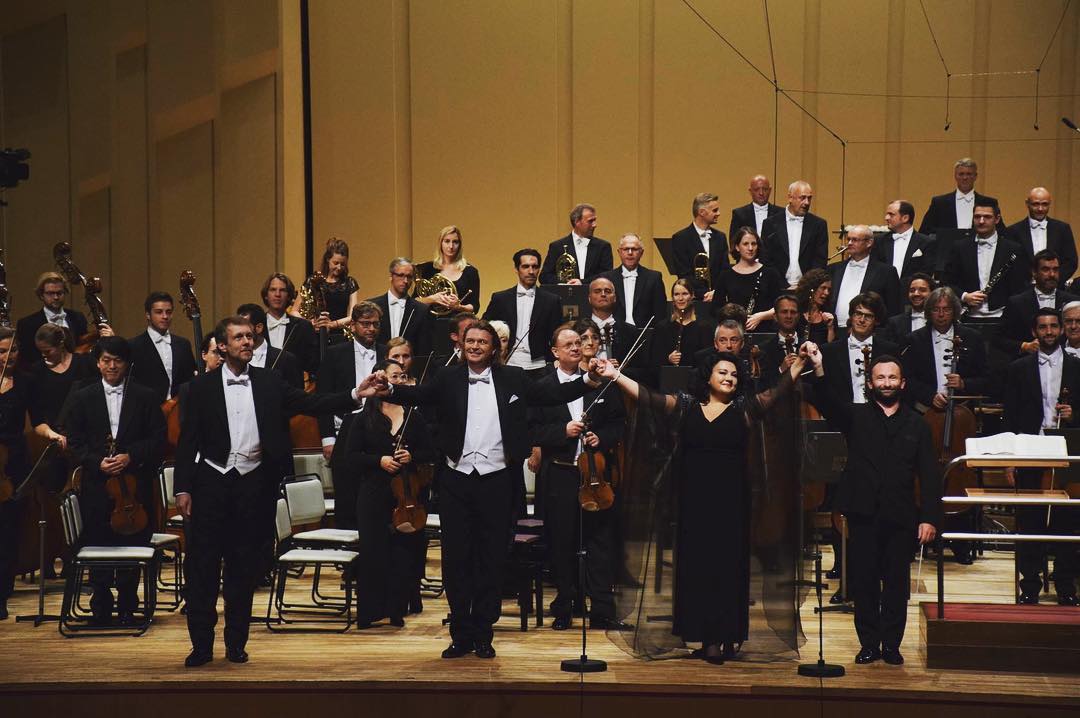
Review - Kirill Petrenko and the Bavarian State Orchestra, NHK Concert Hall Tokyo, 1 October 2017

Das Knaben Wunderhorn (Mahler)
Act 1 from Die Walküre (Wagner)

Matthias Goerne (Baritone)
Klaus Florian Vogt (Siegmund)
Elena Pankratova (Sieglinde)
Georg Zeppenfeld (Hunding)
Bayerisches Staatsorchester
Kirill Petrenko (Conductor)

This concert marked the end of this year Munich Opera's tour in Tokyo, which staged performances of Tannhaüser and Magic Flute were given the week prior. First half featured Mahler's songs set to poems from the youth's magic horn, which contemplate between melancholy, death and afterlife. A fine selection but not always favourable to Goerne's timbre, and some questionable whether
effective at such lower vocal range. The orchestral playing was fraction behind Petrenko's conducting in the slow danced Rheinlegenchen. It felt rather out of place when the phrasing and coordination did not come together naturally. The second song, Wo die schönen Trompeten blasen, showed the best side of Goerne's singing through the tender and lyrical vocal lines. The strings flowed better than the winds, which still not together under Petrenko's indication. Fanfare from horns and trumpets at the coda was sight reading like and the produced sound felt uncertain.

Though the other way round in the third song, Das irdische Leben, which Goerne dragged behind the dramatic yet melancholy orchestral accompaniment. His tone colour was dense for the majestic and more positive 'Urlicht'. Despite the orchestra gave a warm and sweet playing, Goerne adopted a rather slower tempo than with the forward momentum Petrenko tried to indicate in his conducting. The orchestra became rather restrained during the witty waltz driving 'Verlor'ne Müh', whereas Goerne gave a more humorous rendition in a brighter tone than before. The rather uplifting 'Revelge' in the style of a march was the most symphonic and loudness of the selections. Here both orchestral and vocal had more grip to the performing style. Goerne brightened up his singing to enhance the vocal clarity, whereas the orchestra gave a majestic and lively rendition. Musically the last movement, Der Tamboursg'sell, was the most gloomy of all. Vocal range was rather low, and Goerne changed his timbre into a rather dark and covered tone. The woodwinds instead sustained more warmth in contrast with some beautiful duets from the cor anglais and oboe.

The dramatic orchestral introduction to Die Walküre was played tidily but lacked intensity due to the vast hall acoustic. Intonation of Elena Pankratova's entry at first was on the verge of going flat but as the vocal range climbed her tuning improved. Though she employed a rather covered tone and heavy vibrato on the top notes in compare to Klaus Florian Vogt, who sang much brighter vowels in a relaxed voice. He phrased the music poetically and carried the projection that rang throughout the hall. The cello trios played the affection theme beautifully and gradually drove the emotions forward. Despite not much to sing, Georg Zeppenfeld sang in a ringing bass tone with the clarity in diction. He gave the authoritative impression of Hunding to force Siegmund actual identity. Vogt in turn conveyed the emotions through Siegmund' s recalling the past and developed into a dramatic response. The cello and bass gave a clean and precise attacks to create the climatic tension of the men hunt motive.

Gloominess was lightened by the appearance of Notung motive and the music became more hopeful as it went. The return of Sieglinde saw Pankratova's improvement in her intonation but diction still not clear compare to her two colleagues. As music became more intensive and exciting, she seems far from able to sustain the vocal energy. At Winterstürme, Vogt's singing flowed naturally in the ebb and flow of emotions than the orchestra. As the ecstasy of affection between the Wölsung grew, the orchestra played gloriously along including some majestic horns' passages. Vogt sang with even more confidence and crystal clear on the text compare to Pankratova's worrying Sieglinde. Blazing brass when Siegmund pulled Notung out of the tree and Vogt displayed endlessly vocal power for a resounding finale. As a whole, I felt Petrenko had more grip and thoughts in conducting the Wagner than the Mahler in first half. The orchestra too sounded more focused in shaping the music at the second half. In sum, a very polished performance but far from a dramatic deliverance.

Review - Siegfried (Wagner), Hong Kong Philharmonic Orchestra, 19 Jan 2017 & 22 Jan 2017

Siegfried - Simon O'Neill
Wanderer - Matthias Goerne
Mime - David Cangelosi
Brünnhilde - Heidi Melton
Alberich - Werner van Mechelen
Erda - Deborah Humble
Woodbird - Valentina Farcas
Fafner - Falk Struckmann

Hong Kong Philharmonic Orchestra
Jaap van Zweden (Conductor)

Siegfried, the scherzo of the monumental ring cycle, is often overlooked by its fairy tale outlook. Wagner spent fifteen years to complete the work, and the plot is more complex, challenging and progressive than Rheingold and Walküre. On surface a hero appears for an adventure, learning fear after meeting his opposite sex for the first time and eventually falls in love with her. Though arguably it is about Wotan being the master planner, who nearly succeeds in saving his legacy by all means but ultimately the consequence turns against his will. Whether Siegfried is an unconscious slave of fulfilling Wotan's objectives or a child of nature forging his own path is debatable. He learnt from the forest and befriended with animals as an orphan, instead of Mime who took him in at Sieglinde's request before she died. But later Siegfried destroyed Wotan's staff in half with the sword Notung, which released Wotan from all bindings and promises after a careful engineered sequence of events. The unorthodox affection between Siegfried as nephew in love with his aunt Brünnhilde, promises to bring change and free will that conventional relationship cannot not in Wagner's ideology. However, Siegfried fearless self-confidence set himself to trap later in Götterdämmerung. The ring never return to Wotan as planned and Brünnhilde, who promised to guide Siegfried to the goal, allows the free hero to seek his adventure further into the Rhineland. The high risk strategy, which Wotan adopted to save himself, runs offtrack and Brünnhilde's revenge on Siegfried's betrayal leads to the final destruction. Vocally it is also a demanding role for the protagonist, who has to be capable both dramatic and lyrical singing, maintaining the stamina for four hours long and ideally possess a pleasant timbre for the ears.

Surprisingly, it was Cangelosi's Mime who nearly stole the show for being so brilliantly sung with vivid characterisation. He had the right timbre for the role, clear diction and effective phrasing of the music and the text. His bright tone and more projected voice gave more colours and dramatic contrast to the lengthy dialogues. A poignant impression when Mime recalled the past, accused Siegfried being ungrateful of his care and vowed for revenge. Mime was also felt to cunning, intelligent and more greedy than Alberich in these performances. Their fierce argument over the sharing of treasures was dramatically intense, but more successfully realised at the Thursday performance. Mime was no longer a minor role and held the fate of events that triggered the course of actions. The downfall of Mime was his arrogance and covetous of power, than because of Siegfried learnt the true intention after covering in dragon's blood. The only moment Cangelosi could not penetrate through the thick orchestral texture was the crushing crescendo, when Wotan left Mime in horror with flickering flames growing in his hut. He seems also developed a cold and sometimes lacked the vocal weight in the Sunday performance.

Simon O'Neill should be credited for his professionalism in covering Mime's part briefly on Thursday. Cangelosi was visibly struggled with coughs at the ironic moment when Mime attempted to poison Siegfried. O'Neill seems more appreciative of the orchestra and tried very hard to portray the role. Though his timbre and vocal weight were not ideal for the role of Siegfried but better as Mime. In both performances one felt underwhelmed by his voice in the exuberant and masculine passage of the first act. The nasal tone was not appealing for the ears and sounded thin in body. Diction was often muffled and difficult to understand. It did not have the youthful energetic tone colour but the impression of an elderly man instead. The interruption and humiliation of Siegfried at Mime was tame and ineffective. Orchestra had to hold back the volume during the forging scene of Notung to accommodate the balance, which reduced the sheer brilliancy and excitement of the music. Although later his was more audibly detected over the leaner orchestral accompaniment of act two and three, the tone colour was bland and lacked any emotional intention. Siegfried's challenge to Wotan also fell short from the hostile intensity. Later the discovery of Brünnhilde was more a dreamy awakening scene, than the life changing sensation when Siegfried finally learnt fear at last. Even so, the lyric moments were more suited to his rather legato singing style. Projection improved at the call of entering Brünnhilde's rock, timbre was more pleasant and refined during the exchange of affection. Though the outcome still made an impression of Siegfried as a supporting character than on equal partnership, which was supposedly in reverse.

Matthias Goerne improved vocally with better characterisation of Wanderer/Wotan compare to Rheingold and Walküre previously, but still work in progress. Despite a better sense of phrasing, projection and vocal presence, he had a coordination problem with the orchestra at the first attempt. During Wotan's test on Mime regarding giants and gods, Goerne sang dangerously ahead of the orchestra. The problem was rectified in the second attempt with a more fluid progression. Though his rather covered way of singing style produced a cloudy sound than a ringing tone. Diction was often unclear, lacked the vocal richness nor the authoritative impression of Wotan as the master planner. Interestingly, Wotan's summon of Erda was his best moment I reckon. Brightening the vowels and opened up his voice helped the projection and injected more emotion to the singing. It was more attractive to listen to and a sense that he was in command of the situation.

Although Brünnhilde only appears in the later part of act three, it demands the soprano to meet the wide vocal range with limited space of time to warm up the voice. The best part of Heidi Melton's timbre was her rich and creamy mid range with warmth. Her voice filled the hall nicely with a ringing tone, and captured Brünnhilde's negotiations between doubt, fear of change and her affection for Siegfried effectively. Though problematic as her tessitura reaching the higher register and the reach to top notes were not always accurate. The first performance was often a forceful cry that hit and miss with tuning. She was more steady with the tempo in the Sunday performance and more successful at the climbs. Though the switch between registers lacked the smoothness and sounded rough sometimes.

Lesser roles further confirmed that villains had the upper hand with their singing than the goodies in these performances. Pleasant and refined singing from Werner van Mechelen as Alberich. Diction was clear and words were appropriately stressed to flow naturally with the music. The confrontation between Alberich and Wagner before waking Fafner was dramatically delivered. But I am convinced that Mechelen's voice is more suited to Wotan than being a villain, which requires the roughness in timbre than a noble colour. Falk Struckmann, who had recorded Wotan before, carried the depth and vocal weight in his ringing bass tone. The battle between Fafner and Siegfried was dramatically realised when he inserted mockery laughters and painful cries. Mixed results with Valentina Farcas's Woodbird though that her singing lacked the flexibility and direction. Tuning was flat the first time but rectified in the second performance. Beautiful legato singing from Deborah Humble with a rich mellow alto voice. Erda's heated exchange with Wotan was fierce that she was indifferent to his claims nor desires. Though to capture the dreamy state of Erda, a cool tone would have been more effective than passionate.

Jaap van Zweden continued to draw magnificent playing from the Philharmonic Orchestra, and lifted the performance level to a high standard that more than an achievement. Probably due to the performing hours and energy levels, tempo was swift on Thursday compare to Sunday. The bassoon and tuba opening in both occasions though sounded moody and tired than creating a haunting forest scene. Lower strings' built up with tutti brass would need more bites for the violent effect. Tuning among the horns were much better and more confident on Sunday. Strings were particularly alert and responsive to the ebbs and flows of emotions in act one. It would have been dramatically exciting and energetic at the forging scene of Notung if the orchestra did not have to sacrifice for the balance. The spooky and chilling introduction of act two was also more successfully produced on Sunday, particularly the ring motive that made a crushing and devastating effect. Cor anglais's mimic of birdsong was slightly too refined than the out of tune intention in mind. French horn solo of Siegfried's call was accurately rendered but the finishing diminuendo seems exaggerated than a natural recline. Polished woodwinds' playing to evoke the sweet and beautiful forest scene, which Siegfried was excited by the woodbird foretelling the prospect of meeting Brünnhilde finally.

The majesty and masculine introduction of the third act was magnificent rendered on Thursday, which the brass playing was wild in its fullness sense. Though signs of tiredness began to surface on Sunday when the concentration began to lose and drag with the tempo. In both performances the orchestra still managed to elevate the hostile exchange between Wotan and Erda with dramatic playing above the ebbs and flows of emotions, despite the singing lacked dramatic intensity. Later the lush upper strings' playing produced a magical sensation and wonderment at Siegfried's discovery of Brünnhilde. The music spoke for its beauty and tenderness when the idyll theme was played. A magnificent conclusion as the orchestra sent out the ecstatic state of affection in full. The naive hope of love and joy put smile on our face and the sheer thrilling excitement, even after wrongdoings and evil plans are ongoing in this epic tale.

Review - Die Walküre (Wagner), Hong Kong Cultural Centre Concert Hall, 23 January 2016

Siegmund - Stuart Skelton
Sieglinde - Heidi Melton
Hunding - Falk Struckmann
Wotan - Matthias Goerne
Brünnhilde - Petra Lang
Fricka - Michelle DeYoung
Die Walküren - Sarah Castle, Karen Foster, Katherine Broderick, Anna Burford, Elaine McKrill, Okka von der Damerau, Laura Nykänen

Hong Kong Philharmonic Orchestra
Jaap van Zweden (Conductor)


In contrast to Das Rheingold, which highlights the broad issues of greed, power thirsting, hatred and race supremacy, Die Walküre focuses on the dilemma and consequences that Wotan meets in attempt to protect the legacy of gods from the inevitable downfall. While the head of authority bears the duty to defend oaths, upholding laws and honouring promises, the moral dimension of siblings falling in love for each other, breeding offsprings with other women than the lawful partner, and distance manipulation of own children to achieve personal goals all became a tangled web.

Albeit my rather naive understanding of the work philosophy, I gradually believe that the main underlying message is not only a mirror reflection of the composer own struggles, but also how oneself negotiates with life when it evolves rather different from expectations and the plan. The composer's answer to the question by love/humanity/forgiveness is not straight forward and with a price: Siegmund was killed indirectly by Wotan through Hunding, forcing his daughter Sieglinde into hiding at dangerous area and punished the loyal Brünnhilde with the loss of immortality. The underlying message is that no one could avoid the difficult corners in life even with power, might and wisdom. On the other hand, Wotan’s tolerance of sibling’s passionate love and freewill to live as a liberal being were a progressive stance even for modern world. 

The philosophical complexity of the work also posed a challenge to the audience when this performance was presented as a concert version without the visual theatrical presentation. Unless one studied the plot thoroughly, this time the music language not necessarily painting the landscape and surroundings alike in Das Rheingold, but expressions of atmosphere, senses and inner emotions instead. Moments like Wotan killing Hunding at rage and ride of the Valkyries would be easier to visualise by physical actions than realising through the words. That also would help the singers to build their characterisation than standing still on stage. The acoustic between a concert hall and an auditorium of a theatre also made a different audio experience. It allowed musicians the space to make a bigger contrast in dynamic difference and the space for the music to sing more its beauty. Also without the obligation to maintain the theatrical momentum on stage, a broader tempo could be adopted to phrase the music but not dragging. The end result was more refined musical texture and a better sense of intimacy.


As a whole, the performance had exceeded my expectation and maintained the exact standard set as previously in Das Rheingold. Radiant singing from Stuart Skelton’s Siegmund that the tessitura sat comfortably within his vocal range, also an attractive timbre with the desired warmth, smoothness and vocal projection. Interestingly, he and Heidi Melton both took a rather broad tempo for act one, and each word was steadily phrased for a clear diction purpose. A poetic reading was the description, but for my waste it was slightly careful and they could have pushed the tempo slightly from Winterstürme towards the passionate climatic end. Melton was rich in mid range though silvery on the top, which I felt her timbre more suitable for Chrysothemis in Elektra than the more mezzo soprano orientated Sieglinde. Falk Struckmann as Hunding filled the hall with a rich body bass tone and I reckon he would be a better Wotan than Matthias Goerne. Petra Lang sang the Hojotoho of act two beginning rather brilliantly and produced that youthful fearless spirit of Brünnhilde. High vocal range fared better for her but some degree of unnaturalness of her singing style in mid range. Diction was often not too clear at that level and sometimes sliding one notes to another diminished the beauty in tone. The lower range was also audibly soft but the acoustic still helped to maintain the vocal presence. Michelle DeYoung made a fearsome Fricka with a sheer body of vocal volume and captured the essence of an angry wife vividly. The timbre of Walküren complimented each other effectively and one could detect several future potentials as lead Wagnerian singers for future. 

However, like last year, Matthias Goerne’s Wotan continued to be a let down from rest of the cast. I would not be too critical if it was not recorded for commercial release and understood it was a starting point for the role in future. Though it did not help when Goerne continued to dive in the score while singing and lacked visual communications with his colleagues. He was still far from identifying the structure to phrase the text and music in act two that virtually lacked any sense of characterisation while the role of Wotan was so important in this work. His rather dense texture in timbre also made the singing sounded a murmur and lacking difference in vocal colour. He was better in act three which the music seems more familiar to him and at least he would look up and sing to the audience. Still I wonder how he would eventually make an impressive debut in future at an actual production performance if there was not much of an improvement from last year outing.


The Philharmonic Orchestra was reinforced by a number of overseas players, particularly in the brass. It was an impressive sight to see six harps on the stage and at a concert performance one could have a better sense how the ensemble functioned together than at an opera house pit. I felt the orchestra was more well prepared in act two and three than the first. The roadmap was there and Zweden kept a good sense of flow that neither rushing or too slow, which accommodated the singers comfortably with the highly disciplined orchestral accompaniment. The band produced many beautiful moments especially in the emotional Wotan’s farewell and magic fire music. Again the rather Italianate warm tone somehow slightly too positive for the bleak setting of act one in hunding’s house. Though I really enjoyed rest of it that the leaner body of sound was refreshing and even had a sense of hope despite all the woes on the way. I am looking forward to the next instalment in a year’s time and hopefully a competent tenor will be sourced for the role of Siegfried.