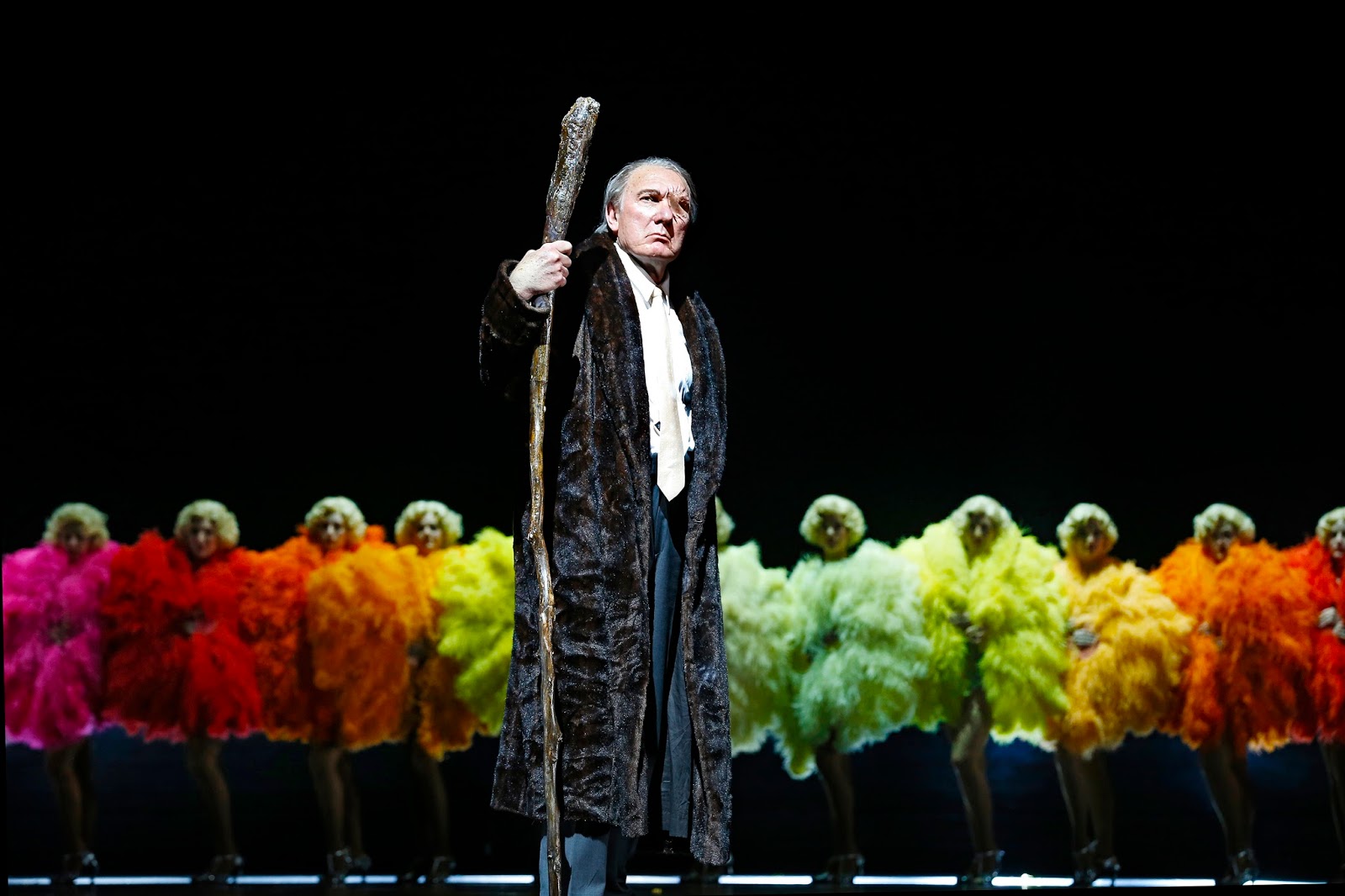
Review - Orphée aux enfers (Offenbach), Opéra royal de Wallonie-Liège, 29 December 2016

Orphée - Papuna Tchuradze
Eurydice - Jodie Devos
L'Opinion publique - Alexise Yerna
Jupiter - Pierre Doyen
Pluton/Aristée - Thomas Morris
Cupidon - Natacha Kowalski
Vénus - Julie Bailly
Diane - Sarah Defrise
John Styx - Frédéric Longbois
Mercure - André Gass
Junon - Laura Balidemaj
Minerve - Alexia Saffery
Fortune - Yvette Wéris
Cérès - Sylviane Binamé
Pomone - Chantal Glaude
Flore - Palmina Grottola
Mars - Marc Tissons

Orchestra, chorus and dancers of Opéra Royal de Wallonie-Liège
Cyril Englebert (Conductor)
Claire Servais (Director)


Offenbach's burlesque take on the tragic myth of Orpheus is arguably best remembered by the Infernal Galop of the second act. Instead of emotional sadness and sentiments encapsulated in Gluck's Orfeo ed Euridice, ironically the protagonists want separation in this comic take and as always gods' involvement complicate matters further. Musically though the operetta is not as extensive and sophisticated as The Tale of Hoffmann. Humorous and witty dialogues stand at the centre stage but without surtitles in English I struggled to follow. The revived staging of Servais received an update to retain its sparkling outlook. The underworld scene was the most elaborate and colourful in terms of staging with the full company. Singers and orchestra under the direction of Cyril Englebert delivered some quality musical moments, but I felt unnecessary to repeat the Infernal Galop so many times as encores.

A relatively small orchestra with less than 50 players to begin the evening with an overture, which was the longest instrumental part of the work. The band was responsive to Englebert's tempo changes with fine playing, but the brass was underwhelming by holding back in volume. Public opinion was an elderly woman and introduced the work with sarcastic remarks from a box alike a television host, while on stage Euridice was ironing in a laundry room. Devos possessed the flexibility in her singing with a rich voice and clarity in diction. Tchuradze as Orphée in compare was rather hard in tone and not pleasant for the ears. The solo violin playing rendered by the leader of the orchestra though was beautiful. Euridice was told off by the conductor when she threw the music into the orchestral pit. Pluto appeared in disguise as a beekeeper and drove a van carrying the Angelus by Jean-François Millet, whatever was the intention. Morris's timbre was distinctively bright, not a smooth voice and rather heavy on vibrato. A red light flashed when Euridice fell into the trap and Pluto's van transformed into a speed car. During the scene change, a group of children attempted to play violins but tuning was bad.


Orpheus reappeared with shopping bags in underwear only, and changed into a period outfit to resemble the classical outlook of a shepherd carrying a harp. He was then chased after by lions, tigers and rats before the scene changed into the assembly of Olympus. The gods were first asleep inside the ocean blue coloured room until a prolonged arguments broke out over their morality. Kowalski as Cupid and Doyen as Jupiter both had a pleasant voice with good bodied vocal volume. Exaggerated entrances when Mercure rode a bike on a string, and the hounds of Pluto were portrayed by men in leather outfits. Jupiter hided behind the speaker's stand when the company of gods decided to descend to the underworld and complained of his infidelity. Choral singing concluded the first half behind the stage curtain resembling the windows of an Olympus Airlines.

Male dancers in erotic outfits as the devil figures began the second half and saw Euridice resting on the couch of a backstage dressing room. Devos's coloratura was not smooth enough in ascending to the upper register even tuning was good. She covered her supervised guard, John Styx, with a leopard patterned sheet who wore a pink stripes underwear only and attempted to drink from her high heels. Kowalski, as Cupid, was more natural in her coloratura but insecure with tuning of the top notes. Flies duet between Pluto and Styx in the style of a fugue were hilarious and the scene ended in a chaotic catch. Later the underworld scene was flooded in orange colour with the whole company in exaggerated outfits. More athletic dance moments for the demons in contrast to the gods' static and convention routine. The conclusion was more a celebration of can can dance and not interest in the separation of Orfeo and Euridice. The protagonists simply moved on along with the festivity even how ridiculous their outlook were.


(Photo credit: Opéra royal de Wallonie-Liège)

Review - Die Zauberflöte (Mozart), Opera Vlaanderen, 27 December 2016

Sarastro - Ante Jerkunica
Koningin van de nacht - Hasmik Torosyan
Tamino - Adam Smith
Pamina - Mirella Hagen
Papageno - Josef Wagner
Papagena - Morgane Heyse
Monostatos - Michael J. Scott
Erste Dame - Hanne Roos
Zweite Dame - Tineke Van Ingelgem
Dritte Dame - Raehann Bryce-Davis
Sprecher/Erster Priester/Zweiter Geharnischter - Evgeny Solodovnikov
Zweiter Priester/Erster Geharnischter - Stephan Adriaens

Symfonisch Orkest Opera Vlaanderen
Koor Opera Vlaanderen
Jan Schweiger (Conductor)
David Hermann (Director)


Instead of portraying Magic Flute as a positive and fairy tale like singspiel, Hermann's conceptual approach focuses on the manipulative and psychopathic aspects. Normality is absent from the fractions of Sarastro and Queen of the Night. The former stands for an abusive predator whereas the latter displays eccentricity. Their associates are also mentally unstable, brutal and, especially Papageno, a victim as results. Tamino's quest is not about affiliating to an organisation claiming to uphold righteous and faith, but to save the loved ones from further harm and torture. Although metaphorical realism offers a different and insightful understanding of symbolism, it takes away the work's attraction of mass appeal with an intellectual exercise. The rethink satisfies connoisseurs but departs from the idea of messaging sophisticated ideas through humour and underlying norms. Sometimes the accessible music becomes an irony or even soundtrack than carrying the actual meanings. As a whole the interpretation is convincing largely that display an establishment will meet its end after wielding power unfairly over individuals, but leaves the masonic perspective without an address. It makes an inconclusive examination of the work and fell short from providing the insight.

The orchestra was a mixture of modern and replicas of period instruments, including the natural brass. It made a brighter tone colour and leaner texture. Schweiger adopted a broad tempo in conducting the Adagio opening alike a solemn fanfare. Instead of hurrying along the allegro, his conducting kept a natural flow of tempo to dramatise the music and shaped it like a dance with momentum. First scene happened in an underground sewage with an exploding power generator that knocked Tamino unconscious. Instead of a lame snake, the explosion was the impact more immediate. Smith's, as Pamino, diction was not audibly convincing even with a good vocal projection. Vibrato was rather heavy and not a relaxing switch in tessitura. The three dames possessed the right timbres for the roles, delivered a good bodied of vocal volume in their trio and managed the swift tempo adopted by the orchestra. Papageno entered the sewage by climbing the hanging ropes and behaving strangely with hissing. Tamino collapsed into the arms of dames when the Queen of the Night approached. She appeared as an eccentric figure in a ragged dress. The dames were terrified by her presence and she was particularly hostile to them. Torosyan's timbre was not too bright in tone with a shade of mellowness and her tessitura technically met the range comfortably.


After the dames unlocked Papageno's mouth, they took the rats he caught for them but nothing in exchange. There were no magical music instrument for Tamino and Papageno except some scrap metals. Hermann seems to engage those passages as part of the orchestral accompaniment than a tool to display on stage. The magical sense seems a psychological stimulation than anything extraordinary. A metal door shut the stage when Tamino and Papageno disappeared into the holes of the sewage wall to embark the adventure. A chilling impression was given during scene change with the sound of wind blowing amplified from the speakers. The following scene saw a forest with rocks and pipes outside the stone cliff of the sewage. Papageno scared Monostatos off by his aggressive outlook and saw Pamina, who dressed in white. He was shy when she asked of his background and hided in the tree. Vocally the duet complimented each other and in good tempo coordination, but Heyse was forceful in reaching the top notes and not natural in placing the words along. Mice as stuffed animal form appeared to tell them how to meet up with Tamino while the three boys sang from the orchestral pit. It would have been effective but vocally they sang without much support and diction was muddy.

The forest illuminated when Tamino tried to force into the temple and a green man refused his entry. Smith had softened his approach and was less strain in reaching the higher vocal register. Diction and phrasing were more successful than the beginning. He crushed into the shrubs whereas Tamina and Papageno were seen climbing around the pipes and trees. Papageno knocked Monostatos off when the latter was stunned by the steam burst from the pipes. Glockenspiel was played and the chorus sang the hymn of praise from sides of the theatre. In effect the choral singing and percussions became soundtrack accompanying the scene than marking the symbolic meaning. Sarastro sat on a chair outside a wooden structured barn, alike the leader of a gang in a western film, with vegetation in front. Jerkunica delivered a rich voice with a ringing tone. The chief was seen as possessive of Pamina and forced her to retreat inside the barn. Two knights became local militia and blindfolded the two men. There was no assurance of hope nor help but the adventure of Tamino sent himself into a torturing institution.


Act two began with Sarastro sewing in the barn and mice wandered around the room. The knights then interrogated and threatened Tamino and Papageno. Though seduction from three dames in erotic outfits became an odd torture than the supposed test, which the intention seems to highlight the strangeness of a mad house than logical progression of actions. There was noticeably more blood stained on the metal door during the scene change into a clinical bathroom. Pamina trembled in fear when Monostatos foreced his way by smashing the door window. Queen of the Night made an unexpected entry from behind the shower curtain with a dagger. Torosyan's timbre sounded more distinctive in colour for the gutsy rendition of the well known pyrotechnical aria. She secured all the top notes mostly but intonation dropped flat towards the end. Monostatos threatened Pamina with the dagger but fled when Sarastro entered the room. The supposed noble and righteous guardian of Pamina turned on the water tap and dipped himself in the bath, while she massaged his feet and even masturbated the genital area reluctantly. Altogether it made a psychopathic scene that morality of the household failed in different extreme forms. Thus, it laid down a convincing motive why Tamino was here to rescue Pamina from the sick society that her parents in control of.

The torturing theme continued when the scene returned to the barn's interior. Papageno went mad when the knights poured him with a bucket of cold water and a brief appearance of Papagena before being taken away. Hagen lacked the flexibility and sang with an effort in her coloratura of Pamina's disappointment by Tamino's indifference. In contrast, the men chorus and brass gave a confident and rich bodied musical introduction to Sarastro's solemn entry. The coordination of the trio though was messy and Smith struggled to fit in the notes. Papageno and Pamina remained in the room as Tamino was first taken away. Pamina's sufferings continued with a soul tortured Papageno threw food at her, stopped only when the knights took her away. Papagena, on a wheelchair with hand folded alike patient from a mental asylum, was pushed in for a brief emotional exchange. It was no longer a joke between the actual age and disguised appearance, but a conversation among the sufferers that the stark torment continued to separate them apart.

A chilling start to the third act with Pamina holding a dagger while stuffed mice were eating grass in front of the barn. Tuning was problematic among the boys' singing and also underwhelming in dynamics. Hagen was straining her voice when climbing up the vocal range. For the first time of scene change there were characters appeared in front of the metal door. The knights made Tamino and Pamina to take part in a torturing game of Russian roulette inside the barn. To their surprise, one of the knights shot himself dead and the rest fled from the room quickly. Papageno was left alone to make his yearning for Papagena with an emotional plead while the mice advised him. He shot the incoming knight who tried to abuse Papagena again. Wagner as Papageno was credited by his characterisation of the eccentric figure and fluid singing. The penultimate scene change abandoned the metal door as the brutal test was over. Stage set of the bathroom scene returned, and saw the company of Queen of the Night electrocuted by Sarastro after plugging in the socket. The bizarre execution was funny at first but ironic by outcome. Sarastro finally met his end when Tamino shot him outside the barn and the couples finally got away from the abusers. After all in this staging magic was an illusion but brutality underpinned the essence, even we felt uncomfortable and shocked by the perceived realism.


(Photo credit: Annemie Augustijns; Opera Vlaanderen)

Review - Parsifal (Wagner), Dutch National Opera, 25 December 2016

Amfortas - Ryan McKinny
Titurel - Bjarni Thor Kristinsson
Gurnemanz - Günther Groissböck
Parsifal - Christopher Ventris
Klingsor - Bastiaan Everink
Kundry - Petra Lang
Grail knights - Marcel Reijans, Roger Smeets

Nieuw Amsterdams Kinderkoor
Koor van De Nationale Opera
Nederlands Philharmonisch Orkest
Marc Albrecht (Conductor)
Pierre Audi (Director)


Like many other productions by Pierre Audi, visual attraction prevails than a particular conceptual approach in his staging of Parsifal. The production is not always a plain narration of the tale, Amfortas resembles Christ's outfit at crucifixion particularly , but the symbolism is unclear when religious representations are not address. Audi does not make gesture with a theory after an answer or interpretation, but rather aim to impress with an elegant artistic viewing. Despite effective stage light schemes and beautiful set, dramaturgy is static at times that not always drawing out the inner emotions nor elevate an understanding of implicit messages. The casting of singers were well chosen and some minor roles exceeded expectation. The orchestra gradually improved its coordination and more balanced as the performance went.

Albrecht took a broad tempo for the prelude but too slow at times and not musically phrased in mind. On stage red lips shaped meteorite appeared on the screen of a night sky. One could not determine whether it had to do with the dripping blood later at the grail scene or an unfortunate sign of bloodshed in the sky. As the curtain went up, red lights flooded on the giant rocks and saw a dark figure covered in long hairs, assuming that was Kundry. A man in armour appeared at the grail theme and later recognised as Gurnemanz. He gazed sadly at the crosses on the debris in the ground when the orchestra reached the erotic theme of the prelude. Kundry reappeared from the rock and strolled around the stage, but collapsed after looking into the small flame on stage. Then the knights entered and monitored the squires whose producing crosses with scrap woods. Up to this point a mysterious impression was given but the connection between actions were unclear of intentions. Despite Groissböck probably suffering from a cold, he soldiered on and made a confident entry with a ringing tone in his singing and placed the words poetically. The fight between Kundry and the two knights were rather soft like a dance instead. Lang's lower vocal register had the projection and audible.

For the bath Amfortas appeared half naked but pushed to the ground when he tried to cling on Kundry. McKinny as a baritone had a bright timbre with good projection. The squires comprised of higher voices did not produce a rich sound compared to the knights, whose vocally had a fuller bodied tone and more dramatic in their singing. Gurnemanz's narration of the past, especially the mention of Amfortas being seduced, saw him starring at Kundry like a predator looking at his prey. Groissböck increased in dynamics to fill the hall with his vocal presence. He emphasised grail and spear especially to give more shape of the narration. However, the orchestra was sluggish that behind him sometimes and a prolong negotiation in momentum. The mention of grail saw squires hold up religious objects and the stage flooded in red again. Later they turned despaired when Amfortas was mentioned being wounded by Klingsor that triggered the downfall. The colour symbolism of stage lights seems more a functional reflection for the eyes than to realise the devastating consequence.


A crowd appeared when the swan shot by Parsifal dropped onto the stage. Their arrival would have been less sudden if accompany Amfortas to the bath earlier. The protagonist himself carried a staff than a bow, and sat on a rock when telling Gurnemanz of his past. Ventris carried a good projection in his singing but the voice did not possess the desired warmth. Lang was vocally underwhelming that lacking the weight and not dramatically done when Kundry mocked Parsifal of his past. He hesitated in killing her with a log and told her to return to sleep. The stage curtain returned at the transition of the grail revealing moment but lacked relation between scene changes. Orchestral playing would need to drive the momentum more for emotional impact, and parts lacked dialogue in their playing. In contrast, the offstage brass were more confident and accurate in their entries.

At the grail scene, quarry like structure erected at the back of the rocks with a bigger crowd congregated. The male chorus blended well together in a more homogeneous sound and minimal vibrato. Several elderly voices were noticeably stick out among the altos and covered voices employed by the sopranos. They watched Amfortas reluctantly to climb the steps for the ritual but stayed motionless. Titurel was a voice in the head instead and sang from off stage. The agony made Amfortas begged to be relieved of the pain at the centre stage, while Parsifal watched from the scaffolding above. Eventually the ritual was performed and Amfortas hold a long piece of white paper with blood dripping in the middle. Artistically it was a beautiful execution of the scene, also McKinny's nice body shape for eye candy, but not reflecting of Amfortas's agony from the ceremony. The men posed as repent and holding crosses in front while female voice parts sang steadily. A magnificent choral moment when the men sang of receiving courage from bread and wine majestically, but tuning in the sopranos' top notes were shaky. The scene change back to the rock setting lacked dramatic continuity when the stage curtain came down briefly. It was unclear whether the ceremony was an imagination or reflection when Parsifal and Gurnemanz were shown in the same spot as before the transition. The capture of moment received the attention than an ongoing relation to unfold the tale.

By comparison, staging of the second act was the highlight of the evening and probably one of the best I have experienced so far. The effects of lightning, smoke and soldiers alike Greek hoplites in Phalanx formation vividly realised the violent orchestral opening. The soldiers collapsed upon the entrance of Klingsor, who was carrying the spear. Vocally Everink delivered crystal clear diction and a rich voice that filled the hall with presence. His phrasing made the singing more dramatically engaged and intense, especially marking the pain of castration that Klingsor experienced. Then a circular metal mirror descended to create the colourful illusion. The flower maidens entered with covered face to mourn their fallen 'husbands' in the battle before revealing themselves with colourful outfits. The orchestral playing flowed better with momentum than sluggish along in the first act. Though one felt Albrecht hurried the tempo too much that dangerously lost coordination with the ensemble of flower maidens. They struggled to breathe and the built up was chaotic, even tuning was fine. There was also a strange acoustic moment in amplifying the singing when singers stood in front of the mirror.

The maidens disappeared when Kundry entered. Orchestra became more relaxing with the tempo in the tender and romantic passage. A small flame descended when Kundry revealed his past to Parsifal and reflected beautifully by its golden colour. It became an illusion between dream and reality to seduce his mind. Ventris was more comfortable in the lower vocal register with better phrasing and projection, but more wobble as he ascended the range. Lang portrayed Kundry as a seductive erotic figure even when she was recalling the motherly love to Parsifal. She was more legato in the lower vocal range even with her singing style was more covered. Tuning became less accurate as she ascended the vocal range and struggled to sustain the top notes.


Stage lights turned red when the two kissed, followed by a lone light reflecting on the mirror that Parsifal suddenly realised the temptation and rectified himself. Ventris sang passionately at the emotional outburst but the timbre lacked the warmth. Though the vibrato in tone reflected the vulnerability when Parsifal looked himself into the mirror. The salvation passage further exposed Ventri's timbre not at the best demonstration for being hard edged in colour. Lang was more secured in the high vocal register this time and brightened up the vowels more. She made a poignant reminder of Amfortas past, gradually built up the madness and furious for being rejected at the vocal climb. Top notes were shouted out and not all pleasant for the ears. Even so, she sustained the vocal energy up to calling for revenge when Klingsor appeared with the spears. A dramatic ending with the stage smoke returned and the mirror sunk into the mist. Klingsor collapsed after the spear broke into half and Parsifal disappeared opposite of Kundry.

In terms of stage set, third act was the least elaborate and close to a plain narration in the first half. Dimmed stage with dark blue colour and Gurnemanz appeared in a long white gown while Kundry lied on the ground. A large hanging white panel at the rear with a hole in the middle. It seems more as a visual representation than resembling the female sexual organ since no erotic gesture was given. The orchestral introduction did not flow naturally, and not able to make the devastating impact in depicting the struggle of redemption. Parsifal reappeared from the side of the panel with helmet and spear. Gurnemanz only recognised him when Parsifal took them off and left on the ground. He prayed at the holy objects and gave an emotional telling of the decaying organisation. Ventris sang with more legato and in a relaxing tone, but the hard edged vocal colour was still noticeable. Groissböck was coughing a lot, but he carried on to phrase the singing poetically and brought out the emotions. A water spring appeared and Parsifal was visibly moved when Gurnemanz acknowledged him as king. Both Kundry and Gurnemanz drank from the spring, but the symbols of cleansing and purification were not dealt with than a ritual. The orchestra played the tender meadow theme beautifully and one felt very moved by the music when Gurnemanz told the joy of redemption. The hole changed to green colour when the grace would be felt by all was sung while the panel slowly shifted to the centre.

As the bell tolled, Amfortas led the men to congregate before the darkened stage for Titurel's funeral. The choral singing became the voice in head and they demanded the ritual to be performed by pointing at Amfortas. The hole turned black as Amfortas blamed himself but the crowd was more fearful when he refused to do anymore. When Parsifal touched him with the spear he collapsed and the mirror reappeared like a shining white plate. Strangely the crowd also fell to ground except Gurnemanz and the smoke mist made a mysterious ending. Audi seems perceived not only Klingsor the evil one, but also Titurel and the knights demanded for bloody and torturing ritual. The mirror became the object of morality. Though the development was rather sudden than a gradual development leading to the outcome. Musically the male chorus gave a muscular and projected wall of sound for a devastating lamentation, but sopranos remained vibrato heavy in the supposedly heavenly conclusion. Only the orchestra produced an enchanting Good Friday music to round off the enigmatic end.


(Photo credit: The website of Dutch National Opera)

Review - Symphony No. 3 (Mahler), Hong Kong Philharmonic Orchestra, Hong Kong Cultural Centre Concert Hall, 10 December 2016

Symphony No. 3 (Mahler)

The Hong Kong Children's Choir
Ladies of the Hong Kong Philharmonic Chorus
Kelley O'Connor (Mezzo-Soprano)
Hong Kong Philharmonic Orchestra
Jaap van Zweden (Conductor)

Mahler's third symphony is a rich and colourful depiction of nature and humanity. The music makes one excite, uplift and even emotional. What marked this performance by the philharmonic a memorable more was the strong musical sense and sublime playing, particularly of the last movement. It had demonstrated the composer's struggle in negotiating between a personal triumph and tragic with fate effectively. The orchestra managed to paint the dramatic colours, which gave more meaning and purpose to the centre message of this monumental work. Zweden had a far better grip and road map in his conducting compare to the performance of the first symphony back in October.

Reinforced horns section gave a muscular and bold entry of the first movement, which later matched by the confident brass section and full bodied strings' playing. Woodwinds at first far from producing the tragic impression while playing soft, but the horns continued to impress and produced the devastating effect. Beautiful violin solo followed at the pastoral and sweet section, followed by the woodwinds gave the chilling and grotesque impression in full effect. The trombone solo was secured, confident and definite by intention, which gradually led the meditative section back onto the playful mode. The woodwinds were cautious than to sustain the grotesque passage as wild as before. Despite the timpani seems under weight in dynamics during the energetic march, the orchestral playing danced well with the music and in shape. The sheer energy made an impact towards the triumphal climax but the tragic sentiment returned after a heavy blow. An energetic transition followed to another triumphal climax but lacked the same resounding impact and being careful. The trombone solo vividly captured the sense of dilemma and more inclined towards the loss feeling in a tragic sense.

The transition into the pastoral passage was rather mechanical in style and then a chase between the strings and winds hurrying along as result. The lower strings and woodwinds would need to swing with the music more at the grotesque passage, so the built up of intention and music direction would have been more contrasting impact when triumph and tragic negotiated again. The horns' entry remained muscular and reassuring at the recapitulation. Tempo stayed on the swift side to keep the music flow with a direction. Solo trombone ably captured the change of emotions followed by a dramatic swift, which the lower strings from a moody fade out sprung back to the spirited mode. It was answered by an uplifting and energetic dance of celebration in the orchestral playing. Rubato was well executed to phrase the music into shape and magnificent sound produced by the horns. All created the sheer dramatic intensity geared towards the final triumphal coda.

Zweden adopted a swift tempo to sustain the momentum in the second movement. The orchestra mostly responded but some parts sometimes slightly behind for being sluggish. Some might find it a risky strategy but the music flowed with a better direction. Fluid playing from the upper strings with a sweet tone for an effective ebbs and flows. Dialogues between sections in vast dynamic contrast highlighted fragments of happiness intertwined with lush orchestration for intimacy and energy. Upper strings' lighthearted opening of the third movement recalled the scene of fairy dance in Mendelssohn's incident music for the Midsummer Night's Dream. It was quickly followed by a muscular tutti movement alike a majesty ride in the field. The humorous dialogues made the playful and tipsy impression of a folk dance. Woodwinds and strings were highly spirited and in exuberant mode swinging along. The offstage posthorn solo was beautifully played but insecure tuning with the top notes. Horns and clarinets could take more time with the long notes at the transition that would allow the elegant impression to last longer. The return to the wild and energetic dance had the intention of momentum by building up the long crescendo. Though the solo trumpet and strings again would need to enjoy the sweet heavenward passage than being impatience. Thus, the crescendo could make the impact at the return to the march like section even the music maintained with direction.

Despite Kelley O'Connor did not possess a rich timbre, her voice had the depth and colour for the part. She phrased the sung text poetically in both fourth and fifth movement, also vibrato free to secure good intonation. The strings' transition was tender and romantic, with the right balance in dynamics. One was captivated by the emotions for being still and meditative the same time. The chorus was on a fine form in projection and diction. Bright vowels were employed to sing the text in clarity, but the sopranos were slightly flat with tuning as they reached the higher vocal register. Balance was good that the orchestral accompaniment did not drown the singing out and accommodating when the alto solo took her time with the music.

The tender and expressive strings' beginning of the sixth movement flowed fluidly and in a radiant tone colour towards the first climatic point. The tragic passage was emotional and lower string's playing was more inward looking at the second section. Upper strings captured the right momentum and phrased the music beautifully. This followed by a sublime flute solo above the tutti strings that made the music highly moving. At the return of tragic passage, Zweden's conducting aimed to drive the music forward than dwelling too much on emotions. Expressive strings' moment in the second climax and recalled the negotiation between tragic and triumph in fate. Brilliant winds in magnificent full bodied tone for the sheer devastation of the third climax. Spellbinding flute solo followed by the trumpet solo at the majestic love theme. A triumphant resounding coda with the full orchestra in glorious tone to repel any doubt and reached the wholehearted triumphal finale. The performance was undoubtedly one of the best displays this year by the philharmonic orchestra.


Review - Ozno, Haydn, Dvořák, Hong Kong Philharmonic Orchestra, Hong Kong Cultural Centre Concert Hall, 3 December 2016

Oikogneia, Book 1 (Ozno)
Sinfonia Concertante (Haydn)
Symphony No. 7 (Dvořák)

Hong Kong Philharmonic Orchestra
Michael Wilson (Oboist)
Benjamin Moermond (Bassoonist)
Jing Wang (Violinist)
Richard Bamping (Cellist)
Jaap van Zweden (Conductor)


Oikogneia consists of music fragments associate with the composer's family members, and subsequently orchestrated from the original MIDI version. The set has referenced to 20th century film music style but also quirky with originality. The first movement is alike a grand exotic ceremonial march similar like Rózsa's works for Hollywood Roman films. The percussions plays a prominent role to generate the rhythmic pulses while high notes for the woodwinds. It is loud in dynamics and finishes abruptly. A light hearted mood follows in the second movement alike the dance sequences of Bernstein's West Side Story, even to do with golf as described by the composer. The third movement is more conventional for being formal and square in patterns. Flourish from the brass while the strings play the melodic lines. The music has a vibrant colour and stays loud throughout, and again a sudden finish off with handclaps.

Rhythmic momentum marks the fourth movement with a narrower music range. The bass clarinet has its solo moment and with an impression of hurrying along the road. The fifth movement reminds the Japanese animation music in Miyazaki's works. Tutti moments has a relatively grandeur outlook and colourful playings from the percussions, with an enigmatic ending that nothing definite. More inward looking in the sixth movement like a military band retreating in distance. It gradually builds up to a slow dance follows by repetitive passages in the brass playing. The last movement is more varied and experimental than before. Glissando on the strings, follows by another Latin dance passage for the brass and percussions, then returns to some plain melodic woodwinds' playing. The music turns into a chase with syncopated rhythmic patterns excitedly marks by the percussions. The dynamic increases to fortissimo or more, with the brass gives a concluding lead and finishes abruptly like previous movements. The set is appropriately programmed to begin this performance, and desirably the rest will perform in future for a better understanding structurally.

After featuring the orchestra lead percussionist as a composer, Haydn's Sinfonia Concertante is an interesting showcase for the principal players of the upper and lower parts in strings and woodwinds. The first movement is regal and majestic in style. The orchestra was able to switch from the energetic Oikogneia into stylish and elegant for the Haydn. Fluid playing among the four soloists with the music flowed with direction and sweet in tone. The violin solo led the melodic line mostly but tuning was not secure as the range went up the fingerboard. The pastoral and sedate like second movement has the violin, oboe and cello take turns in solos. The ensemble achieved the right balance with the soloists and a ringing tone produced by the violin and cello in their duet. It was a pity though that the French horn was flat when finishing off the movement. Structurally the last movement is strange and fluctuated, which Haydn's experimental intention as an operatic showcase for instruments is a work in progress and rather indecisive on tonality. The solo violin was heavy on bow weight and far from producing the thrill of a coloratura flourish. A demanding climb to the very end of the fingerboard for the cellist and the tuning was far from ideal again. The bizarre format left a mixed impression and one not sure whether a future revisit is desirable.

Poor intonation in the horns' introduction of Dvořák seventh symphony, but the strings redeemed the disappointment with their full bodied tone and responded to the style change after the Haydn. The tragic impact would be even more devastating if more weight in the strings' playing. In turn, the produced sound was more suited in the positive outlooking expressive section. Confident horns' playing at loud dynamics, but the woodwinds dragged the tempo slightly and reduced the driving momentum. The crescendo to the climatic expressive moment carried the sheer dramatic impact. Though grainy tone in the horns did not make a refine coda when the music died away slowly. A polished sound from the woodwinds in the pastoral opening of the second movement, but the employed rubato not really able to phrase the music in the right shape and articulate the contrasting moods. In contrast, the strings were better in phrasing even though the tempo would need to be swifter. Beautiful playing from the woodwinds, except the horns, in the lyrical end.

The orchestra would need to dance more in the third movement instead of being rigid and heavy footed. Tempo was on the broad side, and the horns did not match the tone quality of the woodwinds and lower strings. A good bodied of sound from the strings but it could bite more to produce the wildness more effectively. The last movement was dramatically intense in a swift tempo. Brass and strings vividly produced the tempestuous effect and danced with the music in the lyrical expressive passage. The horns were at its best when playing loud in long notes. The contrast in dynamics ably to reflect the ever changing emotions in negotiation between the tragical sense against the heroic force galloping gloriously. The brilliancy sent the audience in enthusiastic reception but the middle movements would need a rethink for a more successful outcome. 

Review - Der Ring des Nibelungen (Wagner), Opera Australia at Arts Centre Melbourne, 21, 23, 25 & 28 November 2016

Wotan - James Johnson
Brünnhilde - Lise Lindstrom
Siegfried - Stefan Vinke
Siegmund - Bradley Daley
Sieglinde - Amber Wagner
Alberich - Warwick Fyfe
Hagen/Fasolt - Daniel Sumegi
Gunther - Luke Gabbedy
Fricka - Jacqueline Dark
Fafner/Hunding - Jud Arthur
Erda - Liane Keegan
Mime - Graeme Macfarlane
Waltraute - Sian Pendry
Gutrune - Taryn Fiebig
Loge - Andreas Conrad
Freia - Hyeseoung Kwon
Wood bird - Julie Lea Goodwin
Froh - James Egglestone
Donner - Michael Honeyman
Rhinemaidens - Lorina Gore, Jane Ede, Dominica Matthews
Norns - Tania Ferris, Jacqueline Dark, Anna-Louise Cole
Valkyries - Anna-Louise Cole, Dominica Matthews, Olivia Cranwell, Sian Pendry, Hyeseoung Kwon, Amanda Atlas, Nicole Youl, Roxane Hislop

Opera Australia Chorus
Melbourne Ring Orchestra
Pietari Inkinen (Conductor)
Neil Armfield (Stage Director)


To mount a ring cycle is a challenge both musically and staging wise. Besides assembling a competent troupe of musicians, the scale of the production also determines the underlying ideologies and styles. Neil Armfield's approach is not so much about extravagant display of stage machinery or colourful scenery nor making political statements, but as a stylish spectacle from a humanistic psychological perspective. The production sees genuine love and affection to rectify mistakes and overcome all perils. It is close to a plain narrative of the tale but still some twists in conceptual direction. The use of simple but effective theatrical elements also make a strong and precise impression of actions. A reminder that the ring is a piece of theatre on equal importance as the music. As a whole the staging style and concept is consistent, original and coherent. Musically the orchestral playing improved as the week went on and there were many magnificent moments. Overall the cast of singers possessed the right timbre, rose to the vocal challenge and some even exceeded the expectation.

Rheingold began with a crowd in circular shape moved slowly towards a direction on a revolving stage, and a large hanging mirror behind to reflect. It was as to create the river flow but also a reference to the ring turning alike the medieval concept of the wheel of fate. The circular movement reappeared many times again in various forms throughout rest of the cycle. The orchestra though would need more direction in its playing and the brass was particularly sluggish in tempo. The crowd stopped at the singing entry of the rhinemaidens, who wore an over the top stylish and feathered samba outfits. The trio's intonation was good but poor in diction that I hardly could distinguish the words, the tempo was also too broad for my preference. Warwick Fyfe's Alberich put the disappointment aside that he not only had an ideal vocal colour and the projection, but also being natural in phrasing the text and the music. He undressed and chased the rhinemaidens around but unsuccessfully. The crowd then brought out the gold coloured pom-poms, metaphorical representing the glittering gold of the Rhine, and spread across the stage. The revealing could have made more impact if a swifter tempo was used in the orchestral playing. Alberich's stealing of the gold saw him taking hostage of a young girl from the crowd and then darkness descended on the stage again. Though dramatically the idea seems tame to reflect the great loss instead of capturing the crowd with a big net or rope.


The scene of god's realm was weak in concept and would need a rethink for a more sophisticated presentation. The high point was Wotan's first appearance from the back door in a pitch black stage that gave an introduction in focus. However, he laid down on the floor and James Johnson made an elderly and soft outlook of the role. Although with the right timbre, his singing far from a ringing tone to fill the hall and diction was poor. He nearly missed an entry after Fricka warned of Freia to be taken hostage by the giants. It struck me odd that a Wotan did not have the physical nor the vocal authority. There were cases of stuffed animals in the backdrop but far from making the intended message. In turn, Jacqueline Dark's Fricka, in her gold dress outfit, was more comfortable with the vocal range and gave a fuller bodied tone. The orchestra again took a board tempo for the Valhalla theme that did not provide a direction where the music was sailing to.

Jud Arthur's timbre, as Fafner, had the richness and colour of a bass than Daniel Sumegi, as Fasolt, who was more baritone in his timbre. The giants were portrayed as a pair of mafia businessmen but not too rough in outfit. The stage choreography was rather static in a park and sing routine. Wotan stood motionless without any sign of decision to prevent the conflict. The rest only walked around and did not much, which was far from realising the tension and confrontation while bargaining with the giants. Andreas Conrad's Loge gave a promising start as a highly competent actor and well paced in his singing and the diction. Though he tried too hard to dramatise every phrase that resulted in missing entries later, also shaky tuning and even dangerously out of place with the orchestra. The coordination problem had caused the strings no intention in accenting the downbeats to maintain the rhythmic pulse. James Johnson only warmed up, when the gods stood under the spotlights at the front stage while Loge urged them to stay strong without the apples from Freia.


The orchestral playing and dramaturgy improved immensely since the descend to Nibelheim. The produced music danced and more energetically engaged. Alberich and Mime were very natural in their singing and clear with diction. The vocal projection were far better than Wotan in terms of body and volume. On the ground there were several stage doors and workers emerged from the holes but fearful of Alberich's power later in wild cries. The tricks of tarnhelm were cleverly demonstrated as a circus magic show with a feather girl holding the python on her neck. It was a more effective visual presentation than a video showing or mechanical replica of a snake. After Alberich being captured by tricking him into a frog, the three races, giants, gods and rhinemaidens, posed like sculptures on the turntable at the music ascend to god's realm. It was as if to remind us their inseparable connections with the ring and metaphorically resembled the wheel of fate again.

When workers brought gold blocks to stage for Alberich's ransom, Warwick Fyfe impressed very much again for his sheer vocal energy and momentum. In contrast, Wotan remained a vulnerable and incompetent figure than Alberich. The villain even dared to grab Wotan's staff and cursed the gods in return. There was also a strange moment at the return of Freia that she was with Froh than with the giants. Like Wotan's first appearance, Erda also entered from the small door in the rear.  Liane Keegan had the right colour and richness in her voice, but could not really project her voice into the hall. Sluggish tempo reoccurred when the giants appeared for ransom. Though I was impressed by the effort that the gold blocks being actually piled up to cover Freia. At the outset Fafner already decided to fight after the treasure than sharing. The killing of Fasolt was dramatically intense and the orchestra effectively reflected the brutality in their playing. Michael Honeyman's Donner did not have the rich and full voice for that dramatic calling of thunder. The brass playing could have given more in dynamics at the glorious conclusion. Otherwise, the troupe of feather girls, with rainbow pompom and glittering stage lights, made a highly effective and memorable scene of the god's entrance to Valhalla. The rhinemaidens and Loge were disappointed by Wotan's indifference while watching the ascend that inevitably brought the destruction later.


Hunding's hut alone on a revolving stage with snowing effect set the first scene of Die Walküre. The simple outlook made a pretty scene later as Siegmund and Sieglinde grown in love. The orchestral introduction would need to play more on the downbeat accents and the brass lacked direction in their playing. Horns were not confident at the forest hunting calls and shaky intonation as a result. The escalated tension between Siegmund and Hunding confrontation not really reflect by the indifferent instrumental playing. Bradley Daley, as Siegmund, sang with great passion but lacked the warmth. Higher vocal register was sometimes strained, notes were muddled up and being throaty. Even so, lower strings gave spellbinding playing when the Wälsungs met and fell in love at first sight. Good diction and secured intonation from Amber Wagner, who sang the role of Sieglinde. Jud Arthur continued to impress as Hunding this time with the richness in his timbre and a powerful voice to fill the hall. Though at the revealing of Notung and Siegmund's narration of the past, tempo remained relax and far from a passionate impression of the twins. Bradley Daley began to sound tired and not always able to sustain the vocal energy. The orchestra dragged the tempo even more at winterstürme and lost the focus in shape. Only Amber Wagner's beautiful singing redeemed from a disappointment by being tender and sweet in tone.

The second act was delayed by an hour due to a motor malfunction under the revolving stage. It was not a surprise though since the stage set was one of the most elaborate of the whole cycle. A multistorey circular runway dominated the stage with stuffed animals hanged within. Since there was only one way to descend or ascend, it reinforced the notion of a labyrinth that the gods were stuck without an alternative path. The animals probably represented deceased heroes being brought back to Valhalla but the visually not effective as backdrop only. The orchestra was far more dramatic than first act with a good momentum in directing the music forward. The Wälsungs first hurried down the runway followed by Wotan, but James Johnson's singing was still timid in terms of vocal volume. Lise Lindstrom, who made her debut as Brünnhilde in a full ring cycle, managed the athletic battle cry 'Hojotoho!' confidently but her voice needed some time to warm up. The timbre of Jacqueline Dark, as Fricka, had the colour of an aged woman but her vocal projection was less impressive than in Rheingold.


James Johnson projected more in the lower vocal register when Wotan narrated how he was trapped by promises while evils spread around freely. His image of frustration made a contrast to the cold and still impression in Rheingold. He flung his clothes off at the emotional foretelling of the god's doom and the Wälsungs, his children, to be killed. Exquisite woodwinds' playing during the scene change when the twins stopped for rest at their escape. Amber Wagner sang in a radiant tone at the highly dramatic nightmare passage but Bradley Daley far from matching her voice by lacking the desired warmth. The brass had more direction and energy in its playing but tuning was not always accurate. Lise Lindstrom's tessitura was comfortable in the higher vocal range during the dialogue with the orchestra winds, but James Johnson was again very thin in vocal body after Siegmund was killed.

The ride of the valkyries in act three was a military operation to retrieve the bodies of fallen warriors to Valhalla. However, the dramaturgy looked random that the crowd appeared rather lost on stage by walking around aimlessly. The impression did not match the sheer dramatic impact of the music. The voices of the eight valkyries complimented each other very well and delivered a powerful ensemble singing. James Johnson improved in vocal volume when Wotan arrived in rage of Brünnhilde defiance of his order, but diction remained muddy. The lower vocal register was problematic for Lise Lindstrom as her singing became rather grainy and not natural in phrasing. Towards the final scene of magic fire, the music was very moving with the tenderness and outpour of emotions as the father and daughter finally reconciled. A ring of fire in the middle of the dimmed bare stage was an effective and simple approach to realise Wotan's fatherly love to protect Brünnhilde.


My experience of Siegfried in live or on records so far were often with mixed results. The most challenging part I reckon was the final scene when the music style switched from a dramatic style to lyrical. Rarely singers could manage the changes evenly and also vocal stamina to last for four hours. In terms of staging, Armfield emphasized Siegfried as a play in the theatre. Mime's living room occupied the front stage with his workshop on the left and a bunk bed on the right. The tall white wall behind actually helped singers to project their voice with the hall acoustic. Previously in Rheingold and Walküre, the singing was often trapped within the stage. It was probably why the orchestra sometimes hesitated and sluggish as they struggled to hear the singers from the pit. This was no longer the case in Siegfried, which the orchestral playing had a much better sense in rhythmic flow and more energetic in momentum.

Stefan Vinke, as the protagonist, made a confident start vocally and being a native German speaker his diction was most naturally placed in the singing. Though Graeme Macfarlane's Mime did not match close that the phrasing were sometimes random and out of the place. Instead of an actual bear, Siegfried dressed up as one to scare Mime off and annoyed him after being accused of ungrateful to Mime's care since birth. Musically the heated exchange between the two was highly dramatic with the right ebbs and flows. The orchestra was very excited and confident in its playing that even ahead of the singers at various points. James Johnson's Wotan also projected better vocally with a fuller tone. Stage lights flickered as he quizzed Mime with riddles and threatened him with his staff to recognise his true identity. The orchestra made an impact in the crescendo until the stage flooded with lights and Mime trembled in fears. His introduction of fear later to Siegfried was intense vocally and the orchestra gave strong rhythmic pulse at the sword forging scene. Stefan Vinke had the vocal energy to sustain the heroic singing without any strain and most excited with the sheer impact. The highly dramatic orchestral playing put a brilliant end to act one and we saw Siegfried cut through the white wall to look for Fafner's cave. The audience went wild in reception.


An exaggerated facial expressions of a clown was projected on screen at the beginning of act two. The terrifying image of Fafner, as the music depicted, was wonderfully captured and realised. It was a brilliant touch than to recreate a dragon head, but a pity that one viewing only and later the rest happened behind the back of a theatre set in white. There were leaves scattered on the stage to evoke the forest floor, and tossed around by wind to imitate the dragon's breath. Though visually it looked underwhelming and not able to capture the sense of a haunted place. Warwick Fyfe's Alberich continued to impress with a ringing tone to fill the hall and very natural with the sung text. The amplification of Jud Arthur's rich and deep tone, as Fafner the dragon, achieved the right balance and effect in the auditorium.

However, Graeme Macfarlane dragged the tempo too much sometimes, and Stefan Vinke was not legato enough in the lyrical line of imitating the singing of wood bird on a picnic blanket. The scene of killing the dragon was not a spectacular fight, but a raw erotic impression when a naked and wounded Fafner in blood dragged out of the hole instead. The wood bird was in a plain dress only, which one questioned why not the Ziegfeld girl's outfit in Rheingold with elaborate feathers instead. Julie Lea Goodwin technically competent as a lyric coloratura soprano, but her tuning was insecure and dense in timbre than the preferred bell like quality. Towards the end, Siegfried positioned the bodies of Fafner and Mime next to the cave entrance probably as a show off. Stefan Vinke was more able to connect the long notes in the higher vocal register than the previous more athletic passage.


In act three, only the stage arch left with Wotan lying on the floor in the spotlight at first. Without the white wall to bounce the singing back like before, James Johnson's singing lost the projection again. The orchestra though continued to sound powerful in volume, especially the brass, and the computerised drum effect to imitate the sound of thunder made a dramatic sonic impression of what would follow. Erda appeared from the back door again after being summoned by Wotan but in a sleepy state. Liane Keegan did not have a big vocal body but her phrasing, diction and timbre were ideal. Despite the orchestra could have been more patience to avoid getting ahead of her, they played beautifully at Wotan's declaration of self destruction and Siegfried's challenge to Wotan was dramatically intense.

To realise the magic fire which protected the rock where Brünnhilde in deep sleep, light bulbs on the theatre arch came into full and a golden glittering curtain descended as Siegfried approached. The turntable spun the arch around slowly and made a highly theatrical transition to the discovery and awakening scene. A wood case containing Brünnhilde was revealed and a statue of her horse Grane was placed in the rear. Stefan Vinke captured Siegfried's cautious discovery vividly and his disbelief at first sight, before a passionate awakening of the first woman he met. Lise Lindstrom was more comfortable with the tessitura as the vocal register stayed high for the role this time, but she was heavy on vibrato and lacked the warmth in her voice. The orchestra made an emotional outburst of the love theme when the two exchanged their affections, even Brünnhilde was rather doubtful and negotiated the idea of her role change for a while. The theme of birdsong was tender and beautifully played and vocally the pair complimented each other in their duet. The sheer energy and music brilliancy of hailing to love made a resounding conclusion to the third part.


At the beginning of Götterdämmerung, the Norns were weaving an old styled theatre curtain in light blue. They had the right vocal colour and technically capable for the parts, but diction was muddy and individual voices not always pleasant to hear. The curtain collapsed as the thread broke and a house in skeleton was shown where Siegfried and Brünnhilde slept. The sunrise music was gloriously played by the orchestra and a ringing tone in Lise Lindstorm's singing at the wakening. Though the stage acoustic sucked the sound upward and made the orchestra difficult to hear the singer, which resulted a prolong negotiation in tempo. Stefan Vinke's upper register sounded hard for the lyrical passage and not the best moment to display his voice. The beautiful orchestral playing of the love theme rectified the disadvantage and the crowd appeared to celebrate the pair's strong affection for each other. They then evoked the river current with arm movements and danced at Siegfried's journey at the Rhine,which the orchestral playing was majestic and radiant. The group then pretended to imitate rowing together as the house spun and gradually became a slow community dance before disappearing into darkness.

The Hall of the Gibichungs was a gym with classical painting in the rear. Hagen in military uniform observed Gunther's and Gutrune's work out from behind. Daniel Sumegi, as Hagen, was more a bass-baritone as mentioned before and rather bright in timbre for the role of Hagen. He was dangerously ahead of the orchestra at the muscular call to signal Siegfried's arrival. Taryn Fiebig as Gutrune had a more suitable voice for the role but her projection was rather timid at first. Her singing opened up as passing the drink to dope Siegfried in her bright orange dress. Luke Gabbedy was more satisfied vocally as Gunther with the richness and depth in colour, also phrased the words and music more naturally. The swearing of blood brotherhood between Siegfried and Gunther was dramatically captured.

When the two went off to steal the ring from Brünnhilde, a lone light focused on Hagen, who sat in front of the house, plotting against with a gun in hand. Gutrune was more sympathetic to Hagen and gave him a kiss, which the two seems to share some affection for each other. It was not sure later whether she truly wanted to wed Siegfried or pretending as part of the plan. Brünnhilde was more patient and welcoming to Waltraute when she came to warn of the dangers. Lise Lindstrom took the tempo on a steady side but the singing still flow naturally and dramatic. Sian Pendry, as Waltraute, made a confident start in vocal volume and diction but the tuning became more shaky and losing the shape. The stage lights turned red when Siegfried took the ring by force from Brünnhilde and marked by wielding Notung in the air, which made the impression that she being raped by him. The orchestra though sounded tired at the end of act one and far from creating the devastating impact to finish off the first half.


A wedding tent instead dominated the second half and saw Alberich walked across the stage like a ghost. Hagen sat on a chair in the middle with the stage light gradually focused on him in a small spot. Warwick Fyfe's Alberich continued to impress for wonderful musical sense and the rich body in his singing. Daniel Sumegi tried to match Warwick Fyfe vocally and the dream telling scene of revenge was dramatically executed, but his timbre was baritone like and not always had the desired weight. Hagen then pointed the gun at the auditorium and stared at it to mark the killing weapon. He then assembled the men in tuxedos with guns like a gang meeting. The chorus delivered a magnificent wall of sound in their rousing call to war. It was matched by a muscular orchestral playing with the sheer dramatic impact from the brass. The entrance of the couples led to the standout of Brünnhilde, who smashed the wedding cake and pushed Siegfried to the floor in rage as he denied her accusations. Lise Lindstorm projected far better and more intense in her singing at the emotional outburst. The dramatic exchange between her and Stefan Vinke fitted their vocal style ideally for better control between the higher and lower registers. When she plotted against Siegfried with Gunther and Hagen together, a ringing tone in her voice and very bright with the top notes to create a strong impression of revenge. It made the cake cutting scene a chilling moment before the assassination scene happened.

The house in skeleton returned for the final act on the turntable and saw the rhinemaidens pulling feathers from their head gears. The irony of their boredom and lost the sense of living purpose after the ring being stolen triggered laughters among the audience. When Siegfried appeared, they went hide and seek around the house, but failed to attract nor convince him to give up the ring even in their flamboyant outlook. Their tuning improved and the singing had more shape as their voices warmed up. The offstage french horn also played Siegfried's hunting call more accurately than the one in the orchestra. The hunting scene was realised by an actual rifle shooting game on stage, which the repeated sound of gun shots captured the atmosphere of tension and insecurity of a killing scene. Gunther could not prevent Hagen to shot Siegfried after regaining his memories by drinking the antidote. Stefan Vinke's singing sustained with great energy and bold in vocal body. He approached the killing point as Siegfried broke away from illusion and a final resounding declaration of his love to Brünnhilde. The orchestral playing vividly captured that strong feeling of affections and emotional outpour. The ritual performed during the death march was unexpected as the men cleansed Siegfried's body, painted his face in white and he stood still in the centre covered by a black veil. It had effectively realised the solemn and grand image in the music that brilliantly evoked by the orchestral playing.

Taryn Fiebig carried more emotions in her singing as Gutrune gradually learnt the death of Siegfried. In the stage rear we also saw Brünnhilde slowly walked across as the sung text said she went to the Rhine for the final preparation. Hagen shot Gunther when he was blamed for the assassination, but terrified by the illuminating ghostly figure of Siegfried when the veil was removed. Lise Lindstorm began the immolation scene in the stage front but rather heavy on vibrato. The lyrical ascend lacked the smoothness and warmth at first, though she phrased the words poetically and took her time by employing rubato appropriately. The climb to the higher vocal register was confident and sang gloriously. The crowd laid flowers around Siegfried and he was joined by Brünnhilde after she gave the ring to the rhinemaidens. Alberich and Hagen tried to approach it but stopped. In the end, edges of the wood structures were in flames on the revolving stage with the couple at the centre under the spotlight. The funeral pyre was visually spectacular with the crowd sitting in rows watching from behind. The orchestral coda was transcendental to mark this very memorable and emotional finale.


(Photo credits: Jeff Busby, The Website of Opera Australia)

Review - Wagner, Schumann and Mendelssohn, Hong Kong Philharmonic Orchestra, Hong Kong Cultural Centre Concert Hall, 5 November 2016

Prelude to Act One and Good Friday Music from 'Parsifal' (Wagner)
Piano Concerto (Schumann)
Encore: Second movement from Nocturne op. 9 (Chopin)
Symphony No. 5 'Reformation' (Mendelssohn)

Hong Kong Philharmonic Orchestra
David Fray (Piano solo)
Constantin Trinks (Conductor)


In this survey of three iconic German composers from the romantic period, the selected works all distinctively have a progressive contemporary outlook but also referencing music around or before their time. Both Mendelssohn and Wagner include the 'Dresden Amen' as a musical expression of faith. The Reformation Symphony takes a dramatic approach on romantic ideology, which expands from solemnity and darkness to a confident triumph. In Parsifal, redemption is the ultimate goal through thematic examinations of the grail, holy rituals and resisting temptation. Leitmotifs give a music illustration of the symbolism and underlying ideologies. Despite Schumann's piano concerto not religious in nature, many lyrical themes are hymn like. It is also quirky in style and rather invert looking in compare to other piano concertos of its time, which often focus on technical showcase with big gestures.

The challenge in performing the prelude from Parsifal is how to keep the music in shape at slow tempo and without losing the direction. Constantin Trinks employed a broad tempo but well paced and never drag. The orchestral playing was noble and majesty by producing a transparent texture. A pure and clean effect with the desire projection from the trumpet solo. Quality woodwinds playing by making a beautiful tone and sensitive to dynamic changes. The produce sound had a level of depth and magnificent playing from the brass on the grail theme. Though the orchestra lost the focus in the more fluid flowing Good Friday Music. It still maintained a beautiful sound but lacked certainty in phrasing and shapes. The score arrangement was also not helpful with a lean texture, and the absence of vocal line did not give an idea where the music was heading but only recurring themes. Horns fell short from matching the radiant tone produced by their colleagues and some shaky tuning. Only at the redemption theme direction regained with the woodwinds' dialogues being sweet and tender. The music spoke for itself with its beauty and emotions.

David Fray's playing was gentle and polish in Schumann's Piano Concerto, but the impression lacked a character and the employed dynamics often too soft for the acoustics. One hardly could distinguish the left hand part and the produced sound lacked presence. Despite one could sense the momentum flows, strangely it far from providing a clear navigation. One could argue that the composer emphasized on beauty and adopted an introvert solo part for his wife Clara's premiere back then, thus, a lighter weight on the keyboard touch. Though I felt the soloist should still be prominent to an extent so the texture could be heard clearly and phrased the music more. Despite a minor coordination issue in the third movement noticed by my friend, the orchestra accompaniment was more spirited and gave more bites in their playing to generate the rhythmic impulse. The phrasing created more shapes and contrast to keep the listener interested. Cellos were hearty and passionate in the expressive theme of second movement. Both the first and third movement the orchestral playing was more effective in bringing out the emotions. Only the virtuosic coda of the third movement that the pianist caught my attention for the technical showcase in display.

Constaintin Trinks continued the good work with the orchestra and rarely a rendition of Mendelssohn's Reformation Symphony so brilliantly and exciting. Brass made a confident opening of the first movement but woodwinds' transition was mysterious and uncertain. The strings driven tutti then gave a dramatic ebb and flow of the fiery and tempestuous passage. It was highly responsive to the conductor's indication for accelerando and captured the wildness vividly, before a smooth return to the solemn recapitulation. The second movement has some reference to Beethoven's symphonies but also the fairy's dance from incidental music to Midsummer's Night Dream. Trinks had successfully drawn the orchestral playing to dance with the music. Strong rhythmical momentum and the sheer contrast in dynamics sustained the intensity. Expressive playing from the strings at the third movement to pour out the emotions even the music was dark and serious. Trinks appropriately took a rather brisk tempo in the last movement to keep the music flowing with energy. Beautiful woodwinds' playing of the chorale theme with the brass and lower strings. The band also delivered a muscular body of sound but not too dense. The dance passage was majesty and confident with a strong direction. Sectional dialogues at the fugue was articulated clearly with a good crescendo up to the triumphant ending. It would have been a perfect conclusion if the trumpet did not slip on tuning at the final climax.


Review - Matsukaze (Toshio Hosokawa & Sasha Waltz), New Vision Arts Festival, Hong Kong Cultural Centre Grand Theatre, 23 October 2016

Matsukaze - Miwako Handa
Murasame - Jihee Kim
Monk - Douglas Williams
Fisherman - Kai-Uwe Fahnert

Vocalconsort Berlin
Sasha Waltz & Guests
Hong Kong New Music Orchestra
David Robert Coleman (Conductor)
Sasha Waltz (Director and Choreographer)


One highlight of Human Requiem back in March was the spellbinding choreography by Sasha Waltz & Guest, which effectively revealed the inner truth of Brahms's Requiem I reckon. Audience and performers went on an emotional theatrical journey from death to afterlife, before arriving an imaginative glimpse of the eternal dwelling. The city is fortunate again to receive another highly regarded contemporary opera production by the same company. A testament of quality and intellectual stimulating staging that allows creativity, inspiration and beauty at its fullness at the theatre. In contrast to the ideology underlines in Human Requiem, Matsukaze follows the concept of Noh plays by contemplating memories and emotions between life and death. The yearning for passionate feelings will eventually fade and vanish, than reaching any spiritual comfort or redemption. Though the pain and the impression of being trapped within space is to be remembered and retold as a tale in romanticism.

In this production, the dance aspect is as equally important as the music. It is a physical expression of abstract emotions and also marking atmospheric characteristics. The sound of waves and theatrical fog set the first scene at the coast in the night. Dancers' arm movements resemble the pressing weight of the tempestuous sea on the shore. The silent lone girl in black surrounds by a dancer doing tai chi, which gives a visual demonstration of inner psychological yearning. The eerie music style creates a sense of uncertainty at a haunted space, especially the bass drum rolling increasingly hard and loud. The dance choreography is increasingly more exaggerated by bigger arm gestures. Atmospherically unsettle and disturbing up to the monk's chanting that provided the background. Various dancers in pairs or groups move across the stage were not an imitation of ghost, but flashback in memory lane without a time sense. The vocal ensemble in circular shape symbolically form a speaking old pine by singing 'ar', and gradually change into a human wall to resemble the tree branches. A woman in white then very slowly pulls a giant web across the stage forward for the next scene.


Metaphorically the web is a memory cage, which the sisters trap themselves into by lamenting past affections for the nobleman. He dies after leaving them for the capital, which the plainsong dialogue between the fisherman and the monk provides the background. Though the net is also emerged as fishing nets when masked dancers pull long ropes alike out from the sea with the chorus emerges from behind. Nothing out of ordinary and symbolism of objects are created from elements in the related nature. Glockenspiel playing evokes small bells ringing along with the sound of water drops, while darkness descends as the stage lights fade. The music become more spooky and chilly when ghostly figures of the sisters descend. Dancers climb around the screen but stuck within an area like insects trap in a spider web. The chant like music texture and atonal in style make a cold and emotionless impression with a moonlight effect illuminates in the background. Eventually the sisters vanish again in the dark, and dancers move like in the shape of frogs on the screen. It creates a pictorial sequence of nature awaking for dawn.

The fantasy seamlessly turn into a more realistic state under this extraordinary sequence of nature and time. The framed wooden structure of a house replace the screen with a soft wooden house floor. Though dimmed light remain to keep the haunting sense of the place. The monk is supposedly to question the sisters in the house but sings from the orchestra pit instead. This provokes the question of whether any is real or just a dream, even a physical space is in place. The music develops more contrasting dynamics, wider vocal range and more emotions engage. Drums and gongs produce violent musical effect to imitate wild gust and stormy seaside. The spinto soprano gives many wild cries at the high vocal range and dancers in open arms posture to plead.


All add to the weighting message that Matsukaze cannot fling off her persistent desire for the return of her lover, despite her sister Murasame warns of the danger that she will fall into false imagination. A masked dancer carried a pole with a hat on it then forms the illusion, follows by a passionate dance duet to capture the intense love and feelings. Dancers also regroup into the shape of branches and more colourful than before. The exuberance of expressive emotional outpour inevitably come to an abrupt end when a shower of needles from the pine tree drop onto the stage. The monk awakes from the surreal state of mind while chimes' ringing return. In the end, water drops replace the music gradually and conclude with a lone girl walks very slowly towards the audience before vanishing in the dark.

Graphical surrealism is undoubtedly the highlight of this production, and elevates by a highly effective dramaturgy to present symbolic or metaphoric aspects at a natural sequence. The dance choreography gives a visual demonstration of the psychology and feelings with an expressive outlook. Music on the other hand delivers the dramatic audio effect in conjunction to the visualisation of senses and theatrical atmosphere. The four soloists are vocally capable with the right timbre and range, though diction is more audible on vowels than articulating the words clearly. Orchestral playing phrases well under the baton of David Coleman and never in the danger being out of shape. All contribute to a coherent and awe-inspiring staging that memorable in many ways. It is a shame though a poor turnout in the audience despite a vigorous marketing campaign in public beforehand. Conservatism, the lack of cultural curiosity and backwardness in artistic knowledge still prevailed unfortunately.


Review - Mahler & Mozart, Hong Kong Philharmonic Orchestra, Hong Kong Cultural Centre Concert Hall, 20 October 2016

Violin Concerto No. 4 (Mozart)
Encore: Presto from Violin Sonata No. 4 (Ysaÿe)
Symphony No. 1 (Mahler)

Hong Kong Philharmonic Orchestra
Tianwa Yang (Violinist)
Jaap van Zweden (Conductor)


This is my first concert of the new season by the philharmonic orchestra, also a start to the two years long Mahler cycle. Like many previous programme featuring late romantic symphonic works, Mozart occupies the first half for a conservative choice instead of offering works from the second Viennese school or later. Any dissonance and experimentalism is shelved on the wall for the sake of comfort. Moreover, Tianwa Yang is a technical orientated violinist than on lyricism, a mismatch I reckon for Mozart's fourth violin concerto which greatly emphasis on exquisite tone quality. Acoustically at where I sat under the balcony, the general tutti sound from stage seems rather distance but the raw quality of the first violins' playing were also noticeable. Zweden took a rather swift tempo for a fluid orchestra introduction in the concerto and balance with the soloist is well controlled. Despite Yang's rather exaggerate posture, her playing produced a pleasant tone and could have employed more hairs to sustain the legato than accenting so abruptly. Though the tuning in the double stopping entry at the first cadenza was shaky and the technical display was styled beyond the classical period. 

In the second movement, Yang should employ less vibrato and smoothen the tone on the bow, which was detached and heavy handed on position changes. Intonation was often insecure and some awkward phrasing that the music increasingly went out of shape. The second cadenza sounded more like an improvised one with the harmonic progression went very distanced, before turning to an abrupt coda that took the orchestra by surprise. Although the third movement is more well suited to her technique, the bow attacks were rather aggressive with too much weights. The final cadenza again a technical showcase but ended with an upward climb to the highest finger positions seems an incomplete finish. She was more in home territory showcasing an impressive encore of the presto movement from Ysaÿe's fourth violin sonata. 

The philharmonic orchestra had delivered many quality and memorable performances last season, including the Beethoven's symphonies cycle and Bruckner's fourth symphony. Though whether this time to do with limited rehearsal time and preparing a tour to China, the rendition of Mahler's first symphony required more thinking and bites for a more successful outcome. Zweden's conducting was rather metric in the mysterious opening, which resulted an angular reading of the music than a natural progression. The joyful pastoral section would need more space to breathe and sing than rushing it through, whereas rather slow tempo for the bird calls' dialogues among the woodwinds. The transition to the dark and solemn part was more success in tempo control and produced that mysterious feeling than a tragic overtone. Though later some intonation problems among the horns, trumpets and clarinets, and that the produced sound was often muffled. The recalling to the pastoral image also needed to dance more, and the orchestra lacked the weight in sound body at the muscular transition. The triumphant coda was polished and solid enough to redeem from a lesser impressive start.

The ländler dance in the second movement would be more effective, if the orchestral playing was more wild and gave more attacks than being careful. The waltz was on a steady side too that it did not quite drive the momentum forward. The volume was appropriately double at the recapitulation but the horn section would need to give more than holding back. Tempo was right for the funeral march in the double bass solo at the beginning of the third movement. Woodwinds were too nice though that lacked the bites to articulate their entries and made the dynamic contrast. In turn, the lyric section was dreamy enough and polished. The muted trumpets would also need to move more than dragging the tempo at the recapitulation, which the spell for a fading march was somehow lost into the attaca of fourth movement.

The long crescendo in the violent opening of the last movement made an impression and structurally clear. Though Zweden adapted a very broad tempo in the first emotionally expressive passage, which the music was in danger losing the effect of emotion outpour. Even so, the orchestra finally came together at the mysterious return to the violent stormy part. It produced the sheer dramatic impact and unleashing the energy with depth in its playing. The horn produced a magnificent sound at the triumphant climax along with the energetic percussions. Tempo changes for the second tender and expressive moment was more accurately captured and better phrased. Though the crescendo would need to sustain more and in volume for the contrast. Poor horns' tuning again at the transition before reaching the triumphant conclusion, which the music spoke for itself to display all brilliancy.


(Photo credit: HKphil website, Jonathan Ng)