Showing posts with label Jens Larsen. Show all posts

Review - The Fair at Sorochyntsi (Mussorgsky), Komische Oper Berlin, 9 April 2017

Cherevik - Jens Larsen
Khivrya - Agnes Zwierko
Parasya - Mirka Wagner
Kum - Tom Erik Lie
Gritsko - Alexander Lewis
Afanasiy Ivanovich - Ivan Tursic
The gypsy - Hans Groning

Vocalconsort Berlin
Choir and Orchestra of Komische Oper Berlin

Henrik Nanasi (Conductor)
Barrie Kosky (Director)


Musically this lesser known opera by Mussorgsky has all the varieties from melancholy to lyric sentiments, and the rather dramatic choral version of night on bald mountain, which is arguably the composer's most familiar tone poem. Though the plot is rather naive in contrary to its wide spectrum of music styles. It centres on the villagers' superstition of a haunting tale and their fear trigger bizarre yet comical reactions. The gypsy plays the role of a wizard that attempts to make people afraid psychologically. Alongside there was a romantic affair between a young couple, but complicated by their feelings and parental interference. The sole dramatic high point is the witches' sabbath when hell broke loose with demonic figures, but that is a nightmare vision of Gritsko and none actually happen in the village. By morning, normality resumes and happily ever after for Gritsko and Parasya.

Nevertheless, this time it was the production itself and musical execution that lifted the appeal to this not so inspiring libretto. The opera choirmaster David Cavelius made choral arrangements, of Mussorgsky's songs and dances of death and the Hebrew song by Rimsky Korsakov, to be sung
between scenes. Accompanied by the pluck string instrument Balalaika, the choral singing reinforced the Russian folk context yet felt religious than the irony expressed in the lyrics. Even so the music colour was dense and sung under dimmed lights, which added that haunting sense of death in mind. Though one would probably more appreciate the arrangement on upper level, where I sat, to admire the fresco while the choir sang from different parts of the hall. One experience a hair raising moment when the rich choral voices flooded from behind during the fourth song called 'Field Marshal', which depicted death commanding the fallen soldiers. But those at the boxes or stalls might not share the same experience as they sat in the dark and not much to look at.

The strength of Barrie Kosky's staging was the humourous touch through exaggeration, command of a fluid dramaturgy and also retained a level of seriousness to the tale. The chorus sang magnificently
even under complicated choreography including dancing wildly, and adjusted their singing colour accordingly. One could sense the excitement when the crowd went arm in arm at the celebration. The silly quarrels and incidents between Cherevik and his wife Khivrya were particularly hilarious during the chaos at the kitchen. She was at no mercy to slap her drunken husband, breaking eggs on his forehead when he slept on the kitchen table, and woke him up by putting his hand on the stove. Her short fling with Afanasiy developed into a comical affair when she tried to hide him from Cherevik. She first mistakenly by throwing the cake cream into his face and in hurry put his head inside a chicken. As the crowd recounted the ghost tale of red coat, Afanasiy sudden bizarre appearance scarred them off.

After Gritsko gave the eerie and melancholic lullaby describing death put a sickened baby into eternal sleep, the feast of devils saw animal headed figures filled the stage. Again Kosky's big scene choreography was effective as a spectacle and unleashed the wildness in full. Pigs and cockerels
jumped and serenaded along to the music of night on bald mountain. A pig headed leader commanded the devils and the rest wearing high heeds joined in the colourful feast. Though afterwards the return to normality in a plain staging and Russian folk costumes, it felt losing the theatrical focus and dramatically lacked a continuity from before. The choral Hebrew song was sung again in a candlelit set up to finish the opera but one wondered the purpose of it. It also felt the sequence was alike clusters of events than a build up towards a climatic point, which was why one felt the story was not inspiring and questioned the attractiveness of it.

The magnificent bass tone from Jens Larsen filled the hall with his powerful projection. Clear on diction and flexible to change his vocal colour to fit into different emotions. He portrayed Cherevik as a bossy but drunken and clumsy figure. Agnes Zwierko had the richness of a mezzo in her timbre, but her singing sometimes vertical in direction and not always sustained the full value of the notes.
Both Mirka Wagner and Alexander Lewis possessed the youthful and lyrical vocal colour. Though Lewis was more consistent in sustaining the warmth and projection in his singing, also more able to convey the emotions such as the anguish and frustration when Gritsko met opposition from Cherevik to marry Parasya. Wagner vocally sounded thin at first in Parasya's song of disappointment and timbre rather unique, only later produced a fuller tone as her emotion gather as the village celebration went in full swing. The choir was generally in good intonation and produced a sound of wall that not many opera choruses consistently able to. Though a few hesitations that affected the tuning and momentum probably due to unable to see the conductor clearly and no prompter on stage. The orchestra under Henrik Nanasi produced many dramatic playing with urgency to maintain the music flowing forward. It produced a more bodied tone and tidier coordinations than my previous encounters of the same group. As a whole, the music had the edge this time for atmospherically beautiful whereas the production would benefit from some rethinking to be on the same par.


(Photo credits: Monika Rittershaus, Komische Oper Berlin)

Review - Les Contes d'Hoffmann (Offenbach), Komische Oper Berlin, 14 October 2015


Hoffmann 1 - Uwe Schönbeck
Hoffmann 2 - Dominik Köninger
Hoffmann 3 - Alexander Lewis
Stella / Olympia / Antonia / Giulietta - Nicole Chevalier
La Muse / La mère d’Antonia - Alexandra Kadurina
Lindorf/Coppélius/Le docteur Miracle/ Dapertutto - Jens Larsen
Andrès/Spalanzani/ Pitichinaccio - Ivan Tursic
Cochenille/Crespel/Peter Schlémil - Alexey Antonov

Choir, Extras and Orchestra of Komischen Oper Berlin
Conductor - Daniel Huppert
Director - Barrie Kosky

This new production of Offenbach's unfinished opera by Barrie Kosky was the one I felt most inspiring and well executed during my stay in Berlin and musically there were many high points.


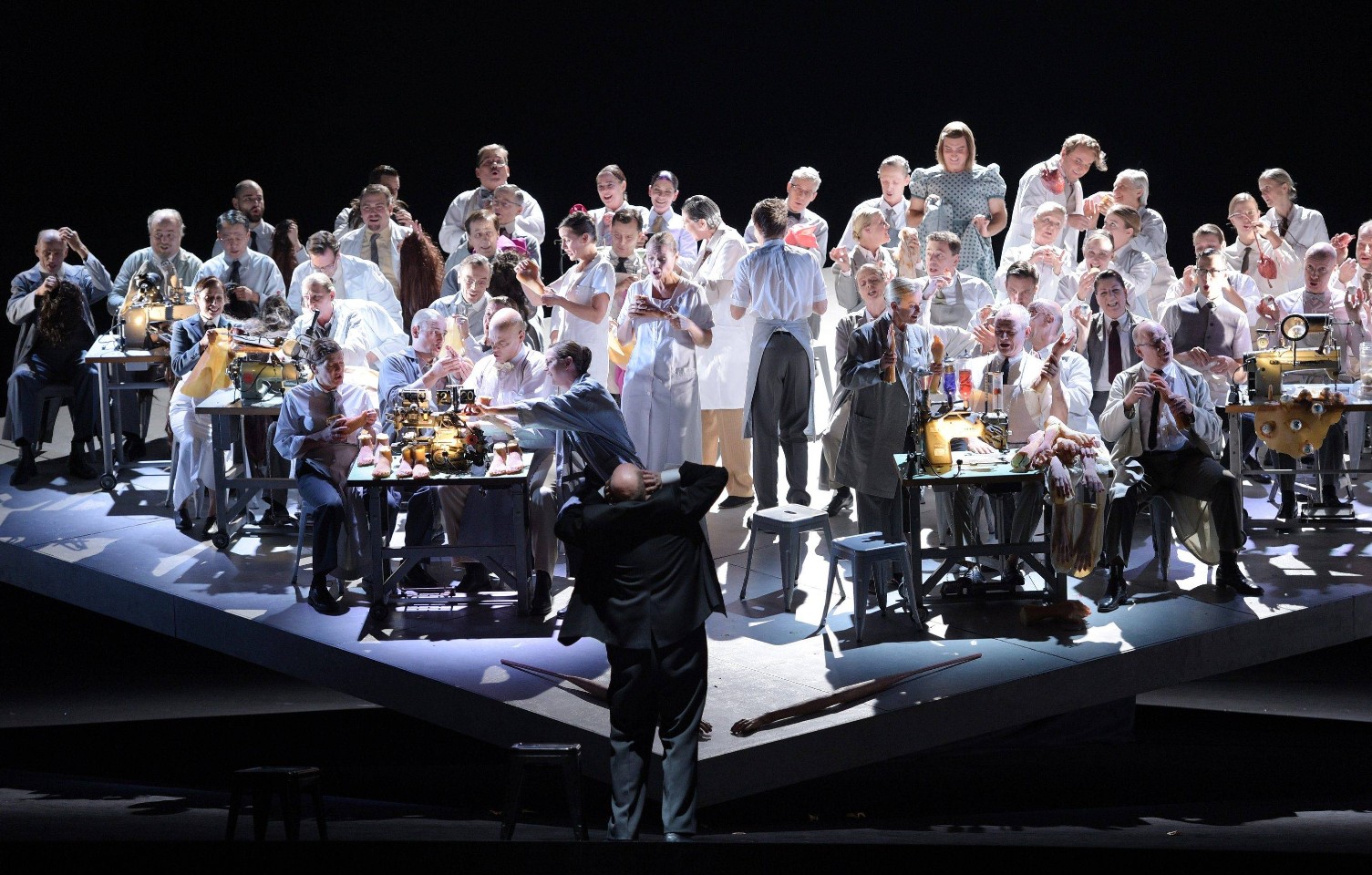
Since there is no final version of the opera, Kosky production focuses on the psychology and illusions of the protagonist himself. Unlike others, there are three Hoffmann in this production. The spoken role plays by Uwe Schönbeck is a reference to Kleinzach, who is ugly and deform in outlook, believes he will meet the beautiful actress Stella from the theatre even until in the coffin at the end. Although on stage, he acts as is watching with us in theatre with commentary in German on the sequence of tales. The Hoffmann, sung by the baritone, in first half plays the mad lover after the robot Olympia despite blindly believes she is a real human being. The tenor sings the other one in second half, who is already the lover of Antonia and later falsely believes Giulietta in love with him but a set up only. In the middle of the stage there is the moveable platform to maximise the effects of characters and surroundings in Hoffmann's fantasy/madness/nightmares. They represent his experience of desires, frustrations, conscience, joys and pains from the affections for the imagined lover. The evil Lindorf, or devils in different forms, is not the one causing the downfalls/failures of Hoffmann in the three love tales, but a harsh voice in the head condemning himself with consequence. The muse is his imagination of being youthful, motivations to be in love but also conscience when things should stop and look back into the reality. 


The chorus is the ever changing group of spectators reinforcing the madness of the scenes and watching Hoffmann as he walks near to the death trap each time. Kosky skilfully articulated the deform and ironic aspect in each scenes with the chorus portraying as drag queens, hardcore partygoers, killers of Antonia with violin bows and the evil masked crowd. The stage evolves from a sewing workplace to produce robots, then dancehall until the coffin is brought to put a nail in all madness at the Venice tale. In the opening scenes of first and second half the tone is already set for followings, as we see Hoffmann in the midst of drinking bottles and later playing the violin alone frantically, and combining with dim chilling stage lights. Dark humours receive a particular attention on the theme of each tales. Though one cannot not decide strongly whether to feel pity for Hoffmann misgivings, or he simply not deserve any sympathy because we are watching him as a cycle of madness instead of a trapped human being. As the audience we have a good laugh from the bizarre demonstration of Olympia with long limbs and facial expressions from the cupboard. Whereas the death scene of Antonia is emotional and tragic before we come to the final part to see how Hoffmann is punished and tricked. All these come to the conclusion that Hoffmann is a victim of his obsession.


Nicole Chevalier was outstanding in the role of Stella/Olympia/Antonia/Giulietta both as singer and actress, which I would want to hear more from her in future. Let alone doing all four roles by herself, rarely a singer could act so well, sing competently to meet all the technical challenge with the right timbre. Her rendition of the 'doll song' by Olympia had a lot of fun with exaggerated facial expressions, while nailing all the top notes accurately and not a sign of strain. She was also adaptable to the change of character by presenting a vulnerable Antonia in negotiation between passion and survival. There were also many moving musical moments as she sang the arias in part two beautifully. In terms of singers for Hoffmann, I preferred the baritone Dominik Köninger than the tenor Alexander Lewis. The former had a warmer and more beautiful timbre for the ears to enjoy, also smooth and natural in phrasing the lines. Uwe Schönbeck should be credited for his portrayal of Hoffmann as an old aged lunatic. He captured the mental anguish and deform physical expression vividly while maintaining the irony and humour at the same time. Alexandra Kadurina made a youthful and energetic muse but mixed results on the vocal side. I enjoyed her timbre with a darker colour, but her intonation and smoothness in singing were more secured in solo arias than duets and recitatives. Jens Larsen made the evil figure Linhorf alike a Mafia boss in outlook with good vocal projection but his voice was more a baritone than a bass. The chorus lived up to their reputation after being voted choir of the year by opernwelt. Not only they sang well with good intonation, vocal volume and good on the French diction, but also excellent in acting and dancing. The men particularly had a lot to do and wearing a dress did not stop to them to go wild in dancing or exaggerated gestures playing the violins, at the death of Antonia, while unleashing the sheer vocal impact. The chorus built such a climax in the cabaret scene towards the end of first half that no productions I known of could have captured the irony, craziness and excitements so successfully. The orchestra delivered many musical excitements and exquisite solo playing especially at the opening of part two. Daniel Huppert maintained a good musical direction and no hesitation to push the ensemble for climatic moments when necessary. As a whole, I would like to watch it again in future and another triumph from Komische Oper.